
In the realm of mathematics and its practical applications, the ability to seamlessly translate between different numerical representations is a fundamental skill. Fractions and decimals are two such representations, each offering a distinct perspective on numerical values. While fractions provide a clear depiction of parts of a whole, decimals excel in their compatibility with digital systems and scientific notation. Understanding how to convert fractions into decimals is not merely an academic exercise; it’s a crucial skill that underpins proficiency in various professional domains, particularly those deeply integrated with technology. This article delves into the conversion of 5/16 to its decimal form, exploring the underlying mathematical principles and its relevance in tech-driven environments.

The Mathematical Foundation of Fraction-to-Decimal Conversion
The essence of converting a fraction to a decimal lies in understanding the definition of division. A fraction, such as 5/16, represents a division problem where the numerator (5) is divided by the denominator (16). This operation yields a decimal number that represents the same value as the fraction but in a base-10 system.
Understanding the Division Process
To convert 5/16 into a decimal, we perform the division 5 ÷ 16. This can be done through long division or by utilizing a calculator, which is a ubiquitous tool in technology.
Long Division Method:
- Set up the division: Write the numerator (5) as the dividend and the denominator (16) as the divisor. Since 5 is smaller than 16, we add a decimal point and a zero to the dividend, making it 5.0.
    ____

16 | 5.0
- First step of division: How many times does 16 go into 5? It doesn’t, so we place a 0 above the 5 and a decimal point in the quotient, aligning with the decimal point in the dividend.
    0.

16 | 5.0
- Bring down the zero and divide: Now we consider 50. How many times does 16 go into 50?
- 16 x 1 = 16
- 16 x 2 = 32
- 16 x 3 = 48
- 16 x 4 = 64
16 goes into 50 three times (3). We write 3 in the quotient after the decimal point and multiply 3 by 16, which is 48. We then subtract 48 from 50.
0.3

16 | 5.0

-48

---

 2
- Continue the process: Bring down another zero to make the remainder 20. How many times does 16 go into 20?
- 16 x 1 = 16
- 16 x 2 = 32
16 goes into 20 one time (1). We write 1 in the quotient and multiply 1 by 16, which is 16. Subtract 16 from 20.
0.31

16 | 5.00

-48

---

 20

-16

---

  4
- Repeat until the remainder is zero or a repeating pattern emerges: Bring down another zero to make the remainder 40. How many times does 16 go into 40?
- 16 x 1 = 16
- 16 x 2 = 32
- 16 x 3 = 48
16 goes into 40 two times (2). We write 2 in the quotient and multiply 2 by 16, which is 32. Subtract 32 from 40.
0.312

16 | 5.000

-48

---

 20

-16

---

  40

 -32

 ---

   8
- Final step: Bring down another zero to make the remainder 80. How many times does 16 go into 80?
- 16 x 5 = 80
16 goes into 80 exactly five times (5). We write 5 in the quotient and multiply 5 by 16, which is 80. Subtract 80 from 80.
0.3125

16 | 5.0000

-48

---

 20

-16

---

  40

 -32

 ---

   80

  -80

  ---

    0
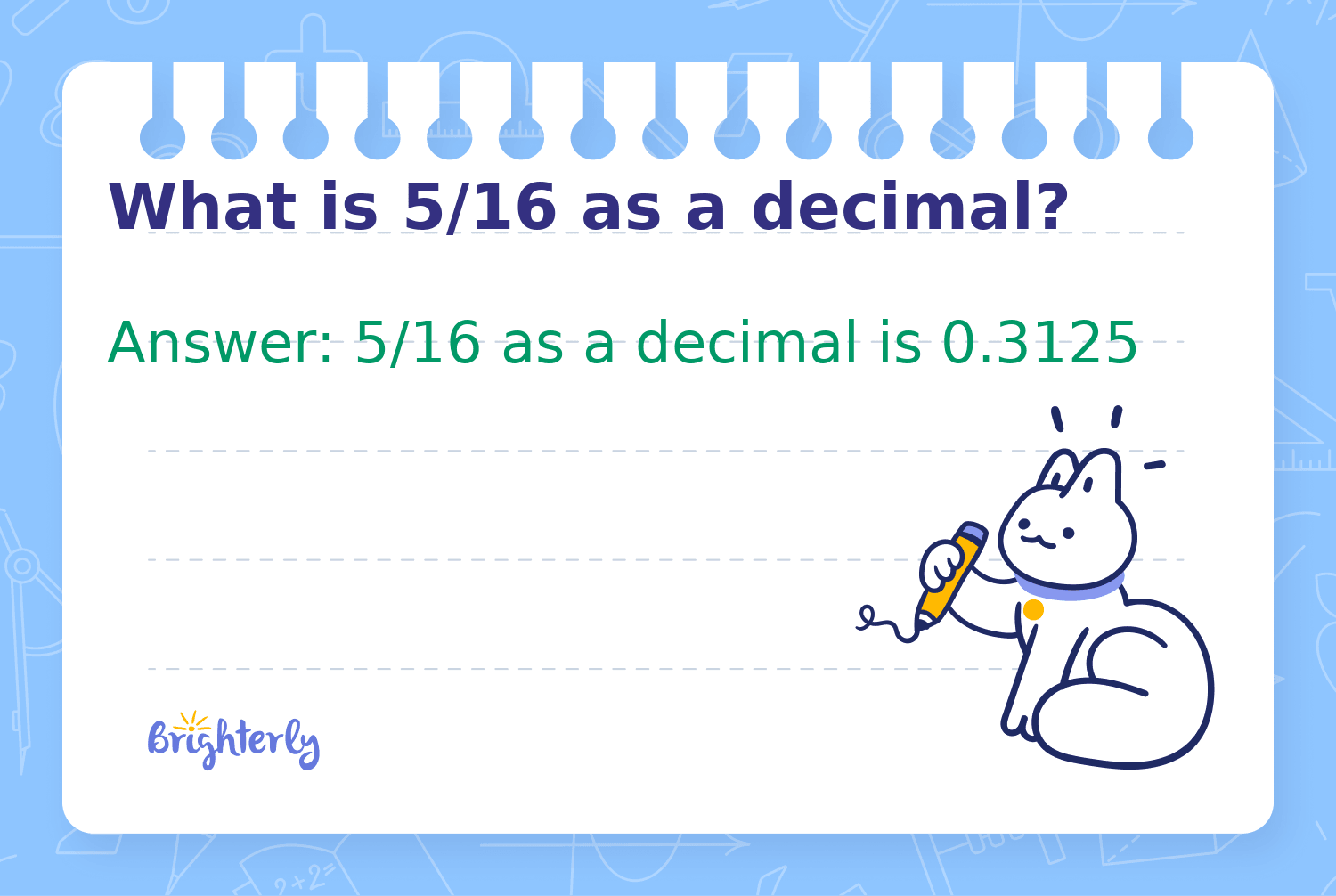
The remainder is now 0, indicating that the decimal conversion is complete and exact. Therefore, 5/16 as a decimal is 0.3125.
- 16 x 5 = 80
Understanding Terminating vs. Repeating Decimals
Fractions can result in two types of decimals: terminating or repeating.
-
Terminating Decimals: These decimals have a finite number of digits after the decimal point. This occurs when the prime factors of the denominator of a fraction (in its simplest form) are only 2s and/or 5s. In the case of 5/16, the denominator is 16. The prime factorization of 16 is 2 x 2 x 2 x 2 (or 2⁴). Since the only prime factor is 2, 5/16 results in a terminating decimal.
-
Repeating Decimals: These decimals have an infinite sequence of digits that repeat indefinitely. This happens when the denominator of a fraction (in its simplest form) has prime factors other than 2 or 5. For instance, 1/3 results in 0.333… where the ‘3’ repeats infinitely.
Knowing the type of decimal a fraction will produce can be a useful shortcut or a way to verify calculations.
The Digital Significance of Decimal Representation
In the context of technology, decimal numbers are the standard. From programming languages to scientific calculations, the base-10 decimal system is universally adopted. Understanding how to represent fractions as decimals is therefore essential for anyone working with data, software, or digital systems.
Precision and Calculation in Software Development
Software development relies heavily on numerical precision. When dealing with measurements, financial transactions, scientific data, or graphical rendering, developers frequently encounter values that are initially expressed as fractions or ratios. For instance, in web development, CSS (Cascading Style Sheets) allows for measurements in fractions of an inch or pixels. Understanding the decimal equivalent of such fractions is crucial for accurate layout and design.
Consider a scenario where a design specification calls for an element to occupy 5/16 of the available width. A web developer needs to translate this fraction into a pixel value or a percentage for implementation. If the total width is, for example, 800 pixels, then 5/16 of 800 pixels would be:
(5/16) * 800 = 0.3125 * 800 = 250 pixels.
This direct translation is seamless because the decimal representation of 5/16 (0.3125) can be directly multiplied by the total pixel count. If the fraction were to yield a repeating decimal, such as 1/3, developers would need to decide on an appropriate level of rounding or use specific formatting functions within their programming language to handle the repeating nature accurately.
Data Representation and Storage
In computer systems, data is stored and processed in binary. However, the interface between the user and the system, and often between different software components, is through decimal numbers. Numerical libraries and data types in programming languages are designed to handle decimal values with varying degrees of precision (e.g., float, double). When input data might originate from fractional measurements or calculations, converting them to their decimal equivalents ensures compatibility and correct interpretation within these systems.
For example, in scientific computing, experimental results might be represented as fractions for theoretical elegance, but for analysis and comparison with sensor data, they must be converted to decimals. This ensures that the results can be processed by algorithms, visualized in graphs, and stored in databases that predominantly use decimal representations for numerical data.
Financial Calculations and E-commerce
The financial sector is heavily reliant on precise decimal calculations. While fractions are sometimes used in stock market notations or options pricing, the actual transaction amounts, interest calculations, and reporting are almost exclusively done using decimals. E-commerce platforms, for instance, need to calculate prices, discounts, taxes, and shipping costs with high accuracy.
If a product has a discount of 5/16 off its original price, the platform would convert 5/16 to 0.3125. Then, to calculate the discount amount, it would multiply the original price by 0.3125. For example, on a $100 item, the discount would be $100 * 0.3125 = $31.25. The final price would then be $100 – $31.25 = $67.75. This straightforward calculation is enabled by the decimal representation. Any ambiguity from fractional representation would introduce errors in financial reporting and customer billing.
Practical Applications of 5/16 as a Decimal in Various Tech Fields
The decimal value of 5/16, which is 0.3125, finds its way into numerous practical applications across different technology sectors. Its exact decimal representation makes it straightforward to integrate into calculations and representations within digital environments.
1. Engineering and Manufacturing
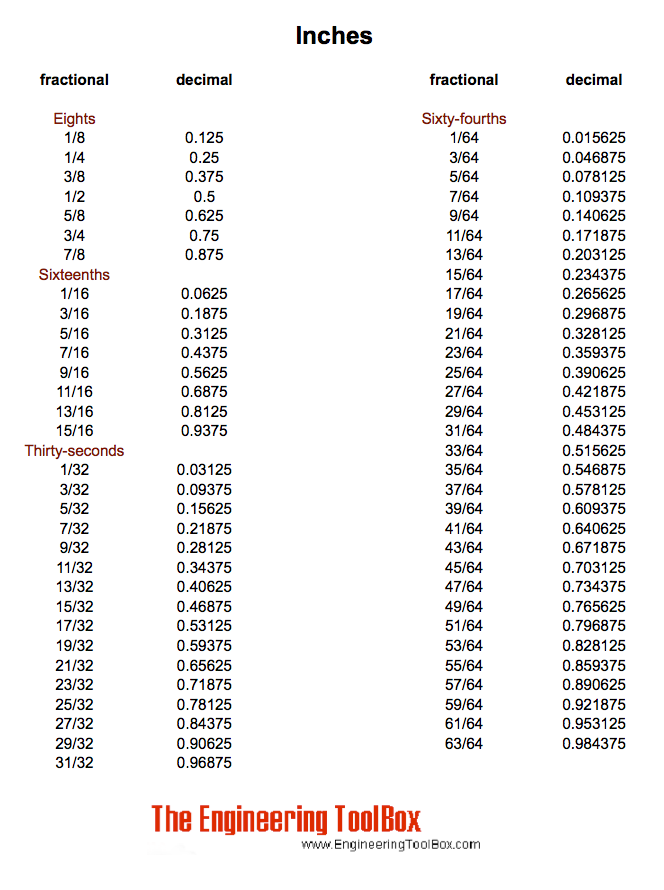
In engineering disciplines, precise measurements are paramount. Whether it’s calculating material tolerances, determining stress loads, or specifying component dimensions, fractions are often used in technical drawings and specifications, especially in industries with a historical reliance on imperial units (e.g., the United States). The decimal equivalent of 5/16 of an inch is 0.3125 inches. This value is critical for machinists operating CNC (Computer Numerical Control) machines, where precise tool paths are programmed using decimal coordinates. A machinist might need to cut a component to a diameter of 0.3125 inches, and this direct decimal input into the machine’s control system ensures accuracy.
Furthermore, in circuit board design, trace widths are often specified in mils (thousandths of an inch). Converting fractional measurements to mils is a common task. For instance, 0.3125 inches is equal to 312.5 mils. This level of precision is necessary for designing intricate electronic circuits where signal integrity can be affected by trace dimensions.
2. Scientific Research and Data Analysis
Scientists often work with data that can be expressed as ratios or proportions. When analyzing experimental results, especially in fields like chemistry, physics, or biology, proportions are frequently encountered. For example, if a chemical reaction requires a reactant mixture in a specific ratio, say 5 parts of substance A to 16 parts of substance B, understanding this as a decimal proportion (0.3125 of substance A in the total mixture) is vital for precise preparation of solutions or mixtures in a lab setting.
In data analysis, when calculating percentages or proportions of a dataset, fractions are naturally converted to decimals. If a survey found that 5 out of 16 respondents had a particular preference, this translates to 0.3125 or 31.25% of the respondents. This decimal form is readily used in statistical software packages for generating reports, charts, and performing further statistical tests.
3. Gaming and Graphics
The world of video games and computer graphics is inherently digital, and decimal numbers are the backbone of rendering and spatial calculations. While abstract concepts might sometimes be expressed fractionally, the actual implementation on screen relies on decimal pixel coordinates, transformations, and color values.
For instance, when rendering a 2D or 3D model, vertices are defined by coordinates. These coordinates might be derived from mathematical models that involve fractional relationships. A texture mapping might also involve fractional offsets or scaling factors. If a particular effect requires a 5/16 scaling factor on a texture, this would be implemented as a multiplier of 0.3125 in the graphics engine. Similarly, in game physics, projectile trajectories or movement vectors can be defined using decimal components, where fractional relationships would need to be converted for accurate simulation.
4. Networking and Data Transfer
In computer networking, data is transmitted in packets, and their sizes or throughput rates can sometimes be discussed in terms of fractions of a standard unit. While usually discussed in bits, bytes, kilobytes, megabytes, etc., underlying calculations or theoretical discussions might involve fractional relationships. For example, if a particular protocol efficiency is described as being 5/16 better under certain conditions, understanding this as 0.3125 is crucial for performance analysis and optimization. More directly, when calculating bandwidth utilization or data transfer rates, precise decimal values are used. If a connection can sustain a certain rate, and a particular application is utilizing 5/16 of that rate, the exact decimal calculation (0.3125 * total rate) provides the precise data flow for that application.
Tools and Techniques for Decimal Conversion in the Digital Age
With the pervasiveness of digital devices, converting fractions to decimals has become remarkably accessible. Modern technology provides a range of tools that can perform this conversion instantaneously, simplifying complex calculations and ensuring accuracy.
Built-in Calculator Applications
Almost every smartphone, tablet, and computer comes equipped with a native calculator application. These calculators typically offer standard, scientific, and sometimes even programmer modes. In their basic and scientific functions, these calculators can directly accept fractional input or can be used to perform the division required for conversion. For example, on a smartphone, one might simply input “5 / 16” and the calculator will display “0.3125”. This is the most immediate and widely available tool for fraction-to-decimal conversion.
Programming Language Libraries and Functions
For developers working with software, programming languages offer robust libraries and built-in functions for numerical manipulation. When dealing with data processing, scientific simulations, or financial applications, these functions are indispensable.
In Python, for instance, the conversion is as simple as:
fraction_value = 5 / 16
print(fraction_value) # Output: 0.3125
Even if the division resulted in a repeating decimal, Python’s floating-point arithmetic would represent it to a certain precision. For exact rational number arithmetic, Python’s fractions module can be used, which can then be converted to a float or string representation of the decimal.
Similarly, in JavaScript, the operation is straightforward:
let decimalValue = 5 / 16;
console.log(decimalValue); // Output: 0.3125
These programming tools are fundamental for automating calculations in applications, backend systems, and data analysis pipelines.
Online Converters and Tools
Beyond device-specific applications, the internet is replete with online fraction-to-decimal converter tools. These web-based utilities are designed for quick and easy conversions, often allowing users to input a fraction and instantly receive its decimal equivalent. Many of these tools also offer additional features, such as converting decimals back to fractions, simplifying fractions, or displaying the decimal as a percentage. For quick, one-off conversions without needing to open a dedicated app, online converters are an efficient solution.
Spreadsheets and Data Analysis Software
Software like Microsoft Excel, Google Sheets, and other data analysis platforms are powerful tools for managing and manipulating numerical data. When working with data that includes fractions, these programs can automatically interpret them as such and perform calculations. If a cell contains “5/16”, the spreadsheet software will recognize it as a fraction and, in many contexts, will automatically use its decimal equivalent (0.3125) in calculations. Users can also explicitly format cells to display numbers as decimals, ensuring clarity and consistency in their financial models, scientific datasets, or project plans.
In conclusion, the conversion of 5/16 to its decimal form, 0.3125, is a simple mathematical operation with profound implications in the technological landscape. From the fundamental calculations in software development and engineering to the precise transactions in e-commerce, understanding and applying decimal representations is a cornerstone of modern digital operations. The accessibility of conversion tools further democratizes this knowledge, ensuring that professionals across various tech-driven fields can leverage accurate numerical data for innovation and efficiency.
aViewFromTheCave is a participant in the Amazon Services LLC Associates Program, an affiliate advertising program designed to provide a means for sites to earn advertising fees by advertising and linking to Amazon.com. Amazon, the Amazon logo, AmazonSupply, and the AmazonSupply logo are trademarks of Amazon.com, Inc. or its affiliates. As an Amazon Associate we earn affiliate commissions from qualifying purchases.