
When you are evaluating a job offer, negotiating a salary, or simply trying to gauge your financial standing in the current economy, translating an hourly wage into an annual salary is one of the most critical steps in the process. While “$43 an hour” might sound like a significant sum, understanding what that translates to on a gross annual basis—and more importantly, what it means for your take-home pay—requires a closer look at the math behind your paycheck.
The Annual Salary Breakdown
To calculate the annual equivalent of an hourly wage, the standard professional assumption is a 40-hour work week over the course of a 52-week year. This totals 2,080 working hours annually.

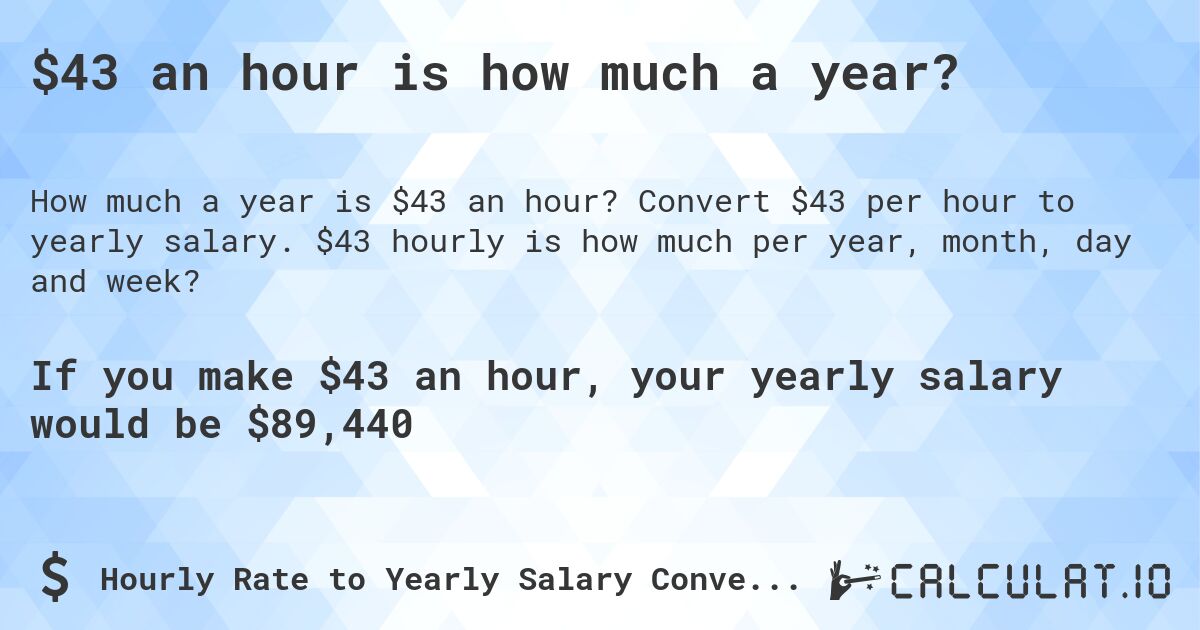
When you multiply $43 per hour by 2,080 hours, the gross annual salary comes out to exactly $89,440.
It is important to clarify that this figure is your “gross” income—the total amount earned before any taxes, deductions, or employer-sponsored benefits are removed. While $89,440 is a robust salary in most parts of the United States, your actual “take-home” pay will vary significantly based on your specific financial situation.
Factoring in Unpaid Time Off
The 2,080-hour model assumes you are paid for every single hour of the standard work year. However, if your position does not offer paid time off (PTO), or if you choose to take unpaid leave, your actual income will be lower. If you take two weeks of unpaid vacation, your working hours drop to 2,000 per year, bringing your annual gross down to $86,000. When calculating your annual earnings, always account for your specific company’s holiday and vacation policy.
Overtime Considerations
If your position is non-exempt under the Fair Labor Standards Act (FLSA), you may be eligible for overtime pay. In the U.S., overtime is generally calculated at 1.5 times your hourly rate for any hours worked beyond 40 in a single work week. At an hourly rate of $43, your overtime rate would be $64.50 per hour. Even a modest amount of overtime can push your total annual gross income well into the six-figure range, turning an $89,440 base salary into something significantly higher by year-end.
Understanding Your Take-Home Pay
Gross income is a useful metric for comparing job offers, but it rarely reflects the amount that hits your bank account. To determine what $43 an hour feels like in practice, you must subtract the mandatory and voluntary deductions that come out of every paycheck.
Mandatory Payroll Deductions
Federal and state taxes are the largest components of these deductions.
- Federal Income Tax: Depending on your filing status and total income, federal withholding will take a significant slice of your earnings.
- FICA Taxes: You must account for Social Security (6.2%) and Medicare (1.45%) taxes, which remain consistent regardless of your tax bracket.
- State and Local Taxes: Depending on where you reside, state income tax can range from 0% in states like Texas or Florida to over 9% in states like California or New York.
For someone earning $89,440, a realistic estimation of tax impact often ranges between 20% and 30% of total gross income, depending on your residency and individual deductions.
Voluntary Deductions
Beyond taxes, your paycheck is affected by your own financial choices and benefit elections:
- Retirement Contributions: Contributing to a 401(k) or 403(b) reduces your immediate take-home pay but is essential for long-term wealth building.
- Health Insurance Premiums: Even with excellent employer coverage, you will likely pay a monthly premium that is deducted from your check.
- Health Savings Accounts (HSA) or Flexible Spending Accounts (FSA): These pre-tax contributions lower your taxable income but further reduce your net paycheck.
When you factor in these deductions, an annual salary of $89,440 often results in a monthly take-home pay ranging from $4,800 to $5,600, depending heavily on your state of residence and your personal benefits choices.
Budgeting for an $89,440 Income
Earning $43 an hour places you in a comfortable bracket in many regions, but lifestyle inflation can quickly absorb the extra income. Managing an income of this size requires a strategic approach to personal finance, particularly when it comes to housing and debt.
The 50/30/20 Rule
A highly effective method for managing an $89,440 salary is the 50/30/20 budget rule:
- 50% for Needs: This includes rent/mortgage, utilities, groceries, transportation, and insurance. At this income level, you should aim to keep these essential costs below $45,000 annually.
- 30% for Wants: This covers discretionary spending—dining out, entertainment, travel, and hobbies. Managing this category is the key to maintaining a high quality of life without sacrificing your long-term goals.
- 20% for Financial Goals: This is the non-negotiable portion dedicated to retirement savings, building an emergency fund, or paying down high-interest debt.
Avoiding Lifestyle Creep
As you move into the $90,000 salary range, it is tempting to upgrade your vehicle, move into a more expensive apartment, or increase your discretionary spending significantly. However, true financial stability at $43 an hour comes from maintaining a modest lifestyle while aggressively investing the difference. By keeping your overhead low, you turn that $89,440 into a powerful engine for wealth creation rather than just a way to cover daily expenses.
Career Progression and Future Earning Potential
Viewing $43 an hour as a snapshot in time rather than a final destination is essential. Most careers that start at this pay point offer significant paths for growth. Whether you are in IT, project management, nursing, or skilled trade, the jump from $43 an hour to $55 or $60 an hour is often just a matter of gaining specialized certifications or moving into a senior role.
The Impact of Raises
A 3% annual raise on an $89,440 salary adds approximately $2,683 to your gross annual income in the first year alone. Over a five-year period, with compounded raises, that hourly rate climbs steadily, significantly increasing your long-term earning power.

Negotiating Your Worth
If you are currently earning $43 an hour, you should constantly monitor the market rate for your specific role. Use resources like salary transparency platforms and professional networking sites to ensure your pay aligns with current industry standards. If you find that the market value for your skillset is higher, use that data to negotiate your next review or to prepare for a pivot to a higher-paying employer.
Ultimately, $43 an hour is a strong foundation. By understanding the difference between gross and net income, budgeting effectively for the long term, and treating your salary as a starting point for growth, you can leverage this income to build a secure and prosperous financial future.
aViewFromTheCave is a participant in the Amazon Services LLC Associates Program, an affiliate advertising program designed to provide a means for sites to earn advertising fees by advertising and linking to Amazon.com. Amazon, the Amazon logo, AmazonSupply, and the AmazonSupply logo are trademarks of Amazon.com, Inc. or its affiliates. As an Amazon Associate we earn affiliate commissions from qualifying purchases.