
In the realm of digital displays, software development, and hardware engineering, the numbers “4” and “3” represent far more than a simple mathematical ratio. When we ask what 4/3 is as a fraction, we are looking at the foundational geometry that defined the first century of visual media. In technical terms, the 4:3 aspect ratio—often expressed as the fraction 1.33:1—is the mathematical backbone of early cinematography, the golden age of television, and the burgeoning era of modern mobile productivity.
Understanding the significance of this fraction requires a deep dive into how technology handles space. While the modern consumer is accustomed to the “widescreen” 16:9 format, the 4:3 fraction is experiencing a significant renaissance in high-end computing and professional-grade tablets. This resurgence is driven by a shift in how we consume and create data, moving away from passive media consumption toward active, vertical-oriented digital workflows.
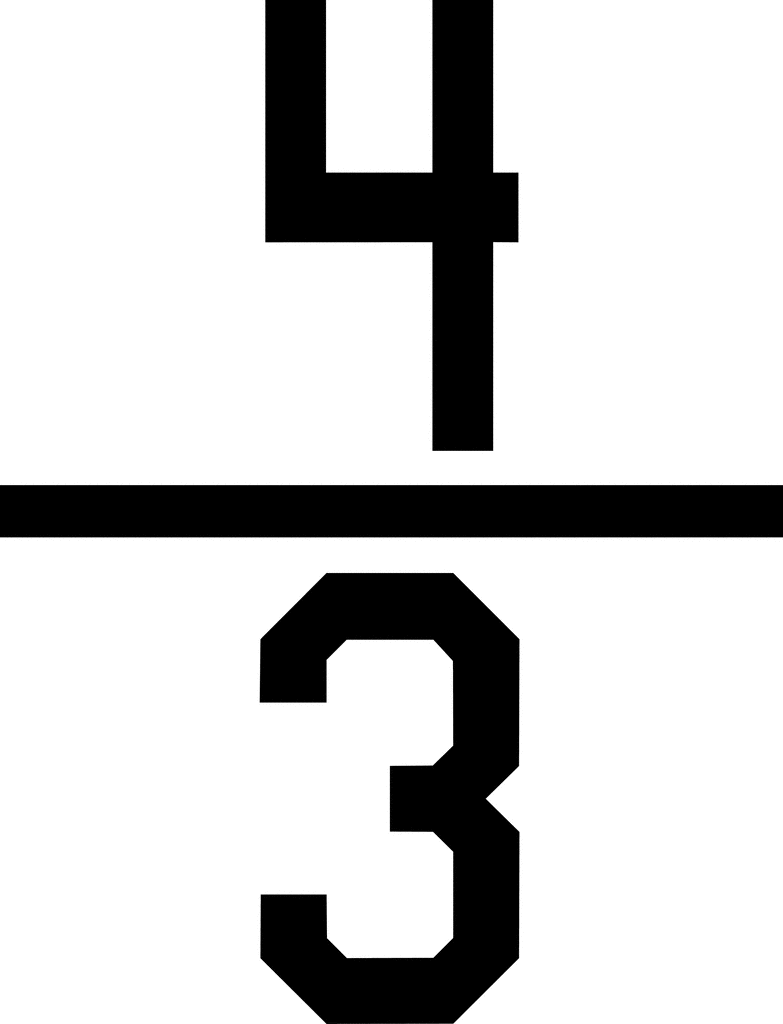
The Geometry of the Screen: Decoding the 1.33:1 Technical Standard
To understand 4/3 as a fraction in a technical context, one must first look at the X and Y axes of a display. A 4:3 ratio means that for every four units of width, there are three units of height. Mathematically, this results in a decimal value of approximately 1.33. In the early days of display engineering, this was considered the “standard definition” (SD).
The Historical Logic of 4:3
The adoption of the 4:3 fraction was not accidental. In the late 19th century, William Dickson and Thomas Edison settled on this ratio for 35mm film. The decision was rooted in the physical limitations of film stock and the desire to maximize the surface area of the negative. When television technology emerged in the 1940s and 50s, engineers adopted the 4:3 ratio to maintain compatibility with existing filmed content. This legacy created a technical ecosystem where everything—from vacuum tubes to transmission signals—was optimized for this specific fraction.
Pixel Mapping and Resolution Scaling
In the digital age, 4/3 evolved from physical film dimensions into pixel counts. Classic resolutions such as 640×480 (VGA), 800×600 (SVGA), and 1024×768 (XGA) are all perfect manifestations of the 4/3 fraction. For developers, this meant calculating layouts where the horizontal density was exactly 1.33 times the vertical density. While simple in theory, this required precise interpolation when scaling images to ensure that circles remained circular and squares remained square—a technical hurdle known as aspect ratio distortion.
The Shift to Widescreen and the Productivity Paradox
As the tech industry moved into the 2000s, there was a massive push toward 16:9 (1.77:1) and even 21:9 ultra-wide formats. This shift was largely driven by the entertainment industry’s desire to mimic the “cinemascope” feel of modern theaters. However, this transition created what many power users call the “Productivity Paradox.”
The Loss of Vertical Real Estate
While 16:9 is ideal for watching movies, it is often suboptimal for technical work. Most digital tasks—coding, writing, web browsing, and spreadsheet management—are vertical in nature. When a display is stretched horizontally, the user loses “vertical real estate.” A 4:3 display (or its modern high-resolution derivatives) provides more room for lines of code or paragraphs of text without requiring constant scrolling.
For example, a developer working on a 4:3 screen can often see 15–20% more lines of code than on a 16:9 screen of the same diagonal size. This technical efficiency is the primary reason why the “4/3 as a fraction” concept has returned to the forefront of laptop and tablet design.
Why Modern Hardware is Returning to “Taller” Ratios
Companies like Microsoft (with the Surface line) and Apple (with the iPad) have moved away from widescreen formats. The iPad, for instance, famously utilizes the 4:3 ratio. This makes the device feel more like a standard sheet of paper (8.5×11), which is technically a similar ratio. By prioritizing height, these devices cater to professional workflows where the density of information matters more than the “cinematic” experience.
Software and UX Design Challenges for the 4:3 Ecosystem
Designing software that scales across different fractions is one of the most complex tasks in modern UI/UX engineering. When a developer builds an app, they must account for how elements will shift when moving from a 16:9 smartphone to a 4:3 tablet.
Responsive Design and Fluid Layouts
In modern web development, “Responsive Design” is the standard. However, 4:3 displays present unique challenges. Because the screen is “boxier,” UI elements that are pinned to the sides can feel claustrophobic. Developers use CSS Media Queries to detect the aspect ratio fraction. If the ratio is closer to 1.33 (4:3) than 1.77 (16:9), the software might trigger a “compact” mode or adjust the sidebar width to prevent the main content area from becoming too narrow.
Gaming and Legacy Compatibility
The technical community of “Retro Gaming” is perhaps the most dedicated to the 4:3 fraction. Modern AI-driven upscaling tools (like DLSS or FSR) are often designed with 16:9 in mind. To play a classic game designed for 4:3 on a modern monitor, the software must either “pillarbox” the image (adding black bars to the sides) or use “integer scaling” to map the 4:3 pixels onto a 16:9 grid without causing blurriness. Technical purists often seek out 4:3 CRT monitors or high-end OLEDs that can perfectly replicate the 1.33:1 fraction to ensure mathematical accuracy in frame rendering.
The Future of Ratios: Moving Beyond Fixed Rectangles
As we look toward the future of technology, the concept of “4/3 as a fraction” is evolving from a physical screen constraint into a virtual one. With the rise of Spatial Computing (AR and VR), the boundaries of the display are disappearing, but the mathematical utility of the ratio remains.
Aspect Ratios in Augmented Reality
In a spatial environment, such as that provided by the Apple Vision Pro or Meta Quest 3, users can create virtual windows of any size. Interestingly, many users default to a roughly 4:3 or 3:2 window for productivity tasks. This suggests that the human brain finds the 1.33 to 1.5 ratio to be the most “readable” and ergonomic for information processing. Tech designers are now building “infinite canvases” where the 4:3 fraction serves as a modular block for organizing data.
AI and Content Adaptation
Artificial Intelligence is now being used to bridge the gap between different aspect ratio fractions. Generative AI tools can “outpaint” an image, taking a 4:3 photo and intelligently filling in the sides to turn it into a 16:9 cinematic shot. Conversely, AI-driven video cropping can take 16:9 footage and identify the most important action to center it within a 4:3 or 9:16 frame. This technical capability makes the original fraction of the content less of a limitation than it was in the analog era.
Conclusion: The Persistence of the 4/3 Fraction in Tech
What is 4 3 as a fraction? In the world of technology, it is the fundamental constant that shaped our digital heritage and continues to refine our professional future. While 16:9 conquered the living room, the 4:3 ratio (1.33:1) remains the gold standard for those who value verticality, information density, and ergonomic design.
As software becomes more adaptive and hardware becomes more specialized, the 4/3 fraction will continue to be a vital tool in the engineer’s kit. Whether it’s providing the extra space needed for a complex line of code, mimicking the feel of a physical notebook on a tablet, or serving as the base for a retro-gaming masterpiece, the “boxy” fraction of 4/3 proves that in technology, the most efficient shapes are often the ones we’ve known all along. The return to this ratio isn’t just a nostalgic trend; it is a calculated, technical decision to prioritize human productivity over passive consumption.
aViewFromTheCave is a participant in the Amazon Services LLC Associates Program, an affiliate advertising program designed to provide a means for sites to earn advertising fees by advertising and linking to Amazon.com. Amazon, the Amazon logo, AmazonSupply, and the AmazonSupply logo are trademarks of Amazon.com, Inc. or its affiliates. As an Amazon Associate we earn affiliate commissions from qualifying purchases.