
In the world of finance, precision is the bedrock upon which fortunes are built and preserved. While a simple fraction like 3/20 might appear to be a relic of a middle-school mathematics classroom, its decimal equivalent—0.15—carries profound implications when applied to personal finance, taxation, investment yields, and corporate accounting. Understanding how to transition between fractions and decimals is more than a mental exercise; it is a fundamental skill for any investor or business professional who seeks to master the language of money.
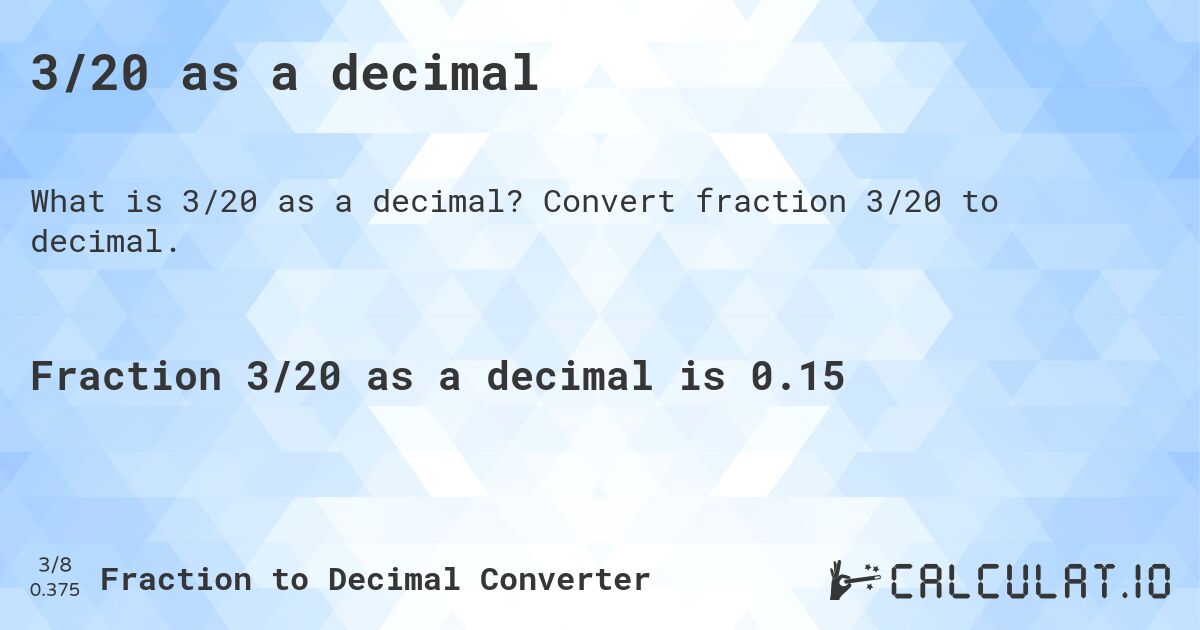
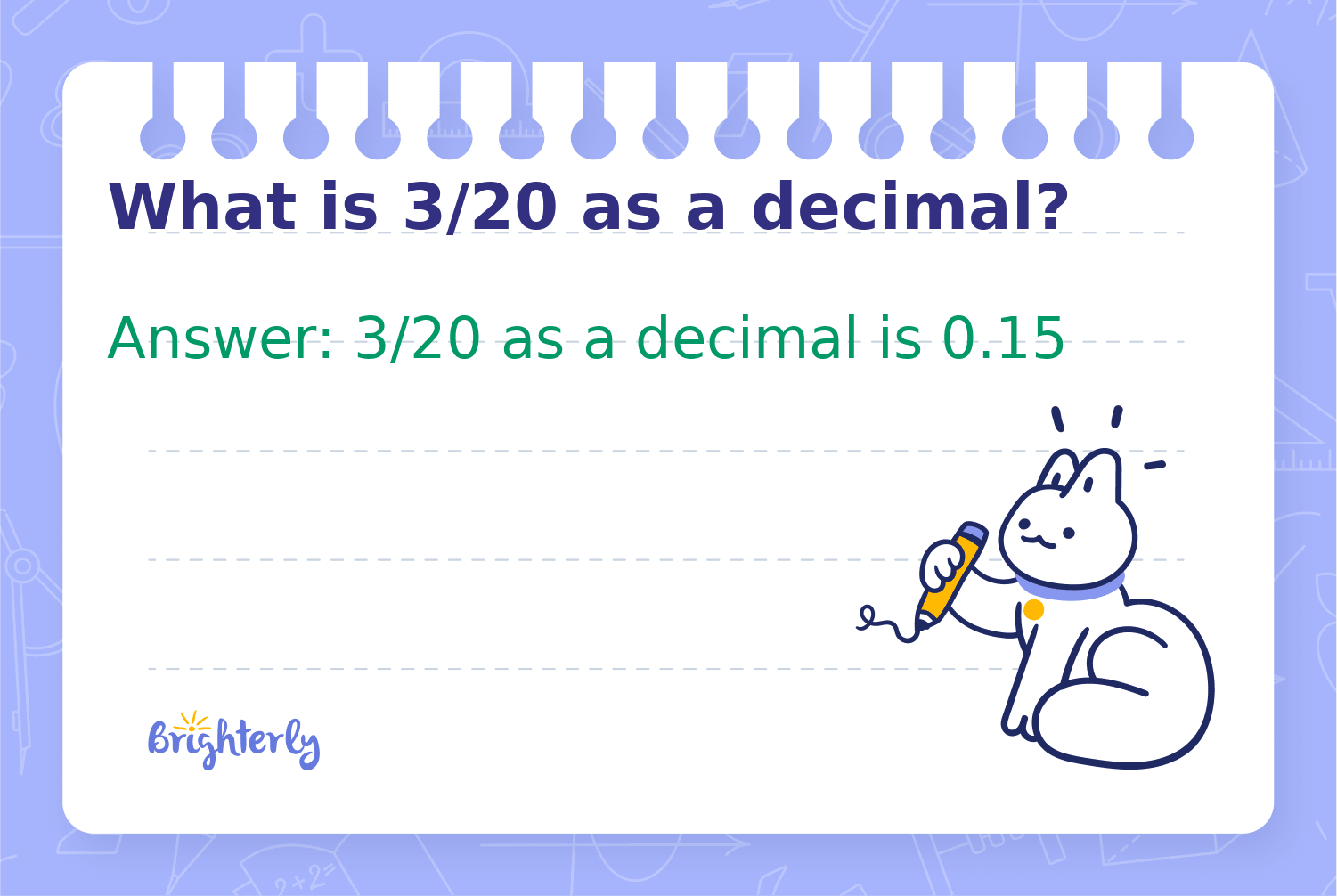
To answer the immediate question: 3/20 as a decimal is exactly 0.15. When converted to a percentage, this represents 15%. In the context of a diversified portfolio or a high-yield savings strategy, 15% is a significant figure that often marks the boundary between moderate growth and aggressive expansion.
The Mathematical Foundation of Financial Decimals
Before exploring the high-stakes applications of this figure in the markets, it is essential to understand the mechanics of the conversion. In financial modeling, fractions are often used to represent ownership stakes or ratios, but decimals are the standard for computational software, spreadsheets, and banking systems.
Converting 3/20 Through Division
To convert the fraction 3/20 to a decimal, one simply divides the numerator (3) by the denominator (20). Since 20 does not go into 3, we add a decimal point and zeros, making it 3.0. Twenty goes into 30 once, with a remainder of 10. Adding another zero to make it 100, we find that 20 goes into 100 exactly five times. Thus, we arrive at 0.15.
The Power of 15 Percent
In the realm of personal finance, 0.15 is most commonly recognized as 15%. This percentage appears frequently in various financial sectors:
-
Capital Gains Tax: In many jurisdictions, the long-term capital gains tax rate for middle-income earners is set at 15%.
-
Retirement Contributions: Financial advisors frequently recommend that individuals aim to save 15% of their gross income for retirement.
-
Equity Stakes: A 3/20 stake in a startup or a small business represents a 15% ownership interest, often a threshold for significant voting rights or influence.
0.15 in the Context of Investment Yields and Basis Points
In professional trading and institutional investing, small decimal movements can result in millions of dollars in gains or losses. While 0.15 may seem small, in the world of fixed income and currency trading, it is a substantial figure.
Understanding Basis Points (BPS)
In finance, we often discuss changes in interest rates or yields in terms of “basis points.” One basis point is equal to 0.01%, or 0.0001 in decimal form. Therefore, our decimal of 0.15 (15%) is equivalent to 1,500 basis points.
When a central bank raises interest rates by 15 basis points, they are moving the needle by 0.0015. While this is a fraction of our 0.15 figure, it illustrates the scale. An investment yielding 0.15 (15%) annually is considered high-performing, especially when compared to the historical average of the S&P 500, which hovers around 10% (0.10).
Dividend Yields and 3/20
For income-focused investors, the dividend yield is a critical decimal. If a company pays out 3/20 of its share price in annual dividends, it is offering a 15% yield. In the current market, a 15% dividend yield is exceptionally high and often serves as a “red flag” for investors, suggesting that the market expects a dividend cut or that the stock price has plummeted due to underlying instability. Understanding that 3/20 equals 0.15 allows an investor to quickly categorize this yield as an “outlier” compared to the standard 2% to 5% range seen in blue-chip stocks.
The 15% Rule: Personal Finance and Budgeting
Beyond the stock market, the decimal 0.15 serves as a strategic benchmark for household wealth management. Financial planning is often built on ratios, and 3/20 is a recurring theme in sustainable wealth building.
The Retirement Savings Benchmark
One of the most enduring pieces of financial advice is the “15% Rule” for retirement. The logic suggests that if an individual invests 0.15 of their gross income starting in their mid-20s, they will likely maintain their standard of living throughout retirement. This decimal is calculated to account for inflation, market volatility, and increased life expectancy. By viewing 3/20 of their paycheck as “non-negotiable” savings, earners leverage the power of compound interest.
Tax Implications and the 0.15 Multiplier
For many investors in the United States and similar economies, 0.15 is the magic number for long-term investments. If you hold an asset for more than a year, the profit is often taxed at the 15% rate.
For example, if an investor nets a profit of $10,000 on a stock sale, they must calculate 0.15 of that gain to set aside for the IRS.
- $10,000 x 0.15 = $1,500.
Knowing this decimal conversion allows for immediate tax planning, preventing the common pitfall of spending investment gains before the tax liability is accounted for.
Debt-to-Income Ratios
Lenders also use decimal ratios to determine creditworthiness. While a 3/20 (15%) debt-to-income ratio is considered excellent, it is the threshold many financial experts suggest staying under for non-mortgage debt. If 0.15 of your monthly income is going toward credit cards or car loans, it signals to lenders that you have high disposable income and low financial risk.
Corporate Finance: Profit Margins and Efficiency Ratios
In a corporate setting, the transition from 3/20 to 0.15 is essential for analyzing balance sheets and income statements. Managers and analysts use these decimals to gauge the health of a business.
Net Profit Margin
If a company generates $20 in revenue for every $3 in profit, its net profit margin is 15% (0.15). In many industries, such as retail or hardware manufacturing, a 0.15 margin is considered healthy and sustainable. In software or high-tech sectors, a margin of 0.15 might be seen as low, as these industries often command margins of 0.30 to 0.50.
By converting the fraction of earnings into the decimal 0.15, an analyst can quickly compare the company’s performance against industry benchmarks and historical data.
Asset Turnover and Return on Equity
Decimals are also used to measure how efficiently a company uses its assets. If a company has an equity multiplier or a specific return ratio of 0.15, it tells investors that for every dollar of equity, the company is generating fifteen cents of profit. This granular level of detail is lost when looking at whole numbers, but becomes crystal clear when using decimals.
The Digital Shift: Why Decimals Dominate Modern Finance
We live in an era of algorithmic trading and FinTech. In these environments, fractions like 3/20 are virtually non-existent. Computers operate in a binary world that translates most effectively into decimals and floating-point numbers.
Algorithmic Trading and High-Frequency Math
In high-frequency trading (HFT), algorithms make decisions based on decimal movements that occur in microseconds. A shift from 0.150 to 0.151 can trigger a massive sell order. For the modern investor using digital tools—whether it’s a brokerage app, a crypto wallet, or a robo-advisor—the interface will almost always present data in decimal form. Understanding that 0.15 represents 3/20 allows the investor to maintain a conceptual grasp of their “slice of the pie” while the software handles the high-precision calculations.
Real Estate and Fractional Ownership
The rise of “fractional investing” in real estate and fine art has brought the 3/20 fraction back into the spotlight. Platforms that allow you to buy “shares” of a rental property might offer units representing 1/20 of the building. If you own three of those shares, you own 3/20 of the asset.
However, your monthly distribution of rental income will be calculated as 0.15 times the total net profit. If the property generates $5,000 in monthly profit after expenses:
- $5,000 x 0.15 = $750.
This seamless move between the physical “share” (the fraction) and the monetary “payout” (the decimal) is a vital skill in the modern “sharing economy” of finance.
Conclusion: The Strategic Value of 0.15
Whether you are calculating the interest on a loan, determining your tax liability, or setting a retirement goal, the decimal 0.15 is a constant companion in the financial journey. The transition from 3/20 to 0.15 is more than a simple division; it is a transition from a theoretical portion to a practical, actionable number.
In an economy that rewards those who pay attention to the details, being able to identify that 3/20 of a dollar is 15 cents—and that 15 cents compounded over decades can grow into significant wealth—is the mark of a financially literate individual. Precision in calculation leads to precision in strategy, and in the world of money, precision is the ultimate competitive advantage.
aViewFromTheCave is a participant in the Amazon Services LLC Associates Program, an affiliate advertising program designed to provide a means for sites to earn advertising fees by advertising and linking to Amazon.com. Amazon, the Amazon logo, AmazonSupply, and the AmazonSupply logo are trademarks of Amazon.com, Inc. or its affiliates. As an Amazon Associate we earn affiliate commissions from qualifying purchases.