
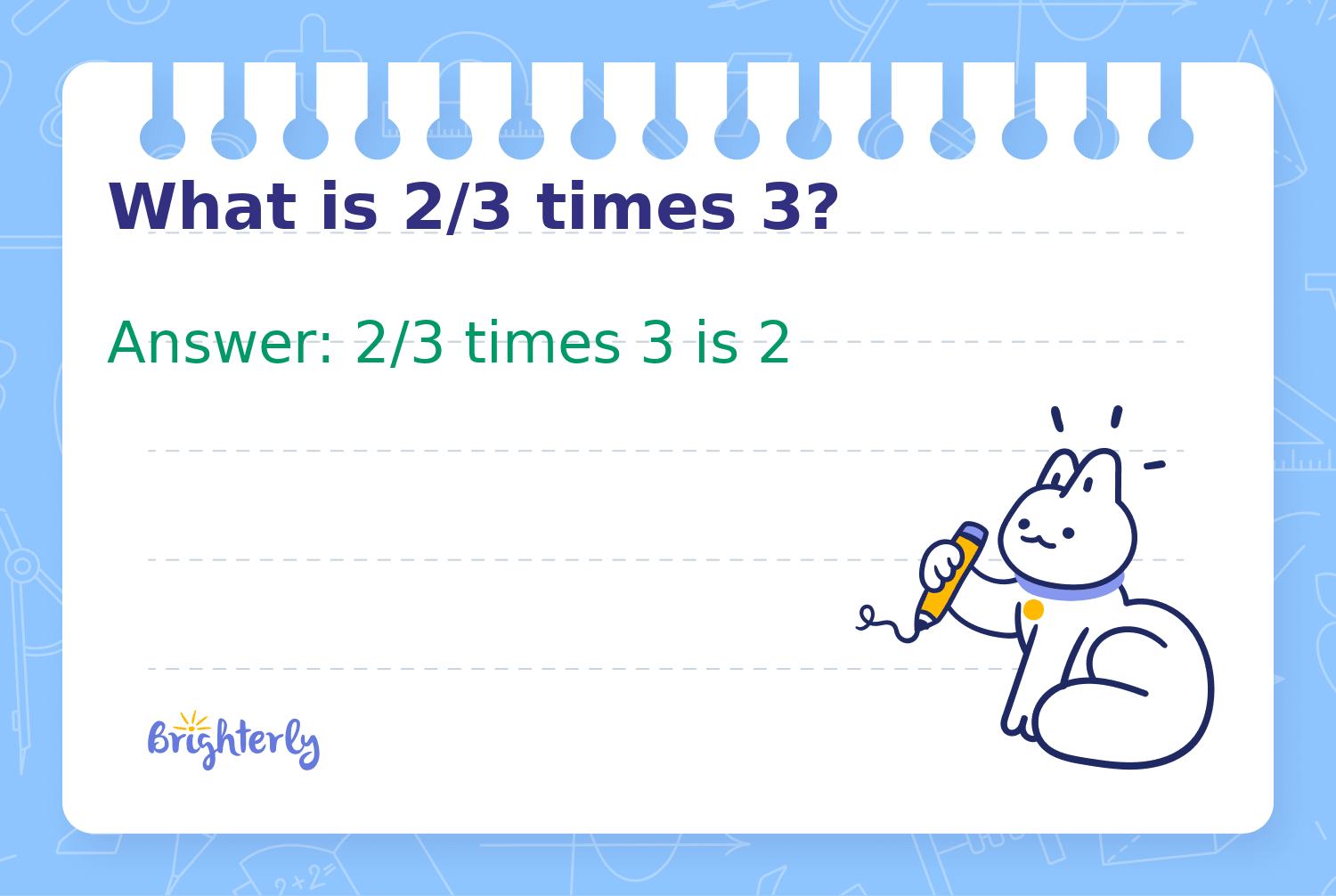
In the world of mathematics, the answer to “what is 3 times 2/3” is a straightforward two. However, when we translate this numerical relationship into the language of personal finance, business strategy, and capital allocation, the implications become far more complex and rewarding. This equation represents the fundamental principle of fractional scaling—a concept that dictates how we manage risk, how we distribute assets, and how we multiply our efforts to achieve outsized financial returns.
To understand the financial power of this ratio, one must look beyond the integer. In finance, “3” often represents the pillars of a wealth-building strategy: capital, time, and rate of return. The “2/3” represents the conservative margin or the strategic allocation required to ensure that even a partial success leads to a whole result. When you apply a multiplier of three to a two-thirds stake, you aren’t just doing basic arithmetic; you are practicing the art of strategic leverage.
The Mathematical Foundation of Wealth: Understanding the 2/3 Rule
The “2/3 Rule” is a common heuristic used across various financial disciplines to ensure sustainability and provide a margin of safety. Whether it is a business maintaining a 66% equity-to-debt ratio or an investor keeping 2/3 of their portfolio in low-volatility assets, the goal is to create a structure that can withstand market fluctuations while still providing enough fuel for growth.
The Concept of Fractional Allocation
Fractional allocation is the practice of dividing resources into specific segments to optimize performance. In the context of “3 times 2/3,” we are looking at how a concentrated effort on a significant portion (two-thirds) of one’s resources can yield a complete unit of success when multiplied by the right factors.
In personal finance, this often manifests in the “2/3 Savings Rule.” For high-earning professionals looking to reach financial independence early, saving or reinvesting two-thirds of their net income—while living on the remaining one-third—creates a massive compounding effect. When this high savings rate is multiplied by three different investment vehicles (such as equities, real estate, and tax-advantaged accounts), the path to wealth is drastically shortened.
Why 3×2/3 Equals More Than Just 2 in Finance
In a vacuum, the result is two. In a dynamic market, the result is “Optimized Stability.” By focusing on two-thirds of a goal, an investor acknowledges that perfection is impossible. They account for a one-third “drag” caused by taxes, inflation, or market downturns. By applying a 3x multiplier—perhaps through active management, leverage, or diverse income streams—they effectively neutralize that drag.
This approach is particularly relevant in “Core and Satellite” investing. If an investor puts 2/3 of their capital into a “core” index fund and uses the remaining 1/3 for “satellite” high-growth opportunities, they are essentially using the 2/3 foundation to stabilize their overall returns. The multiplier effect comes from the high-growth sector, which, if it performs at a 3x rate compared to the market, elevates the entire portfolio’s performance beyond the baseline.
Strategic Asset Allocation: Applying the 2/3 Principle to Portfolios
Asset allocation is the most significant driver of long-term investment success. Most retail investors struggle because they either over-concentrate (risking everything on one “3x” play) or over-diversify (diluting their returns into meaningless fractions). The “3 times 2/3” mindset offers a middle ground: focused diversification.
The Modern Portfolio Theory and Proportionality
Modern Portfolio Theory (MPT) suggests that there is an “efficient frontier” where risk and return are perfectly balanced. For many institutional investors, a common target is the 60/40 split (close to our 2/3 ratio). By keeping roughly two-thirds of a portfolio in growth-oriented assets (equities) and one-third in defensive assets (bonds or cash), an investor creates a “3-pillar” defense: growth, income, and liquidity.
When we multiply this 2/3 allocation by the power of compounding over three decades, the math shifts from simple addition to exponential growth. The key is consistency. If an investor can maintain a 2/3 exposure to the market’s upside while mitigating the 1/3 downside risk through hedging, the mathematical outcome over time is significantly higher than a 100% exposure that suffers from catastrophic “drawdowns.”
Risk Management and the Margin of Safety
Benjamin Graham, the father of value investing, famously championed the “Margin of Safety.” This is effectively the 2/3 rule in action: never pay more for an asset than 2/3 of its intrinsic value. If you buy an asset at a 33% discount (paying 2/3), you have built in a buffer.
If your valuation was correct and the asset returns to its full value, you have achieved a 50% gain. If you apply a 3x multiplier to this strategy by repeating it across three different sectors, you have diversified your risk while maintaining a high probability of success. The “3 times 2/3” logic here ensures that even if one-third of your investments fail, the remaining two-thirds—bought at a discount—will carry the portfolio to a positive return.
Business Finance: The 2/3 Efficiency Multiplier
For entrepreneurs and business owners, the “3 times 2/3” equation is a blueprint for operational efficiency. In business, it is often said that 80% of your profits come from 20% of your customers (the Pareto Principle). However, in terms of resource management, a more sustainable model is the 2/3 efficiency multiplier.
Operating Leverage and Scalability
Operating leverage occurs when a business can increase its revenue without a corresponding increase in its costs. Consider a software-as-a-service (SaaS) company. If the company spends 2/3 of its budget on product development and customer acquisition, and 1/3 on administrative overhead, it is positioned for a 3x scale-up.
When a business reaches a point where “3 times 2/3” of its effort results in a “2x” increase in net profit, it has achieved a high level of scalability. This is the stage where private equity firms and venture capitalists take interest. They look for businesses where a strategic injection of capital (the multiplier) can take a solid 2/3 foundation (a working product and a loyal customer base) and turn it into a market-dominant force.
Calculating ROI on Partial Assets
Many businesses do not own 100% of their infrastructure. They lease equipment, use contract labor, or partner with third-party logistics providers. This is a “fractional” business model. By owning or controlling only 2/3 of the value chain, a business remains lean and agile.
The “3 times” multiplier in this context represents the speed of execution. Because the business isn’t weighed down by the “full 3/3” of ownership (including the maintenance, liability, and depreciation of all assets), it can pivot three times faster than a traditional, vertically integrated competitor. The result is a higher Return on Investment (ROI) because the denominator (the capital invested) is smaller.
Real-World Applications: From Side Hustles to Corporate Strategy
The transition from understanding the theory to implementing the practice requires a shift in how we view “completeness.” We often feel that to be successful, we must give 100% to every single endeavor. However, the “3 times 2/3” approach suggests that giving a calculated 66% (2/3) to three different strategic areas is more effective than giving 100% to one.
Reinvesting 2/3 of Your Profits
For those pursuing online income or side hustles, the temptation is to spend the initial profits on lifestyle upgrades. However, the “3 times 2/3” rule for income states:
-
Keep 1/3 for taxes and immediate security.
-
Reinvest 2/3 back into the business or into income-generating assets.
When you repeat this cycle across three different income streams—for example, a service-based business, a digital product store, and a dividend portfolio—you are creating a self-sustaining financial ecosystem. The multiplier is the synergy between these streams. The digital product store provides the “passive” 2/3 that funds the dividend portfolio, while the service-based business provides the active capital to scale both.
The Psychological Impact of Incremental Gains
Financial success is as much about psychology as it is about math. The “3 times 2/3” framework helps manage the “all-or-nothing” fallacy. Many people give up on their financial goals because they cannot achieve a “perfect” 100% savings rate or a “perfect” investment return.
By aiming for 2/3 of a goal and achieving it across three different areas, the psychological win is immense. If you wanted to save $30,000 in a year but only saved $20,000 (2/3), but you also reduced your debt by 2/3 and increased your credit score by a proportional amount, you have achieved a comprehensive “3-part” success. This momentum is what leads to long-term wealth. It is the realization that a series of “2s”—the result of our 3×2/3 equation—eventually adds up to a much larger, more stable sum than a single, high-risk attempt at a “3.”
Conclusion: The Power of the Fractional Multiplier
The question “what is 3 times 2/3” may seem like a elementary math problem, but in the context of money and finance, it is a masterclass in strategic allocation. It teaches us that wealth is not built through brute force or by chasing 100% returns on 100% of our capital. Instead, wealth is built through the intelligent application of multipliers to sustainable fractions.
By focusing on the 2/3—the majority of our efforts, our safest assets, and our most reliable income streams—and applying a 3x multiplier of time, leverage, or diversification, we reach the integer of “2.” In financial terms, this “2” represents the doubling of our net worth, the doubling of our business’s reach, or the doubling of our financial security. It is a reminder that in a world of uncertainty, the most reliable path to “whole” success is through the mastery of the fractions.
aViewFromTheCave is a participant in the Amazon Services LLC Associates Program, an affiliate advertising program designed to provide a means for sites to earn advertising fees by advertising and linking to Amazon.com. Amazon, the Amazon logo, AmazonSupply, and the AmazonSupply logo are trademarks of Amazon.com, Inc. or its affiliates. As an Amazon Associate we earn affiliate commissions from qualifying purchases.