
In the rapidly evolving landscape of global logistics, automated manufacturing, and digital inventory management, data encoding remains the backbone of efficiency. When developers, systems architects, or supply chain managers ask “what is 2/5,” they are rarely referring to a simple fraction. Instead, they are usually diving into the world of Interleaved 2 of 5 (I2of5)—a high-density, numeric-only barcode symbology that has served as a foundational technology in the industrial sector for decades.
Despite the rise of complex 2D barcodes like QR codes and Data Matrix codes, the 2/5 symbology remains a critical component of modern tech stacks. Its ability to pack numeric data into a compact physical footprint makes it indispensable for applications where space is at a premium and scanning speed is paramount. This guide explores the technical architecture, implementation strategies, and industrial relevance of Interleaved 2 of 5 technology.
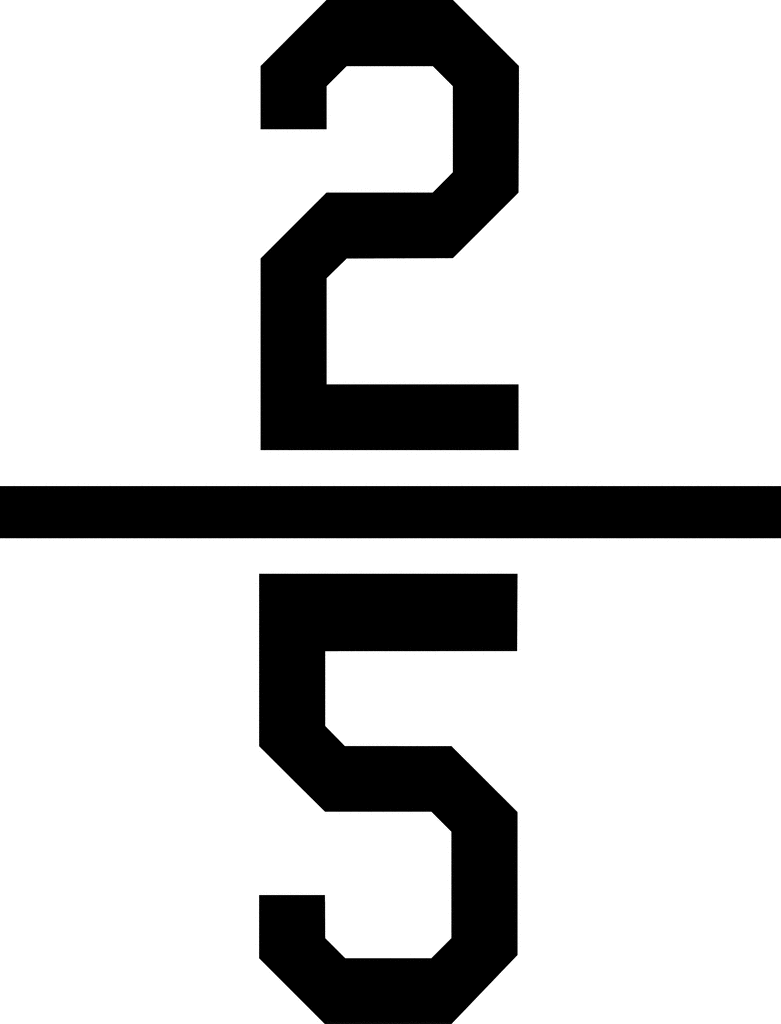
Understanding the Fundamentals of Interleaved 2 of 5 (I2of5)
Interleaved 2 of 5 is a continuous, two-width barcode symbology that encodes pairs of digits. Unlike discrete barcodes where each character is represented by a specific set of bars and spaces followed by an inter-character gap, I2of5 “interleaves” the data to maximize density.
The Symbology Explained
The “Interleaved” aspect of the 2/5 name refers to how the bars and spaces work together. In a standard barcode, bars represent data, and spaces are merely separators. In I2of5, the first digit of a pair is encoded in five bars, while the second digit of the pair is encoded in the five spaces that sit between those bars.
To visualize this, imagine two separate barcodes being merged into one: one digit occupies the dark elements, and the next digit occupies the light elements. This design allows the barcode to be significantly shorter than other linear symbologies, such as Code 39, which requires much more horizontal space to convey the same amount of information.
Why “Two of Five”?
The “2 of 5” nomenclature refers to the binary encoding logic used for each digit. Every digit is represented by five elements (either five bars or five spaces). Out of these five elements, exactly two are “wide” and three are “narrow.”
This fixed-ratio system provides a built-in layer of physical validation. If a scanner detects a character with three wide bars or only one wide bar, it immediately recognizes a read error. This makes the 2/5 system inherently more robust against printing defects compared to older, non-ratio-based technologies.
Technical Advantages and Software Integration
From a software engineering perspective, I2of5 is prized for its simplicity and the minimal computational overhead required to generate or decode it. Because it is a numeric-only format, the algorithms used to convert integers into bar-and-space patterns are extremely efficient, making it ideal for low-power IoT devices and high-speed industrial printers.
High-Density Data Storage
The primary technical advantage of I2of5 is its density. In many warehouse environments, labels must be applied to small components or narrow edges of corrugated cardboard boxes. Because I2of5 encodes two digits in the space that other barcodes might use for one, it allows for longer identification numbers—such as Global Trade Item Numbers (GTIN-14)—to be printed in a small area.
For software developers building inventory management systems, this means the database architecture can support 14-digit identifiers without worrying about the physical limitations of the hardware scanners on the floor.
Error Detection and Self-Checking Mechanisms
While the “two of five” rule provides a basic level of security, professional-grade I2of5 implementations often utilize a Modulo 10 check digit. This is a mathematical calculation added to the end of the data string.
When a scanner reads the barcode, the software performs the Modulo 10 calculation on the scanned digits. If the result does not match the check digit printed on the barcode, the data is rejected. In high-speed environments where a “misread” could result in a shipping error costing thousands of dollars, this checksum is a non-negotiable requirement. Furthermore, because I2of5 requires an even number of digits (since they are encoded in pairs), software must often “pad” the data with a leading zero if the input string is an odd length.

Industrial Applications: From Warehousing to Manufacturing
The “2/5” technology is not just a theoretical concept; it is a workhorse of the global economy. If you look at the outer shipping container of almost any consumer electronic or appliance, you are likely to see an I2of5 barcode.
Logistics and Supply Chain Optimization
In the world of logistics, I2of5 is the standard for the ITF-14 (Interleaved Two of Five) barcode. This specific version is used on “outer” packaging—the boxes that contain multiple individual retail units.
Logistics software uses these barcodes to track “shippers” or “master cartons.” Because these boxes are often made of rough, corrugated cardboard, the I2of5 symbology is preferred because its wide tolerances allow it to be read accurately even when printed on low-quality surfaces. Modern Warehouse Management Systems (WMS) use I2of5 to automate the receiving process, allowing sensors on a conveyor belt to scan boxes moving at high speeds without human intervention.
The Role in Automated Sorting Systems
High-speed sorting facilities, such as those operated by major couriers, rely on the “self-checking” nature of I2of5. In these environments, tech integration involves syncing the barcode scanner (the hardware) with a Programmable Logic Controller (PLC). The PLC interprets the I2of5 data in real-time to trigger mechanical diverters that send packages to specific loading docks. The low error rate of I2of5 ensures that the “automation” stays truly automatic, minimizing the “no-read” exceptions that require manual handling.
Implementing I2of5 in Modern Tech Stacks
Integrating I2of5 into a modern enterprise environment requires a mix of legacy support and contemporary software practices. Whether you are using Python, JavaScript, or C#, generating these barcodes is straightforward through various open-source libraries.
Hardware Compatibility and Scanner Configuration
While most modern laser and imager-based scanners can read I2of5 out of the box, they often require specific configuration. Because I2of5 is a continuous symbology, it can be susceptible to “partial reads” (where the scanner only reads a middle portion of a long barcode).
To mitigate this, tech administrators must configure scanners with “Fixed Length” settings. By telling the software that it should only accept 14-digit I2of5 strings, you eliminate the risk of a partial scan being misinterpreted as a valid, shorter number. This is a crucial step in the “Digital Security” aspect of industrial tech, preventing data corruption at the point of entry.
Transitioning to 2D Barcodes and QR Codes
As we look toward the future, many are asking if I2of5 is being replaced. While 2D barcodes (like QR codes) can hold significantly more data—including URLs and alphanumeric strings—the 1D “2/5” barcode remains superior for high-speed, long-distance scanning.
Laser scanners, which are common in warehouses, can read 1D barcodes from several feet away much faster than a camera-based imager can decode a 2D QR code. Therefore, many tech stacks are moving toward a “hybrid” approach: using I2of5 for internal logistics and automated sorting, while using QR codes for consumer engagement and detailed product information.

Best Practices for Digital Security and Data Integrity
When implementing 2/5 technology, security and integrity are paramount. Because barcodes are essentially “cleartext” for machines, the security lies in the validation logic of the software receiving the data.
- Check Digit Enforcement: Never implement I2of5 without a Modulo 10 check digit. This is your primary defense against “substitution errors,” where a damaged bar is misread as a different number.
- Quiet Zone Maintenance: In the technical world of barcodes, the “quiet zone” is the blank space before and after the bars. For I2of5 to be read securely by software, this zone must be at least 10 times the width of the narrowest bar. Failure to maintain this in the design phase leads to “scan failures” and system latency.
- Data Masking and Validation: On the server side, always validate that the incoming data from an I2of5 scan matches the expected format. Use Regular Expressions (Regex) to ensure the string is purely numeric and follows the anticipated length (e.g.,
^d{14}$).
By understanding the technical nuances of “what is 2/5,” organizations can better appreciate the invisible layers of technology that keep the modern world moving. From the specific binary encoding of the bars to the Modulo 10 algorithms running in the background, Interleaved 2 of 5 is a testament to the enduring power of efficient, well-designed technical standards. As software continues to eat the world, these foundational pieces of “Tech” ensure that the physical and digital realms remain perfectly synchronized.
aViewFromTheCave is a participant in the Amazon Services LLC Associates Program, an affiliate advertising program designed to provide a means for sites to earn advertising fees by advertising and linking to Amazon.com. Amazon, the Amazon logo, AmazonSupply, and the AmazonSupply logo are trademarks of Amazon.com, Inc. or its affiliates. As an Amazon Associate we earn affiliate commissions from qualifying purchases.