
Understanding the transformation of an hourly wage into an annual salary is a fundamental step in personal finance. For many, $22 an hour represents a significant income bracket, offering a solid foundation for financial planning, budgeting, and saving. However, the raw calculation is just the starting point; a comprehensive understanding requires delving into tax implications, living expenses, and strategies for financial growth. This article will dissect what $22 an hour means for your annual income and your financial life, providing insights into budgeting, maximizing earnings, and planning for the future.
The Core Calculation: From Hourly to Annual Income
The conversion of an hourly wage to an annual salary is often simpler than many assume, though it relies on standard assumptions about work hours. This calculation provides your gross annual income, the total amount earned before any deductions are applied.
Standard Work Week Assumptions
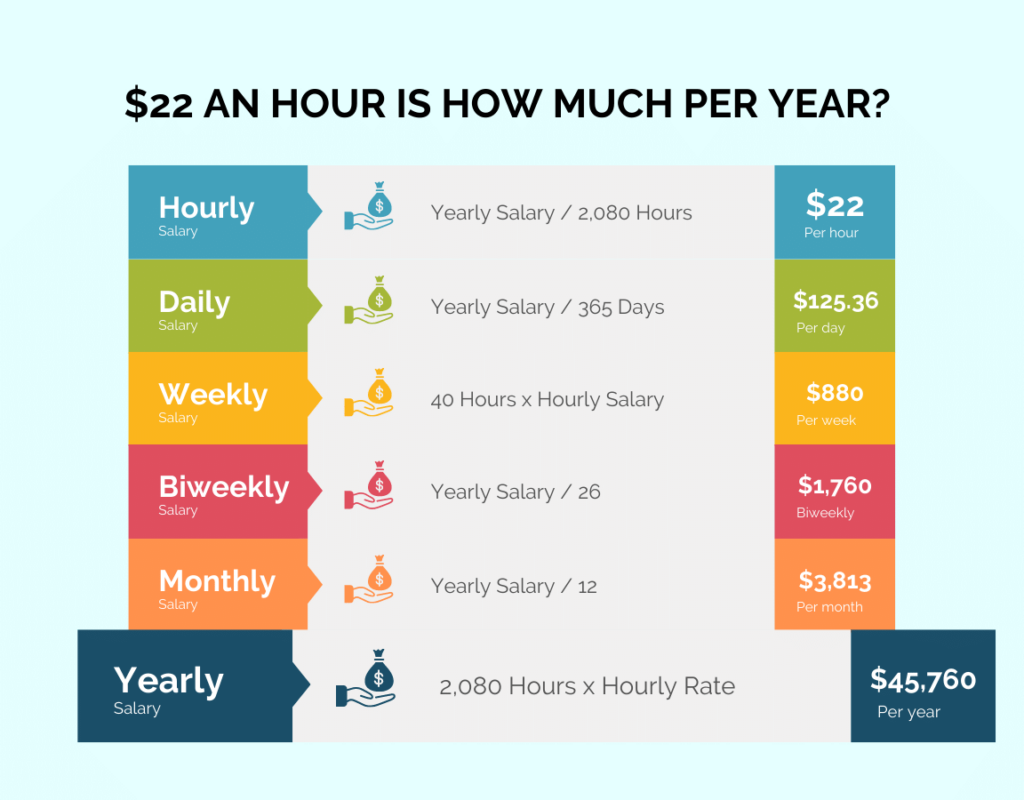
The most common basis for calculating annual income from an hourly rate is a full-time work schedule. In most economies, this translates to 40 hours per week.
- Weekly Hours: 40 hours
- Weeks in a Year: 52 weeks
Using these figures, the initial calculation is straightforward:
- Hourly Wage: $22
- Weekly Earnings: $22/hour * 40 hours/week = $880
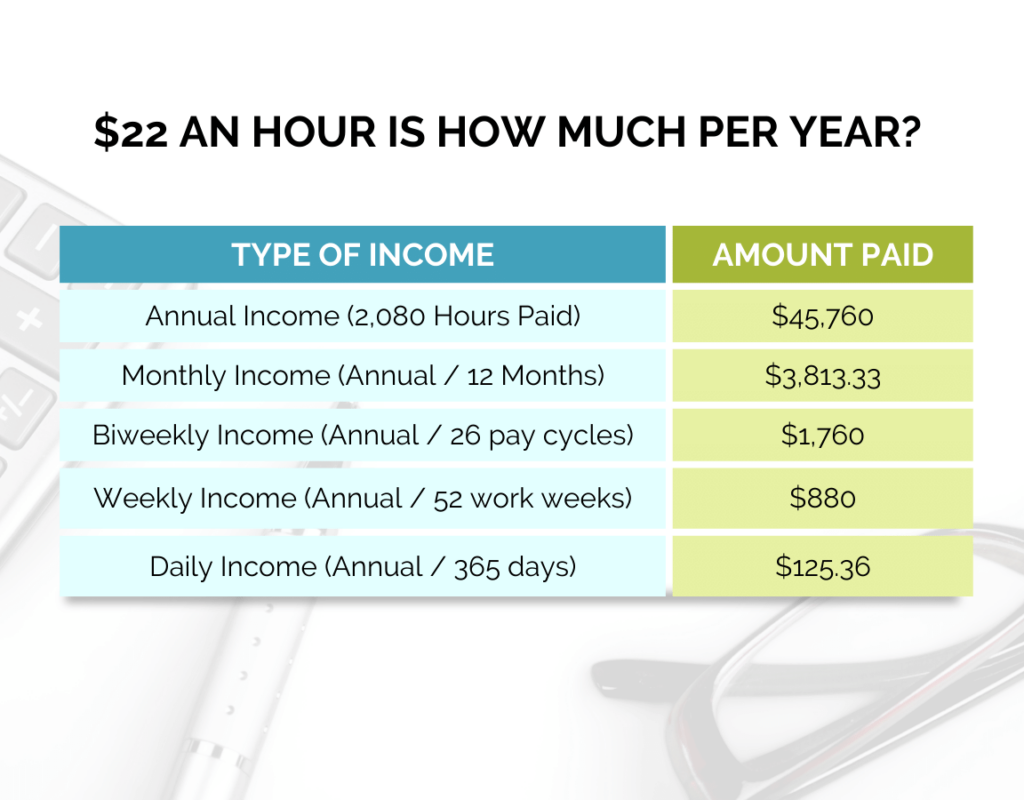
- Gross Annual Income: $880/week * 52 weeks/year = $45,760
Therefore, working a standard 40-hour week at $22 an hour translates to a gross annual income of $45,760.
Factoring in Paid Time Off and Holidays
It’s important to note that the above calculation assumes you are paid for every single one of those 2,080 hours (40 hours/week * 52 weeks/year). In reality, most salaried or full-time hourly positions come with benefits like paid time off (PTO), vacation days, sick leave, and paid holidays. While these don’t necessarily increase your gross annual income as calculated based on hours worked, they ensure your income remains consistent even when you’re not actively working. From a budgeting perspective, knowing your employer offers paid leave means you don’t have to budget for income loss during these periods. However, if your job does not offer paid time off, each day or week you don’t work means a direct reduction from that $45,760 figure.
Understanding Overtime and Bonuses
The $45,760 figure is a baseline. For hourly employees, overtime can significantly boost annual earnings. Overtime pay, typically 1.5 times the regular hourly rate for hours worked over 40 in a week (in the U.S.), can add substantial sums. If, for instance, you consistently work an additional 5 hours of overtime per week:
- Overtime Rate: $22 * 1.5 = $33/hour
- Additional Weekly Overtime Earnings: $33/hour * 5 hours = $165
- Additional Annual Overtime Earnings: $165/week * 52 weeks = $8,580
- Total Gross Annual Income (with 5 hrs/week overtime): $45,760 + $8,580 = $54,340
Similarly, performance bonuses, holiday bonuses, or commissions can further augment your gross income. While these are often less predictable, they are important factors to consider when assessing your total financial picture. However, for initial budgeting and stability, it’s generally best to plan around your base gross annual income and treat overtime and bonuses as supplementary.
Understanding Net Income: Beyond the Gross Figure
While $45,760 sounds like a clear annual figure, it’s crucial to understand that this is your gross income. The amount you actually take home – your net income – will be considerably less due to various deductions. This is where personal finance gets real, as your budget must be built on your net income, not your gross.
Federal, State, and Local Taxes
The largest chunk of deductions typically comes from taxes.
- Federal Income Tax: This is levied by the U.S. government (or your country’s national tax authority) and is progressive, meaning higher earners pay a larger percentage. The amount withheld depends on your filing status (single, married filing jointly, etc.) and the allowances claimed on your W-4 form. For a $45,760 income, you would fall into a specific tax bracket, but the “effective” tax rate will be lower than your marginal bracket due to standard deductions and other credits.
- State Income Tax: Many states also impose an income tax, which varies widely from 0% (in states like Florida, Texas, Washington) to over 13% (in states like California). This is a significant factor in your take-home pay depending on where you reside.
- Local Income Tax: Some cities or counties also have their own income taxes, though these are less common than federal and state taxes.
Calculating exact tax withholding is complex and depends on many individual factors, but it’s safe to assume a substantial portion of your gross income will go towards taxes.
Payroll Deductions: Social Security and Medicare (FICA)
In the U.S., two mandatory federal deductions are Social Security and Medicare taxes, collectively known as FICA (Federal Insurance Contributions Act) taxes.
- Social Security Tax: This is currently 6.2% of your gross wages, up to an annual limit ($168,600 for 2024). For a $45,760 income, this would be approximately $2,837 annually.
- Medicare Tax: This is currently 1.45% of your gross wages, with no income limit. For a $45,760 income, this would be approximately $663 annually.
These deductions contribute to future retirement and healthcare benefits and are non-negotiable for most employees.
Voluntary Deductions: Health Insurance, Retirement Contributions, and More
Beyond mandatory taxes, many employers offer benefits that, while advantageous, come with deductions from your paycheck.
- Health Insurance Premiums: If you receive health insurance through your employer, a portion of the premium is often deducted from your paycheck. This can range from a few hundred to over a thousand dollars per month depending on the plan type and coverage (individual vs. family).
- Retirement Contributions: Contributing to a 401(k), 403(b), or other employer-sponsored retirement plan is an excellent financial move. These contributions are often pre-tax, reducing your taxable income, but they do reduce your take-home pay. Employer matching contributions are essentially “free money” and should be taken advantage of if available.
- Life Insurance, Disability Insurance, and Other Benefits: Many employers offer additional benefits that may be deducted from your pay.
- Flexible Spending Accounts (FSAs) or Health Savings Accounts (HSAs): Contributions to these accounts, used for healthcare expenses, are also pre-tax deductions.
After all these deductions, your actual take-home pay will likely be significantly less than $45,760, perhaps in the range of $3,000 to $3,500 per month, depending heavily on your tax situation, state of residence, and benefit elections. It’s crucial to review your pay stubs regularly to understand precisely where your money is going.
Budgeting and Lifestyle Implications of a $22/Hour Wage
With a gross annual income of $45,760 (or $3,813/month gross), and a likely net monthly income in the range of $2,800 to $3,500, careful budgeting becomes essential. This income level offers a comfortable living in some regions but can be challenging in high cost-of-living areas.
Crafting a Realistic Monthly Budget
A robust budget is your financial roadmap. Start by categorizing all your expenses. The 50/30/20 rule (50% needs, 30% wants, 20% savings/debt repayment) is a popular guideline, but it may need adjustment based on your specific circumstances and location.
- Needs (50%): Housing, utilities, groceries, transportation, insurance, minimum debt payments.
- Wants (30%): Dining out, entertainment, subscriptions, hobbies, shopping.
- Savings & Debt Repayment (20%): Emergency fund, retirement, investments, additional debt payments.
For a net income of, say, $3,200 per month:
- Needs: Max $1,600
- Wants: Max $960
- Savings/Debt: Min $640
These targets provide a framework, but real-world costs can push these percentages.
Housing Costs: Rent/Mortgage Considerations
Housing is typically the largest expense. The general guideline is to spend no more than 30% of your gross income on housing. For $45,760 annually, that’s roughly $1,144 per month.
- In many parts of the U.S., finding comfortable single-person housing (apartment, shared housing) for around $1,100-$1,300 is feasible.
- In major metropolitan areas (e.g., NYC, San Francisco, Boston), this budget would likely necessitate roommates or living significantly further from the city center.
- Owning a home might be challenging at this income level in many areas, particularly considering down payment requirements, property taxes, and maintenance, unless you have significant savings or a partner’s income.
It’s crucial to research average rental costs in your specific location and adjust your housing budget accordingly.
Transportation, Food, and Other Living Expenses
After housing, transportation and food are usually the next largest categories.
- Transportation: Whether it’s a car payment, insurance, gas, maintenance, or public transit passes, these costs can accumulate. A car payment alone could consume a large portion of your “needs” budget if you’re not careful. Consider public transport, carpooling, or living close to work to minimize these expenses.
- Food: Groceries and dining out can quickly deplete funds. Meal planning, cooking at home, and limiting restaurant visits are effective strategies.
- Utilities: Electricity, gas, water, internet, and cell phone are essential but variable. Research average utility costs for your area and housing type.
- Healthcare: Even with employer insurance, you’ll likely have co-pays, deductibles, and out-of-pocket maximums. Budget for these potential costs.
- Personal Care, Clothing, Entertainment: These “wants” need to be balanced with your budget.
Debt Management and Savings Potential
At $22 an hour, managing existing debt and building savings are both achievable and critical.
- Debt Repayment: Prioritize high-interest debt (e.g., credit cards) using methods like the debt snowball or debt avalanche. Ensuring you make at least minimum payments on all debts is non-negotiable.
- Emergency Fund: Aim to save 3-6 months’ worth of essential living expenses. This income level allows for consistent contributions to this fund, which is vital for financial security.
- Retirement Savings: Even if your employer doesn’t offer a match, contributing to a Roth IRA or traditional IRA is a wise move. Small, consistent contributions can grow significantly over time due to compound interest.
Maximizing Your Financial Potential at $22/Hour
While $22 an hour provides a stable base, there are numerous strategies to enhance your financial well-being and accelerate wealth accumulation.
Strategies for Increasing Income
- Skill Development and Certifications: Investing in yourself through online courses, certifications, or workshops can lead to promotions or higher-paying positions. Many industries offer specialized certifications that directly translate to increased earning potential.
- Negotiate Raises: Regularly review your performance and market value. Don’t be afraid to ask for a raise based on your contributions and industry standards.
- Side Hustles: Explore opportunities to earn extra income outside your main job. This could involve freelance work, gig economy jobs (delivery, ride-sharing), tutoring, or selling handmade goods. Even a few extra hours a week can significantly boost your income and savings.
- Overtime: If available and manageable, consistently taking on overtime hours can dramatically increase your gross annual income, as discussed earlier.
Smart Spending and Frugal Living Tips
Maximizing income isn’t just about earning more; it’s also about spending wisely.
- Track Your Expenses: Use budgeting apps or spreadsheets to know exactly where your money is going.
- Meal Prep: Plan your meals, buy groceries in bulk when appropriate, and cook at home to save substantial amounts compared to dining out.
- Minimize Subscriptions: Regularly review and cancel unused streaming services, apps, and other recurring memberships.
- Seek Deals and Discounts: Use coupons, loyalty programs, and sales for everyday purchases.
- Delay Gratification: Before making a significant purchase, wait 24-48 hours. This can help prevent impulse buys.
- Energy Efficiency: Adopt habits like turning off lights, unplugging electronics, and optimizing thermostat settings to reduce utility bills.
Building an Emergency Fund
As highlighted, an emergency fund is paramount. Aim to automate transfers from each paycheck into a separate, easily accessible savings account. This fund protects you from unexpected expenses like medical emergencies, car repairs, or job loss without resorting to high-interest debt. For a $22/hour income, a 3-6 month buffer could mean having $8,000-$20,000 readily available.
Exploring Investment Options (Even Small Amounts)
You don’t need a large income to start investing.
- Employer-Sponsored Retirement Plans: If your employer offers a 401(k) or similar plan, contribute at least enough to get the full employer match – it’s essentially free money.
- Individual Retirement Accounts (IRAs): A Roth IRA is particularly attractive for those at this income level, as contributions are made with after-tax dollars but withdrawals in retirement are tax-free.
- Robo-Advisors: Platforms like Betterment or Schwab Intelligent Portfolios can manage diversified portfolios with low fees, making investing accessible even with small recurring contributions ($50-$100 per month).
- Diversification: Regardless of the platform, focus on investing in a diversified portfolio of low-cost index funds or ETFs to spread risk and benefit from market growth.
Long-Term Financial Planning and Growth
The $22 an hour income level is an excellent starting point for building substantial long-term wealth through disciplined financial habits.
Setting Financial Goals
Clearly defined goals provide direction and motivation. These could include:
- Saving for a down payment on a home.
- Funding higher education (for yourself or dependents).
- Achieving financial independence and early retirement.
- Paying off all consumer debt.
Break down large goals into smaller, actionable steps. For example, if you want a $30,000 down payment in five years, you’ll need to save $500 per month.
The Power of Compound Interest
Albert Einstein reportedly called compound interest the “eighth wonder of the world.” Reinvesting your earnings allows your money to grow exponentially over time. Even small, consistent contributions to investment accounts can accumulate to significant sums over decades. Starting early is the most powerful strategy. A person who starts investing at 25 at $22/hour will likely have far more at retirement than someone who starts at 35, even if the latter contributes more later on.

Continuous Skill Development and Career Advancement
Your earning potential isn’t fixed. Continuously acquiring new skills, staying updated with industry trends, and seeking out opportunities for advancement within your current role or by exploring new career paths can lead to substantial increases in your hourly wage over time. A $22/hour job today could be a stepping stone to a $30, $40, or even $50+/hour position in the future with strategic planning and dedication. Networking, mentorship, and professional development are invaluable tools in this journey.
In conclusion, $22 an hour provides a solid financial foundation. By understanding the transition from gross to net income, meticulously budgeting, seeking opportunities to increase earnings, and committing to long-term financial planning, individuals earning this wage can build significant financial security and achieve their financial aspirations.
aViewFromTheCave is a participant in the Amazon Services LLC Associates Program, an affiliate advertising program designed to provide a means for sites to earn advertising fees by advertising and linking to Amazon.com. Amazon, the Amazon logo, AmazonSupply, and the AmazonSupply logo are trademarks of Amazon.com, Inc. or its affiliates. As an Amazon Associate we earn affiliate commissions from qualifying purchases.