
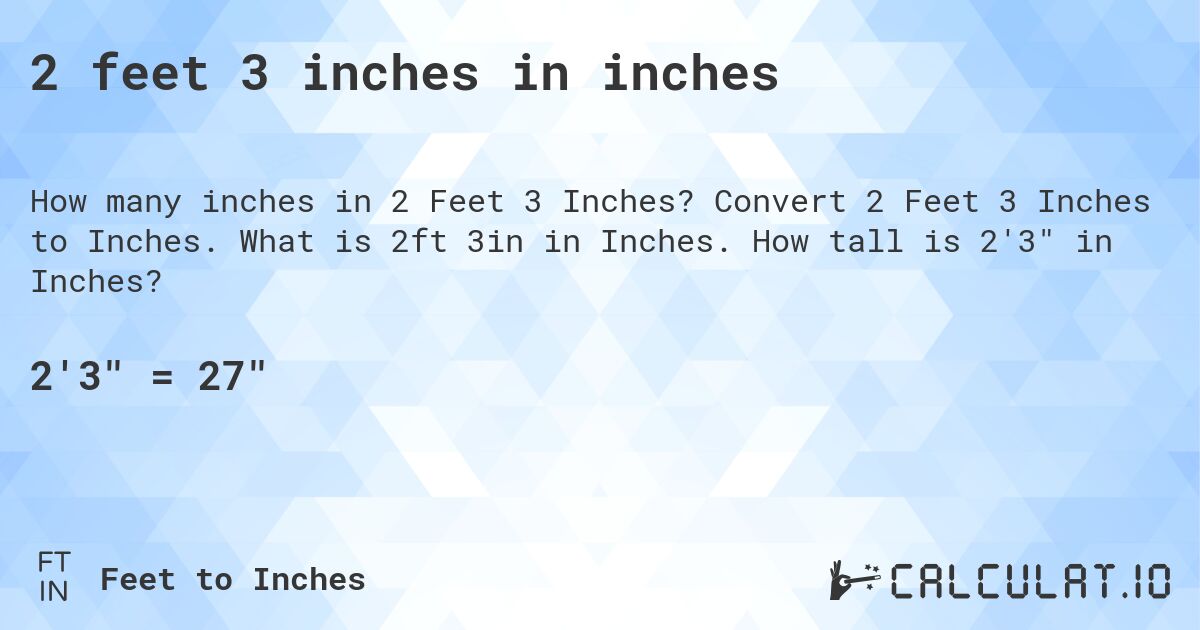
The seemingly simple question “what is 2 3 in inches” might appear to be a basic arithmetic query. However, within the intricate world of technology, specifically imaging and digital hardware, “2/3-inch” (often expressed as ‘2/3-type’ or ‘2/3″‘) represents far more than a mere fraction. It denotes a specific, widely adopted standard for camera sensor size, a critical component that dictates everything from image quality and low-light performance to device form factor and cost. Understanding this measurement and its implications is fundamental for anyone evaluating advanced cameras, high-end smartphones, professional broadcasting equipment, or even sophisticated drone optics.
The Ubiquitous 2/3-Inch Sensor: More Than Just a Measurement
In the realm of digital imaging, sensor size is king. Larger sensors typically capture more light, produce less noise, and offer greater dynamic range. The 2/3-inch sensor, while not the largest available, has carved out a significant niche, particularly in applications where a balance of image quality, optical design flexibility, and compact form factor is paramount.
Historical Context and Evolution
The “inch” measurement for image sensors is a legacy term stemming from the days of vacuum tubes and Cathode Ray Tubes (CRTs). Originally, the “inch” referred to the outer diameter of the glass envelope of a video camera tube, not the actual diagonal of the active imaging area. For a 2/3-inch tube, the actual diagonal of the photosensitive area was significantly smaller, approximately 11 mm. When charge-coupled device (CCD) and later complementary metal-oxide-semiconductor (CMOS) sensors replaced these tubes, manufacturers retained the familiar “type” designation (e.g., 2/3-inch type) for consistency, even though modern sensors are solid-state and don’t have glass envelopes. This historical anomaly means a 2/3-inch type sensor doesn’t literally measure 2/3 of an inch (approximately 16.9 mm) diagonally; its actual diagonal is closer to 11 mm, with an active area of roughly 8.8 x 6.6 mm (aspect ratio dependent). Despite this numerical quirk, the designation remains a crucial benchmark in sensor categorization.
Where 2/3-Inch Sensors Thrive Today
The 2/3-inch type sensor strikes an optimal balance, providing a significantly larger light-gathering surface than the tiny sensors found in most entry-level smartphones, yet remaining much smaller and less expensive than full-frame or APS-C sensors. This sweet spot makes it ideal for several demanding applications:
- Professional Broadcasting and Cinema: Many high-definition (HD) broadcast cameras and some compact digital cinema cameras utilize 2/3-inch sensors. Their size allows for robust optical systems with powerful zoom capabilities and excellent depth-of-field control, crucial for live events and field production.
- High-End Compact Cameras: Before the advent of large-sensor mirrorless cameras, premium compact cameras from manufacturers like Fujifilm (X-series) and Panasonic (LX-series) leveraged 2/3-inch sensors to deliver superior image quality in a pocketable form factor, often paired with fast, high-quality fixed lenses.
- Medical and Scientific Imaging: Precision and clarity are paramount in medical endoscopy, microscopy, and scientific instrumentation. 2/3-inch sensors provide the resolution and low-noise performance needed for accurate diagnostics and research.
- Surveillance and Machine Vision: For advanced security systems and industrial automation, where clear imaging under varying conditions is essential, 2/3-inch sensors offer robust performance and can be integrated into specialized optical setups.
- Drones and Robotics: While many consumer drones use smaller sensors, higher-end professional drones designed for cinematography or industrial inspection may incorporate 2/3-inch sensors for their superior image quality and ability to handle more complex lighting scenarios.
Pixels, Light, and Performance: The Technical Merits of Sensor Size
The 2/3-inch sensor’s appeal lies not just in its dimensions but in how those dimensions interact with photon capture, pixel design, and overall image processing.
Understanding “Sensor Type” vs. Actual Dimensions
As noted, the “type” designation is historical. For a 2/3-inch type sensor, the actual diagonal measurement of the active imaging area is approximately 11 mm. This translates to a surface area significantly larger than the 1/3-inch or 1/2.3-inch sensors common in consumer electronics but smaller than 1-inch, Micro Four Thirds, APS-C, or full-frame sensors. This distinction is crucial when comparing specifications, as a simple “inch” number can be misleading without understanding the “type” convention.
The Photon-Gathering Advantage
The primary benefit of a larger sensor, even one like the 2/3-inch, is its ability to gather more light. This translates directly into several performance advantages:
- Improved Low-Light Performance: More photons collected per pixel means a stronger signal, requiring less electronic amplification, which in turn reduces digital noise. This allows for cleaner images in dimly lit environments.
- Greater Dynamic Range: The capacity to capture a wider range of light intensities, from deep shadows to bright highlights, is enhanced with larger photosites (pixels) on a larger sensor. This results in images with more detail in extreme lighting conditions.
- Better Color Fidelity: With more light information, the sensor can distinguish subtle color variations more accurately, leading to richer and more true-to-life color reproduction.
- Higher Signal-to-Noise Ratio (SNR): A fundamental measure of image quality, a higher SNR indicates a clearer image with less distracting noise, which is directly influenced by the amount of light gathered relative to electronic noise.
Impact on Depth of Field and Optical Characteristics
Sensor size also fundamentally influences the aesthetic qualities of an image, particularly depth of field. A larger sensor, when paired with a lens of a given focal length and aperture, will produce a shallower depth of field compared to a smaller sensor under the same conditions. This allows for greater subject isolation, creating desirable background blur (bokeh) that is often sought after in professional photography and videography. The 2/3-inch sensor, while not as extreme as full-frame, still offers a noticeable improvement over smaller sensors in this regard, providing more creative control over focus. Furthermore, the relative size of the 2/3-inch sensor allows for the design of lenses that are both optically robust and physically manageable, striking a balance between performance and portability.
Beyond the Camera: Precision Measurement in Digital Design and Manufacturing
While the 2/3-inch sensor is a prime example of a specific measurement’s significance in tech, the broader principle of precise measurement extends across the entire digital design and manufacturing landscape. Inches, millimeters, and even microns play critical roles in bringing technology to life.
CAD, 3D Printing, and Micron-Level Accuracy
In computer-aided design (CAD) and manufacturing (CAM), every dimension, down to fractions of an inch or sub-millimeter scales, is meticulously defined. From the internal layout of a smartphone’s circuit board to the complex geometry of a turbine blade, precision is paramount. 3D printing, for instance, operates with layer resolutions often measured in tens of microns (where 1 micron = 0.000039 inches), directly impacting the fidelity and functionality of prototypes and final products. Errors in these minute measurements can lead to component incompatibility, structural failure, or compromised performance.
Miniaturization and Component Integration
The relentless drive towards miniaturization in consumer electronics relies heavily on precise dimensional control. Components like microprocessors, memory chips, and tiny sensors (often even smaller than 2/3-inch) must fit together perfectly within increasingly confined spaces. This requires advanced manufacturing techniques that operate with extreme precision, ensuring that a 2/3-inch sensor can be seamlessly integrated with its corresponding lens, image processor, and power management circuitry without waste or malfunction. The careful management of every fraction of an inch allows for thinner phones, smaller drones, and more compact professional equipment.
Evaluating Gadgets: How Sensor Size Informs Consumer Choices
For consumers and professionals alike, understanding the implications of measurements like “2/3-inch” is key to making informed purchasing decisions in the tech market.
Balancing Size, Cost, and Image Quality
When choosing a camera or a device with imaging capabilities, the sensor size – whether it’s 2/3-inch, 1-inch, APS-C, or full-frame – is one of the most significant specifications. A 2/3-inch sensor offers a compelling compromise:
- Cost-Effectiveness: Cameras with 2/3-inch sensors are generally more affordable than those with larger sensors (like APS-C or full-frame), primarily due to lower manufacturing costs for both the sensor and the associated optics.
- Portability: The smaller sensor allows for more compact camera bodies and lighter lenses, making them ideal for travel, street photography, or professional setups where space and weight are critical.
- Strong Performance: While not rivaling full-frame in ultimate low-light or depth-of-field potential, a 2/3-inch sensor still delivers vastly superior image quality compared to the tiny sensors found in most budget smartphones, especially when optical zoom and natural bokeh are desired.
The Future of Small Sensors and Computational Photography
The discussion around sensor size is evolving with advancements in computational photography. Algorithms can now combine multiple exposures, enhance dynamic range, reduce noise, and even simulate shallow depth of field, effectively “punching above the weight” of smaller sensors. However, even with these innovations, the fundamental physics of light capture remain: a larger sensor, like the 2/3-inch type, still provides a superior raw data foundation for these algorithms to work with, leading to even better results. As technology continues to push boundaries, the specific dimensions of components, whether it’s 2/3-inch for a sensor or another precise fraction for a circuit, will continue to define the capabilities and innovations within the tech landscape.
aViewFromTheCave is a participant in the Amazon Services LLC Associates Program, an affiliate advertising program designed to provide a means for sites to earn advertising fees by advertising and linking to Amazon.com. Amazon, the Amazon logo, AmazonSupply, and the AmazonSupply logo are trademarks of Amazon.com, Inc. or its affiliates. As an Amazon Associate we earn affiliate commissions from qualifying purchases.