
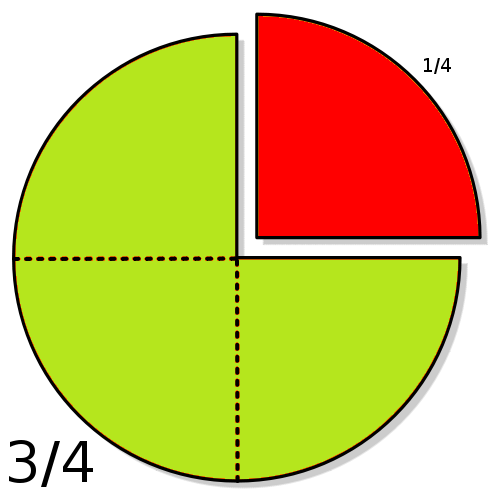
In the world of finance, precision is not merely a preference; it is a prerequisite for long-term wealth preservation and growth. At its simplest mathematical level, the question of “what is 1/4 of 3/4” yields the answer of 3/16. In decimal terms, this is 0.1875, or 18.75%. While this might seem like a basic elementary school calculation, in the context of personal finance, investment strategy, and corporate equity, this fraction represents a critical pivot point.
Understanding how to calculate and leverage fractions of a whole is the foundation of sophisticated financial modeling. Whether you are calculating the management fees on a private equity fund, determining your net ownership after a series of venture capital rounds, or managing the expense ratios of a diversified portfolio, the “3/16th” principle appears more frequently than many investors realize. To master your money, you must move beyond whole numbers and embrace the nuanced reality of fractional gains and losses.
The Mathematics of the 18.75% Threshold
When we break down 3/4 into four equal parts, we are left with 3/16. In the landscape of investment returns, 18.75% is a significant figure. It often sits right at the intersection of “market-beating performance” and “extraordinary growth.” For a retail investor, achieving a consistent 18.75% annual return would result in a portfolio that doubles approximately every 3.8 years—a rate that significantly outpaces the historical average of the S&P 500.
The Impact of Compounding on Fractional Returns
The power of 3/16 becomes most apparent when applied to the principle of compounding. If an investor manages to secure a return of 18.75% on a $100,000 investment, they earn $18,750 in the first year. However, the true financial “magic” happens when that fractional gain is reinvested. Because financial growth is exponential rather than linear, understanding the difference between a 1/4 return and a 3/16 return over a twenty-year horizon can mean the difference between a comfortable retirement and generational wealth.
Fractional Analysis in Budgeting
From a personal finance perspective, the 3/16 ratio is an excellent benchmark for “flexible” spending. If we assume that 75% (3/4) of a household income is dedicated to essential living expenses and long-term savings, then 1/4 of that remainder—the 18.75%—represents the “buffer” for discretionary lifestyle upgrades or unexpected opportunistic investments. Mastering this level of granular detail allows for a more resilient financial plan that can withstand market volatility.
Fractional Ownership and the Evolution of Modern Equity
In the realm of corporate finance and startups, 1/4 of 3/4 often describes a scenario of equity dilution. Imagine a founder who owns 75% of a company. If they decide to grant a key executive or a seed investor 1/4 of their personal stake, they are effectively moving to a 3/16 total ownership position in the broader cap table. This specific transition is a common milestone in the lifecycle of a growing business.
Navigating the Cap Table
Understanding fractional ownership is essential for any entrepreneur. When multiple rounds of funding occur, ownership is rarely expressed in clean, whole numbers. Investors and founders must become comfortable with the 3/16ths and the 5/32nds of the world. A 18.75% stake in a company valued at $10 million is worth $1.875 million. However, if the founder does not understand the math of dilution—how 1/4 of their 3/4 stake disappears with a new issuance—they may find themselves with less control than they anticipated.
The Rise of Fractional Shares in Retail Investing
The financial industry has undergone a revolution with the introduction of fractional share trading. Previously, an investor might have been unable to afford a single share of a high-priced tech stock. Today, fintech platforms allow users to buy 3/16 of a share or any other fraction. This democratization of the market means that the math of “1/4 of 3/4” is now a daily reality for the average person. It allows for precise dollar-cost averaging, ensuring that every cent of a “3/4” budget is put to work, rather than sitting idle in a cash account because it couldn’t cover the cost of a full share.
The Erosion of Wealth: How Fractional Fees Impact Long-Term Returns

While 18.75% is a beautiful number when it represents growth, it is a devastating number when it represents the erosion of capital through fees and inflation. In the world of institutional investing, “2 and 20” was the long-standing standard—a 2% management fee and a 20% performance fee. If a fund generates a 15% return (which is roughly 3/20), and the manager takes a significant fraction of those gains, the net return to the investor is drastically reduced.
The Hidden Cost of Expense Ratios
Consider the impact of a 0.75% (3/4 of a percent) expense ratio on a mutual fund. If that fund’s total return is 4%, then the fee represents nearly 1/5 of your total profit. When we look at “1/4 of 3/4” in terms of basis points, we are discussing the fine margins that separate top-tier financial products from mediocre ones. Over a 30-year investment horizon, losing 18.75% of your potential gains to cumulative fees and “drag” can result in hundreds of thousands of dollars in lost opportunity.
Tax Drag and the Net-of-Tax Reality
Taxes are perhaps the most significant “fraction” taken from our financial “whole.” If you realize a short-term capital gain on a 3/4 portion of your portfolio, and the tax rate is roughly 25% (1/4), you are left with that 3/16 figure in actual, spendable profit. Intelligent financial planning focuses on “net-of-tax” returns. By using tax-advantaged accounts like IRAs or 401(k)s, investors can prevent the government from taking that “1/4 of 3/4,” allowing the full 75% of their gains to continue compounding.
Strategic Asset Allocation and the Precision of the “Three-Sixteenths” Approach
Asset allocation is the process of dividing an investment portfolio among different asset categories, such as stocks, bonds, and cash. A common strategy might involve a “Core and Satellite” approach. If the “core” of a portfolio represents 75% (3/4) of total assets, an investor might decide to allocate 1/4 of that core to a specific sector, such as emerging markets or renewable energy.
Risk Management Through Fractional Diversification
The resulting 18.75% allocation to that specific sector is a calculated risk-management move. It is large enough to move the needle on total portfolio performance if the sector outperforms, but small enough that a total collapse of that sector would not jeopardize the investor’s overall solvency. This level of precision—calculating the fraction of the fraction—is what separates professional portfolio managers from speculators.
Rebalancing for Consistency
Market movements naturally shift these fractions over time. If your 18.75% allocation grows to become 1/4 of your total 3/4 core, the portfolio is now “overweight.” Rebalancing is the disciplined act of selling a portion of the winners to return to your original fractional target. This forces the investor to “buy low and sell high,” adhering to the mathematical rigor of their original plan rather than emotional impulses.
Implementing Fractional Thinking in Daily Financial Management
To truly benefit from the insight that 1/4 of 3/4 is 3/16, one must apply this logic to the “micro-moves” of their financial life. This involves looking at every transaction not as an isolated event, but as a percentage of a larger goal.
The Opportunity Cost of Small Expenses
Wealth is often built in the margins. If you can reduce your 75% “cost of living” by just 1/4, you are essentially freeing up 18.75% of your total income for wealth-building activities. This is the essence of the “Financial Independence, Retire Early” (FIRE) movement. By aggressively managing the fractions of their expenses, adherents are able to transform their “3/4” spending into a “3/16” investment engine.

Using Financial Tools for Precision
In the modern era, we have access to AI-driven financial tools and apps that do this math for us in real-time. These tools can track every 3/16 of a percent in your portfolio, alert you when your spending exceeds a specific fraction of your budget, and calculate the future value of those small savings. The key is to engage with these tools with a clear understanding of the underlying math.
When you ask, “What is 1/4 of 3/4?” you are asking about the power of the remainder. You are asking how to take a significant portion of your resources and refine it even further for a specific purpose. In money management, as in mathematics, the answer 3/16 represents clarity, discipline, and the pursuit of incremental improvement that leads to monumental results. Whether you are dividing a pizza, a paycheck, or a multi-million dollar equity pool, the ability to calculate and respect the fraction of the fraction is the ultimate mark of financial literacy.
aViewFromTheCave is a participant in the Amazon Services LLC Associates Program, an affiliate advertising program designed to provide a means for sites to earn advertising fees by advertising and linking to Amazon.com. Amazon, the Amazon logo, AmazonSupply, and the AmazonSupply logo are trademarks of Amazon.com, Inc. or its affiliates. As an Amazon Associate we earn affiliate commissions from qualifying purchases.