
At first glance, the question “What is 1/6 of 18?” appears to be a simple arithmetic problem, perhaps something one might encounter in an elementary school math class. The answer, of course, is 3. However, to dismiss this seemingly trivial calculation would be to overlook a fundamental building block of financial literacy. In the intricate world of money, from personal budgeting to complex investment strategies and business finance, the ability to understand and manipulate fractions is not just an academic exercise – it’s an indispensable skill that underpins sound financial decision-making.

This article delves beyond the elementary solution to “1/6 of 18” to illustrate how such basic mathematical concepts are critically relevant in the realm of finance. We’ll explore how a solid grasp of fractions translates into practical advantages in managing personal finances, making informed investment choices, and navigating the complexities of business operations. By connecting this foundational arithmetic to real-world financial scenarios, we aim to underscore that financial mastery isn’t solely about sophisticated algorithms or market timing, but begins with the confident application of core mathematical principles. Understanding “1/6 of 18” isn’t just about getting the right answer; it’s about developing the numerical fluency that empowers you to take control of your financial future.
The Core Calculation: Deconstructing “1/6 of 18”
Before we immerse ourselves in the financial implications, let’s briefly revisit the calculation itself to ensure a shared understanding of the underlying principles. This isn’t just about arriving at the number 3; it’s about comprehending what a fraction represents and how it operates in relation to a whole.
Understanding Fractions in Practical Terms
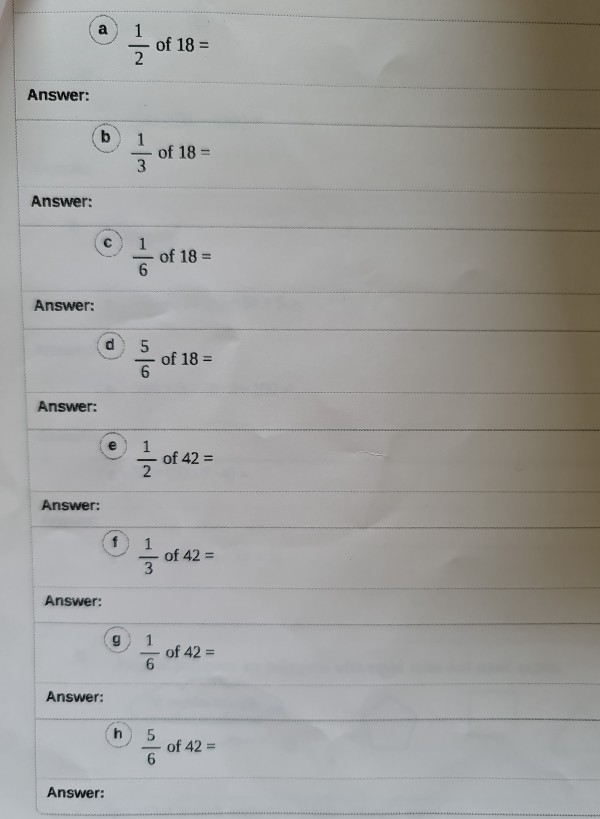
A fraction, like 1/6, represents a part of a whole. The top number, the numerator (1), tells us how many parts we have, while the bottom number, the denominator (6), tells us how many total equal parts make up the whole. So, 1/6 means one out of six equal parts. When we ask “what is 1/6 of 18,” we are essentially asking: if we divide 18 into six equal pieces, what is the value of one of those pieces?
Step-by-Step Solution
The calculation is straightforward:
To find a fraction of a number, you multiply the fraction by that number.
-
Multiply the numerator by the whole number: 1 * 18 = 18
-
Divide the result by the denominator: 18 / 6 = 3
Thus, 1/6 of 18 is indeed 3. This simple operation serves as a blueprint for countless financial calculations, from calculating a discount to determining an equity stake.
Why This Simple Math Matters
While seemingly basic, the ability to quickly and accurately perform such calculations forms the bedrock of financial literacy. It builds confidence in handling numbers, which is essential when faced with percentage rates, investment allocations, or budgeting decisions. If you can confidently calculate 1/6 of 18, you are better equipped to understand what 25% of your income is, or what 1/3 of a company’s profits represent. It’s the mental training for more complex financial thought.
Bridging Basic Math to Everyday Personal Finance
In the realm of personal finance, fractions are more ubiquitous than many realize. They are the silent workhorses that help us manage our money day-to-day, making abstract financial concepts tangible and actionable.
Budgeting and Expense Allocation
One of the most immediate applications of fractional understanding is in budgeting. When planning how to spend or save your income, you are constantly dealing with portions of your total earnings. For instance, you might decide to allocate:
-
1/2 (50%) of your income to housing.
-
1/6 to savings.
-
1/10 to debt repayment.
-
And the remainder to other expenses.
If your monthly take-home income is $3,000, understanding that 1/6 of it ($500) goes to savings helps you visualize your financial goals and track your progress. This fractional approach makes budgeting a powerful tool for financial control, allowing for clear division and understanding of where every dollar goes.
Understanding Discounts and Sales
Fractional math is also crucial for smart shopping and taking advantage of sales. While often expressed as percentages (e.g., 20% off), these are directly equivalent to fractions (20% = 1/5). Imagine a store advertises “1/6 off” a product priced at $180. Knowing that 1/6 of $180 is $30, you immediately understand your savings and the final price ($150). This quick calculation prevents impulse buys based on vague “great deal” claims and allows for informed purchasing decisions.
Savings Goals and Progress Tracking
Setting savings goals often involves breaking down a large target into manageable fractions. If you aim to save $18,000 for a down payment and you’ve managed to put away $3,000, you can instantly see that you’ve achieved 1/6 of your goal. This fractional perspective provides a clear metric for progress, motivating continued effort and allowing for adjustments to your savings strategy if you’re falling behind or ahead. It makes abstract long-term goals feel more attainable by breaking them into understandable components.
Debt Management Insights
Even in managing debt, fractions play a role. When you make a loan payment, a portion of it goes towards interest, and a portion towards the principal. While not always a simple fraction like 1/6, understanding the concept helps you comprehend how your payments are distributed. For instance, if you pay $300 on a loan, and 1/6 of that payment, or $50, goes to principal, you can track how much closer you are to being debt-free. This clarity empowers you to make strategic decisions about extra payments or refinancing.
Leveraging Fractions in Investing and Wealth Building
Beyond day-to-day personal finance, fractional understanding becomes even more critical in the world of investing. Here, it underpins strategies for diversification, calculating returns, and structuring partnerships.
Portfolio Diversification

A cornerstone of sound investing is diversification – spreading your investments across various asset classes to mitigate risk. This process is inherently fractional. An investor might decide to allocate:
-
1/2 of their portfolio to large-cap stocks.
-
1/4 to bonds.
-
1/8 to real estate.
-
And the remaining 1/8 to emerging markets.
If your total investment capital is $180,000, calculating that 1/6 ($30,000) is allocated to a specific sector or asset class becomes an exercise in applying the very same principle as “1/6 of 18.” This granular understanding ensures your portfolio truly reflects your desired risk profile and investment strategy.
Understanding Returns and Dividends
When evaluating investments, you often look at returns as a fraction or percentage of your initial capital. If an investment of $18,000 yields $3,000 in profit, that represents a 1/6 return (or approximately 16.67%). Similarly, companies pay dividends as a fraction of their earnings or a set amount per share. Understanding these fractions allows investors to compare the profitability and yield of different investment opportunities accurately.
Splitting Profits and Partnerships
In entrepreneurship, joint ventures, or small business partnerships, profits are frequently divided based on fractional ownership or contribution. If three partners own a business with stakes of 1/2, 1/3, and 1/6 respectively, and the business makes a profit of $18,000, each partner can easily calculate their share:
-
Partner 1 (1/2): $9,000
-
Partner 2 (1/3): $6,000
-
Partner 3 (1/6): $3,000
This ensures transparency and fairness in profit distribution, preventing disputes and fostering trust among business partners. It’s a direct application of fractional arithmetic to real-world business outcomes.
Business Finance and Fractional Understanding
The principles of fractions extend deeply into the operations and analysis of businesses, from startups to multinational corporations. Financial statements, operational metrics, and strategic planning all rely on a solid grasp of how parts relate to the whole.
Cost Allocation and Overhead Distribution
Businesses often incur shared costs (overhead) that need to be allocated across different departments, products, or projects. This allocation is frequently done using fractional or percentage bases. For example, if a company’s total utility bill is $1,800 and the marketing department is deemed to utilize 1/6 of the total office space, then $300 (1/6 of $1,800) would be allocated to their budget. Accurate cost allocation is crucial for understanding the true profitability of individual segments of a business.
Revenue Share Models
Many modern business models, particularly in digital industries, rely on revenue-sharing agreements. Software developers might take a fraction of app sales, content creators a fraction of advertising revenue, or affiliate marketers a fraction of product sales. If a platform generates $18,000 in ad revenue and the content creator’s agreement entitles them to 1/6, they instantly know their earnings are $3,000. These models highlight the direct financial impact of fractional calculations.
Inventory Management and Supply Chain
Even in inventory and supply chain management, fractional understanding can be important. Businesses might need to calculate a fraction of their total stock that is “on hand,” “in transit,” or “damaged.” If a warehouse holds 1,800 units of a product, and 1/6 of them are back-ordered, then 300 units are currently unavailable, impacting sales forecasts and logistics planning.
Financial Ratios and Performance Metrics
While often presented as ratios (e.g., current ratio, debt-to-equity ratio) or percentages (e.g., profit margin), these critical business performance metrics are fundamentally derived from fractional relationships. For instance, a profit margin is net income divided by revenue, which is a fraction expressed as a percentage. Understanding that these ratios represent a part of the whole (e.g., what fraction of revenue becomes profit) is essential for analyzing a company’s health and efficiency.
Cultivating Financial Literacy: Beyond the Numbers
The ability to calculate “1/6 of 18” with ease is more than just a party trick; it’s a testament to a foundational numerical fluency that underpins true financial literacy. It’s about building a robust mental framework that allows individuals and businesses to navigate complex financial landscapes with confidence and clarity.
The Importance of Foundational Skills
The journey to financial mastery isn’t paved with shortcuts; it’s built brick by brick on foundational skills. Understanding fractions, percentages, and basic arithmetic enables one to critically evaluate financial information, from loan offers and investment prospectuses to sales pitches and budgeting tools. Without this basic understanding, one is vulnerable to misinformation, poor decisions, and financial exploitation. Complex financial models are merely elaborate assemblies of these simpler mathematical operations.
Practical Tools and Resources
While sophisticated financial calculators and budgeting apps abound, they are merely tools. Their effectiveness is maximized when the user understands the underlying math. Relying solely on a calculator without comprehending why the numbers are what they are can lead to a superficial understanding and potential errors. Therefore, cultivate a habit of mentally estimating or quickly calculating fractions and percentages – it builds intuition and empowers you to double-check digital tools. Many online resources and courses are available to reinforce these basic math skills, framed within real-world financial contexts.
Empowering Financial Confidence
Perhaps one of the most significant benefits of mastering foundational math like fractions is the boost in financial confidence. When you understand how money works at its most basic level, you feel more in control. Financial anxiety often stems from a lack of understanding or a feeling of being overwhelmed by numbers. By confidently tackling questions like “what is 1/6 of 18” and seeing its broader applications, you equip yourself with the cognitive tools to make informed decisions, negotiate effectively, plan for the future, and ultimately, achieve financial well-being. This confidence is invaluable in all aspects of life touched by money.
In conclusion, the seemingly straightforward query “what is 1/6 of 18?” serves as a powerful reminder of the deep connection between fundamental mathematical principles and robust financial literacy. From meticulously planning a personal budget and discerning smart investment opportunities to strategically managing business finances and understanding economic indicators, the ability to work with fractions is paramount. It empowers individuals and organizations to not only answer simple arithmetic problems but to confidently construct a financially secure and prosperous future. Embrace these foundational skills, for they are the invisible architects of financial mastery.
aViewFromTheCave is a participant in the Amazon Services LLC Associates Program, an affiliate advertising program designed to provide a means for sites to earn advertising fees by advertising and linking to Amazon.com. Amazon, the Amazon logo, AmazonSupply, and the AmazonSupply logo are trademarks of Amazon.com, Inc. or its affiliates. As an Amazon Associate we earn affiliate commissions from qualifying purchases.