
In the intricate world of personal finance, business operations, and investment strategies, clarity is paramount. Every number, every ratio, and every proportion holds significance, influencing decisions that can shape one’s financial future. While sophisticated financial models and complex algorithms often dominate discussions, the bedrock of financial understanding frequently rests on simpler, fundamental mathematical concepts. Among these, the ability to effortlessly convert and comprehend fractions, mixed numbers, and their decimal equivalents is an indispensable skill, far more impactful than it might initially appear.
The seemingly straightforward question, “What is 1 2/3 as a fraction?”, serves as a gateway to exploring the deeper importance of numerical literacy in managing, growing, and dissecting financial information. It’s not just an arithmetic exercise; it’s an entry point into a world where understanding how to break down and build up numbers can reveal hidden insights in budgets, investment returns, and asset allocations. This article will deconstruct this basic mathematical query, illuminating its practical implications and profound relevance within the money niche, demonstrating how a mastery of such conversions empowers individuals and businesses to make more informed and strategic financial decisions.
The Foundation: Deconstructing Mixed Numbers for Financial Acumen
Before we tackle the specific conversion of 1 2/3, it’s crucial to understand what a mixed number represents and why this format appears so frequently in financial contexts. A mixed number, by definition, combines a whole number with a proper fraction. In our example, ‘1’ is the whole number, and ‘2/3’ is the proper fraction. This seemingly simple construct is a powerful tool for representing quantities that aren’t perfectly whole, a common occurrence in the dynamic landscape of finance.
Understanding the Components: Whole Numbers and Proper Fractions
At its core, a mixed number like 1 2/3 precisely describes a quantity greater than one but not quite two. The ‘1’ signifies a complete unit—be it one full share of a company, one whole unit of currency, or one complete cycle of a financial process. The ‘2/3’ then denotes an additional, incomplete portion of that next unit. This granular representation is vital. Imagine a stock price quoted as $12 3/4, or an interest rate described as 1 1/2 percent. These are not arbitrary figures but precise indicators that combine discrete units with fractional parts, each carrying significant weight in financial calculations.
The whole number provides immediate context for the magnitude, while the proper fraction (where the numerator is smaller than the denominator) refines this understanding, adding precision. This duality allows for both broad strokes and fine details, essential for avoiding ambiguity in financial reporting and analysis. Without this distinction, one might misinterpret a ‘part’ for a ‘whole’ or vice versa, leading to potentially costly errors in judgment or calculation.
Why Mixed Numbers Matter in Financial Contexts: Beyond the Basics
In the realm of money, mixed numbers are not just abstract mathematical constructs; they are practical descriptors of real-world financial scenarios. Consider investment growth rates: an annual return of “1 and a half percent” (1 1/2%) or “one and two-thirds percent” (1 2/3%) communicates more intuitive sense than merely “1.5%” or “1.666…%.” While decimals are often preferred for calculation, the mixed number offers a more digestible initial understanding, especially when communicating with diverse stakeholders who may not be mathematically inclined.
Moreover, mixed numbers can represent partial ownership stakes in an asset or business, such as “owning 1 1/4 plots of land” or “a 1 2/3 stake in a venture fund if one unit equals a specific share of ownership.” They also appear in resource allocation, where a budget might allocate “1 1/3 units of funding” to a particular department, where a “unit” might represent a million dollars. Understanding these expressions immediately frames the scale and portion involved, crucial for budgeting, forecasting, and asset valuation. Ignoring the fractional component, or misinterpreting it, can lead to significant discrepancies in financial projections and actual outcomes, impacting profitability and financial stability.
The Conversion Process: From Mixed Number to Improper Fraction
The act of converting a mixed number into an improper fraction (where the numerator is greater than or equal to the denominator) is not merely an academic exercise; it’s a fundamental step that often precedes complex financial calculations. For instance, when dealing with formulas for compound interest, return on investment (ROI), or even simple ratios, working with improper fractions or their decimal equivalents is almost always more efficient and less prone to error than managing mixed numbers directly.
Step-by-Step Guide to Converting 1 2/3 (and other examples)
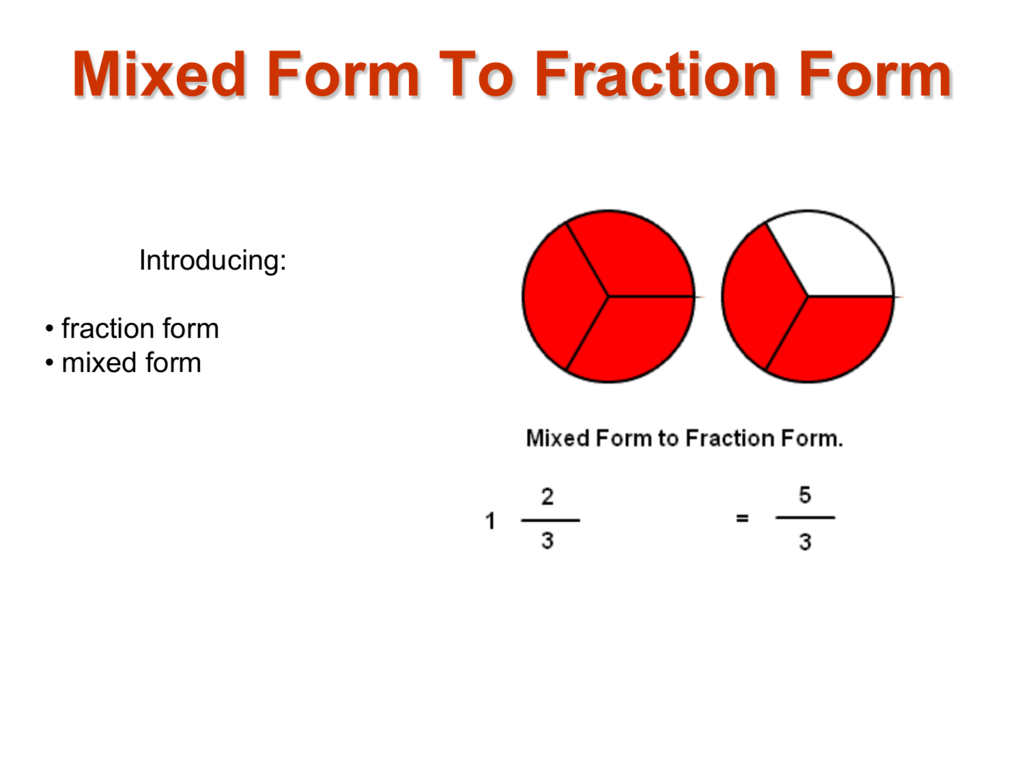
Let’s break down the conversion of 1 2/3:
-
Identify the Whole Number and the Fraction: In 1 2/3, the whole number is 1, and the fraction is 2/3.
-
Multiply the Whole Number by the Denominator: This step converts the whole number into an equivalent number of ‘thirds’. For 1 2/3, multiply the whole number (1) by the denominator of the fraction (3): 1 * 3 = 3. This means that the whole number ‘1’ can be expressed as ‘3/3’.
-
Add the Numerator of the Fraction to the Result: Now, add the numerator of the original fraction (2) to the result from step 2 (3): 3 + 2 = 5. This new sum (5) becomes the numerator of our improper fraction.
-
Keep the Original Denominator: The denominator remains the same as the original fraction. So, the denominator is 3.
Therefore, 1 2/3 as an improper fraction is 5/3.
This methodical approach ensures accuracy, a non-negotiable requirement in financial computations. Whether you’re calculating an investment return, dividing profits among partners, or even figuring out sales tax on an unusual item, precision is paramount. A small error in converting a mixed number can lead to a cascading series of inaccuracies, culminating in incorrect financial reporting or misguided investment decisions.
Practical Application: When Improper Fractions Simplify Financial Understanding
The beauty of converting to an improper fraction lies in its ability to consolidate disparate parts into a single, cohesive numerical representation, which simplifies subsequent calculations. For example, if you’re trying to calculate 1 2/3 times an initial investment of $1,500, performing the multiplication with the mixed number directly can be cumbersome. However, multiplying $1,500 by 5/3 is straightforward: (1,500 * 5) / 3 = 7,500 / 3 = $2,500. This is a much smoother operation.
In scenarios involving partial ownership or complex interest calculations, improper fractions provide a clear, unified factor to work with. Imagine a situation where a fund’s value grew by “one and two-thirds times” its initial worth. Using 5/3 immediately provides a multiplier for the original principal, streamlining the calculation of the new fund value. Similarly, when allocating shares or distributing profits, expressing proportions as improper fractions (or their decimal equivalents) can simplify the division process, ensuring that each stakeholder receives their precise portion without the confusion of mixed units. This clarity minimizes disputes and enhances transparency, vital for maintaining trust in financial partnerships.
The Power of Simplification: Fractions in Everyday Finance
Beyond complex investment strategies, fractions play a pervasive and often understated role in everyday personal finance. From budgeting monthly expenses to understanding sales and discounts, a solid grasp of fractional concepts empowers individuals to manage their money more effectively and make smarter purchasing decisions.
Budgeting and Allocating Funds: The Fractional Framework
Budgeting is essentially an exercise in fractional allocation. When you decide to dedicate a portion of your income to housing, savings, or discretionary spending, you are, in essence, working with fractions. Many popular budgeting rules, like the “50/30/20 rule” (50% needs, 30% wants, 20% savings/debt), are fractional breakdowns of one’s income. Understanding that 1/3 of your income to housing means you are dedicating $1 for every $3 earned helps to visualize and control spending.

Consider a scenario where you aim to save 1/5 of your after-tax income each month. If your income is a mixed number of thousands, say $2,500, knowing how to work with fractions allows you to quickly calculate that you need to save $500. For more complex allocations, such as dedicating 1 2/3 of a specific category’s budget to a sub-category, converting to 5/3 (or 1.666…) makes the multiplication simple and precise, ensuring that funds are distributed exactly as intended without overspending or underspending. This level of precision is crucial for maintaining a balanced budget and achieving financial goals.
Understanding Investment Returns and Ratios: Beyond Whole Percentages
Investment returns and financial ratios are frequently expressed in fractional or percentage terms, often requiring an understanding of how these values relate to each other. A stock’s dividend yield might be 2 1/4 percent, or a company’s price-to-earnings (P/E) ratio might be 15 1/2. While these are often converted to decimals for calculations, grasping their mixed number form offers a more intuitive sense of their value.
For instance, understanding P/E ratios in fractional terms helps investors compare companies. If Company A has a P/E of 15 1/2 and Company B has a P/E of 16, it’s immediately clear that Company A might be slightly cheaper relative to its earnings. Furthermore, when assessing growth, a return of 1 2/3 times an initial investment means significantly more than merely 1.5 times, translating into a tangible difference in accumulated wealth. The ability to switch between mixed numbers, improper fractions, and decimals allows for a more holistic and nuanced interpretation of complex financial indicators, empowering investors to make more discerning choices.
Real Estate and Asset Division: Equitable Distribution
In real estate and asset management, fractions are instrumental in defining ownership stakes and distributing profits or losses. When multiple parties co-own a property, their shares are often expressed as fractions (e.g., 1/2, 1/3, 1/4). If one partner contributes an amount that results in an ownership stake that is a mixed number, such as 1 2/3 units of a 5-unit investment, converting that to 5/3 of a unit or 1/3 of the total investment (since 5/3 out of 5 units = 1/3) becomes essential for clarity and equitable distribution.
This is particularly critical during the sale of an asset or dissolution of a partnership. Imagine a property valued at $300,000, and a partner has a 1 2/3 “share unit” out of a total of 5 “share units” in the partnership. Converting 1 2/3 to 5/3 simplifies the calculation of their precise ownership. Their share would be (5/3) / 5 = 1/3 of the total property value, equating to $100,000. Accurate fractional understanding prevents disputes and ensures fair dealings among stakeholders, a cornerstone of sound financial practice.
Beyond Basic Arithmetic: Leveraging Fractional Understanding for Financial Growth
The utility of fractions extends far beyond simple conversions; they are critical tools for understanding advanced financial concepts that drive wealth creation and protection. A deep appreciation for fractional values can unlock a more sophisticated approach to investment, risk management, and long-term financial planning.
Interest Rates and Compound Growth: The Fractional Multiplier
Compound interest, often hailed as the “eighth wonder of the world,” relies heavily on fractional multipliers. Whether an interest rate is expressed as 3.5% or 3 1/2%, understanding its fractional equivalent (e.g., 7/200) can provide a clearer perspective on how quickly your money grows. For example, knowing that an annual growth of 1 2/3 times an initial principal results in a specific gain allows for precise forecasting of future wealth.
When financial institutions quote rates, these are often annual percentages. However, if interest is compounded more frequently (e.g., monthly or quarterly), these annual rates must be divided into smaller fractions. Understanding how to divide a nominal rate (e.g., 6% annual) into its effective periodic rate (e.g., 1/2% or 1/200 per month) is a fundamental fractional calculation that directly impacts the power of compounding. The more accurately one can work with these fractional interest components, the better one can predict and optimize returns on savings and investments, crucial for long-term financial growth.
Risk Assessment and Diversification: Weighing Portfolios
Diversification, the strategy of spreading investments across various assets to reduce risk, is inherently a fractional concept. An investment portfolio is often described as having certain percentages or fractions allocated to different asset classes—e.g., 1/2 in stocks, 1/3 in bonds, and 1/6 in real estate. The ability to quickly sum, compare, and rebalance these fractional components is vital for effective risk management.
When markets fluctuate, the fractional weights of a portfolio’s components change. Rebalancing requires investors to adjust these fractions back to their desired proportions. If a particular asset class has grown “1 2/3 times” its original allocation, an investor needs to understand this multiplier to calculate the new weight and determine how much to sell to bring it back in line with their risk tolerance. This dynamic fractional adjustment is a continuous process for managing risk and optimizing returns.
Advanced Financial Modeling: The Role of Precise Fractional Values
In advanced financial modeling, particularly in areas like derivatives pricing, option valuations, or complex capital budgeting, fractional values are not merely convenient; they are essential for accuracy. Financial models often deal with probabilities, partial periods, and proportional impacts that demand exact numerical representations. While computers handle much of the heavy lifting, the underlying logic and input parameters frequently involve fractional expressions.
For example, calculating the present value of future cash flows over non-integer periods (e.g., 1 2/3 years) requires precise application of fractional exponents in discounting formulas. Any approximation or rounding too early in such calculations can lead to significant discrepancies in the final valuation, potentially misguiding investment decisions worth millions. Therefore, a thorough understanding of how fractions translate into decimals and how they are manipulated in complex equations is a critical skill for financial analysts and strategists.
Tools and Techniques for Fractional Financial Management
While the conceptual understanding of fractions is crucial, practical financial management often benefits from leveraging modern tools and techniques. These resources can simplify complex fractional calculations, reducing the likelihood of human error and freeing up time for strategic thinking.
Digital Calculators and Financial Software
Today’s digital financial calculators, spreadsheet software (like Excel or Google Sheets), and specialized financial modeling applications are indispensable for handling fractional arithmetic. These tools can effortlessly convert mixed numbers to improper fractions, perform operations with high precision, and translate fractions into decimals for further analysis. Knowing how to input fractional values or use specific functions (e.g., DECIMAL to convert fractions to decimals or GCD for simplification) can significantly streamline financial tasks.
For example, when setting up a budget in a spreadsheet, one might designate cells for fractional allocations (e.g., 1/3 for housing). The software can then automatically calculate the monetary value based on total income. For investors, financial software can track portfolio allocations, showing precisely how various asset classes contribute to the overall portfolio as fractions of the total. While the tools perform the calculations, the human understanding of the underlying fractional concepts is what makes these tools effective, allowing users to interpret results correctly and validate outputs.
Developing a ‘Fractional Mindset’ for Better Decision-Making
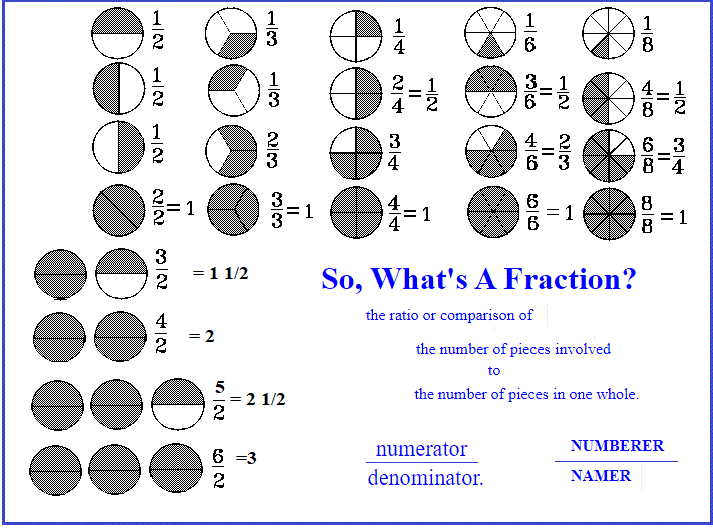
Ultimately, the most powerful tool for mastering fractions in finance is the development of a ‘fractional mindset’. This involves habitually thinking about numbers not just as whole entities, but as parts of a greater whole, and understanding their proportional relationships. When evaluating an investment, consider its return not just as a percentage, but as a fraction of the initial capital. When budgeting, view expenses as fractions of your total income.
This mindset fosters a deeper intuition for financial concepts, enabling quicker mental estimations, more confident interpretations of financial data, and a more strategic approach to money management. It cultivates the ability to see how smaller parts contribute to the bigger picture, how a fractional change in an interest rate can significantly impact long-term wealth, or how a slight adjustment in asset allocation can alter risk exposure. By internalizing the principles behind questions like “what is 1 2/3 as a fraction,” individuals and businesses equip themselves with a fundamental numerical literacy that is a cornerstone of financial success and sustained prosperity.
aViewFromTheCave is a participant in the Amazon Services LLC Associates Program, an affiliate advertising program designed to provide a means for sites to earn advertising fees by advertising and linking to Amazon.com. Amazon, the Amazon logo, AmazonSupply, and the AmazonSupply logo are trademarks of Amazon.com, Inc. or its affiliates. As an Amazon Associate we earn affiliate commissions from qualifying purchases.