
For decades, the answer to the question of what industry Nvidia belongs to was simple: the computer hardware industry, specifically focused on gaming. If you were a PC enthusiast in the early 2000s, Nvidia was the name on the box of the graphics card that allowed you to play the latest titles with higher frame rates and better resolution. However, in the last five years, that definition has undergone a radical transformation.
To describe Nvidia simply as a hardware manufacturer today is like describing a smartphone as just a telephone. While the company still produces physical components, it has evolved into a multi-faceted technology powerhouse that sits at the intersection of several high-growth sectors. Today, Nvidia is more accurately defined as the world leader in accelerated computing, providing the foundational architecture for the artificial intelligence (AI) revolution, the modern data center, and the future of autonomous systems.
From Gaming Roots to the Engine of Modern Computing
The foundation of Nvidia’s current dominance lies in a pivotal realization made by its leadership early on: the math required to render a 3D pixel is remarkably similar to the math required to train a neural network. This realization allowed the company to pivot from a niche gaming supplier to a central pillar of the global tech stack.
The Birth of the GPU
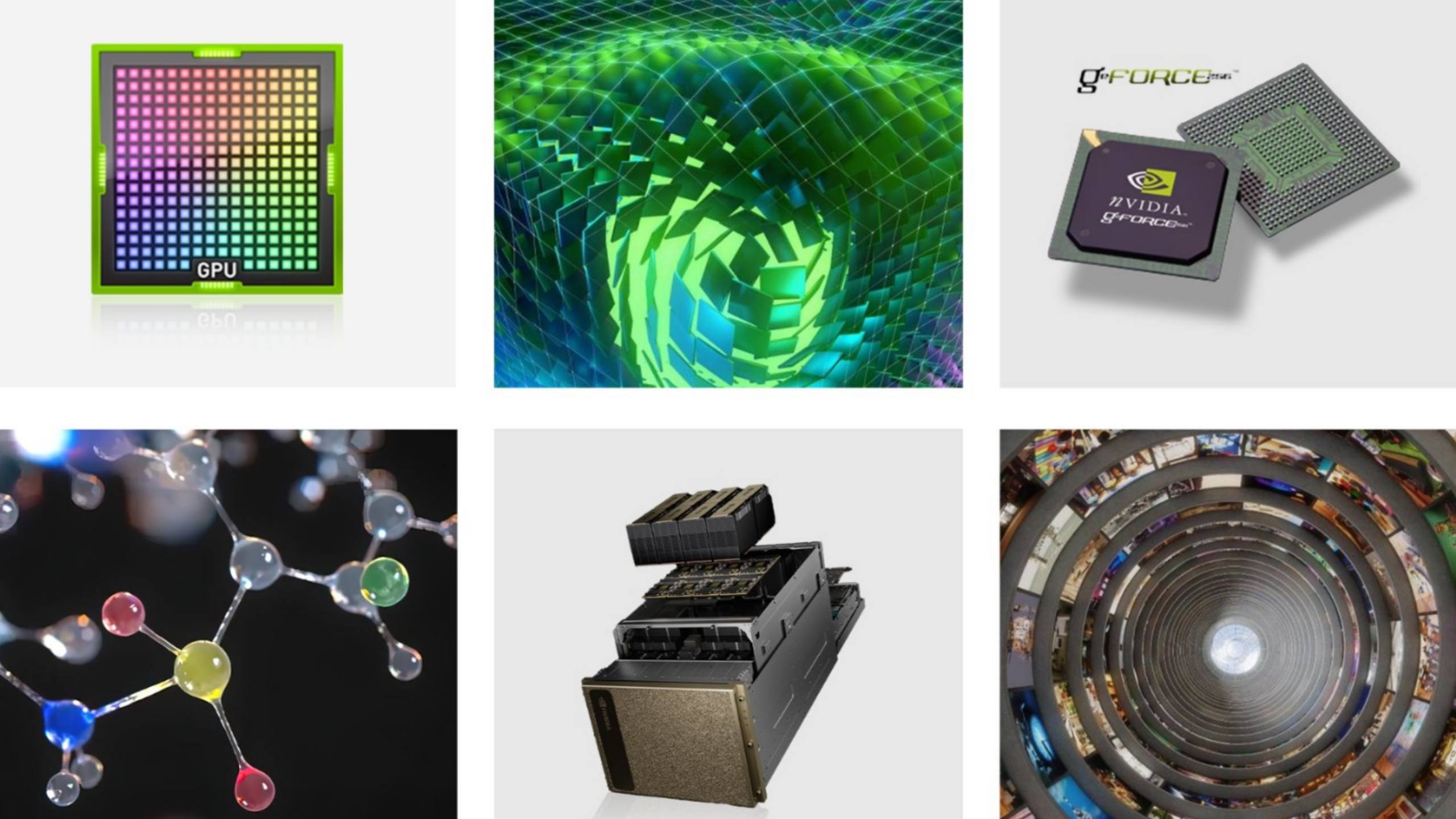
In 1899, Nvidia introduced the GeForce 256, marketed as the world’s first Graphics Processing Unit (GPU). Unlike the Central Processing Unit (CPU), which is designed for general-purpose tasks and handles instructions sequentially, the GPU was built for parallel processing. It could break down complex visual tasks into thousands of smaller, simultaneous calculations. For years, this served the gaming industry exclusively, but it laid the groundwork for a massive shift in computational theory.
The Pivot to Parallel Processing
As the tech world moved toward more data-intensive applications, the limitations of the traditional CPU became apparent. The “Moore’s Law” era of simply shrinking transistors to gain speed was hitting physical limits. Nvidia recognized that the parallel architecture of their GPUs could be repurposed for tasks far beyond gaming. By introducing CUDA (Compute Unified Device Architecture) in 2006, they allowed developers to use the GPU for general-purpose mathematical processing. This was the moment Nvidia effectively entered the high-performance computing (HPC) industry, setting the stage for the AI boom that would follow a decade later.
Dominating the Artificial Intelligence Infrastructure
If you look at the current landscape of technology, Nvidia is the primary architect of the AI industry. When we talk about Generative AI, Large Language Models (LLMs) like GPT-4, or deep learning, we are essentially talking about software that runs on Nvidia hardware.
The Transformer Engine and Blackwell Architectures
Nvidia’s dominance in AI is not a result of luck, but of specific architectural choices. Modern AI models rely on the “Transformer” architecture, which requires massive amounts of throughput. Nvidia’s H100 and H200 Tensor Core GPUs were designed specifically to accelerate these workloads.
With the introduction of the Blackwell platform, Nvidia has moved beyond being a “chip maker” to being a “systems builder.” The Blackwell architecture isn’t just a faster chip; it is an integrated system of GPUs, CPUs (like the Grace Hopper Superchip), and high-speed interconnects designed to handle models with trillions of parameters. This puts Nvidia in a category of its own within the semiconductor industry—one where the silicon is inseparable from the AI research it enables.
Why the AI Industry Relies on Nvidia Hardware
The reason Nvidia holds an estimated 80% to 95% share of the AI chip market isn’t just about raw speed; it’s about the ecosystem. In the tech industry, hardware is only as good as the software that runs on it. Because Nvidia spent nearly two decades optimizing its software for its hardware, they have created a “virtuous cycle.” Every major AI research paper is written using Nvidia-compatible frameworks, and every major cloud provider (AWS, Azure, Google Cloud) builds its infrastructure around Nvidia’s specifications.
The Software Ecosystem: CUDA as the Moat
To understand what industry Nvidia is in, one must look past the green circuit boards. Nvidia is, in many ways, a software company. This is the most misunderstood aspect of their business model.

Bridging the Gap Between Hardware and Code
The real “moat” that protects Nvidia from competitors like AMD or Intel isn’t just the hardware performance; it’s CUDA. CUDA is a parallel computing platform and programming model that allows software developers to use a GPU for general-purpose processing.
Over the last 18 years, millions of developers have built their libraries, tools, and research on CUDA. If a competitor releases a chip that is technically faster than an Nvidia GPU, a developer cannot simply switch over. They would have to rewrite years of code and optimize their entire stack for a new architecture. This makes Nvidia the “operating system” of AI and scientific computing.
SDKs and Enterprise AI Software
Nvidia also operates in the enterprise software industry. They provide a suite of software development kits (SDKs) and platforms like Nvidia AI Enterprise. This is a cloud-native suite of AI and data science software optimized to run on their hardware. By providing the tools for speech AI, vision AI, and cybersecurity, Nvidia has integrated itself into the workflow of Fortune 500 companies. They are no longer just selling a component; they are selling a full-stack solution that includes the operating system, the libraries, and the hardware necessary to run them.
Expanding the Footprint: Data Centers and Omniverse
Nvidia’s largest revenue source is now the Data Center segment. This shift signifies that they are no longer a consumer electronics company; they are an infrastructure provider for the global internet.
The Modern Data Center as a Factory
Nvidia CEO Jensen Huang often refers to the modern data center as an “AI Factory.” In the old world, data centers were places where we stored files and served web pages. In the new world, data centers take raw data as input and produce “intelligence” as output.
Nvidia has expanded into the networking industry to support this. With the acquisition of Mellanox in 2020, Nvidia gained control over high-speed interconnect technologies like InfiniBand. This is critical because in an AI supercomputer, the bottleneck is often not how fast a single chip can think, but how fast thousands of chips can talk to each other. By owning the networking stack, Nvidia ensures that their hardware scales perfectly across massive server farms.
Industrial Digitization and Digital Twins
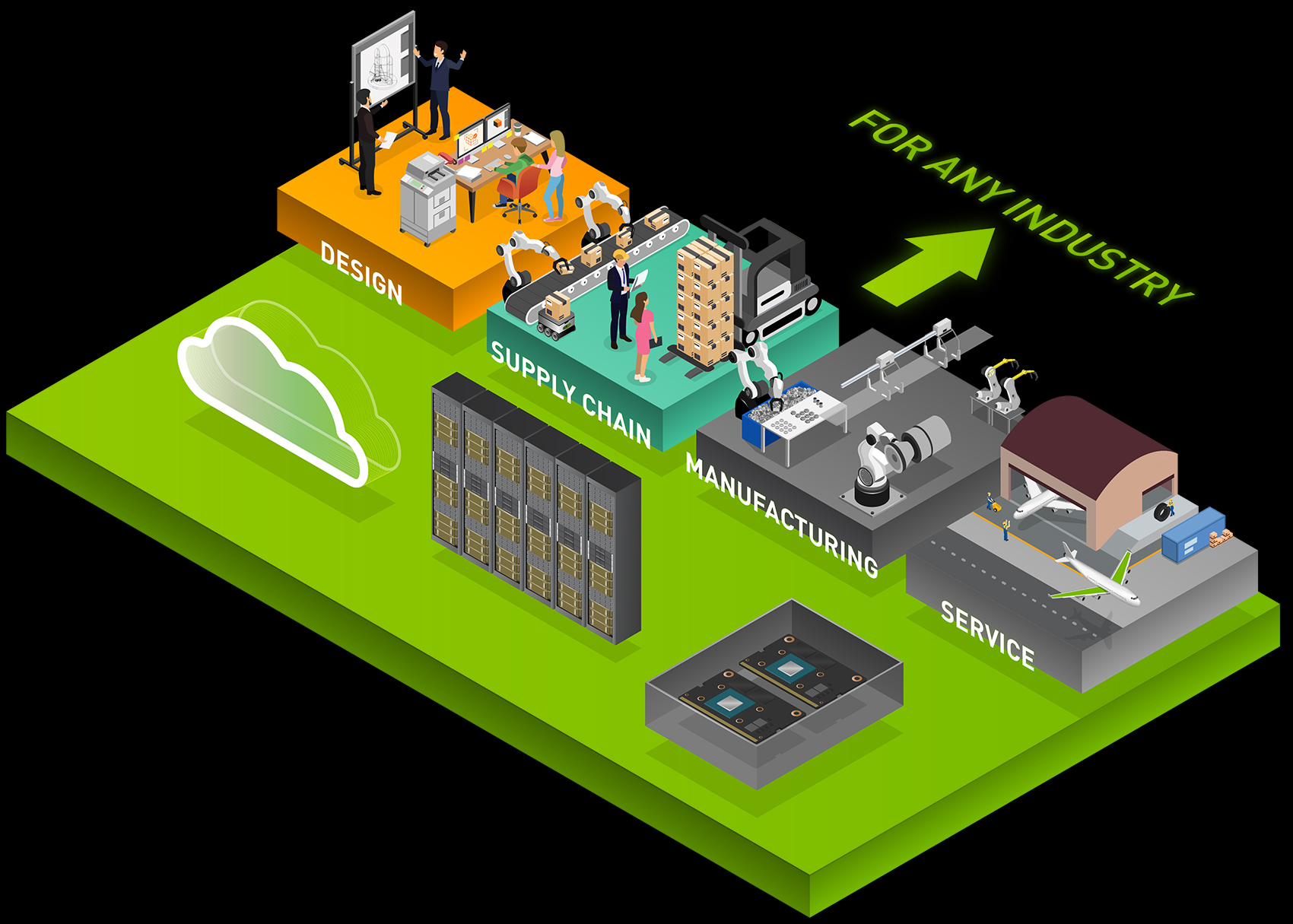
Nvidia is also a leader in the nascent industry of “Industrial Digitization” through its Omniverse platform. Omniverse is a computing platform that enables individuals and teams to develop Universal Scene Description (OpenUSD)-based 3D workflows.
Think of this as the “Industrial Metaverse.” Large companies like BMW use Nvidia Omniverse to create “digital twins” of their factories. Before a single physical brick is laid, every robot, conveyor belt, and human worker is simulated in a physics-accurate digital environment. This allows for optimization that was previously impossible, placing Nvidia firmly in the enterprise simulation and industrial software industry.
Future Horizons: Robotics and Autonomous Systems
The final piece of the puzzle in identifying Nvidia’s industry is their work in “Physical AI.” This refers to AI that interacts with the real world—specifically robotics and autonomous vehicles.
The Edge Computing Revolution
While much of the AI hype focuses on chatbots in the cloud, the next frontier is “Edge AI.” This is where AI happens on the device itself, whether that’s a self-driving car, a delivery drone, or a robotic arm on a factory floor.
Nvidia’s DRIVE platform is a full-stack solution for the automotive industry. It includes everything from the chips inside the car to the cloud-based simulation software used to train the driving algorithms. Major automakers are essentially outsourcing the “brain” of their future vehicles to Nvidia. Similarly, their Isaac platform provides the foundation for the next generation of autonomous mobile robots (AMRs).
Conclusion: The Accelerated Computing Industry
If we must put Nvidia in a box, that box is Accelerated Computing. They are the company that solved the problem of how to keep computing power growing after the traditional CPU reached its limits.
By combining cutting-edge semiconductor design with an unassailable software moat and a deep focus on the specific mathematical needs of artificial intelligence, Nvidia has transcended the “hardware” label. They are the infrastructure layer for the 21st century. Whether it is a researcher curing a disease with generative biology, a gamer playing a hyper-realistic simulation, or a corporation building a digital twin of its global logistics, they are all operating within the ecosystem that Nvidia built. Nvidia isn’t just in an industry; it is the engine powering the modernization of every other industry on the planet.
aViewFromTheCave is a participant in the Amazon Services LLC Associates Program, an affiliate advertising program designed to provide a means for sites to earn advertising fees by advertising and linking to Amazon.com. Amazon, the Amazon logo, AmazonSupply, and the AmazonSupply logo are trademarks of Amazon.com, Inc. or its affiliates. As an Amazon Associate we earn affiliate commissions from qualifying purchases.