
When examining the impact of the Trump administration’s policies on the Black community, the conversation is most tangibly measured through the lens of “Money.” From macroeconomic indicators like unemployment rates to granular legislative changes affecting Historically Black Colleges and Universities (HBCUs) and distressed urban corridors, the financial landscape for Black Americans underwent significant shifts between 2017 and 2021. To understand the “what,” one must look at the flow of capital, tax structures, and the institutional support systems designed to foster Black entrepreneurship and wealth preservation.
The Architecture of Opportunity: Understanding Opportunity Zones and Community Investment
One of the most significant financial pillars associated with the Trump administration was the creation of “Opportunity Zones” via the Tax Cuts and Jobs Act of 2017. This policy was designed to incentivize long-term private investment in low-income urban and rural communities across the United States. For the Black community, which often resides in zip codes historically starved of capital, this represented a fundamental shift in how community development was funded.
Tax Incentives and the Flow of Capital
The core mechanism of Opportunity Zones was the deferral and reduction of capital gains taxes. By reinvesting realized capital gains into “Qualified Opportunity Funds,” investors could potentially eliminate taxes on any appreciation of those new investments held for at least ten years. This was not a traditional government grant program; it was a market-based strategy intended to move trillions of dollars in “unrealized” gains into neighborhoods that needed it most. For Black entrepreneurs and real estate developers, this meant a new pool of venture capital and equity investment became available for projects ranging from affordable housing to tech incubators.
Long-term Wealth Building vs. Short-term Gains
The efficacy of Opportunity Zones is often debated through the lens of gentrification, but from a purely financial strategy standpoint, it provided a framework for localized wealth building. By encouraging investors to keep their money in a community for a decade, the policy aimed to move away from “flip-and-run” real estate tactics toward sustainable business growth. For Black business owners within these zones, the influx of capital theoretically increased property values and consumer traffic, creating a “multiplier effect” within the local micro-economy.
Strengthening the Foundation: Financial Support for HBCUs and Educational Infrastructure
Education is the primary driver of socio-economic mobility, and for the Black community, Historically Black Colleges and Universities (HBCUs) are the engines of the middle class. The financial stability of these institutions was a major focal point, culminating in legislative actions that moved beyond symbolic support into permanent fiscal security.
The FUTURE Act and Permanent Funding
In 2019, the Fostering Undergraduate Talent by Unlocking Resources for Education (FUTURE) Act was signed into law. This was a landmark moment for the business of education. Previously, HBCUs had to lobby Congress annually for a $255 million pot of federal funding, leading to budgetary uncertainty and long-term planning difficulties. The FUTURE Act made this funding permanent. From a financial management perspective, this allowed HBCU administrators to issue bonds, plan multi-year capital improvements, and invest in high-tech laboratories without the looming threat of a “fiscal cliff.”
The Link Between Education and Economic Mobility
Beyond direct institutional funding, the administration oversaw the forgiveness of debts for several HBCUs following natural disasters and increased the maximum Pell Grant awards. These moves directly impacted the personal finances of Black students. By lowering the debt burden on both the institution and the individual, these policies aimed to ensure that more Black graduates entered the workforce with higher net worths and the ability to invest in homes or startups earlier in their careers.
Labor Market Dynamics: Black Unemployment and Wage Growth Trends
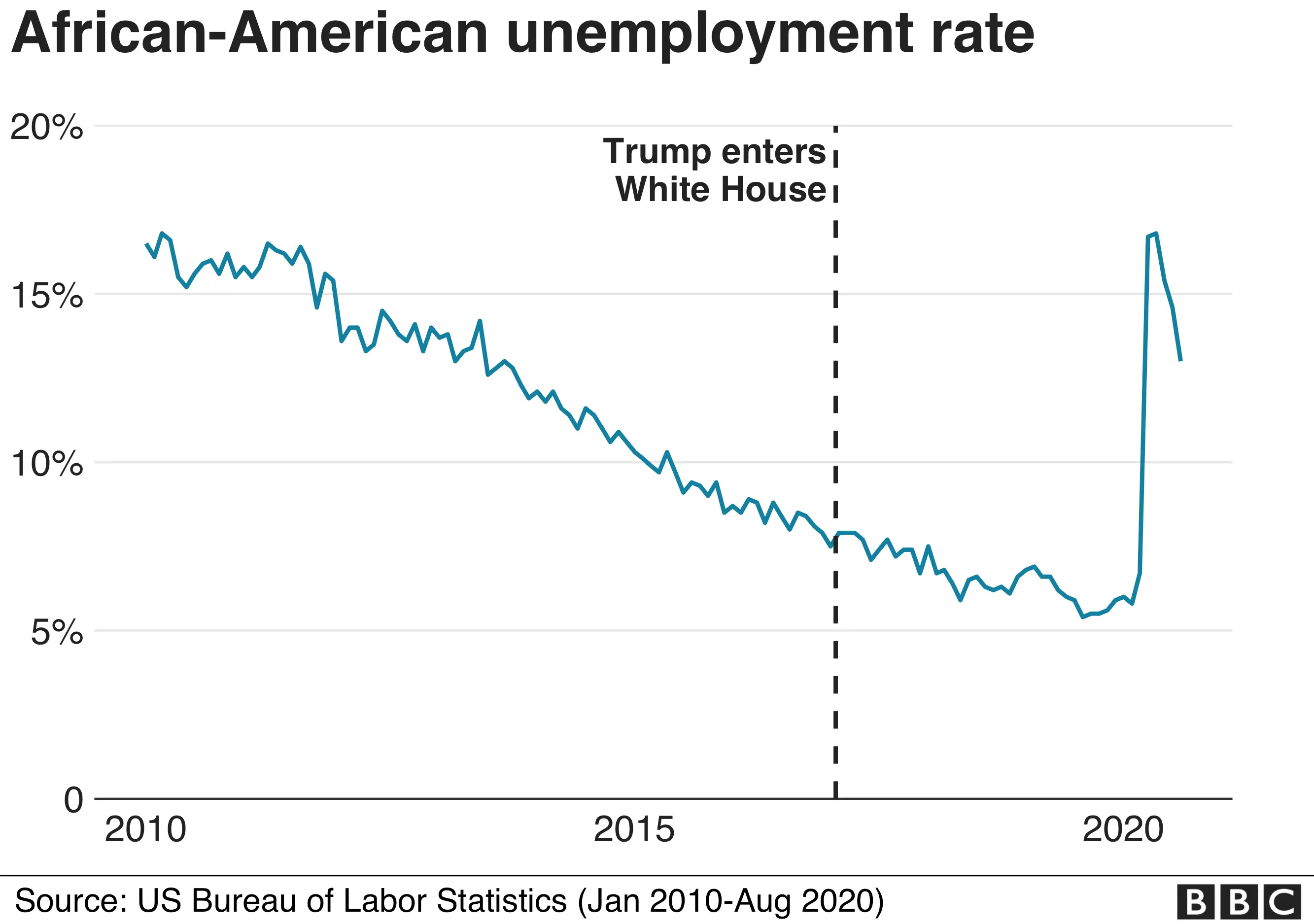
For the average household, “what was done” is most visible in the monthly paycheck. During the Trump administration, the Black labor market hit several statistical milestones that had a direct impact on household liquidity and personal finance.
Reaching Historic Lows: The 2019 Data
In September 2019, the Black unemployment rate dropped to 5.4%, the lowest level recorded since the Department of Labor began tracking the statistic in 1972. While economists debate how much of this was a continuation of previous trends versus new policy, the result was an undeniable increase in the number of Black Americans with a steady income. Full employment is the most effective tool for increasing the bargaining power of workers. As the labor market tightened, firms were forced to compete for talent, which led to significant wage growth for the bottom quartile of earners—a demographic where Black workers are disproportionately represented.
Closing the Wealth Gap? A Structural Analysis
While the unemployment rate hit record lows, the broader conversation in “Money” focuses on the racial wealth gap. The Trump-era economy saw a rise in Black homeownership rates and a surge in the value of 401(k) portfolios due to a booming stock market. However, the structural gap remains a challenge. The administration’s focus was primarily on “rising tide” economics—the idea that deregulation and corporate tax cuts would create a robust enough environment that all boats, including those in the Black community, would rise. This approach prioritized cash flow and job availability over direct wealth redistribution.
Criminal Justice Reform as an Economic Lever: The First Step Act
While often discussed as a social or legal issue, criminal justice reform is profoundly tied to personal and community finance. The First Step Act, signed in 2018, had clear economic implications for Black families and the broader economy.
Reducing the Financial Burden of Mass Incarceration
Mass incarceration has been a significant drain on Black wealth for decades, not only through lost wages but through the high costs of legal fees, communication with incarcerated loved ones, and the “re-entry tax” faced by those with records. By shortening mandatory minimum sentences for non-violent drug offenses and addressing the disparity between crack and powder cocaine sentencing, the First Step Act allowed thousands of individuals to return to the workforce sooner. This effectively returned “human capital” to the community, allowing families to move from a state of financial drain to one of productivity.
Workforce Re-entry and Entrepreneurial Opportunities
A key component of the First Step Act was the focus on vocational training and rehabilitation. From a business finance perspective, this was an investment in the labor pool. By equipping returning citizens with marketable skills, the policy aimed to reduce recidivism—which is a massive taxpayer burden—and instead create new taxpayers. Many formerly incarcerated Black men and women have since utilized small business grants and specialized “second-chance” hiring programs to launch enterprises, contributing to the growth of the Black entrepreneurial ecosystem.
Small Business and Entrepreneurship: The Role of Deregulation and Tax Policy
The Trump administration’s economic philosophy was rooted in the idea that the government should get out of the way of the entrepreneur. For the Black community, which has the fastest-growing rate of female entrepreneurs, these macro policies had localized effects.
The Tax Cuts and Jobs Act (TCJA) and Minority-Owned Firms
The TCJA reduced the corporate tax rate from 35% to 21%, but more importantly for Black small business owners, it created a 20% deduction for “pass-through” business income. Since the vast majority of Black-owned businesses are structured as sole proprietorships or LLCs, this was a direct “Money” win. It allowed owners to keep more of their profits to reinvest in equipment, hiring, or marketing. By increasing the after-tax return on investment, the policy sought to make Black entrepreneurship a more viable path to middle-class stability.
Access to Capital and the Minority Business Development Agency
The administration also focused on the Minority Business Development Agency (MBDA), which saw record levels of capital being steered toward minority-owned firms. By facilitating partnerships between Black-owned businesses and larger corporate entities, the administration aimed to solve the “access to capital” problem that has long plagued Black entrepreneurs. Financial tools, such as the New Markets Tax Credit, were also utilized to ensure that business financing was available even in areas where traditional banks were hesitant to lend.
In conclusion, the impact of the Trump administration on the Black community through the lens of “Money” was characterized by a preference for market-based solutions, institutional funding for education, and aggressive labor market expansion. While the long-term effects on the racial wealth gap continue to be analyzed by financial experts, the era was marked by a shift toward treating the Black community not just as a voting bloc, but as an integral economic engine capable of growth when provided with the right fiscal incentives and capital structures.
aViewFromTheCave is a participant in the Amazon Services LLC Associates Program, an affiliate advertising program designed to provide a means for sites to earn advertising fees by advertising and linking to Amazon.com. Amazon, the Amazon logo, AmazonSupply, and the AmazonSupply logo are trademarks of Amazon.com, Inc. or its affiliates. As an Amazon Associate we earn affiliate commissions from qualifying purchases.