
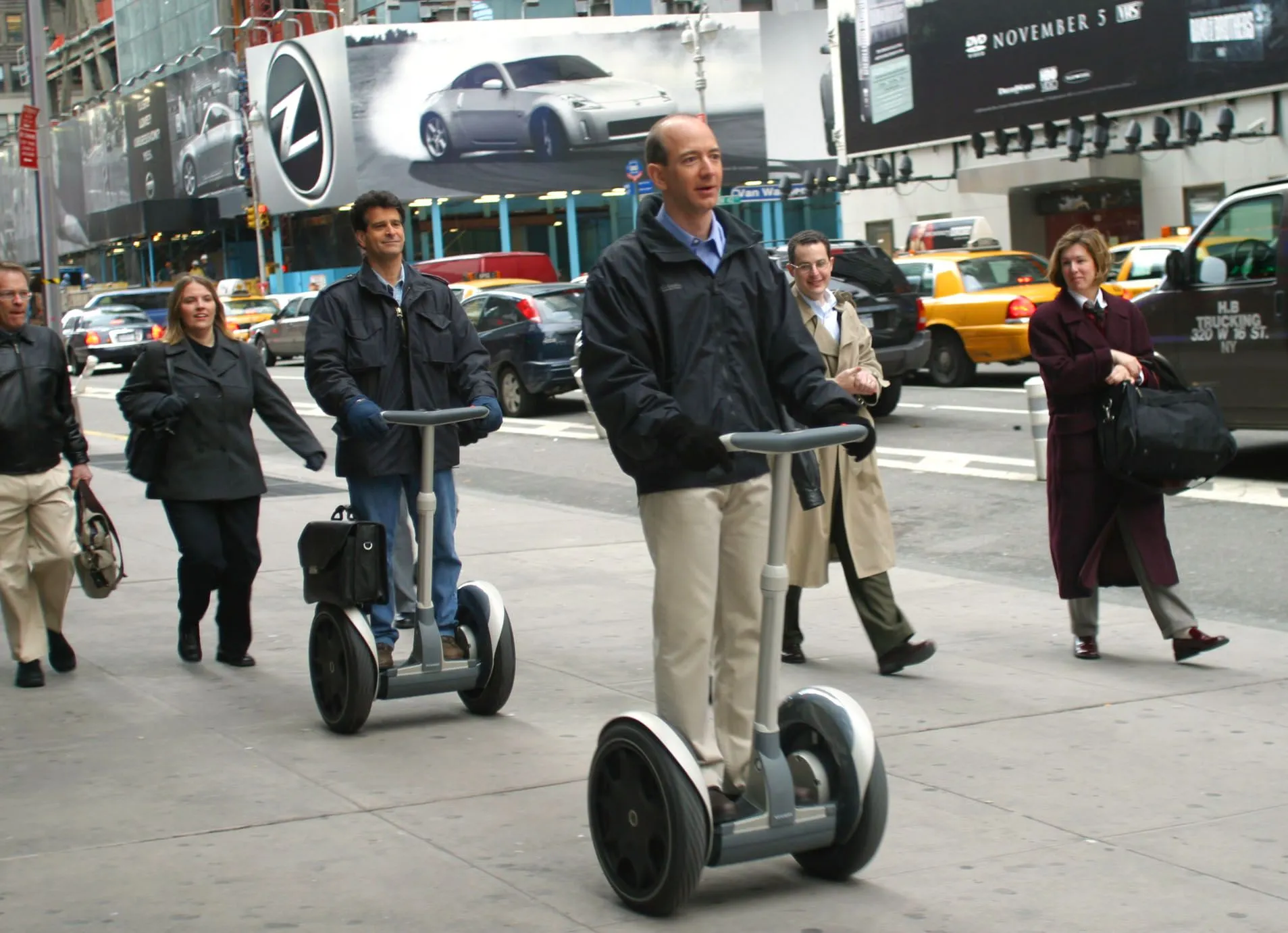
In the early 2000s, the tech world was buzzing with a secret project codenamed “Ginger.” Visionaries like Steve Jobs and Jeff Bezos had seen it, with Jobs famously claiming it would be “as big as the PC.” When Dean Kamen finally unveiled the Segway Personal Transporter (PT) in 2001, it was presented not just as a gadget, but as a technological revolution that would redesign cities and eliminate the need for cars in urban environments.
Yet, two decades later, the original self-balancing upright scooter has been discontinued, and the brand name is more commonly seen on the floorboards of shared electric kick-scooters or delivery robots. To understand what happened to Segway, one must look past the marketing hype and examine the technological trajectory of personal mobility—from a complex engineering marvel to a streamlined, software-driven ecosystem.

The Engineering Marvel: How the Segway PT Redefined Motion
At its core, the Segway PT was a masterpiece of control theory and mechanical engineering. Before the Segway, personal transport was largely mechanical; you pushed a pedal or turned a throttle. The Segway introduced the world to “Dynamic Stabilization,” a technology that attempted to mimic human equilibrium.
The Gyroscopic Core: Dynamic Stabilization Explained
The genius of the Segway lay in its ability to maintain upright balance on a single axle. This was achieved through a sophisticated array of five solid-state angular rate sensors (gyroscopes) and two tilt sensors. These sensors monitored the center of gravity 100 times per second.
When a rider leaned forward, the system detected the shift and told the high-torque electric motors to spin the wheels forward at the exact speed necessary to keep the platform under the rider. This “drive-by-wire” system eliminated traditional brakes and accelerators, creating a seamless interface between human intent and machine movement. From a tech standpoint, it was one of the first successful consumer applications of complex robotic stabilization.
The Redundancy Systems: Safety Through Complexity
Because the Segway relied entirely on electronics to keep the rider from falling face-first, the engineering team implemented unprecedented levels of redundancy. The device featured dual batteries, dual flight-control-grade circuit boards, and even dual windings in the motors. If one system failed, the second would take over long enough to bring the rider to a safe stop.
This level of “fail-safe” engineering was closer to aerospace technology than consumer electronics. While this made the Segway incredibly safe and robust, it also contributed to its high entry price—approximately $5,000 at launch—and a weight of nearly 100 pounds, which ultimately limited its adoption as a portable tech gadget.
The Technological Friction: Why the Revolution Stalled
Despite the brilliance of its stabilization tech, the Segway PT faced “technological friction”—a mismatch between the hardware’s capabilities and the environment it was designed to inhabit. The dream of the Segway as a “car-killer” hit a wall of infrastructure and regulatory hurdles that the technology wasn’t yet ready to solve.
Form Factor vs. Infrastructure
Technologically, the Segway PT was a “tweener.” It was too fast and bulky for the sidewalk, yet too slow and vulnerable for the road. In the tech world, product-market fit is often determined by how well a device integrates into existing workflows. The Segway required its own niche in the urban landscape that simply didn’t exist.
Furthermore, the “human-machine interface” (HMI) of the Segway, while intuitive once learned, had a steep psychological curve. Users felt conspicuous. The tech was “too visible,” drawing attention to the rider in a way that felt socially awkward rather than futuristic. This lack of “social integration” is a common hurdle for disruptive hardware, a lesson later learned by developers of products like Google Glass.
The Weight and Energy Density Constraint
In 2001, battery technology was not where it is today. The Segway originally launched using Nickel Metal Hydride (NiMH) batteries before eventually transitioning to Lithium-ion. The energy density required to power two high-torque motors while simultaneously running the stabilization processors meant the device had to be heavy.
This weight created a mobility paradox: the device intended to help you move was difficult to move if the battery died or if you encountered a flight of stairs. In the tech evolution timeline, the Segway PT was a precursor to the “last-mile” solution, but it lacked the portability that defines modern micro-mobility.
The Pivot to Micro-Mobility: From Self-Balancing to Shared Tech
The “demise” of the original Segway PT in 2020 wasn’t an end, but rather a final pivot. In 2015, Segway was acquired by Ninebot, a Chinese robotics and transportation startup. This acquisition marked a fundamental shift in the brand’s technological philosophy: moving from high-cost, self-balancing marvels to high-volume, cost-effective electric scooters.
Ninebot and the Standardization of the E-Scooter
The tech world realized that for personal mobility to scale, it didn’t need to balance on two wheels using expensive gyroscopes; it could use three or four wheels, or simply two wheels in a tandem (scooter) configuration that stayed upright with a kickstand.
Ninebot leveraged the Segway brand and patents to become the primary hardware provider for the global “scooter revolution.” When companies like Bird and Lime launched their shared-scooter platforms, the vast majority of the “tech under the hood” was engineered by Segway-Ninebot. By simplifying the technology—removing the complex self-balancing requirement—they were able to drop the price from $5,000 to $500, making the tech accessible to the masses.
Software and Connectivity in Modern Light Electric Vehicles (LEVs)
The modern iteration of Segway tech is heavily focused on software integration. Today’s Segway-Ninebot products are “Internet of Things” (IoT) devices. They feature Bluetooth connectivity, over-the-air (OTA) firmware updates, and sophisticated Battery Management Systems (BMS) that can be monitored via smartphone apps.
This transition represents the broader trend in tech: the commoditization of hardware and the prioritization of the software ecosystem. A modern Segway scooter isn’t just a vehicle; it’s a connected terminal that tracks mileage, optimizes power consumption, and provides anti-theft geofencing.
Robotics and the Future: Segway’s Legacy in Autonomous Systems
While the upright PT is gone, the DNA of that original self-balancing technology lives on in the burgeoning field of service robotics. Segway-Ninebot has effectively transitioned from a “transportation company” to a “robotics company.”
The Loomo Project and AI Integration
One of the most significant developments in the post-PT era was the introduction of Segway Loomo. This device is essentially a Segway that doubles as a sidekick robot. Using Intel RealSense cameras and AI-driven computer vision, Loomo can follow its owner, record video, and interact with users via voice recognition.
This represents the ultimate realization of Dean Kamen’s vision. The self-balancing platform is no longer just a way to move a person; it is a mobile base for Artificial Intelligence. The tech that once helped a human stay upright is now used to help a robot navigate a crowded sidewalk autonomously.
Off-Road and Specialized Utility Tech
Beyond the urban sidewalk, Segway has applied its electric drivetrain expertise to the Powersports market. By developing all-electric UTVs (Utility Terrain Vehicles) and ATVs, the company is pushing the boundaries of high-performance electric motors and thermal management.
These vehicles utilize “Smart Moving” technology, which allows for remote control and data syncing through a specialized app. This allows operators to monitor engine performance, fuel/battery levels, and safety alerts in real-time. It is a far cry from the original 2001 scooter, but it utilizes the same core principles of electric efficiency and electronic control that the Segway PT pioneered.

Conclusion: A Legacy of Innovation
What happened to Segway is a classic tale of technological evolution. The original product was a “solution in search of a problem,” perhaps too advanced and too expensive for its time. However, the technology it pioneered—brushless DC motors, advanced gyroscopic stabilization, and redundant electronic systems—laid the groundwork for the modern micro-mobility industry.
Segway didn’t fail; it evolved. It moved from a singular, bulky piece of hardware to a diversified ecosystem of scooters, go-karts, and autonomous robots. In the tech industry, success isn’t always about the survival of the first iteration; it’s about the survival and adaptation of the ideas. Today, as we see thousands of electric scooters zipping through city streets, we are witnessing the ghost of the original Segway, reimagined for a world that finally caught up to its vision.
aViewFromTheCave is a participant in the Amazon Services LLC Associates Program, an affiliate advertising program designed to provide a means for sites to earn advertising fees by advertising and linking to Amazon.com. Amazon, the Amazon logo, AmazonSupply, and the AmazonSupply logo are trademarks of Amazon.com, Inc. or its affiliates. As an Amazon Associate we earn affiliate commissions from qualifying purchases.