
When audiences sat down in theaters in May 1999 for the release of Star Wars: Episode I – The Phantom Menace, they were prepared for a cinematic revolution. While the film’s narrative choices and dialogue would remain subjects of heated debate for decades, one figure stood at the center of a technical firestorm: Jar Jar Binks. Often dismissed as a creative misstep, the character of Jar Jar represents one of the most significant milestones in the history of digital technology, software engineering, and visual effects.
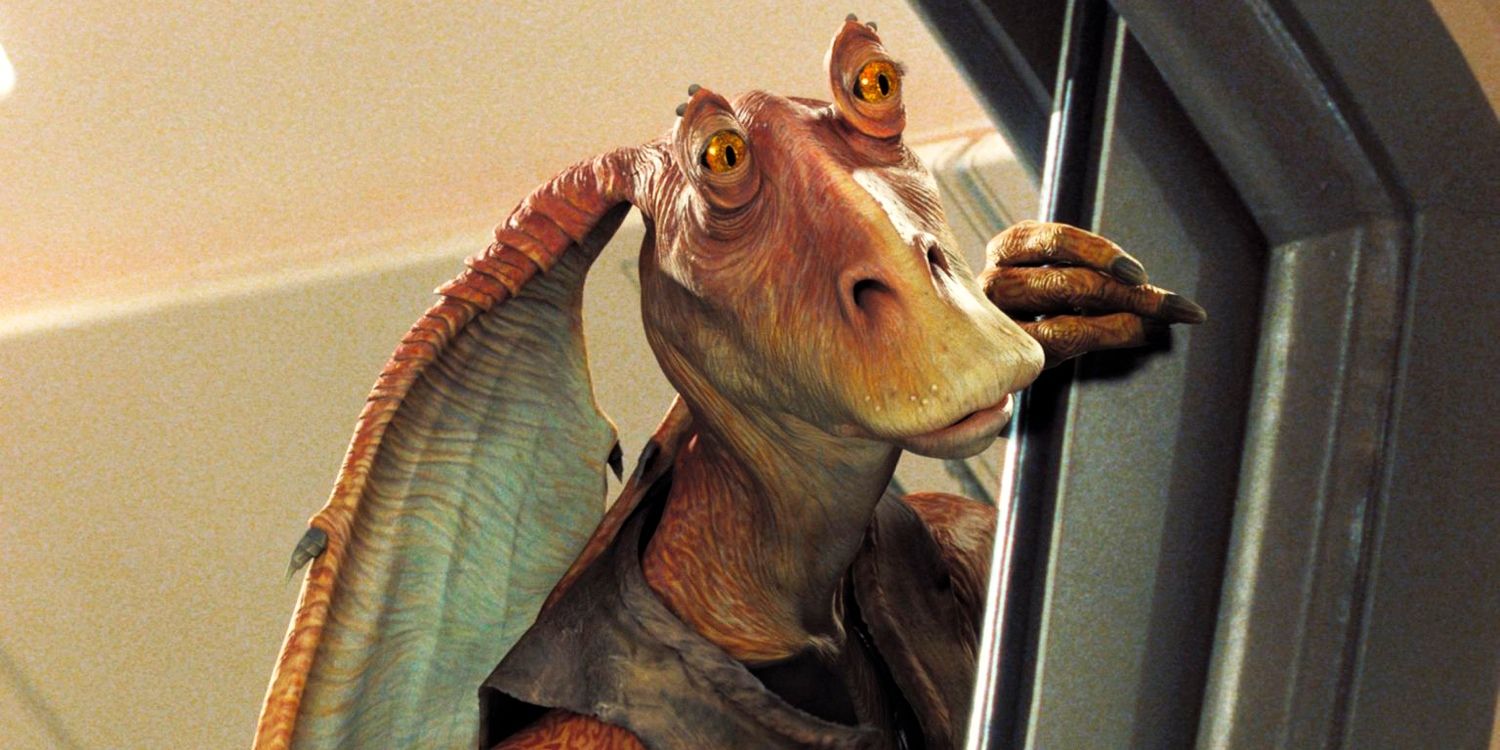
To understand “what happened” to Jar Jar, one must look past the floppy ears and the polarizing vernacular to examine the underlying code and the pioneering hardware that brought him to life. Jar Jar was not just a character; he was a proof-of-concept for the future of digital humans and performance capture.
The Birth of a Digital Pariah: Jar Jar and the Dawn of Full-CGI Characters
Before 1999, digital characters in cinema were largely limited to non-humanoid creatures, background elements, or brief sequences. We had seen the liquid metal of the T-1000 in Terminator 2 and the majestic dinosaurs of Jurassic Park, but the industry had yet to produce a fully realized, computer-generated (CGI) lead character that interacted seamlessly with live-action actors for the duration of a feature film.
Breaking the Practical Barrier
The technical ambition behind Jar Jar was to move beyond the limitations of “man-in-a-suit” prosthetics. Practical effects, while tactile, limited the range of motion and the physics of character design. George Lucas and his team at Industrial Light & Magic (ILM) wanted a character whose anatomy defied physical puppetry—a creature with long, slender limbs and ears that reacted to wind and momentum with a fluidity that latex could not replicate. This necessitated a shift from mechanical engineering to software engineering.
The Industrial Light & Magic (ILM) Breakthrough
The development of Jar Jar forced ILM to rewrite their technical playbook. They had to develop new ways to handle “match-moving”—the process of tracking the camera’s movement in a live-action shot so that the digital character could be placed into the 3D space with pixel-perfect accuracy. What happened to Jar Jar in the development phase was a rigorous baptism by fire for ILM’s proprietary software, “Cary,” and their animation tools, which had to be scaled to handle thousands of frames of high-resolution digital skin and cloth simulation.
The Tech Behind the Gungan: Motion Capture and Digital Synthesis
The most significant technical contribution of Jar Jar Binks lies in the evolution of performance capture. While modern audiences are used to seeing actors in grey suits covered in reflective pips, the technology was in its infancy during the late 90s. Jar Jar was the bridge between traditional animation and the modern “mo-cap” era.
Ahmed Best and the Foundations of Performance Capture
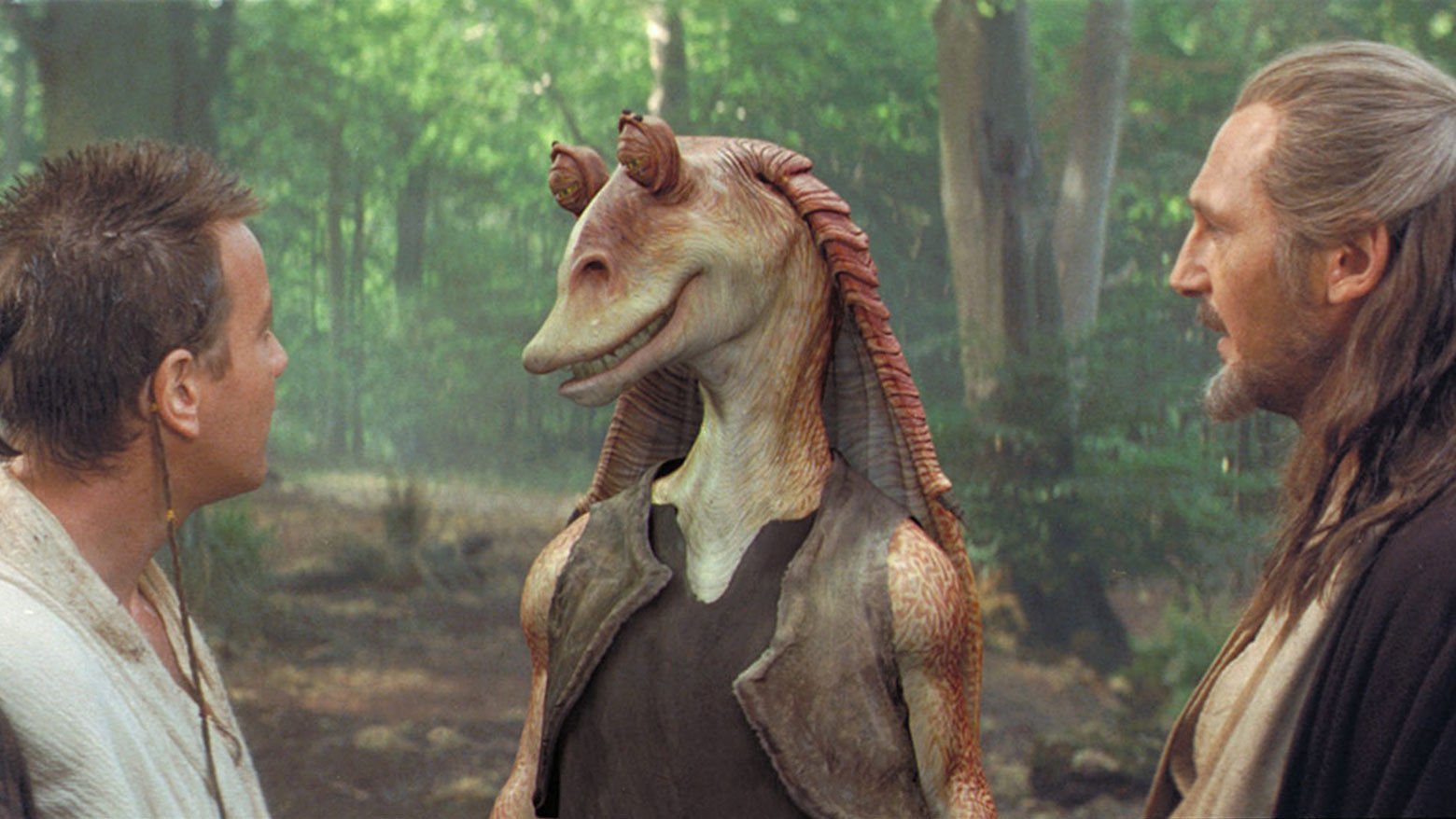
Actor Ahmed Best did not merely provide the voice; he was on set for almost every scene, wearing a partial prosthetic suit to give the other actors a physical reference point. However, the technical challenge was translating Best’s physical performance into the digital Gungan skeleton.
In 1997 and 1998, the software lacked the automated “retargeting” capabilities we see in modern game engines like Unreal Engine 5. Animators had to manually “rotomate”—a process of hand-animating the digital character over the live-action footage of Ahmed Best—to ensure the weight, eye-lines, and interactions were realistic. This hybrid approach laid the groundwork for the more advanced motion capture systems that would later be used for characters like Gollum in The Lord of the Rings.
Overcoming the “Uncanny Valley” in 1999
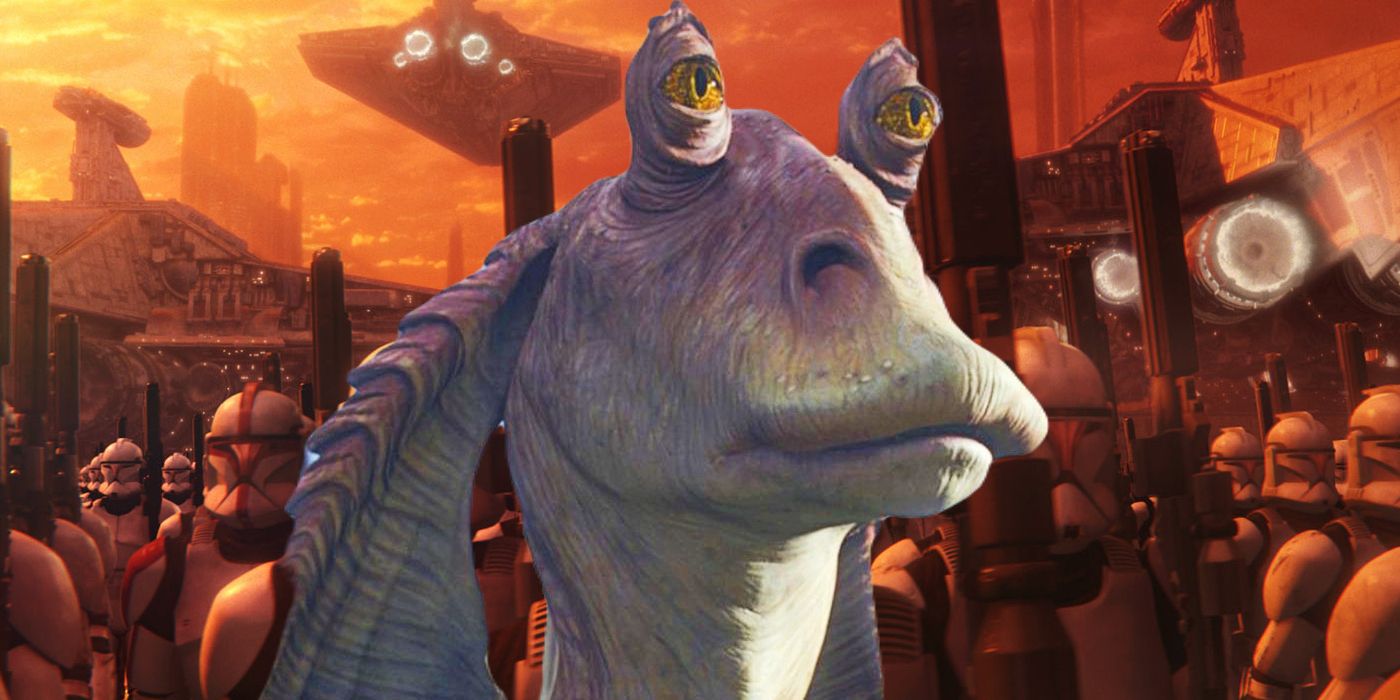
One of the primary technical hurdles was the “Uncanny Valley”—the point at which a digital representation of a living being looks almost real but “off” enough to cause revulsion in the viewer. To combat this, ILM developed sophisticated shaders to mimic the way light penetrates skin (subsurface scattering) and how moisture glints off eyes. While Jar Jar’s stylized design helped him avoid the worst of the uncanny valley, the technical solutions developed to manage his skin textures and the “soft-body” physics of his ears were revolutionary for the time.
The Evolution of CGI Character Integration After Jar Jar
If we ask what happened to the technology that created Jar Jar, the answer is that it evolved into the backbone of modern blockbusters. The “Jar Jar workflow” became the industry standard, refined and optimized by every subsequent VFX-heavy production.
Refining Interaction with Physical Sets
One of the most difficult tasks in 1999 was making a digital character look like they were actually touching the physical world. When Jar Jar sat in a chair or waded through water, the digital team had to simulate the displacement of weight and fluids. This led to the development of more robust physics engines. Today, the seamless interaction between digital characters and real-world environments in films like Avatar or Guardians of the Galaxy is a direct descendant of the “interaction R&D” performed for The Phantom Menace.
From Jar Jar to Gollum: The Technical Hand-off
Technologically, Jar Jar is the father of Gollum, Caesar from Planet of the Apes, and Thanos. Each of these characters took the “actor-on-set” methodology pioneered by Ahmed Best and ILM and pushed it further into the realm of data-driven performance. The industry learned from Jar Jar’s technical successes (fluidity and lighting) and his aesthetic failures (character design and tone). By the time Andy Serkis took on the role of Gollum in 2001, the software had evolved to allow for real-time motion tracking, but the conceptual blueprint remained the one established by the Gungan.
Digital Archaeology: Why Jar Jar’s Code Matters Today
In the world of technology, Jar Jar Binks is a specimen of “digital archaeology.” The files and assets created for him represent a specific era of computing power and software philosophy.
Legacy Software and Modern Rendering Engines
The rendering power required for Jar Jar was immense for its time. In 1999, rendering a single frame of a complex CGI character could take hours. Today, mobile devices have more processing power than the entire render farm used for Episode I. However, the algorithms developed for Jar Jar’s movement—specifically how his joints moved and how his “skin” stretched over a digital skeleton—are still referenced in the development of modern character rigs.
Technicians today look back at the Jar Jar files to understand how to optimize “envelope deformation”—the way a character’s surface changes when they move. The Gungan was one of the first characters to utilize a complex multi-layered rig, featuring a skeleton, a muscle layer, and a skin layer, a hierarchy that remains the gold standard in high-end VFX.
AI and the Future of Re-creating Legacy Characters
As we move into the era of Artificial Intelligence and deep-learning-based rendering, what happened to Jar Jar is taking on a new dimension. Researchers are using legacy footage of characters like Jar Jar to train neural networks in understanding non-humanoid movement. Because Jar Jar has a consistent, high-quality digital “truth” (the original CGI files) and a corresponding physical “truth” (Ahmed Best’s on-set performance), he serves as a perfect data set for training AI to translate human movement into stylized character animation.
Conclusion: A Technical Triumph Masked by Narrative Failure
To the average moviegoer, Jar Jar Binks is a punchline or a symbol of creative excess. But to the technologist, he is a pioneer. What happened to Jar Jar was not a disappearance into obscurity, but an assimilation into the very fabric of modern filmmaking.
The software breakthroughs necessitated by his existence—from advanced match-moving and subsurface scattering to the very concept of performance capture—now power everything from the Marvel Cinematic Universe to the latest AAA video games. Jar Jar Binks was the sacrificial lamb of the digital revolution; he bore the brunt of the public’s resistance to “all-CGI” characters so that the technology could mature.
Ultimately, the technical legacy of Jar Jar is one of undisputed success. He proved that a digital character could carry a narrative load, interact with a physical environment, and evoke a visceral reaction from an audience. While his personality remains a point of contention, his code remains a masterclass in the evolution of digital artistry. In the history of technology, Jar Jar Binks doesn’t represent a failure—he represents the moment the wall between the real and the virtual finally began to crumble.
aViewFromTheCave is a participant in the Amazon Services LLC Associates Program, an affiliate advertising program designed to provide a means for sites to earn advertising fees by advertising and linking to Amazon.com. Amazon, the Amazon logo, AmazonSupply, and the AmazonSupply logo are trademarks of Amazon.com, Inc. or its affiliates. As an Amazon Associate we earn affiliate commissions from qualifying purchases.