
The narrative of Yugoslavia is more than just a chapter in European history; it is a profound case study in the creation, maintenance, and ultimate catastrophic failure of a national brand identity. For decades, “Yugoslavia” stood as a unique geopolitical entity, a carefully constructed collective identity amidst deep-seated ethnic, religious, and cultural diversity. Its eventual violent unraveling offers stark lessons for any entity, be it a corporation or a nation, attempting to forge and sustain a unified identity from disparate parts.
This article explores the trajectory of Yugoslavia through a branding lens, examining how its initial brand was established, the internal and external pressures that eroded its equity, the dramatic crisis of its dissolution, and the subsequent rebranding efforts of its successor states.
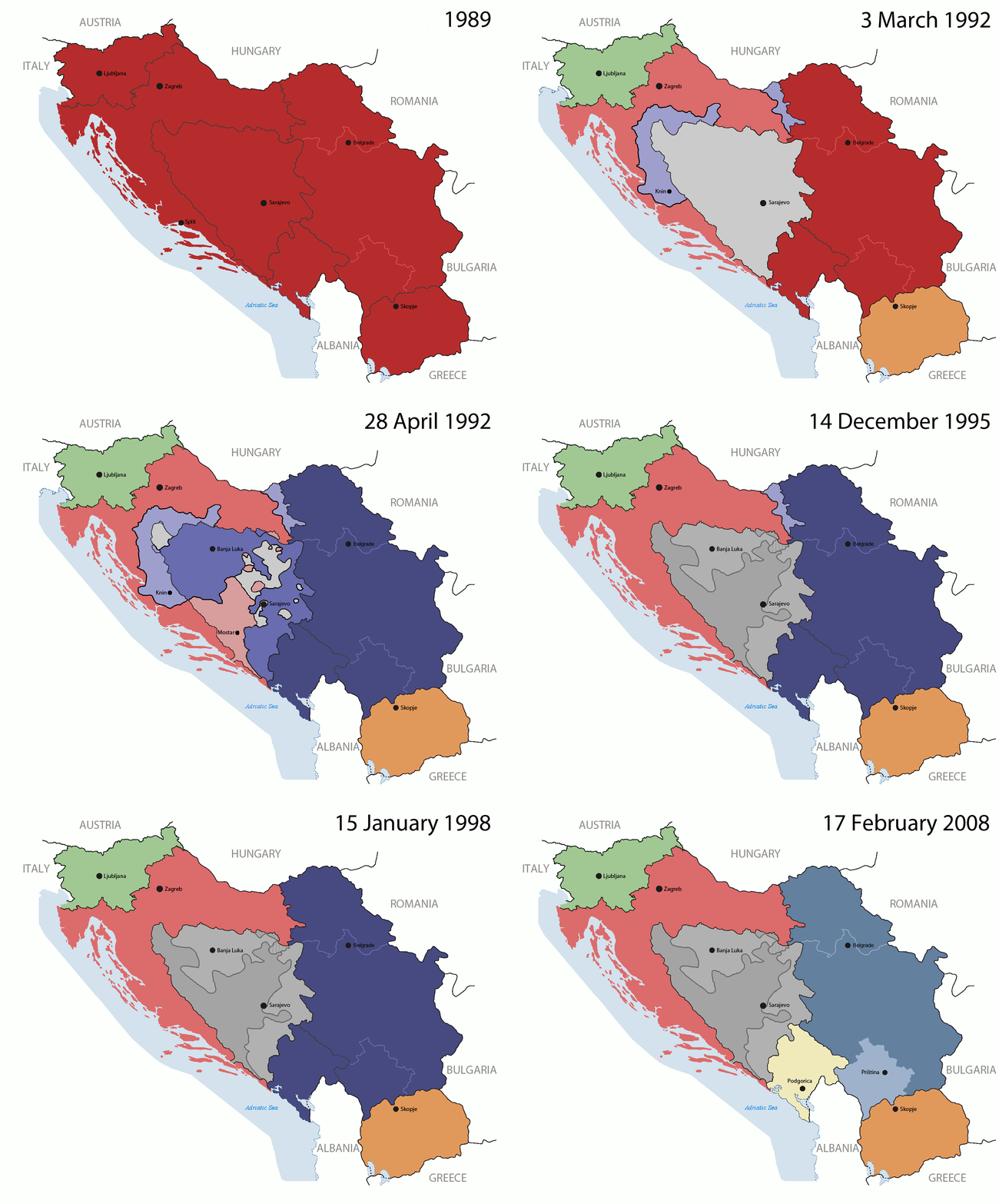
The Genesis of a Nation-Brand: Tito’s Yugoslavia
The concept of Yugoslavia – the “land of the South Slavs” – first emerged in the aftermath of World War I, but it was under the charismatic leadership of Josip Broz Tito following World War II that the “Yugoslavia” brand truly solidified into a distinct corporate identity on the global stage. Tito’s vision transcended mere political governance; it was a deliberate and sophisticated brand strategy designed to unite disparate peoples under a singular, compelling banner.
Forging the Brotherhood and Unity Brand Pillar
At the core of the Yugoslav brand was the powerful slogan and ideological pillar of “Brotherhood and Unity” (Bratstvo i jedinstvo). This was not merely a political slogan but a concerted marketing campaign aimed at overcoming centuries of ethnic and religious divides among Serbs, Croats, Slovenes, Macedonians, Montenegrins, and Bosniaks. Through education, propaganda, cultural policies, and the shared experience of resisting fascism, Tito’s regime actively promoted a pan-Yugoslav identity. This brand pillar was reinforced by a centralized federal structure, a socialist economic model, and a robust national defense that fostered a sense of collective purpose and mutual dependence. The brand promised stability, prosperity, and protection from external threats, effectively positioning Yugoslavia as a unique model of multi-ethnic coexistence.
Non-Alignment: Yugoslavia’s Unique Market Positioning
Beyond its internal identity, Yugoslavia crafted a distinctive external brand image through its leadership in the Non-Aligned Movement. During the Cold War, when the world was sharply divided into two ideological blocs, Tito masterfully positioned Yugoslavia as an independent third force, refusing allegiance to either NATO or the Warsaw Pact. This strategic market positioning gave Yugoslavia disproportionate influence on the international stage, enhancing its global brand equity. It projected an image of neutrality, moral authority, and a commitment to self-determination for developing nations. This unique selling proposition attracted foreign aid, fostered diplomatic ties, and instilled a sense of pride and distinctiveness among its citizens, reinforcing the idea that the “Yugoslav” brand offered a superior, more principled path.
The Architect of the Brand: Tito’s Personal Branding
Central to the success of the Yugoslav brand was the formidable personal branding of Josip Broz Tito himself. He was not just a political leader but the living embodiment of the Yugoslav ideal. His image, cultivated through omnipresent portraits, statues, and media narratives, symbolized strength, unity, and unwavering resolve. Tito’s personal charisma and his wartime heroics provided the foundational trust and credibility for the entire nation-brand. His meticulous management of internal ethnic dynamics, coupled with his international stature, made him an indispensable component of Yugoslavia’s corporate identity. He was the brand’s CEO, spokesperson, and primary guarantor of its stability, effectively masking underlying tensions beneath a veneer of unified leadership.
Cracks in the Brand Facade: Unraveling Unity
Despite Tito’s masterful brand management, the Yugoslav identity was always an artificial construct, continuously battling against historical grievances and nascent nationalist sentiments. As external conditions shifted and internal dynamics evolved, the initial brand equity began to erode, revealing the fragility beneath the surface.
Economic Strain and Regional Brand Divergence
While the socialist economic model initially delivered post-war reconstruction and some level of prosperity, it began to falter in the 1970s. High unemployment, inflation, and a growing national debt strained the federal system. Crucially, economic development was uneven, leading to significant disparities between the more industrialized northern republics (Slovenia, Croatia) and the less developed south (Serbia, Bosnia, Macedonia, Montenegro). This created regional “sub-brands” with increasingly divergent interests. Wealthier republics resented subsidizing poorer ones, fostering sentiments that they would fare better independently. This economic disparity became a critical fault line, fueling discontent and eroding the shared economic benefit that was a key part of the Yugoslav brand promise. The sense of collective prosperity, a vital brand differentiator, was slowly replaced by a perception of economic exploitation or burden, depending on the republic.
The Succession Crisis and Brand Leadership Vacuum
The most significant blow to the Yugoslav brand identity came with the inevitable: the aging and eventual death of its primary architect, Josip Broz Tito, in 1980. His passing created an unprecedented leadership vacuum, triggering a succession crisis that the decentralized federal system was ill-equipped to handle. Without Tito’s personal authority and unifying presence, the carefully cultivated “Brotherhood and Unity” mantra lost its most potent advocate and enforcer. The collective leadership that replaced him lacked the charisma, vision, and iron will to keep the disparate elements of the brand cohesive. This leadership vacuum allowed dormant nationalist narratives to resurface and gain traction, as there was no longer a single, authoritative voice to articulate and enforce the core brand values. The brand lost its guiding star, and its vision became fragmented.
Rise of Competing Narratives and Brand Fragmentation
The post-Tito era saw a dramatic resurgence of nationalistic rhetoric across the republics. Political entrepreneurs and media outlets began to actively dismantle the pan-Yugoslav identity by emphasizing historical grievances, cultural distinctiveness, and perceived injustices. In Serbia, figures like Slobodan Milošević capitalized on growing Serb nationalism, framing Serbs as victims and demanding a reassertion of Serbian dominance within the federation. Simultaneously, in Croatia and Slovenia, leaders advocated for greater autonomy, pushing for their own distinct national brands. These competing narratives directly challenged the core premise of the Yugoslav brand, transforming it from a unifying force into a contested space. The federal government, the official brand manager, became increasingly impotent, unable to counter the deluge of localized, ethnically charged rebranding efforts that were pulling the federation apart.
The Brand Crisis and Catastrophe: Wars of Dissolution
By the late 1980s and early 1990s, the internal and external pressures had mounted to an unbearable degree, pushing the Yugoslav brand past the point of no return. What followed was a brutal and tragic brand crisis that manifested as a series of violent conflicts.
Secession and the Erosion of the Core Identity

The decisive moment came when Slovenia and Croatia declared independence in 1991, followed by Macedonia and Bosnia and Herzegovina. These declarations were acts of ultimate brand repudiation—a rejection of the existing Yugoslav identity in favor of new, sovereign national brands. The federal government, now largely dominated by Serbian interests, refused to accept these secessions, perceiving them as a direct threat to the integrity of the “Yugoslav” brand, which it sought to preserve, albeit under a new, Serb-centric interpretation. This clash of brand visions, one seeking complete independence and the other attempting to retain a modified union, ignited the first of the Balkan Wars.
Violent Rebranding: Ethnic Cleansing and Conflict
The subsequent wars in Croatia, Bosnia, and Kosovo were not merely territorial disputes; they were brutal processes of forced rebranding. Ethnic cleansing, genocide, and mass displacement were abhorrent attempts to homogenize territories and create ethnically pure national identities. The violence aimed to erase the multi-ethnic legacy that was once the core promise of the Yugoslav brand, replacing it with a singular, often exclusionary, national narrative. Cities like Sarajevo, once symbols of multi-cultural coexistence (a key Yugoslav brand attribute), became battlegrounds where this forced rebranding was violently enacted. The “Yugoslav” identity, once a source of pride, became tainted by association with atrocities, further accelerating its repudiation.
International Intervention and Brand Dissolution
The international community’s response was slow and often uncoordinated, but eventually, military and diplomatic interventions (e.g., NATO bombing campaigns, UN peacekeeping efforts) underscored the complete dissolution of the Yugoslav brand. The Dayton Accords in 1995, followed by the Kosovo War in 1999, effectively sanctioned the creation of new nation-states, legally and geopolitically confirming the death of the multi-ethnic Yugoslavia. The brand was no longer just fractured; it was officially liquidated, replaced by a portfolio of distinct, often mutually hostile, national entities.
Rebranding and Identity Formation: The Successor States
In the wake of the dissolution, each newly independent state embarked on its own journey of national branding, attempting to forge a distinct identity in a post-Yugoslav landscape. This process has been complex, often fraught with challenges, and deeply influenced by the memory of the past.
Crafting New National Narratives and Symbols
Each successor state—Slovenia, Croatia, Bosnia and Herzegovina, Serbia, Montenegro, North Macedonia, and Kosovo—had to develop entirely new national brands. This involved designing new flags, anthems, currencies, and constitutional frameworks. More profoundly, it required crafting new national narratives that emphasized historical distinctiveness, cultural uniqueness, and often, a clear break from the Yugoslav past. For some, like Slovenia, the rebranding was relatively smooth, aligning with its Central European heritage. For others, particularly those directly impacted by conflict, the rebranding was a struggle, intertwining with trauma, victimhood, and unresolved historical disputes. The challenge was not just to create a new brand, but to differentiate it sharply from the perceived failures of the old, and often, from the brands of their immediate neighbors.
Economic Repositioning and European Integration
A key aspect of post-Yugoslav rebranding has been the economic repositioning of these new states. Many have sought to integrate into the European Union, viewing it as a pathway to stability, prosperity, and a new collective identity. EU membership (for Slovenia and Croatia) or candidacy represents a significant brand shift, moving away from a non-aligned, socialist past towards a modern, market-oriented European future. This required extensive reforms, aligning laws, regulations, and economic policies with EU standards, effectively adopting a new “corporate strategy” for national development. For others, like Serbia, the path has been more complex, balancing historical ties with Russia with aspirations for European integration, creating a nuanced and often contradictory national brand message.
Ongoing Brand Management and Regional Challenges
The rebranding process is far from complete, particularly in the Western Balkans. Issues such as unresolved border disputes, the legacy of war crimes, and persistent ethnic tensions continue to challenge the internal consistency and external perception of these new national brands. Bosnia and Herzegovina, for instance, remains a highly complex brand, struggling to maintain a unified identity amidst a decentralized political structure based on ethnic divisions. The region as a whole grapples with issues of democratic consolidation, corruption, and brain drain, which affect its overall “regional brand” in the eyes of international investors and partners. The shadow of Yugoslavia, while largely repudiated, continues to influence the branding efforts of its former components, reminding them of the fragility of constructed identities.
Lessons from a Failed Brand: The Geopolitical Implications
The collapse of Yugoslavia serves as a powerful cautionary tale, offering profound lessons applicable not only to political science but also to the intricate world of brand strategy and corporate identity.
The Peril of a Charisma-Dependent Brand
The Yugoslav brand was excessively dependent on the personal charisma and political will of Josip Broz Tito. While he was alive, his personal brand equity was sufficient to paper over the cracks. However, his death exposed the fundamental flaw: the absence of robust institutional structures and deeply internalized shared values that could sustain the brand independently. This highlights a critical lesson for any organization: a brand built solely on the cult of personality is inherently vulnerable. True brand resilience requires embedding core values within the organizational culture and structures, making them independent of any single leader.
The Importance of Inclusive Brand Messaging
“Brotherhood and Unity” was a compelling ideal, but in practice, it often failed to genuinely address and resolve deep-seated ethnic and religious grievances. When economic prosperity waned and leadership weakened, these suppressed identities resurfaced with devastating force. An effective brand must offer genuinely inclusive messaging that resonates with all stakeholders, not just superficially, but through equitable distribution of resources, respect for diverse identities, and mechanisms for conflict resolution. Failure to achieve true inclusivity inevitably leads to alienation and fragmentation, as competing internal “sub-brands” begin to prioritize their own interests over the collective.

The Cost of Brand Neglect and Conflict
The breakdown of the Yugoslav brand resulted in one of Europe’s most brutal conflicts since World War II, costing hundreds of thousands of lives, displacing millions, and causing incalculable economic damage. This starkly illustrates the catastrophic consequences of brand neglect, unresolved internal conflicts, and the failure to adapt a brand to changing environmental factors. For nations and corporations alike, proactive brand management, including continuous market research (listening to constituent voices), strategic communication, and adaptive leadership, is not merely a marketing exercise but a fundamental requirement for stability, prosperity, and survival.
In conclusion, the story of Yugoslavia is a compelling brand case study—a complex saga of identity creation, erosion, and violent dissolution. It underscores the immense power of a unifying vision and the devastating consequences when that vision loses its authenticity, its leadership, and its ability to genuinely connect with its diverse stakeholders. The legacy of Yugoslavia continues to shape the geopolitical landscape, offering enduring lessons on the fragile interplay between identity, power, and human aspirations.
aViewFromTheCave is a participant in the Amazon Services LLC Associates Program, an affiliate advertising program designed to provide a means for sites to earn advertising fees by advertising and linking to Amazon.com. Amazon, the Amazon logo, AmazonSupply, and the AmazonSupply logo are trademarks of Amazon.com, Inc. or its affiliates. As an Amazon Associate we earn affiliate commissions from qualifying purchases.