
Tax season is an annual ritual that can evoke a mix of emotions, from mild apprehension to outright dread. Yet, it’s an unavoidable aspect of financial life for most individuals and businesses. The complexity often stems not just from the calculations, but from understanding which specific forms are relevant to your unique financial situation. Navigating the labyrinth of IRS documents is crucial for accurate filing, ensuring compliance, and ultimately, optimizing your financial outcome. This guide aims to demystify the essential forms, helping you identify what you need to file taxes, whether you’re a salaried employee, a burgeoning entrepreneur, or a seasoned investor. Understanding these forms is not just about meeting a deadline; it’s about gaining control over your personal finance narrative.
The Foundation: Essential Forms for Individual Filers
For the vast majority of taxpayers, a core set of forms forms the bedrock of their annual tax return. These documents report your primary sources of income and often reflect basic deductions or contributions. Familiarizing yourself with these is the first step toward a confident tax filing experience.
The Ubiquitous W-2: Reporting Wages and Withholding
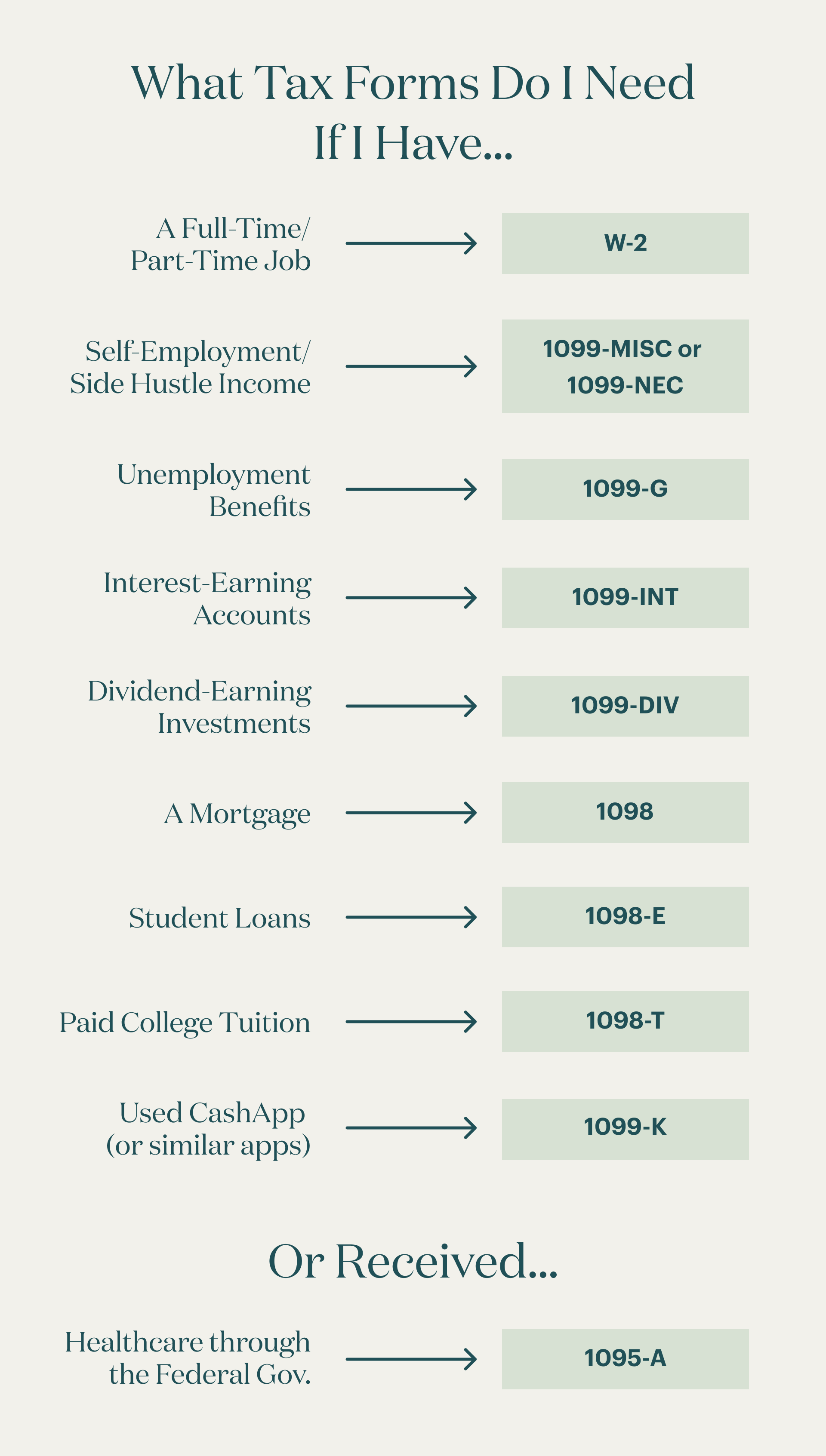
If you are an employee of a company, the Form W-2, Wage and Tax Statement, is arguably the most critical document you will receive. Your employer is legally obligated to send this form to you by January 31st each year. The W-2 summarizes your annual earnings, the federal, state, and local taxes withheld from your paychecks, and your contributions to Social Security and Medicare.
Box 1 of the W-2 shows your total taxable wages, tips, and other compensation. This is typically the starting point for your income calculation on your main tax form (Form 1040). Boxes 2, 4, and 6 detail the federal income tax, Social Security tax, and Medicare tax withheld, respectively. These amounts represent payments you’ve already made towards your annual tax liability, and they are crucial for determining whether you owe more taxes or are due a refund. Other boxes might show contributions to a 401(k) retirement plan (Box 12) or the cost of employer-sponsored health coverage (Box 12, DD code). Ensuring your W-2 is accurate and understanding each box’s significance is fundamental to correctly reporting your income.
Understanding 1099 Forms: Non-Employee Compensation and Other Income
Beyond the traditional W-2, a variety of Form 1099s exist to report income received from sources other than an employer. These forms are vital for those with diverse income streams, from freelance work to investment earnings.
- Form 1099-NEC (Nonemployee Compensation): This form replaced Form 1099-MISC for reporting non-employee compensation starting with the 2020 tax year. If you worked as an independent contractor, freelancer, or gig worker and received at least $600 from a single payer, you should receive a 1099-NEC. This income is typically reported on Schedule C (Profit or Loss from Business) and is subject to self-employment tax.
- Form 1099-MISC (Miscellaneous Information): While no longer used for non-employee compensation, this form still reports other types of income, such as rents, royalties, prizes, awards, or medical and health care payments from specific payees. If you rent out a property or receive royalty payments, this form will be essential.
- Form 1099-INT (Interest Income): Issued by banks and financial institutions, this form reports interest income of $10 or more.
- Form 1099-DIV (Dividends and Distributions): Investment firms issue this form to report dividends and other distributions (like capital gain distributions) from stocks and mutual funds.
- Form 1099-B (Proceeds From Broker and Barter Exchange Transactions): If you sold stocks, bonds, or other securities, your brokerage firm will send you a 1099-B detailing the proceeds from these transactions. This information is crucial for calculating capital gains or losses.
- Form 1099-R (Distributions From Pensions, Annuities, Retirement or Profit-Sharing Plans, IRAs, Insurance Contracts, etc.): This form reports distributions you received from retirement accounts, pensions, or annuities. It indicates whether the distribution is taxable, non-taxable, or a rollover.
Mortgage Interest, Student Loan Interest, and Tuition: 1098 Forms
Certain significant expenses that can lead to deductions or credits are reported on Form 1098 series.
- Form 1098 (Mortgage Interest Statement): If you paid more than $600 in mortgage interest during the year, your mortgage lender will send you this form. The interest reported here is often deductible as an itemized deduction on Schedule A.
- Form 1098-E (Student Loan Interest Statement): Lenders report student loan interest paid to them on this form. You may be able to deduct a portion of this interest, up to $2,500, even if you don’t itemize deductions.
- Form 1098-T (Tuition Statement): Educational institutions issue this form to report tuition and related expenses. This document is essential for claiming education credits (like the American Opportunity Tax Credit or Lifetime Learning Credit) or the tuition and fees deduction.
Navigating Income Streams: Beyond the Standard Paycheck
While W-2 and 1099 forms cover many income types, certain scenarios, particularly for self-employed individuals and those with rental properties, require specific schedules to report income and associated expenses. These forms allow for a more detailed breakdown of your financial activities, which is critical for accurate tax calculation.
Self-Employment Income: Schedule C and SE
For freelancers, independent contractors, small business owners operating as sole proprietors, or those with side hustles, Schedule C (Profit or Loss from Business) is indispensable. This form is used to report your business income and expenses. It requires a detailed breakdown of your gross receipts or sales, returns and allowances, and various business expenses such as advertising, car and truck expenses, office expenses, and supplies. The net profit or loss calculated on Schedule C flows directly to your Form 1040.
Closely related to Schedule C is Schedule SE (Self-Employment Tax). If your net earnings from self-employment are $400 or more, you must file Schedule SE. This form calculates the self-employment tax, which covers your contributions to Social Security and Medicare. Unlike employees whose employers pay half of these taxes, self-employed individuals are responsible for both the employer and employee portions, totaling 15.3% on up to a certain income threshold for Social Security and 2.9% for Medicare on all net earnings. A portion of your self-employment tax can be deducted from your gross income, offering a small relief.
Investment Income: Schedules B and D
If you have income from interest, dividends, or capital gains, you’ll likely need additional schedules.
Schedule B (Interest and Ordinary Dividends) is typically required if your total taxable interest or ordinary dividends from all sources exceeds $1,500. Even if you receive Form 1099-INT or 1099-DIV, you might still need to list these sources on Schedule B if they surpass the threshold. This schedule ensures all your interest and dividend income is properly aggregated and reported.
For those actively involved in the stock market or other investments that generate capital gains or losses, Schedule D (Capital Gains and Losses) is essential. This form, often supported by Form 8949 (Sales and Other Dispositions of Capital Assets), details the sale of stocks, bonds, and other capital assets. You’ll need to report the purchase date, sale date, cost basis, and sale price for each transaction to calculate your capital gains or losses. Capital gains are generally taxed at different rates depending on whether they are short-term (assets held for one year or less) or long-term (assets held for more than one year). Schedule D helps categorize these, ensuring you pay the correct tax rate.
Rental and Royalty Income: Schedule E
If you own rental property or receive royalty payments, Schedule E (Supplemental Income and Loss) is the form you’ll use. This schedule allows you to report income and deduct expenses related to rental real estate, royalties, partnerships, S corporations, estates, trusts, and residual interests in REMICs. For rental properties, you’ll report gross rents, property taxes, mortgage interest, insurance, repairs, depreciation, and other relevant expenses. Accurately tracking these expenses is vital, as they can significantly reduce your taxable rental income. Understanding the nuances of passive vs. active income and material participation is also important when dealing with rental properties on Schedule E.
Claiming Credits and Deductions: Optimizing Your Tax Outcome
Beyond simply reporting income, tax forms also provide avenues for reducing your tax liability through deductions and credits. These can significantly impact your final tax bill, potentially leading to a larger refund or a smaller amount due. Knowing which forms apply to your eligible deductions and credits is key to effective tax planning.
Itemized Deductions vs. Standard Deduction: Schedule A
One of the fundamental decisions for many taxpayers is whether to take the standard deduction or to itemize their deductions. The standard deduction is a flat dollar amount that reduces your taxable income, and it varies based on your filing status (e.g., single, married filing jointly). If your total eligible itemized deductions exceed the standard deduction amount, then filing Schedule A (Itemized Deductions) becomes advantageous.
Schedule A allows you to report various deductible expenses, including:
- Medical and Dental Expenses: Only the amount exceeding 7.5% of your Adjusted Gross Income (AGI) is deductible.
- State and Local Taxes (SALT): A combined deduction for state and local income, sales, and property taxes, capped at $10,000 per household.
- Home Mortgage Interest: Interest paid on home mortgages, as reported on Form 1098.
- Charitable Contributions: Donations to qualified charitable organizations.
- Casualty and Theft Losses: Limited to losses from federally declared disaster areas.
Carefully calculating your potential itemized deductions against the standard deduction is crucial for maximizing your tax savings.

Key Tax Credits for Families and Education
Tax credits are particularly valuable because they directly reduce your tax liability dollar-for-dollar, unlike deductions which only reduce your taxable income. Several important credits are available, often requiring specific forms or information from other documents.
- Child Tax Credit (CTC) and Credit for Other Dependents: If you have qualifying children or other dependents, these credits can provide significant tax relief. The CTC is a refundable credit for qualifying children. You generally provide information about your dependents directly on your Form 1040, often supported by details like Social Security Numbers or ITINs.
- Earned Income Tax Credit (EITC): A refundable credit designed to assist low-to-moderate-income working individuals and families. The eligibility and amount depend on your income, filing status, and number of qualifying children. While there isn’t a specific EITC form you file separately, your tax software or preparer will calculate it based on your overall income and family information.
- Education Credits:
- American Opportunity Tax Credit (AOTC): A partially refundable credit for qualifying higher education expenses for the first four years of post-secondary education. Up to $2,500 per eligible student.
- Lifetime Learning Credit (LLC): A nonrefundable credit for qualified education expenses paid for eligible students enrolled in an eligible educational institution. Up to $2,000 per tax return.
Both credits rely on information from Form 1098-T (Tuition Statement) and are claimed using Form 8863 (Education Credits).
Retirement Contributions and Health Savings Account (HSA) Deductions
Many contributions made to retirement accounts or Health Savings Accounts (HSAs) can be tax-deductible or tax-advantaged.
- Traditional IRA Contributions: Contributions to a Traditional IRA may be fully or partially deductible, reducing your taxable income. The deductibility depends on whether you or your spouse are covered by a retirement plan at work and your Adjusted Gross Income (AGI). This deduction is typically claimed directly on your Form 1040.
- Health Savings Account (HSA) Contributions: Contributions made to an HSA are also tax-deductible. If you contribute to an HSA, you’ll generally receive Form 5498-SA (HSA, Archer MSA, or Medicare Advantage MSA Information) from your HSA administrator, detailing your contributions. The deduction is taken on Form 8889 (Health Savings Accounts (HSAs)). These deductions are “above-the-line” deductions, meaning they reduce your AGI regardless of whether you itemize.
Special Scenarios and Business Filings
While the forms discussed so far cover the majority of individual tax situations, certain financial events or business structures necessitate specialized forms. Understanding these can prevent headaches and ensure full compliance.
Navigating Retirement Distributions: 1099-R
As mentioned earlier, Form 1099-R (Distributions From Pensions, Annuities, Retirement or Profit-Sharing Plans, IRAs, Insurance Contracts, etc.) is crucial when you start receiving income from retirement accounts. This form reports the gross distribution, the taxable amount, any federal or state income tax withheld, and specific distribution codes that explain the type of distribution (e.g., normal distribution, early distribution, rollover). Incorrectly reporting 1099-R information can lead to penalties, especially if you take an early distribution that is subject to a 10% penalty in addition to ordinary income tax. Understanding the codes in Box 7 is essential for accurate filing.
Small Business Structures and Their Forms
The forms required for business tax filing vary significantly based on the legal structure of the business.
- Sole Proprietorship: As previously discussed, a sole proprietor uses Schedule C (Profit or Loss from Business) to report income and expenses, and Schedule SE to calculate self-employment tax. The business income and expenses are reported directly on the owner’s personal Form 1040.
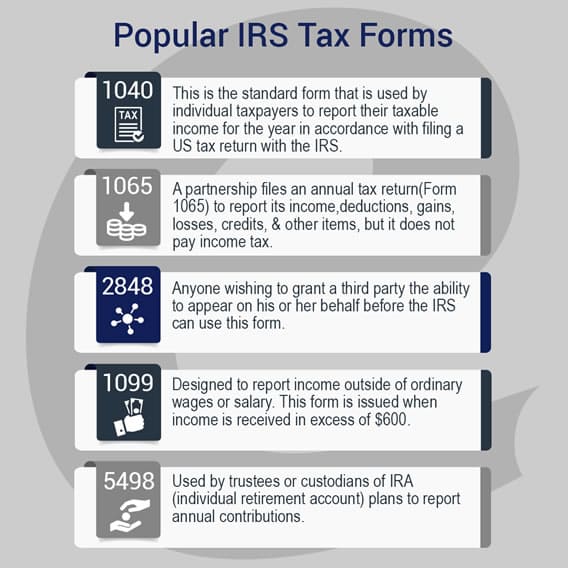
- Partnership: Partnerships (including multi-member LLCs taxed as partnerships) file Form 1065 (U.S. Return of Partnership Income). This form reports the partnership’s income, deductions, gains, and losses but does not pay income tax itself. Instead, it generates a Schedule K-1 (Partner’s Share of Income, Deductions, Credits, etc.) for each partner. Each partner then uses their K-1 to report their share of the partnership’s income or loss on their personal Form 1040.
- S Corporation: S corporations (including single-member or multi-member LLCs that elect S corporation status) file Form 1120-S (U.S. Income Tax Return for an S Corporation). Like partnerships, S corporations are “pass-through” entities, meaning they generally don’t pay corporate income tax. Instead, income, losses, deductions, and credits are passed through to the shareholders and reported on their individual tax returns via a Schedule K-1 (Shareholder’s Share of Income, Deductions, Credits, etc.).
- C Corporation: C corporations are separate legal entities that pay their own income tax. They file Form 1120 (U.S. Corporation Income Tax Return). Shareholders of a C corporation pay tax on dividends they receive from the corporation, leading to what is often called “double taxation.”
Choosing the right business structure has significant tax implications, and understanding the corresponding forms is paramount for business finance management.
Estimated Taxes for Non-W-2 Income: Form 1040-ES
If you receive income not subject to withholding, such as income from self-employment, rents, interest, or dividends, you may be required to pay estimated taxes throughout the year using Form 1040-ES (Estimated Tax for Individuals). The U.S. tax system operates on a “pay-as-you-go” basis. If you expect to owe at least $1,000 in tax for the year and your withholding doesn’t cover at least 90% of your current year’s tax liability or 100% of your prior year’s tax liability (110% for high-income taxpayers), you likely need to pay estimated taxes in quarterly installments. Failing to do so can result in penalties, even if you pay all your taxes by the April deadline. Form 1040-ES helps you calculate and submit these payments.
Leveraging Technology and Professional Guidance
While the array of tax forms can seem daunting, modern financial tools and professional expertise have made the process more manageable and accurate. Utilizing these resources is an integral part of smart personal and business finance.
Digital Tools for Tax Preparation and Filing
The digital age has revolutionized tax preparation. A variety of tax software solutions are available, ranging from free basic versions to comprehensive premium packages. Companies like TurboTax, H&R Block, and FreeTaxUSA offer user-friendly interfaces that guide you through the process, prompting you with questions to identify relevant forms and deductions.
- Benefits of Tax Software: These tools help ensure accuracy by performing calculations, checking for errors, and identifying potential deductions or credits you might overlook. They also streamline the process of e-filing your federal and state returns, often offering direct deposit for refunds. Many platforms allow you to import W-2 and 1099 data directly from employers and financial institutions, significantly reducing manual data entry and potential transcription errors. For those with relatively straightforward tax situations, these digital tools can be incredibly empowering, placing control directly in the hands of the taxpayer.
When to Seek Professional Assistance
While DIY tax software is excellent for many, there are scenarios where professional assistance from a qualified tax preparer, CPA (Certified Public Accountant), or Enrolled Agent (EA) is invaluable.
- Complex Financial Situations: If you own a business with multiple income streams, have significant investment activity, deal with international income, or have undergone major life changes (like marriage, divorce, or the sale of a home), a professional can navigate the intricacies and potentially uncover nuanced tax advantages.
- Audits or Discrepancies: If you receive a letter from the IRS or are facing an audit, a tax professional can represent you and help resolve issues.
- Optimizing Business Taxes: For small business owners, a CPA specializing in business finance can offer strategic advice on entity structure, deductions, and long-term tax planning that goes beyond simple form completion.
- Time Savings and Peace of Mind: For those with limited time or a desire for expert reassurance, offloading the tax preparation burden to a professional can be a wise investment.
A good tax professional doesn’t just fill out forms; they offer insights into financial planning and strategies to minimize your tax liability legally in future years, aligning perfectly with sound money management principles.
The Importance of Record-Keeping and Organization
Regardless of whether you use software or a professional, diligent record-keeping is the cornerstone of accurate tax filing. The forms discussed above are merely summaries; the underlying receipts, statements, and documentation are what substantiate the figures.
- Tips for Keeping Documents:
- Digitalize Everything: Scan and save important documents (W-2s, 1099s, receipts for deductions, mileage logs) in a secure, cloud-based folder.
- Categorize: Organize your records by type (income, expenses, investments) and by year.
- Backup: Ensure you have multiple backups of your digital files.
- Retain for the Required Period: Generally, keep tax records for at least three years from the date you filed your original return or two years from the date you paid the tax, whichever is later. For certain situations, like capital gains or losses, retention might be longer.
Being organized throughout the year, rather than scrambling at tax time, significantly reduces stress, minimizes errors, and empowers you to make informed financial decisions. It transforms tax season from a dreaded chore into a manageable component of your annual financial review.
Understanding “what forms do you need to file taxes” is more than just a procedural exercise; it’s a critical component of effective personal and business finance. From the foundational W-2 for employees to the intricate Schedules C and SE for entrepreneurs, and the various 1099 and 1098 series for diverse income and expense reporting, each document plays a vital role. By familiarizing yourself with these forms, leveraging modern tax preparation tools, and knowing when to consult a professional, you can navigate the tax landscape with confidence. Proactive engagement with your tax forms not only ensures compliance but also unlocks opportunities for strategic financial planning, contributing to your overall financial well-being within the robust sphere of money management.
aViewFromTheCave is a participant in the Amazon Services LLC Associates Program, an affiliate advertising program designed to provide a means for sites to earn advertising fees by advertising and linking to Amazon.com. Amazon, the Amazon logo, AmazonSupply, and the AmazonSupply logo are trademarks of Amazon.com, Inc. or its affiliates. As an Amazon Associate we earn affiliate commissions from qualifying purchases.