
The cosmos operates on a set of immutable laws that have fascinated humanity since the first stargazers looked upward. However, in the modern era, our understanding of “what force keeps the planets in orbit” has transitioned from pure philosophical inquiry into the backbone of a multi-billion dollar aerospace and technology industry. At the intersection of classical physics and cutting-edge engineering lies the delicate balance of gravity and inertia—the “force” that not only governs the movement of planets but also enables our global positioning systems, satellite communications, and deep-space exploration.

To understand how planets stay in orbit, we must look at the universe as a complex operating system. Gravity is the fundamental code, while momentum acts as the continuous execution of that code. In the tech sector, replicating these natural phenomena through software and hardware is the primary challenge of the 21st-century “New Space” economy.
The Fundamental Physics: Gravity as the Universal Operating System
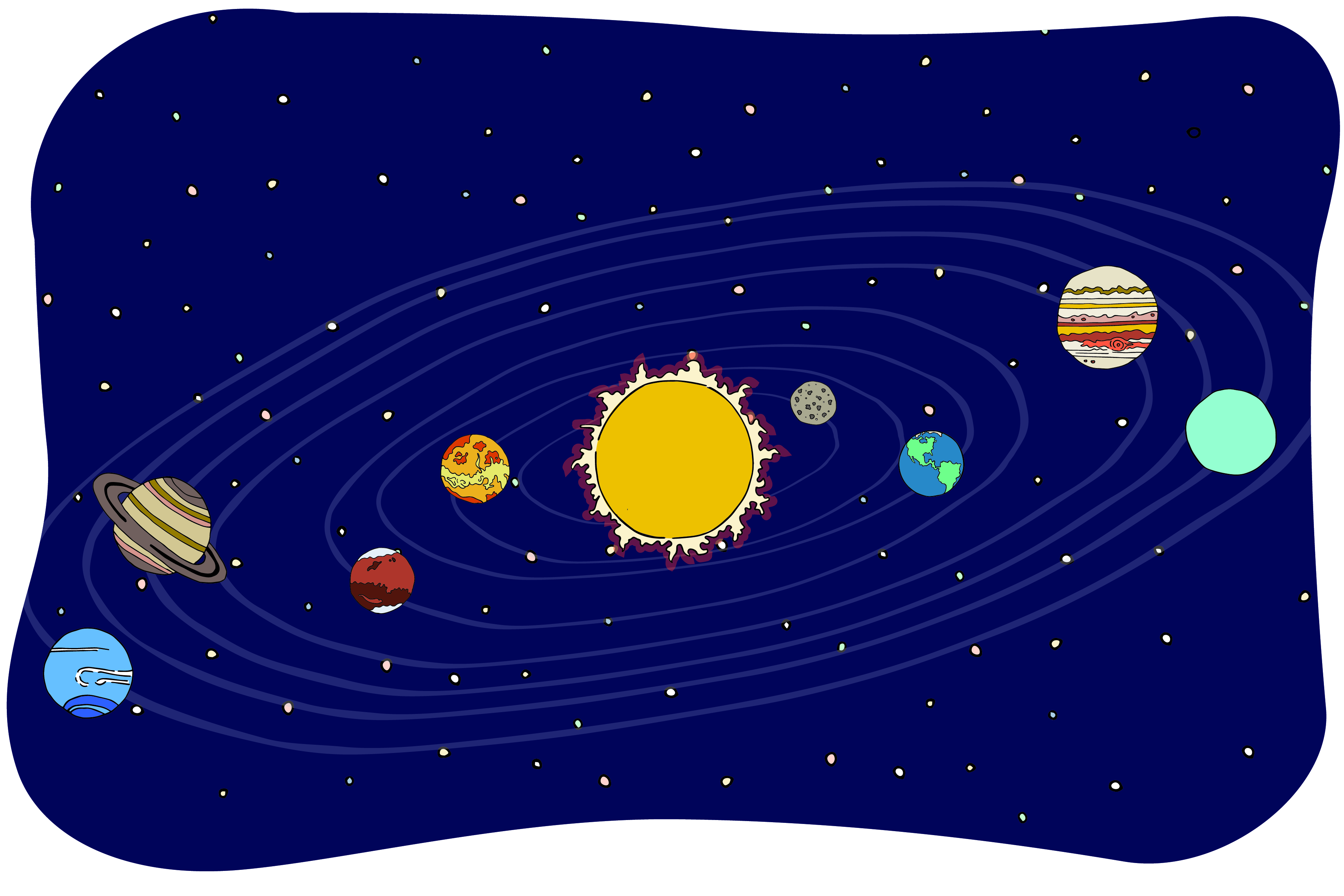
At the most basic level, the force keeping planets in their orbits is gravity. However, gravity alone would simply cause a planet to crash into its sun. The “orbit” is actually a perpetual state of falling that never hits the ground. This is achieved through a precise equilibrium between gravitational pull and the planet’s forward momentum (inertia).
Newtonian Mechanics and the Inverse Square Law
Isaac Newton was the first to mathematically define the force of gravity. His Law of Universal Gravitation states that every mass exerts an attractive force on every other mass. In the context of our solar system, the Sun’s massive core creates a gravitational well so deep that it captures all the planets within it. From a technical perspective, this is a predictable, scalable calculation. The force is proportional to the product of the masses and inversely proportional to the square of the distance between them. In the realm of orbital tech, these calculations are the “Hello World” of trajectory software.
Einsteinian Relativity: The Curvature of Spacetime
While Newton provided the “how,” Albert Einstein provided the “why” through General Relativity. He proposed that gravity isn’t just an invisible tug-of-war, but a physical warping of spacetime. Imagine placing a heavy bowling ball on a trampoline; the fabric curves. Any smaller ball (a planet) rolling nearby will follow the curve. In high-tech applications, such as the synchronization of atomic clocks in GPS satellites, Einstein’s theories are not just theoretical—they are functional requirements. Without accounting for the way gravity warps time, our digital mapping tools would lose accuracy by several kilometers every single day.
Satellite Technology: Replicating Natural Orbits for Global Connectivity
Humanity has taken the lessons learned from planetary orbits and applied them to a dense network of artificial satellites. Today, the “force” that keeps a SpaceX Starlink satellite or a NOAA weather station in orbit is the same one that governs Mars or Jupiter. However, the technology required to achieve and maintain these positions involves sophisticated hardware and real-time data processing.
Geostationary vs. Low Earth Orbit (LEO) Architectures
The tech industry categorizes orbits based on their altitude and application. Geostationary Orbit (GEO) allows a satellite to appear stationary over a single point on Earth by matching the planet’s rotation. This requires a precise altitude of approximately 35,786 kilometers. Conversely, Low Earth Orbit (LEO) is the domain of modern internet constellations. Because LEO satellites are closer to Earth, they must travel at much higher velocities—roughly 17,500 mph—to keep from falling back into the atmosphere. Managing the hand-off between these high-speed nodes requires advanced networking protocols and low-latency software.
Propulsion Systems and Orbital Station-Keeping
While planets have been in stable orbits for billions of years, satellites face “orbital decay” due to atmospheric drag and solar radiation pressure. To counter this, modern satellites are equipped with “station-keeping” technology. This includes ion thrusters and Hall-effect thrusters, which use electricity to accelerate ions and create thrust. This represents a peak in hardware miniaturization, allowing small “CubeSats” to maintain their “orbital force” for years using only a few kilograms of propellant.
The Role of AI and Machine Learning in Orbital Maintenance
As the space around Earth becomes increasingly crowded—a phenomenon known as “space congestion”—the “force” of gravity is no longer the only thing engineers worry about. We are now entering an era where Artificial Intelligence (AI) and Machine Learning (ML) are essential for maintaining the integrity of orbits.
Predictive Collision Avoidance Systems
With thousands of active satellites and millions of pieces of space debris, the risk of a “Kessler Syndrome” (a chain reaction of collisions) is a primary concern for tech firms. AI algorithms are now used to process “Conjunction Data Messages” from radar arrays. These AI tools calculate the probability of two objects occupying the same space at the same time. If the “force” of gravity is pulling a satellite toward a collision course with debris, the software autonomously triggers a maneuver command, recalculating a new, safe trajectory in milliseconds.
Autonomous Orbit Determination
In the past, tracking a satellite’s orbit required massive ground-based teams. Today, Edge Computing allows satellites to perform “Autonomous Orbit Determination.” Using onboard star trackers and GPS sensors, the satellite’s internal AI can determine its exact position in space without waiting for a signal from Earth. This autonomy is crucial for deep-space missions where the “light delay” makes real-time human control impossible. By understanding the gravitational forces of nearby celestial bodies, the software ensures the craft stays on its intended path.
Space-Tech Infrastructure: The Hardware Behind the Gravity
Maintaining an orbit is an exercise in managing energy. To harness the force of gravity, we must first overcome it. This requires a massive infrastructure of rocketry, materials science, and digital twins.
Rocketry and the Escape Velocity Threshold
To place any object into orbit, it must reach “escape velocity” to break free from Earth’s primary gravitational grasp, or “orbital velocity” to stay balanced within it. This is a feat of chemical engineering. Modern rockets, like the Falcon 9 or the SLS, use high-frequency sensors to monitor engine pressure and gimbal actuators thousands of times per second. This ensures that the force of thrust perfectly counters the force of gravity until the desired orbital insertion point is reached.
Digital Twins and Simulation Software
Before a single piece of hardware is launched, aerospace engineers use “Digital Twins”—virtual replicas of the spacecraft and the gravitational environment it will inhabit. Using high-performance computing (HPC), these simulations account for the gravitational pull of the Earth, Moon, and Sun, as well as the non-uniformity of Earth’s gravity (the planet isn’t a perfect sphere). This software-driven approach allows tech companies to predict how the “orbital forces” will affect the lifespan of a satellite over ten or twenty years, optimizing the build for maximum ROI.
Future Horizons: Gravity-Assist Tech and Deep Space Exploration
Our mastery of orbital forces is moving beyond Earth. The next frontier of technology involves utilizing gravity not just as a tether, but as a fuel source.
Gravity Assists: The Interplanetary Slingshot
In deep-space exploration, NASA and private tech firms use “gravity assists” to propel probes to the outer reaches of the solar system. By flying a spacecraft close to a planet, engineers can “steal” a tiny bit of the planet’s orbital momentum to accelerate the craft. This is the ultimate “green energy” hack, using the natural force of gravity to reach speeds that chemical rockets could never achieve alone. Designing these trajectories requires some of the most complex computational modeling in the tech world.
The Sustainable Tech Orbit and Debris Removal
The future of orbital tech also focuses on “Active Debris Removal” (ADR). Startups are developing “space tugs” equipped with robotic arms or nets to capture “dead” satellites that are no longer able to maintain their own orbit. These technologies are essential for keeping the “orbital lanes” open for future generations. By managing the force of gravity on defunct hardware, we ensure that the digital infrastructure of Earth—the internet, financial markets, and weather tracking—remains secure.

Conclusion
The force that keeps the planets in orbit is a masterpiece of natural physics, a balance of gravity and motion that has persisted for eons. However, in the hands of the modern tech industry, this force has become a tool for global transformation. From the software that predicts celestial movements to the AI that prevents satellite collisions, our ability to understand and manipulate these “orbital forces” defines the limits of our technological reach. As we look toward the stars, the synergy of physics and technology will continue to be the engine that drives human progress into the final frontier.
aViewFromTheCave is a participant in the Amazon Services LLC Associates Program, an affiliate advertising program designed to provide a means for sites to earn advertising fees by advertising and linking to Amazon.com. Amazon, the Amazon logo, AmazonSupply, and the AmazonSupply logo are trademarks of Amazon.com, Inc. or its affiliates. As an Amazon Associate we earn affiliate commissions from qualifying purchases.