
Financial markets are the bedrock of the global economy, intricate networks where individuals, institutions, and governments buy and sell financial assets. More than just physical places, they represent the entire system of exchanges, transactions, and interactions that facilitate the allocation of capital. Understanding what financial markets are, how they function, and their various components is crucial for anyone looking to comprehend the modern economy, make informed investment decisions, or even simply understand the news headlines. They are the engines that power economic growth, providing the liquidity necessary for businesses to expand, governments to fund public services, and individuals to manage their wealth.

At their core, financial markets serve as a conduit, connecting those who have capital to invest (savers) with those who need capital (borrowers). This vital intermediation allows for efficient resource allocation, enabling businesses to raise funds for operations and expansion, governments to finance deficits, and individuals to purchase homes or save for retirement. Without robust financial markets, capital would remain stagnant, severely hampering innovation, productivity, and overall economic prosperity.
The Core Function and Significance of Financial Markets
The primary role of financial markets extends far beyond mere buying and selling; they perform several critical functions that underpin economic stability and growth. These functions ensure that capital is mobilized effectively and risks are managed appropriately across the global financial system.
Facilitating Capital Formation
One of the most fundamental roles of financial markets is to facilitate capital formation. This process involves converting savings into investments. When individuals save money, that capital needs to be put to productive use to generate returns and stimulate economic activity. Financial markets provide the mechanisms through which these savings can be channeled to businesses, governments, and other entities that require funding for long-term projects, operational expenses, or infrastructure development. For example, when a company issues new shares or bonds, it is accessing the capital market to fund its growth, while investors are providing that capital in anticipation of future returns. This interaction is essential for economic expansion, allowing new ventures to emerge and existing ones to innovate.
Price Discovery and Liquidity
Financial markets are crucial for price discovery, which refers to the process by which the forces of supply and demand interact to determine the market price of an asset. Whether it’s a stock, bond, or currency, its price reflects the collective wisdom and expectations of all market participants. This constant interplay ensures that assets are valued fairly, providing transparency for buyers and sellers. Furthermore, financial markets ensure liquidity, meaning that assets can be bought or sold quickly without significantly affecting their price. High liquidity is vital for investors, as it provides the assurance that they can exit or enter positions efficiently, thereby reducing transaction costs and encouraging participation. Without liquidity, investors would be hesitant to commit capital, fearing they might be stuck with illiquid assets.
Risk Transfer and Management
Another critical function is the ability to transfer and manage risk. Financial markets offer various instruments and platforms that allow participants to mitigate or diversify specific financial risks. For instance, derivative products like futures and options allow businesses to hedge against price fluctuations in commodities or currencies, protecting their future revenues or costs. Investors can also diversify their portfolios across different asset classes, industries, and geographies to spread risk, rather than concentrating it in a single investment. This capacity for risk sharing is fundamental, enabling economic activities that might otherwise be too risky for individual entities to undertake, thus fostering innovation and investment in uncertain environments.
Key Types of Financial Markets
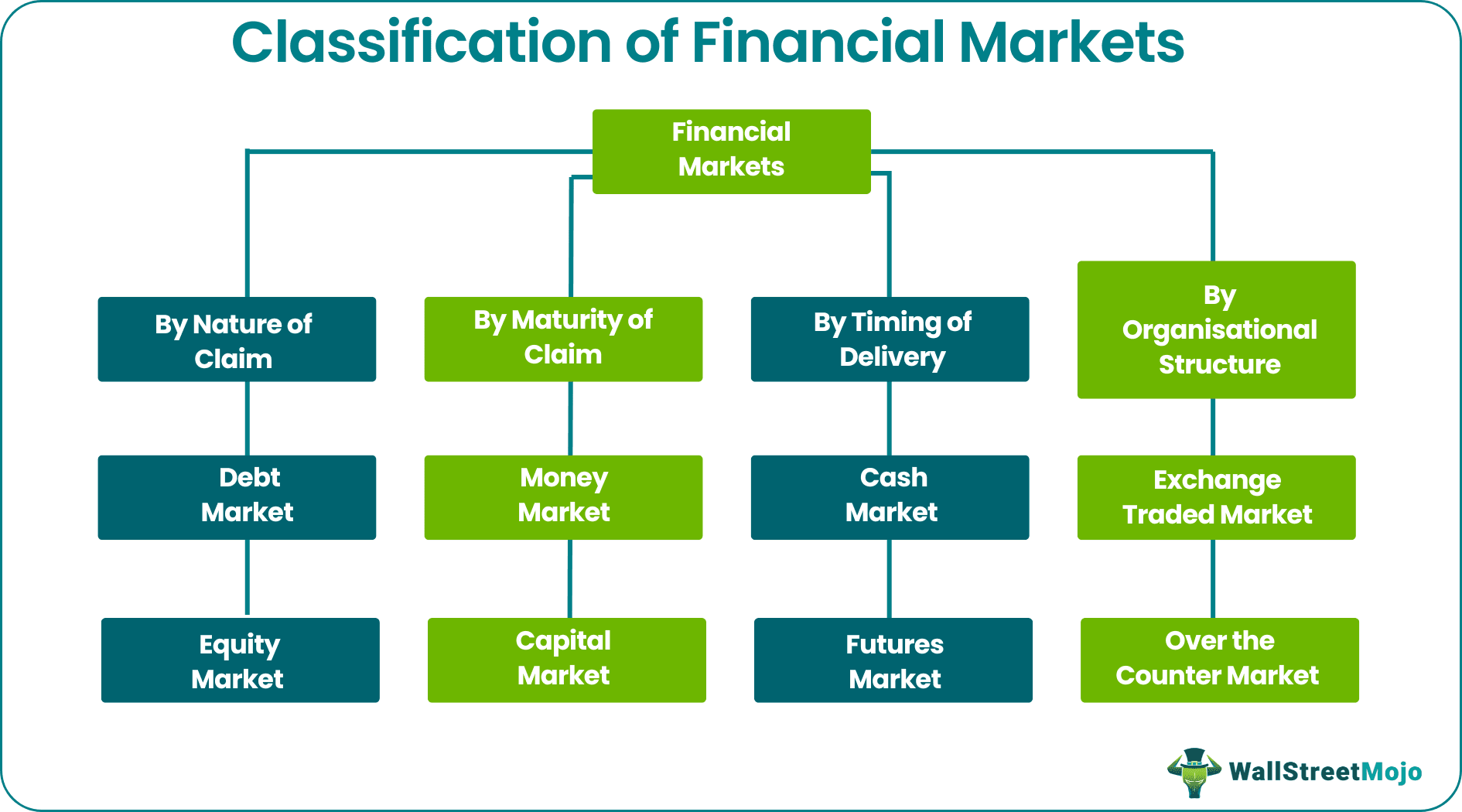
The financial landscape is incredibly diverse, comprising several distinct types of markets, each serving specific purposes and dealing with different categories of financial instruments. Understanding these distinctions is key to grasping the breadth of financial activity.
Stock Markets
Stock markets, also known as equity markets, are perhaps the most widely recognized financial markets. They are where shares of publicly traded companies are bought and sold. When you buy a stock, you are purchasing a small ownership stake in a company. Stock markets are broadly divided into primary markets, where companies issue new shares to the public for the first time through an Initial Public Offering (IPO), and secondary markets, where existing shares are traded among investors. These markets provide companies with capital for expansion and offer investors the potential for capital appreciation and dividends. Major stock exchanges include the New York Stock Exchange (NYSE), NASDAQ, London Stock Exchange (LSE), and Tokyo Stock Exchange (TSE).
Bond Markets (Debt Markets)
Bond markets are where debt securities, known as bonds, are issued and traded. When an investor buys a bond, they are essentially lending money to the bond issuer (e.g., a government, municipality, or corporation) in exchange for periodic interest payments and the return of the principal amount at maturity. Bond markets are crucial for governments to finance public expenditures and for corporations to fund operations and expansion without diluting ownership. They are often considered a less volatile investment than stocks and are a cornerstone of fixed-income portfolios. The yield on bonds is a key indicator of interest rates and economic health.
Foreign Exchange Markets (Forex)
The foreign exchange market, or Forex, is the largest and most liquid financial market globally, facilitating the exchange of national currencies. Participants include central banks, commercial banks, multinational corporations, hedge funds, and individual traders. Forex transactions are essential for international trade and investment, allowing businesses to convert currencies to pay for imports or receive payments for exports. It also offers opportunities for speculation based on anticipated currency movements. The sheer volume of transactions, often exceeding trillions of dollars daily, underscores its critical role in global commerce and finance.
Commodities Markets
Commodities markets deal with the buying and selling of raw materials and primary agricultural products, such as crude oil, natural gas, gold, silver, wheat, corn, and coffee. These markets allow producers and consumers of commodities to hedge against price fluctuations and provide opportunities for speculators to profit from price movements. Commodities are traded either physically (spot markets) or through derivatives contracts like futures and options, which obligate or entitle parties to buy or sell a commodity at a predetermined price on a future date.
Derivatives Markets
Derivatives markets involve financial instruments whose value is derived from an underlying asset, index, or rate. Common types include futures, options, swaps, and forwards. These instruments are primarily used for hedging against risks associated with price movements in the underlying asset or for speculative purposes. For example, an airline might use oil futures to lock in a price for fuel, thereby hedging against future price increases. While complex, derivatives play a crucial role in risk management and price discovery across various asset classes.
Participants and Their Roles
Financial markets are bustling ecosystems teeming with diverse participants, each playing a distinct role that collectively contributes to the market’s efficiency and vibrancy.
Investors
Investors form the demand side of financial markets, providing the capital necessary for various ventures. This group can be broadly categorized into retail investors (individual investors buying and selling securities for their personal accounts) and institutional investors. Institutional investors, such as pension funds, mutual funds, hedge funds, insurance companies, and university endowments, manage vast sums of money on behalf of their clients or beneficiaries. Their sheer size means their investment decisions can significantly influence market prices and trends.
Issuers
Issuers are the entities that create and sell financial securities to raise capital. This group primarily includes corporations, which issue stocks and corporate bonds to finance operations, expansion, or research and development. Governments (national, state, and local) are also major issuers, particularly of bonds (e.g., Treasury bonds, municipal bonds) to fund public projects and manage national debt. Their ability to raise capital cheaply and efficiently is vital for economic stability and public service provision.
Intermediaries
Financial intermediaries are the vital conduits that bridge the gap between investors and issuers. This category includes investment banks, which underwrite new security issues and provide advisory services; brokers, who execute buy and sell orders on behalf of clients; and market makers, who provide liquidity by continuously quoting buy and sell prices for securities. Financial exchanges (like the NYSE or NASDAQ) also act as intermediaries, providing organized platforms for trading. These entities facilitate transactions, provide expertise, and enhance market efficiency.
Regulators
To ensure fairness, transparency, and stability, financial markets are overseen by various regulatory bodies. In the United States, prominent regulators include the Securities and Exchange Commission (SEC), which protects investors and maintains fair markets, and the Commodity Futures Trading Commission (CFTC), which regulates derivatives markets. Central banks, like the Federal Reserve, also play a crucial role in monetary policy and financial stability. Regulators set rules, monitor compliance, and enforce laws to prevent fraud, market manipulation, and systemic risks, thereby building investor confidence and protecting the broader economy.
The Mechanics of Trading and Investment
Understanding how financial markets operate involves looking at the processes through which securities are initially offered and subsequently traded among investors. Technology has fundamentally transformed these mechanics, making markets more accessible and efficient.
Primary Markets: Initial Public Offerings (IPOs) and New Issues
The journey of a financial asset typically begins in the primary market. This is where new securities are created and sold for the first time directly by the issuer to investors. The most well-known example is an Initial Public Offering (IPO), where a private company sells shares to the public for the first time, becoming a publicly traded entity. Investment banks play a critical role here, underwriting the offering, setting the price, and distributing the shares to institutional and retail investors. Governments and corporations also raise capital in the primary market by issuing new bonds. This initial sale provides the vital capital that fuels growth and development.
Secondary Markets: Continuous Trading
Once securities are issued in the primary market, they are subsequently traded among investors in the secondary market. This is where the vast majority of daily trading activity occurs. Secondary markets provide liquidity for investors, allowing them to buy and sell existing securities without involving the original issuer. These markets can be organized as exchanges (like stock exchanges where orders are matched electronically or by specialists) or over-the-counter (OTC) markets, which are decentralized networks where transactions occur directly between two parties, often facilitated by broker-dealers. The secondary market’s efficiency in price discovery and liquidity is crucial for encouraging primary market activity, as investors know they can easily exit their positions if needed.
Role of Technology
Modern financial markets are heavily reliant on advanced technology. Electronic trading platforms have replaced physical trading floors, enabling transactions to be executed almost instantaneously from anywhere in the world. Algorithmic trading, where computer programs execute trades based on predefined rules, and high-frequency trading (HFT), which involves executing a massive number of orders at extremely high speeds, have become dominant forces. Technology has democratized access to markets for retail investors, reduced transaction costs, and increased market efficiency and transparency. However, it also introduces complexities related to cybersecurity and potential for “flash crashes” or other technology-driven disruptions.
Impact on the Economy and Individuals
The influence of financial markets extends deeply into both macroeconomic performance and individual financial well-being, acting as both indicators and facilitators of economic activity.
Economic Indicators and Barometers
Financial markets serve as crucial barometers of economic health and future expectations. Stock market performance, bond yields, and currency exchange rates are often seen as leading economic indicators, reflecting investor confidence, corporate earnings prospects, and inflationary pressures. A robust stock market often signals investor optimism about future corporate profits and economic growth, while rising bond yields might indicate expectations of higher interest rates or inflation. Central banks and policymakers closely monitor these market signals to gauge economic trends and inform their policy decisions. Thus, understanding market movements is not just for investors but for anyone interested in the broader economic outlook.
Wealth Creation and Retirement Planning
For individuals, financial markets offer powerful avenues for wealth creation and the achievement of long-term financial goals, such as retirement planning, funding education, or purchasing a home. By investing in stocks, bonds, mutual funds, or exchange-traded funds (ETFs) over time, individuals can benefit from capital appreciation and income generation. The principle of compounding, where returns on investments also earn returns, can significantly grow wealth over extended periods. Participating in financial markets, often through diversified portfolios, is a cornerstone of modern personal finance and retirement planning strategies, helping individuals secure their financial future.

Risks and Rewards
While financial markets offer significant opportunities for growth, they inherently involve risks. All investments carry some level of risk, ranging from market volatility and economic downturns to specific company or industry-related risks. The value of investments can fluctuate, and there is always the potential for loss of principal. Therefore, understanding the relationship between risk and reward is paramount. Generally, higher potential returns come with higher levels of risk. Informed decision-making, thorough research, diversification, and a clear understanding of one’s risk tolerance are essential for navigating financial markets successfully and mitigating potential downsides while pursuing financial goals.
Conclusion
Financial markets are far more than just trading venues; they are the sophisticated arteries of the global economy, channeling capital, facilitating commerce, and enabling wealth creation. From the bustling stock exchanges to the intricate world of derivatives, these markets perform indispensable functions: allocating capital, discovering prices, providing liquidity, and managing risk. They are complex ecosystems driven by a myriad of participants, from individual investors to colossal institutions, all operating within a framework of regulations and technological advancements.
Understanding “what financial markets are” is fundamental not only for seasoned investors and finance professionals but for every individual who wishes to comprehend the forces shaping their economic reality and to make informed decisions about their own financial future. Their continued evolution, driven by technological innovation and global interconnectedness, ensures they will remain central to economic progress and financial well-being for decades to come. Engaging with these markets responsibly, with a continuous appetite for knowledge, is key to harnessing their immense power.
aViewFromTheCave is a participant in the Amazon Services LLC Associates Program, an affiliate advertising program designed to provide a means for sites to earn advertising fees by advertising and linking to Amazon.com. Amazon, the Amazon logo, AmazonSupply, and the AmazonSupply logo are trademarks of Amazon.com, Inc. or its affiliates. As an Amazon Associate we earn affiliate commissions from qualifying purchases.