
The financial crisis of 2008, often referred to as the Global Financial Crisis (GFC), stands as the most severe economic disaster since the Great Depression of 1929. It was a systemic failure that pushed the global banking system to the brink of total collapse, wiped out trillions of dollars in household wealth, and fundamentally altered the landscape of personal finance and international regulation. While the crisis is often simplified as a “housing bubble,” its roots were deeply embedded in complex financial engineering, predatory lending practices, and a systemic lack of oversight. Understanding what happened in 2008 is not just a historical exercise; it is an essential requirement for any investor or business professional looking to navigate today’s volatile markets.
The Catalyst: Subprime Mortgages and the Housing Bubble
The seeds of the 2008 crisis were sown years earlier in a climate of low interest rates and a rapidly expanding housing market. Following the dot-com burst of the early 2000s, the Federal Reserve lowered interest rates significantly to stimulate economic growth. This made borrowing inexpensive, leading to a surge in demand for real estate.
The Rise of Low-Interest Rates and Cheap Credit
In the early 2000s, the influx of foreign capital and the Federal Reserve’s decision to keep the federal funds rate at 1% created an environment of “easy money.” Investors, seeking higher yields than what government bonds could offer, began looking toward the housing market. Banks, meanwhile, found themselves flush with cash and eager to issue loans. This led to a relaxation of lending standards, where “creditworthiness” became a secondary concern to the sheer volume of loan originations.
Predatory Lending and the Subprime Surge
As the pool of “prime” borrowers (those with high credit scores and stable incomes) was exhausted, lenders turned to “subprime” borrowers. These were individuals with poor credit histories or insufficient income who were previously considered too risky for a mortgage. To entice these borrowers, financial institutions offered “teaser rates”—initially low interest rates that would skyrocket after a few years. Many borrowers took these loans under the assumption that home prices would continue to rise indefinitely, allowing them to refinance before the higher rates kicked in.
The Mechanics of Mortgage-Backed Securities (MBS)
The true danger of the subprime market was hidden within the financial plumbing of Wall Street. Investment banks would purchase thousands of these individual mortgages, bundle them together, and sell them to investors as Mortgage-Backed Securities (MBS). To make these bundles more attractive, they were often sliced into “tranches” based on risk. Credit rating agencies, often suffering from a conflict of interest, gave many of these risky bundles “AAA” ratings—the highest possible—misleading investors into believing they were as safe as government bonds.
The Domino Effect: From Wall Street to Main Street
By 2006, the housing bubble began to hiss. Interest rates started to rise, and the demand for housing cooled. As home prices plateaued and then dropped, subprime borrowers found themselves “underwater,” meaning they owed more on their mortgages than their homes were worth. Unable to refinance or sell, defaults began to climb.
The Collapse of Lehman Brothers and Bear Stearns
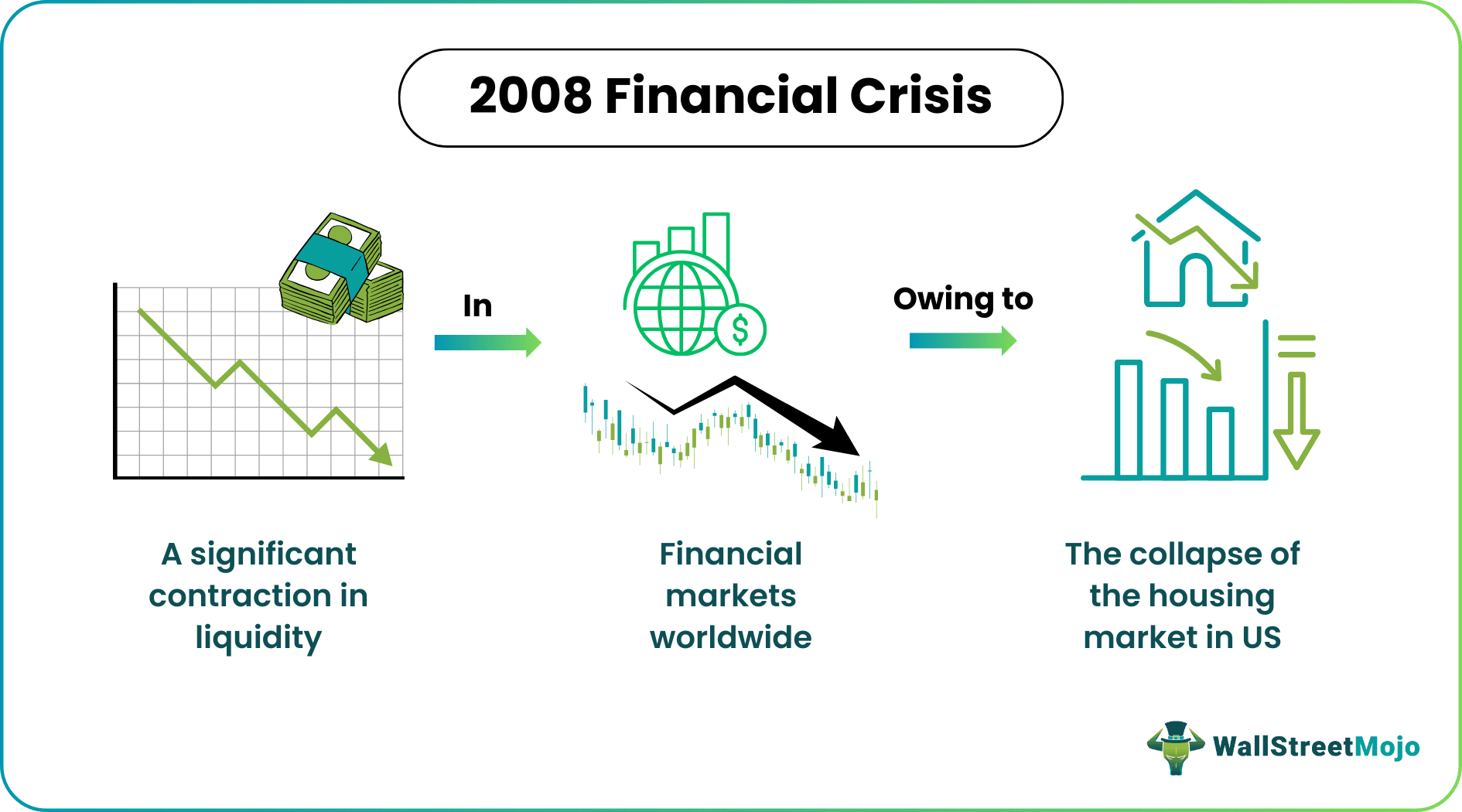
The crisis reached a fever pitch in 2008. In March, the investment bank Bear Stearns nearly collapsed due to its heavy exposure to subprime assets and was forced into a fire sale to JPMorgan Chase. However, the definitive turning point occurred on September 15, 2008, when Lehman Brothers, a 158-year-old investment bank, filed for bankruptcy. Unlike Bear Stearns, the government did not broker a rescue for Lehman. This sent a shockwave through the global financial system, as banks realized that no institution was “too big to fail” without government intervention.
The Credit Freeze and Global Liquidity Crunch
The bankruptcy of Lehman Brothers triggered a massive loss of confidence. Because no one knew which banks were holding “toxic” subprime assets, banks stopped lending to each other. This is known as a credit crunch. In a modern economy, credit is the lifeblood of business; without it, companies cannot fund daily operations, pay employees, or purchase inventory. The crisis quickly moved from a Wall Street problem to a “Main Street” disaster, as small businesses and consumers found their credit lines cut off overnight.

The Impact on Household Wealth and Unemployment
The human cost of the 2008 crisis was staggering. As the stock market plummeted—with the S&P 500 losing nearly 50% of its value from its peak—retirement accounts were decimated. The bursting of the housing bubble led to millions of foreclosures, stripping families of their primary source of wealth. By 2009, the unemployment rate in the United States reached 10%, and the global economy entered the “Great Recession,” characterized by a significant decline in GDP and a prolonged period of stagnant growth.
Government Intervention and the Road to Recovery
Faced with a total systemic meltdown, the U.S. government and the Federal Reserve were forced to take unprecedented actions. The goal was to provide liquidity, restore confidence, and prevent the global economy from sliding into a second Great Depression.
The Emergency Economic Stabilization Act (TARP)
In October 2008, Congress passed the Emergency Economic Stabilization Act, which created the Troubled Asset Relief Program (TARP). This $700 billion program allowed the U.S. Treasury to purchase “toxic assets” from struggling banks and, eventually, to provide direct capital injections into the nation’s largest financial institutions. While highly controversial at the time—viewed by many as a “bailout” for the very people who caused the crisis—most economists agree that TARP was essential in stabilizing the banking sector.
Quantitative Easing and Federal Reserve Policy
Beyond the fiscal response of the government, the Federal Reserve utilized “monetary policy” to its absolute limits. Under Chairman Ben Bernanke, the Fed slashed interest rates to near zero. When that wasn’t enough, they embarked on “Quantitative Easing” (QE)—the large-scale purchase of government bonds and other securities to flood the economy with cash and keep long-term interest rates low. These measures helped lower the cost of borrowing for consumers and businesses, eventually sparking a slow recovery.
Dodd-Frank and Post-Crisis Regulations
To ensure such a crisis never happened again, the Dodd-Frank Wall Street Reform and Consumer Protection Act was signed into law in 2010. This massive piece of legislation aimed to increase transparency in the derivatives market, end “too big to fail” by requiring banks to have larger capital reserves, and protect consumers from predatory lending through the creation of the Consumer Financial Protection Bureau (CFPB). It marked a significant shift toward a more regulated financial environment.
Lasting Impacts on Personal Finance and Global Investing
The 2008 financial crisis changed the way individuals and institutions think about money. The era of “blind faith” in financial institutions ended, giving way to a more cautious, data-driven approach to investing and wealth management.
Shifts in Consumer Saving and Spending Habits
One of the most immediate shifts post-2008 was the “deleveraging” of the American household. Having seen the dangers of excessive debt, many consumers shifted toward higher savings rates and lower credit card usage. The concept of an “emergency fund”—three to six months of living expenses held in liquid cash—moved from a conservative suggestion to a fundamental pillar of personal finance.
The Evolution of Risk Assessment
For investors, 2008 was a masterclass in risk. It highlighted the fact that “risk” is not just the volatility of a stock, but the “systemic risk” of the entire market failing. This led to a surge in the popularity of passive investing and index funds, as investors sought to lower fees and diversify away from the risks of individual stock picking. Furthermore, the crisis emphasized the importance of understanding what you own; the days of blindly buying complex financial products are largely over for the average retail investor.

Why Diversification is Non-Negotiable
If 2008 taught us anything, it is that no asset class is truly “safe” in isolation. During the peak of the crisis, almost all correlated assets fell simultaneously. This reinforced the need for true diversification—not just owning different stocks, but owning different types of assets, such as bonds, real estate, precious metals, and cash. Modern portfolio theory was put to the test, and while it didn’t prevent losses, those with diversified portfolios recovered far more quickly than those who were over-leveraged in a single sector like housing or banking.
The 2008 financial crisis remains a somber reminder of the fragility of the global financial system. By studying its causes—the toxic mix of cheap debt, poor regulation, and irrational exuberance—modern investors can better prepare themselves for the inevitable cycles of the market. While the “Money” landscape has evolved, the core principles of liquidity, transparency, and cautious optimism remain the best defense against future economic storms.
aViewFromTheCave is a participant in the Amazon Services LLC Associates Program, an affiliate advertising program designed to provide a means for sites to earn advertising fees by advertising and linking to Amazon.com. Amazon, the Amazon logo, AmazonSupply, and the AmazonSupply logo are trademarks of Amazon.com, Inc. or its affiliates. As an Amazon Associate we earn affiliate commissions from qualifying purchases.