
In the world of investing, price is often the primary focus of the average retail trader. We look at a ticker symbol, see the green or red numbers, and decide whether a stock is “expensive” or “cheap.” However, seasoned investors know that price only tells half the story. To understand the conviction behind a price movement, one must look at volume.
Volume is essentially the heartbeat of the stock market. It represents the total number of shares or contracts traded for a specific security during a given period—usually a single trading day. Whether you are a long-term value investor or a high-frequency day trader, understanding volume is critical to assessing market strength, identifying reversals, and managing risk. In this guide, we will break down the mechanics of volume, how to interpret its relationship with price, and the advanced indicators that help professionals navigate the financial markets.
The Fundamentals of Trading Volume
At its simplest level, volume is a measure of quantity. If a buyer purchases 100 shares of a company from a seller, the volume for that transaction is 100. It is a common misconception that volume counts the buyer and seller separately; in reality, it takes both parties to create a single unit of volume.
How Volume is Measured and Reported
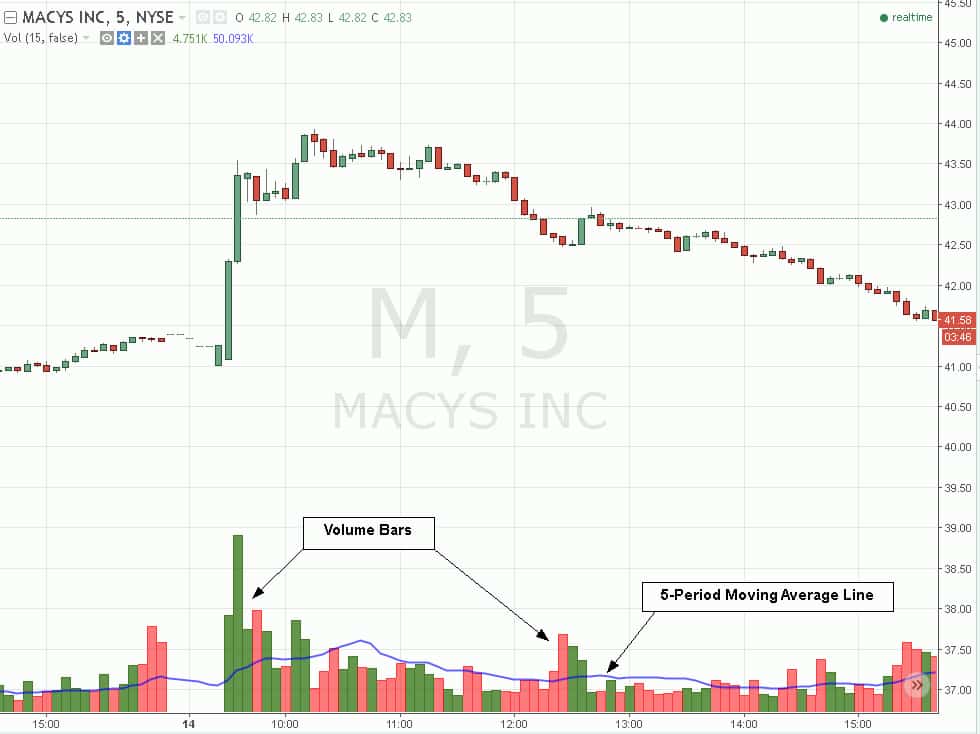
Volume is typically reported as a bar chart at the bottom of a standard price chart. Each bar represents the total number of shares traded during that specific time interval (be it one minute, one hour, or one day). Most trading platforms color these bars: a green bar usually signifies that the stock closed higher than it opened during that period, while a red bar signifies a lower close. However, the volume itself is neutral—it simply reflects the intensity of the exchange.
Investors also look at “Average Daily Trading Volume” (ADTV), which is the average number of shares traded per day over a specific period, such as 30 or 90 days. Comparing the current day’s volume to the ADTV helps investors determine if the current market activity is unusual or standard.
Why Volume is a Leading Indicator
In the “Money” niche of technical analysis, volume is often considered a leading indicator or a confirmation tool. While price shows you where the market is going, volume shows you how much fuel is in the tank. High volume indicates that there is significant interest and liquidity, meaning institutional investors—like mutual funds, pension funds, and hedge funds—are likely involved. Low volume suggests a lack of conviction, where price movements might be erratic or easily reversed.
Interpreting the Relationship Between Price and Volume
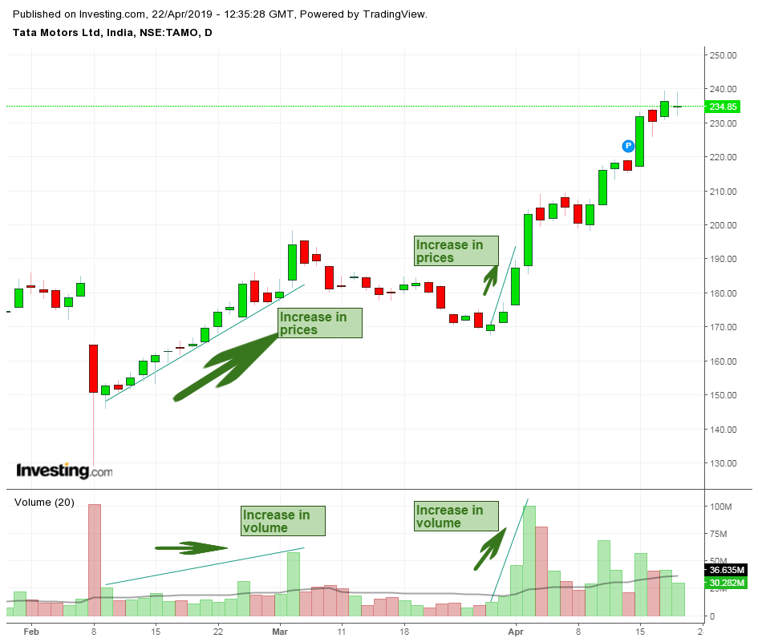
Understanding volume in isolation is useful, but its true power is unlocked when analyzed alongside price action. This relationship provides clues about the “health” of a trend.
High Volume with Price Increases: The Bullish Signal
When a stock’s price rises on high volume, it is generally considered a strong bullish signal. It indicates that there is a broad consensus among buyers that the stock is undervalued or that a positive catalyst (such as an earnings beat or a new product launch) justifies the higher price. Because it takes a massive amount of capital to move a stock significantly on high volume, this usually implies that “Smart Money”—large institutions—is accumulating shares. For an investor, this confirms that the upward trend has a solid foundation.
High Volume with Price Decreases: The Bearish Signal
Conversely, if a stock price is falling on high volume, it suggests a “sell-off” or heavy distribution. This means investors are rushing for the exits, often triggered by bad news or a change in the company’s fundamental outlook. High-volume price drops are a warning sign that the downward trend is strong and likely to continue. It suggests that the “support levels” where buyers usually step in are being overwhelmed by the sheer force of selling pressure.
Low Volume Trends: The Sign of Exhaustion
When a price moves up or down on low volume, it should be viewed with skepticism. A price increase on low volume suggests a “lack of selling” rather than “strong buying.” This is often called a “sucker’s rally.” Without the commitment of high volume, the price is vulnerable to a reversal the moment a few large sellers enter the market. Similarly, if a price is drifting lower on very low volume, it may indicate that the selling pressure is drying up, potentially setting the stage for a consolidation or a reversal.
Advanced Volume Indicators for Financial Analysis
To strip away the noise of daily fluctuations, professional investors use specific mathematical indicators derived from volume data. These tools help quantify “buying pressure” versus “selling pressure.”
On-Balance Volume (OBV)
Developed by Joseph Granville, On-Balance Volume (OBV) is one of the most popular volume-based indicators. It is a cumulative total of volume. On days when the price closes higher than the previous day, the day’s volume is added to the OBV. On days when the price closes lower, the volume is subtracted.
The goal of OBV is to see if volume is flowing into or out of a security. If the price is making new highs but the OBV is failing to make new highs, it creates a “divergence.” This suggests that the smart money is actually selling while retail investors are still buying, often predicting a coming price collapse.
Volume Weighted Average Price (VWAP)
VWAP is a benchmark used primarily by institutional traders. It calculates the average price a stock has traded at throughout the day, based on both volume and price. It is calculated by totaling the dollars traded for every transaction (price multiplied by number of shares traded) and then dividing by the total shares traded.
For a business-minded investor, VWAP serves as a measure of “fair value” for the day. If you buy a stock below the VWAP, you are technically getting a better-than-average price. Large institutions often use VWAP to execute massive orders without significantly moving the market price.
Chaikin Money Flow (CMF)
The Chaikin Money Flow indicator measures the amount of Money Flow Volume over a specific period. It focuses on where the stock closes relative to its range for the period. If a stock consistently closes near its daily high on increasing volume, the CMF will rise, indicating strong accumulation. This tool is excellent for confirming breakouts from long periods of consolidation.
Volume’s Role in Liquidity and Risk Management
Beyond just predicting price movements, volume is a fundamental component of risk management in any financial portfolio. It dictates how easily an investor can enter or exit a position.
Liquidity and the Bid-Ask Spread
Liquidity refers to how quickly an asset can be bought or sold without affecting its price. High-volume stocks (like Apple or Microsoft) are highly liquid. They have “tight” bid-ask spreads, meaning the difference between what a buyer is willing to pay and what a seller wants is very small.
In contrast, low-volume stocks (often “penny stocks” or small-caps) are illiquid. If an investor holds a large position in a low-volume stock, they may find it impossible to sell their shares quickly without crashing the price. This is a significant risk factor; high volume acts as a safety net, ensuring that you can liquidate your investment when necessary.
Identifying Market Exhaustion and Blow-off Tops
Volume is also used to identify the end of a trend. A “blow-off top” occurs when a stock that has been rising steadily suddenly sees a massive, vertical spike in both price and volume. While this looks bullish, it often represents “capitulation” by the shorts and a final frenzy of retail “FOMO” (Fear Of Missing Out). When the volume reaches an extreme peak and then begins to drop, it usually signals that there are no buyers left to push the price higher, leading to a sharp crash.
Conversely, a “selling climax” happens at the bottom of a bear market. When investors panic and sell everything at once, volume spikes to record highs as the last “weak hands” exit. This surge in volume often marks the point where savvy value investors step in to scoop up shares at a discount, marking a definitive bottom.

Conclusion: Integrating Volume into Your Investment Strategy
Volume is the ultimate validator. In the world of finance, talk is cheap, but it takes actual capital—reflected in volume—to move markets. By paying attention to volume, you move beyond simply watching price tickers and begin to understand the psychology of market participants.
Whether you are looking for confirmation of a new bull market, trying to avoid a value trap in a declining stock, or ensuring that you have enough liquidity to manage your risks, volume provides the necessary context. For the serious investor, price may be the destination, but volume is the map that shows you how likely you are to get there. As you refine your financial strategy, remember the golden rule of the tape: “Believe the volume.” High conviction in the markets is always written in the quantity of shares traded.
aViewFromTheCave is a participant in the Amazon Services LLC Associates Program, an affiliate advertising program designed to provide a means for sites to earn advertising fees by advertising and linking to Amazon.com. Amazon, the Amazon logo, AmazonSupply, and the AmazonSupply logo are trademarks of Amazon.com, Inc. or its affiliates. As an Amazon Associate we earn affiliate commissions from qualifying purchases.