
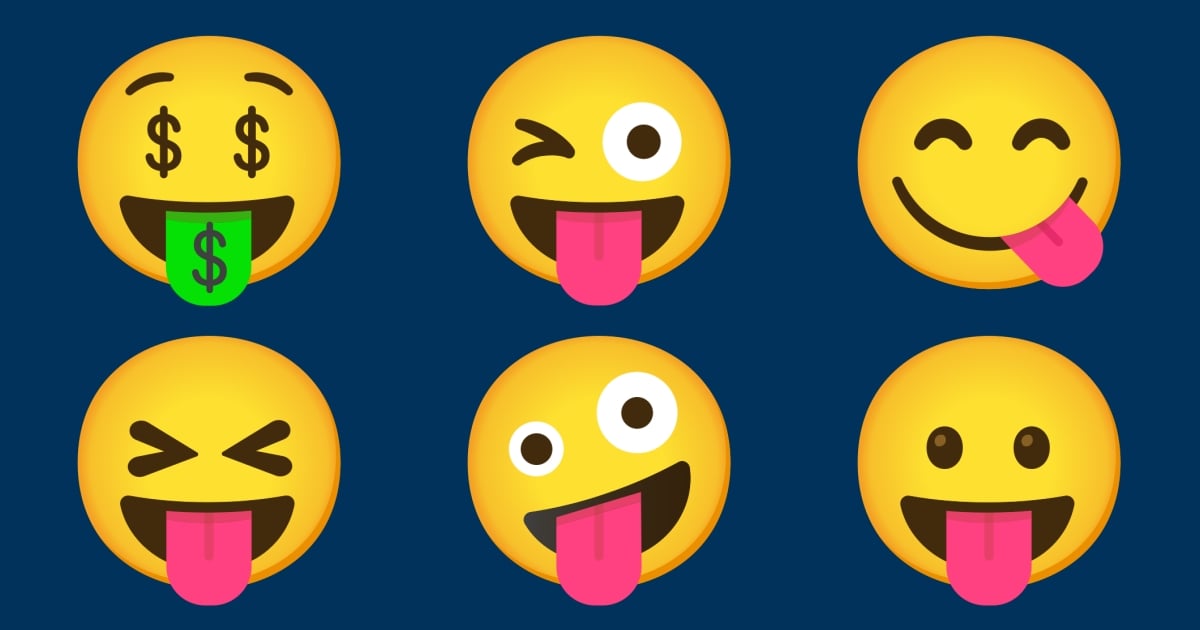
In the landscape of modern digital communication, the “tongue out” emoji family—comprising the standard Face with Tongue ( ), the Winking Face with Tongue ( ), and the Squinting Face with Tongue ( )—represents more than mere playfulness. From a technical perspective, these icons are sophisticated units of data governed by international standards and rendered through complex software architectures. As we move further into an era dominated by rapid-fire messaging and AI-driven interaction, understanding the technical nuances, cross-platform variability, and algorithmic significance of these symbols is essential for tech professionals, developers, and digital linguists alike.

1. The Technical Architecture of Visual Symbols
To understand what the tongue out emoji means in a technical sense, one must first look at the framework that allows it to exist across billions of devices: the Unicode Standard.
The Unicode Consortium and Character Encoding
Every emoji begins as a unique code point assigned by the Unicode Consortium. For instance, the standard “Face with Tongue” is assigned the hexadecimal code U+1F61B. This standardization is what ensures that when a user on an iOS device sends a “tongue out” icon, a user on an Android or Windows device receives a recognizable equivalent rather than a broken “tofu” box (▯).
The process of adopting these symbols involves rigorous technical review. Proponents must prove that the symbol has a distinct “semantic requirement” and is likely to see high frequency of use. The tongue out emoji family passed these hurdles early in the smartphone revolution because they fill a critical gap in digital syntax: the visual representation of tone, specifically humor and non-seriousness.
Cross-Platform Rendering and Fragmentation
While the Unicode hex code is universal, the “glyph” (the actual image) is not. This is where software engineering and graphic design intersect. Apple’s CoreText engine, Google’s Noto Emoji font, and Microsoft’s Segoe UI Emoji all interpret U+1F61B differently.
This technical fragmentation can lead to “semantic slippage.” For example, early versions of the “Winking Face with Tongue” on certain platforms appeared more aggressive or mocking, while on others, they appeared purely flirtatious. Developers must account for these variations when building cross-platform applications, ensuring that the user’s intended sentiment is preserved regardless of the hardware the recipient is using.
2. Digital Linguistics: Emojis as Functional Metadata
In the realm of software development and Natural Language Processing (NLP), the tongue out emoji is treated as a piece of metadata that modifies the “weight” of a text string.
Augmenting Digital Syntax
In written code and data transmission, text is often literal. However, human communication is rarely so. The tongue out emoji serves a technical function known as “illocutionary force.” It acts as a digital gesture that signals to the recipient—and to sentiment analysis algorithms—that the preceding statement should not be taken at face value.
For developers working on sentiment analysis tools, the presence of or often acts as a “flip” or “nullifier” for negative sentiment. A sentence like “I hate you ” is technically processed as a positive or playful interaction, whereas the text alone would be flagged as hostile.
The Role of Context in Algorithmic Interpretation
Advanced AI models, such as LLMs (Large Language Models), process these emojis as tokens. The “meaning” of a tongue out emoji is derived from its proximity to other tokens. In a tech context, this is referred to as “vector embeddings.” The emoji is mapped in a multi-dimensional space where its coordinates are close to terms like “joke,” “kidding,” and “silly.”
As AI becomes more integrated into our communication apps, the “predictive text” functionality uses these embeddings to suggest the tongue out emoji specifically when the user’s typing cadence or word choice suggests a lighthearted mood. This represents a seamless integration of human psychology and machine learning.
3. The Psychology of User Interface and Emoji Integration
The way we interact with the tongue out emoji is heavily influenced by the User Interface (UI) and User Experience (UX) design of our devices.
Haptic Feedback and Input Efficiency
From a UX standpoint, the tongue out emoji is a tool for efficiency. Mobile interfaces are designed to minimize “tap friction.” Expressing the sentiment “I am just joking and don’t want you to be offended by my previous remark” requires dozens of keystrokes. Tapping a single reduces that friction to a single interaction.
Modern keyboards, such as Gboard or the iOS QuickType keyboard, use “emoji prediction” layers. These layers are powered by on-device neural engines that analyze the semantic intent of a message in real-time. If you type “You’re crazy,” the UI will often highlight the tongue out emoji in the suggestion bar, effectively guiding the user’s emotional expression through algorithmic intervention.
Visual Hierarchy in App Design
App developers often treat the “tongue out” emoji as a primary engagement tool. In social media “Reactions” or “Quick Replies,” these emojis are strategically placed within the visual hierarchy to encourage low-stakes, high-frequency engagement. By providing a “tongue out” reaction, developers allow users to acknowledge a post with a specific brand of playfulness that a simple “Like” or “Heart” cannot convey. This technical choice increases user retention and session length by making digital social grooming more nuanced and less taxing.
4. Advanced Interactivity: From 2D Icons to AR and Biometrics
The “meaning” of the tongue out emoji has transitioned from a static 2D image to a dynamic, biometric-driven data point. This is most evident in the development of Augmented Reality (AR) and facial tracking technology.
Biometric Mapping and Animoji
With the introduction of Apple’s TrueDepth camera system and similar technologies on Android, the “tongue out” gesture became a benchmark for hardware capability. Tracking the human tongue is technically difficult because it is a “soft tissue” muscle with no skeletal structure for a camera to easily “anchor” to.
When a user sticks their tongue out to animate a Memoji, the hardware is performing a high-speed analysis of over 50 different facial muscle movements. In this context, the tongue out emoji is a demonstration of sophisticated computer vision. It is no longer just a character code; it is a real-time mapping of human anatomy into a digital avatar.
The Future of Haptic and Spatial Communication
As we move toward spatial computing—exemplified by headsets like the Apple Vision Pro or Meta Quest—the tongue out emoji will likely evolve into a 3D environmental asset. In a virtual workspace or social VR setting, “sending” an emoji might involve a haptic response or a spatial animation that exists in three-dimensional space.
The technical challenge will be maintaining the “playful” meaning of the tongue out emoji while adding layers of depth and texture. We are seeing the beginning of “procedural expression,” where an emoji might change its intensity based on the volume of the user’s voice or the speed of their gestures, all tracked by internal and external sensors.
5. Security, Privacy, and Digital Forensics
Finally, it is important to consider the tongue out emoji from the perspective of digital security and forensics. In a professional and legal tech context, the interpretation of an emoji can have significant consequences.
Metadata and Legal Precedent
In digital forensics, emojis are increasingly used as evidence in legal cases. The “tongue out” emoji can be used to argue the intent of a message. From a data perspective, investigators look at the timestamp, the specific Unicode version used, and the platform-specific rendering to reconstruct a digital conversation.
Because different platforms render differently, a “tongue out” emoji sent from a PC might look “mocking” while the recipient on an iPhone sees it as “playful.” This technical discrepancy is a known issue in digital law, where the “meaning” of a message is inherently tied to the hardware and software used to view it.
AI Moderation and Edge Cases
Large-scale platforms use AI to moderate content. The tongue out emoji poses a unique challenge for automated systems. While generally benign, it can be used in “adversarial attacks” to bypass filters. For instance, combining a “tongue out” emoji with a coded slur can sometimes confuse basic moderation algorithms that prioritize the “positive” weight of the emoji over the “negative” weight of the text. Tech companies are constantly updating their transformer-based models to better understand these subtle, visual nuances in digital irony and sarcasm.

Conclusion
The “tongue out” emoji is far more than a whimsical character in a text message; it is a testament to the sophistication of modern mobile technology. From its roots in the Unicode Standard to its role in biometric AR tracking and AI-driven sentiment analysis, this symbol sits at the intersection of human psychology and high-level software engineering.
As developers and tech enthusiasts, recognizing the technical weight of these icons allows us to build better communication tools, more accurate AI models, and more inclusive digital spaces. The next time you send a , remember that you are not just sending a face—you are initiating a complex chain of data processing, rendering, and algorithmic interpretation that defines the very edge of 21st-century digital linguistics.
aViewFromTheCave is a participant in the Amazon Services LLC Associates Program, an affiliate advertising program designed to provide a means for sites to earn advertising fees by advertising and linking to Amazon.com. Amazon, the Amazon logo, AmazonSupply, and the AmazonSupply logo are trademarks of Amazon.com, Inc. or its affiliates. As an Amazon Associate we earn affiliate commissions from qualifying purchases.