
In the intricate symphony of modern automotive engineering, countless components work in harmony to deliver performance, efficiency, and reliability. At the heart of this complex orchestration often sits a single, powerful conductor: the Powertrain Control Module, or PCM. Far from a mere circuit board, the PCM serves as the central brain of a vehicle’s most critical systems, continuously monitoring, analyzing, and adjusting countless parameters to ensure optimal operation. For anyone navigating the complexities of modern vehicle technology, understanding what the PCM controls is not just academic; it’s fundamental to comprehending how a vehicle truly functions.

Understanding the Powertrain Control Module (PCM)
To grasp the profound influence of the PCM, we must first define its nature and position within the vehicle’s electronic architecture. Often hailed as the “brain” of the car, the PCM is an advanced microprocessor-based control unit designed to manage the engine and transmission. While older vehicles might have separate Engine Control Units (ECU) and Transmission Control Units (TCU), many contemporary vehicles integrate these functions into a single, more powerful PCM for enhanced communication and efficiency.
Defining the Brain of Your Vehicle
The PCM is typically located inside the engine bay, under the dashboard, or beneath a seat, protected from the elements and physical damage. Its primary role is to act as a sophisticated digital supervisor, overseeing the myriad processes that contribute to a vehicle’s powertrain performance. It’s not just reactive; it’s predictive, making real-time adjustments based on a flood of incoming data to optimize everything from fuel economy to emissions control and driveability. Without a functioning PCM, a modern vehicle would be little more than an inert collection of parts, unable to coordinate the thousands of micro-decisions required for propulsion.
The Interconnected Network
The PCM doesn’t operate in isolation. It is a node within a larger, interconnected network of electronic control units (ECUs) that govern various aspects of the vehicle. This network, often employing communication protocols like Controller Area Network (CAN bus), allows the PCM to exchange data with other modules, such as those for the anti-lock braking system (ABS), supplemental restraint system (SRS/airbags), body control module (BCM), and even infotainment systems. For instance, the PCM might receive information about wheel speed from the ABS module to assist with traction control decisions, or communicate with the BCM regarding climate control settings that impact engine load. This constant data exchange ensures that all systems are working cohesively, contributing to a holistic and integrated driving experience.
The Core Functions of the PCM: Orchestrating Performance
The sheer scope of what the PCM controls is immense, encompassing virtually every aspect of the engine’s combustion process and the transmission’s gear selection. Its decisions are executed in milliseconds, ensuring seamless and efficient operation under diverse driving conditions.
Engine Management
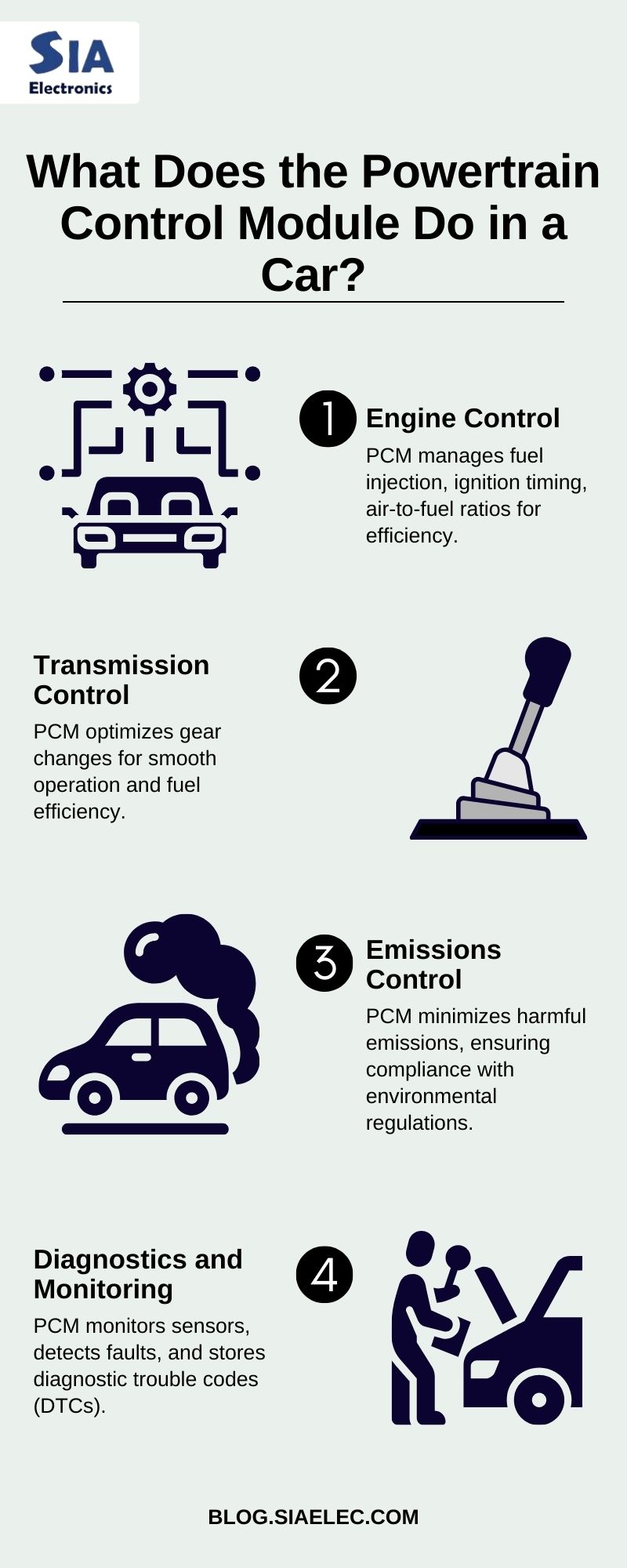
At its heart, the PCM is the ultimate engine manager. It precisely dictates the three pillars of engine operation: air, fuel, and spark.
- Fuel Injection: The PCM determines the precise amount of fuel to inject into each cylinder and the exact moment it should be delivered. It considers factors like engine load, speed, air temperature, and oxygen sensor readings to ensure the optimal air-fuel ratio for efficient combustion and reduced emissions. This can involve adjusting fuel injector pulse width and timing.
- Ignition Timing: It controls when the spark plugs fire, igniting the air-fuel mixture in each cylinder. Proper ignition timing is critical for maximizing power output and fuel efficiency while preventing engine knock or pre-ignition. The PCM dynamically advances or retards timing based on engine conditions.
- Idle Speed Control: The PCM maintains a stable idle speed by adjusting the amount of air bypassing the throttle body (via an Idle Air Control valve or by controlling the electronic throttle itself). This prevents stalling and ensures smooth operation when the vehicle is stationary.
- Variable Valve Timing (VVT) and Lift Control: Many modern engines employ VVT systems to optimize valve overlap and duration for different RPMs and loads. The PCM commands these actuators to improve torque, horsepower, and fuel economy across the engine’s operating range.
Transmission Control
Beyond the engine, the PCM also exerts significant influence over the vehicle’s transmission, particularly in automatic transmissions.
- Gear Shifting Logic: The PCM determines the optimal shift points for upshifts and downshifts based on throttle input, vehicle speed, engine load, and driver behavior. It aims to balance performance with fuel economy, ensuring smooth transitions.
- Torque Converter Lock-Up: It controls the locking and unlocking of the torque converter, which provides a direct mechanical link between the engine and transmission, improving fuel efficiency at cruising speeds.
- Shift Quality: By precisely managing hydraulic pressure to the transmission’s clutch packs and bands, the PCM ensures smooth and imperceptible gear changes, enhancing passenger comfort.
Emissions Control
Modern vehicles are subject to stringent emissions regulations, and the PCM plays a crucial role in meeting these standards.
- Exhaust Gas Recirculation (EGR): The PCM controls the EGR valve, which routes a small amount of exhaust gas back into the combustion chambers to reduce nitrogen oxide (NOx) emissions.
- Catalytic Converter Efficiency: It monitors the oxygen sensors before and after the catalytic converter to ensure it is operating efficiently in converting harmful pollutants into less toxic substances. If the converter is not functioning correctly, the PCM will trigger the Check Engine Light.
- Evaporative Emission Control (EVAP): The PCM manages the EVAP system, which prevents fuel vapors from escaping into the atmosphere, ensuring they are stored and then routed back to the engine for combustion.
Drivability and Safety
While not directly controlling features like airbags or ABS, the PCM provides critical data and control outputs that indirectly contribute to overall drivability and safety.
- Throttle Body Control: In drive-by-wire systems, the PCM translates accelerator pedal input into precise electronic commands for the electronic throttle body, eliminating a mechanical linkage. This allows for features like cruise control, traction control integration, and smooth power delivery.
- Limp Mode Activation: In the event of a severe fault within the powertrain, the PCM can activate a “limp home” mode. This limits engine power and transmission functions to prevent further damage, allowing the driver to reach a service center safely.
Key Systems and Components Managed by the PCM
The PCM’s ability to exert such comprehensive control relies on a sophisticated network of sensors that provide it with real-time data, and a series of actuators that carry out its commands.
Input Sensors
These are the PCM’s eyes and ears, constantly feeding it vital information about the vehicle’s operating conditions:
- Oxygen (O2) Sensors: Measure the oxygen content in the exhaust gases, crucial for optimizing the air-fuel ratio and monitoring catalytic converter efficiency.
- Mass Airflow (MAF) Sensor: Measures the amount of air entering the engine, directly impacting fuel injection calculations.
- Manifold Absolute Pressure (MAP) Sensor: Measures the pressure within the intake manifold, providing an indication of engine load, especially in naturally aspirated or forced induction engines.
- Throttle Position Sensor (TPS): Detects the accelerator pedal’s position and the throttle plate’s angle, informing the PCM of driver demand.
- Crankshaft and Camshaft Position Sensors: These critical sensors track the rotational position and speed of the crankshaft and camshafts, allowing the PCM to precisely time fuel injection and ignition.
- Vehicle Speed Sensor (VSS): Provides vehicle speed data, essential for transmission shift points, cruise control, and overall performance mapping.
- Temperature Sensors: Coolant temperature, intake air temperature, and transmission fluid temperature sensors provide vital thermal data that influence fuel mixture, ignition timing, and transmission operation.
Output Actuators
These are the PCM’s hands, executing its commands based on the data received from the sensors:
- Fuel Injectors: The PCM precisely controls the opening and closing of fuel injectors to deliver the correct amount of fuel.
- Ignition Coils: The PCM commands the ignition coils to generate high-voltage sparks at the optimal time for combustion.
- Electronic Throttle Body (ETB): In drive-by-wire systems, the PCM directly controls the opening and closing of the throttle plate, regulating airflow into the engine.
- Idle Air Control (IAC) Valve: Regulates the amount of air bypassing the throttle plate to control idle speed (in vehicles without ETB).
- Variable Valve Timing (VVT) Solenoids: The PCM actuates these solenoids to adjust valve timing for optimized engine breathing.
- Transmission Solenoids: These solenoids control the hydraulic pressure that engages and disengages clutch packs and bands, facilitating gear changes.
- Cooling Fan Relays: The PCM can activate the engine’s cooling fans when coolant temperatures exceed predefined limits.
Diagnostic Capabilities (OBD-II)
A key function of the PCM, especially in modern vehicles (since 1996 in the U.S., with the introduction of OBD-II standards), is its self-diagnostic capability. The PCM constantly monitors all its controlled systems for anomalies. If it detects a fault that could impact emissions or vehicle operation, it stores a Diagnostic Trouble Code (DTC) in its memory and illuminates the “Check Engine Light” (CEL) or “Malfunction Indicator Lamp” (MIL) on the dashboard. These codes provide technicians with specific information, enabling efficient troubleshooting and repair.
The Evolution and Future of PCM Technology
The journey of the PCM reflects the rapid advancement of automotive technology, from rudimentary electronic controls to highly sophisticated, integrated systems.
From Basic Control to Advanced Integration
Early electronic control units were simple, managing only a few basic engine parameters. Over decades, as microprocessors became more powerful and miniature, these units evolved. The consolidation of engine and transmission control into a single PCM was a significant leap, improving communication speeds and processing power. Today’s PCMs are miniature supercomputers, running complex algorithms and processing millions of calculations per second. They are designed for reliability, robustness, and the ability to adapt to changing conditions and driver inputs.
Software and Firmware Updates
Modern PCMs are heavily software-driven. This means their operational parameters and logic can be modified or updated through firmware flashes. Automotive manufacturers frequently release software updates to improve performance, fix bugs, enhance fuel efficiency, or even add new features. This capability extends the lifespan of the PCM and allows vehicles to benefit from ongoing research and development without requiring hardware replacement. Over-the-air (OTA) updates, common in electric vehicles and high-end luxury cars, further streamline this process, allowing updates to be downloaded and installed remotely, similar to smartphone software updates.
Integration with ADAS and Autonomous Driving
As vehicles move towards higher levels of automation, the PCM’s role continues to expand. The data it generates about engine load, vehicle speed, and driver inputs is crucial for Advanced Driver-Assistance Systems (ADAS) like adaptive cruise control, lane-keeping assist, and automatic emergency braking. In the future of fully autonomous vehicles, the PCM will likely be even more tightly integrated with artificial intelligence and sensor fusion systems, providing critical powertrain control decisions based on environmental data and predictive algorithms. Its reliability and real-time processing capabilities will be paramount for safe and effective autonomous operation.
Cybersecurity Considerations
With increasing connectivity and software reliance, the PCM, like other vehicle ECUs, becomes a potential target for cyber threats. Protecting the PCM’s software and data from unauthorized access, manipulation, or malicious attacks is a growing concern for automotive manufacturers. Robust cybersecurity measures, including encryption, secure boot processes, and intrusion detection systems, are being implemented to safeguard the integrity and functionality of these critical control modules.
Maintaining and Troubleshooting PCM Issues
Given the PCM’s central role, any malfunction can have significant repercussions for vehicle performance and reliability. Understanding common symptoms and diagnostic approaches is vital.
Common Symptoms of a Failing PCM
A failing PCM can manifest in a variety of ways, often leading to frustrating and potentially dangerous driving experiences:
- Check Engine Light On: This is the most common indicator, though it can signal a multitude of other issues. Specific PCM-related DTCs would be stored.
- Engine Performance Issues: This includes rough idle, stalling, misfires, reduced power, poor acceleration, or excessive fuel consumption.
- Transmission Problems: Erratic shifting, hard shifts, inability to shift gears, or the transmission going into “limp mode.”
- Failure to Start: In severe cases, a completely dead PCM can prevent the engine from starting or even cranking.
- Intermittent Problems: Symptoms may come and go, making diagnosis challenging.
- Vehicle Failing Emissions Test: Due to incorrect air-fuel mixture or catalyst monitoring issues.
Diagnostic Procedures
Diagnosing a PCM failure requires specialized tools and expertise. While an OBD-II scanner can read basic DTCs, a professional scan tool can access live data streams, perform actuator tests, and communicate more deeply with the PCM. Technicians will often rule out simpler issues (like faulty sensors or wiring) before condemning the PCM itself, as PCM failures are relatively rare but expensive. Visual inspection for physical damage, water intrusion, or burnt components can also provide clues.

Prevention and Care
While PCMs are generally robust, certain precautions can help ensure their longevity:
- Avoid Electrical Surges: Ensure the vehicle’s electrical system is in good condition, especially the battery and alternator. Disconnect the battery before performing welding on the vehicle.
- Proper Battery Maintenance: A weak or failing battery can cause voltage fluctuations that stress the PCM.
- Prevent Water Damage: Keep the PCM’s housing sealed and protected from moisture, as water intrusion is a common cause of failure.
- Professional Servicing: Always allow qualified technicians to perform diagnostic and repair work that involves the PCM or its related wiring.
In conclusion, the Powertrain Control Module is a marvel of modern engineering, an unsung hero that meticulously manages the engine and transmission to provide the power, efficiency, and reliability we expect from our vehicles. Its extensive control over a vast array of sensors and actuators makes it indispensable, defining the very essence of how a contemporary car drives. As automotive technology continues its rapid evolution, the PCM will undoubtedly remain at the forefront, adapting and expanding its capabilities to meet the demands of future mobility.
aViewFromTheCave is a participant in the Amazon Services LLC Associates Program, an affiliate advertising program designed to provide a means for sites to earn advertising fees by advertising and linking to Amazon.com. Amazon, the Amazon logo, AmazonSupply, and the AmazonSupply logo are trademarks of Amazon.com, Inc. or its affiliates. As an Amazon Associate we earn affiliate commissions from qualifying purchases.