
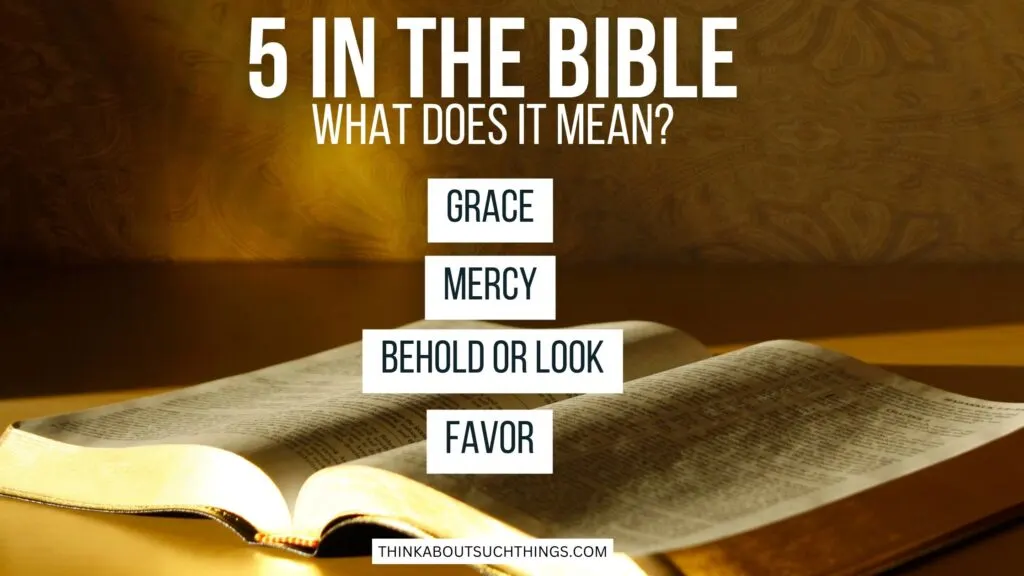
The Bible is a rich tapestry of symbolism, and numbers often carry profound spiritual significance. While some numbers are straightforward, others, like the number five, hold a multifaceted meaning that resonates throughout Scripture. Far from being a mere digit, the number five frequently appears in contexts that point towards concepts of divine grace, human responsibility, the law, and the completeness of God’s provision and judgment. Understanding these scriptural patterns can offer deeper insights into God’s character and His dealings with humanity.
The Foundation of God’s Grace and Law
The number five’s significance is deeply rooted in its connection to both divine favor and the framework of divine instruction. This duality highlights a core theological principle: God’s grace is extended to humanity, yet it is often intertwined with His commands and expectations.

Divine Grace and Provision
One of the most prominent associations of the number five with grace is found in the miracle of the feeding of the five thousand. In this account, a young boy offers five barley loaves and two fish, which Jesus miraculously multiplies to feed a vast multitude. This event is recorded in all four Gospels (Matthew 14:13-21; Mark 6:30-44; Luke 9:10-17; John 6:1-14), underscoring its importance. The five loaves are seen by many as a symbol of the sufficiency of God’s provision, even from humble beginnings, and the abundance of His grace. It demonstrates that with God, even small offerings can be transformed into something extraordinary to meet the needs of many. This miracle doesn’t just speak of physical sustenance; it points to the spiritual nourishment and eternal life that Jesus offers. The five loaves, representing a meager human contribution, become the catalyst for an overwhelming divine blessing, highlighting the principle that God often works through our limited resources to display His boundless power and generosity.
Furthermore, the number five appears in the context of the five books of Moses, known as the Pentateuch or the Torah. These books lay the foundation for Jewish law and covenant, outlining God’s commandments, His relationship with Israel, and His redemptive plan. The Pentateuch is foundational to understanding the Old Testament and God’s dealings with His chosen people. Within these books, the Law itself is often seen as a manifestation of God’s love and wisdom, intended to guide humanity toward a righteous life and a deeper relationship with Him. While the Law can be perceived as demanding, it is also understood as a gift, a framework designed to protect and bless those who adhere to it. The five books represent a complete and foundational body of divine instruction, setting forth the principles by which God’s people were to live.
The Five-Fold Ministry and Spiritual Gifts
In the New Testament, the number five also points to the equipping of believers for service through spiritual gifts, often referred to as the five-fold ministry. Ephesians 4:11 speaks of Christ giving some to be apostles, prophets, evangelists, pastors, and teachers. These roles are vital for building up the body of Christ, equipping the saints for their work of ministry, and bringing them to maturity in faith. This is a direct demonstration of God’s grace in providing the necessary leadership and spiritual enablement for the church to function and grow. The diversity of these gifts, all numbering five in this particular enumeration, underscores God’s comprehensive approach to building His kingdom. Each role, though distinct, contributes to the overall health and mission of the church, showcasing a divinely orchestrated system of spiritual leadership and empowerment.
Symbols of Completeness and Divine Order
Beyond grace and law, the number five frequently symbolizes completeness, perfection, and a divinely ordained order. This can be seen in both natural and spiritual realms, as God’s creation and His plans often exhibit this numerical pattern.
The Pentagram and Human Hand
In a more symbolic, though less direct, biblical sense, the five points of a pentagram can be seen to represent the human form – two arms, two legs, and a head. While the pentagram itself has been co-opted by various, often negative, spiritual practices, its original representation of humanity can be linked to biblical themes of human stewardship and God’s creation. Humanity, made in God’s image, is given dominion over creation. This connection, while speculative in direct biblical exegesis, adds another layer to the number five’s association with the human element within God’s grand design. The five fingers on each hand, the five toes on each foot – these are fundamental aspects of human anatomy that allow for interaction with the world, for work, for creation, and for grasping. This inherent five-pointed structure of the human body can be interpreted as a natural representation of humanity’s place in God’s created order.
The Tabernacle and Temple Structures
The Old Testament Tabernacle, and later the Temple, were meticulously designed by God, with specific measurements and components. While not always explicitly stated as “five,” many elements of these sacred structures exhibit proportions or quantities that align with the significance of five. For instance, the dimensions of certain courts, the placement of pillars, or the number of furnishings can be analyzed for symbolic resonance. The bronze altar, for example, had specific dimensions that, when considered with other proportional aspects, could suggest a numerological pattern. The concept of five often relates to wholeness and fulfillment in God’s dwelling place. The structure of the Tabernacle itself was designed to facilitate worship and atonement, demonstrating God’s desire for relationship with His people. The number five’s presence, even if subtle in architectural detail, reinforces the idea of divine completeness and perfection in His presence.
The Number Five in Prophecy and Judgment
The number five also appears in contexts of divine judgment and prophetic pronouncements. This dual nature – grace and judgment – is characteristic of God’s interaction with humanity, as He offers mercy but also holds individuals and nations accountable for their actions.
Prophetic Cycles and Warnings
Throughout the prophetic books of the Old Testament, visions and pronouncements often involve symbolic numbers. While five may not be as overtly prominent as numbers like seven or forty, its appearances can signify periods of trial or specific divine actions. For example, in some prophetic passages, the number five might be used to denote a partial fulfillment or a preliminary stage of a larger prophetic event. Understanding these numerical allusions requires careful contextual analysis. The prophets often used symbolic language to convey complex spiritual truths, and numbers were a significant part of this lexicon. The recurrence of five in certain prophetic contexts can serve as a reminder of God’s sovereign control over history and His meticulous attention to detail in His judgments and His plans for the future.

The Five Judges and Consequences
In some interpretations of biblical narratives, the number five can be associated with periods of judgment or consequences for sin. While not always explicitly enumerated as “five,” certain passages might describe a series of events or a group of individuals that, when analyzed symbolically, can carry the resonance of this number. For instance, if a passage describes five specific instances of disobedience or five pronouncements of consequence, these could be seen as reinforcing the idea of divine justice. The concept of a judicial process often involves a sequence of actions or a panel of decision-makers, and the number five can subtly allude to such structures when they represent a complete or definitive outcome. This aspect of the number five highlights the seriousness of sin and the inevitability of God’s righteous judgment, even as it is tempered by His boundless mercy.
In conclusion, the number five in biblical terms is a rich symbol that weaves through Scripture, representing God’s grace, His law, His provision, spiritual completeness, and divine order. From the miracle of the loaves and fishes to the foundational books of Moses, and the equipping of believers for ministry, five consistently points to the benevolent yet sovereign hand of God. While it can also appear in contexts of judgment, its overarching theme is one of divine completeness and provision. By recognizing these numerical patterns, we gain a deeper appreciation for the intricate and symbolic language of the Bible, revealing a God who is both merciful and just, and whose plans are meticulously ordered.
aViewFromTheCave is a participant in the Amazon Services LLC Associates Program, an affiliate advertising program designed to provide a means for sites to earn advertising fees by advertising and linking to Amazon.com. Amazon, the Amazon logo, AmazonSupply, and the AmazonSupply logo are trademarks of Amazon.com, Inc. or its affiliates. As an Amazon Associate we earn affiliate commissions from qualifying purchases.