
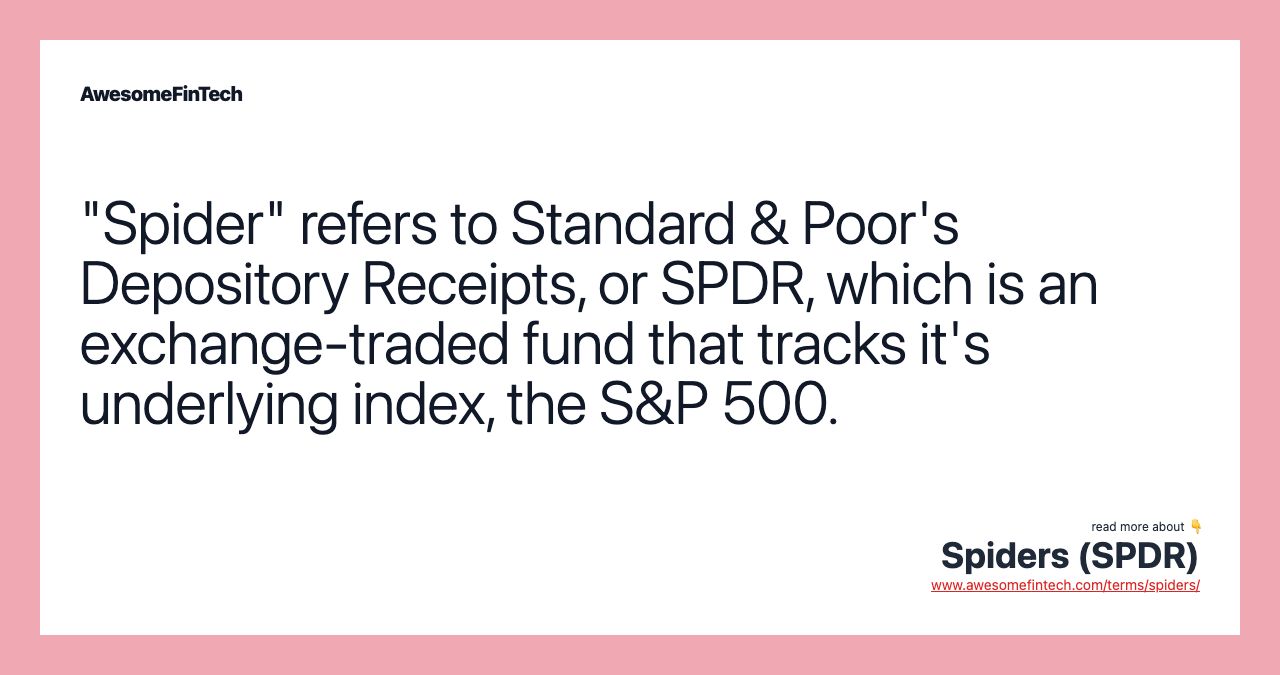
In the landscape of modern finance, few acronyms carry as much weight or historical significance as “SPDR.” For the uninitiated, the term might sound like a tech startup or a niche branding exercise, but for the millions of investors who participate in the global markets, it represents a fundamental shift in how wealth is built and managed. SPDR stands for Standard & Poor’s Depositary Receipt. While the name itself sounds technical, its impact on the world of personal finance and institutional investing has been nothing short of revolutionary.
Commonly referred to as “Spiders,” these financial instruments were the pioneers of the Exchange-Traded Fund (ETF) industry. Managed by State Street Global Advisors (SSGA), SPDRs have evolved from a single innovative product into a massive family of funds covering every conceivable sector, commodity, and asset class. To understand what SPDR stands for in a literal sense is simple; to understand what it stands for in the context of financial evolution requires a deeper look into its history, its structure, and its role in the democratization of the stock market.
The Definition and Origin of SPDR ETFs
The journey of the SPDR began in the early 1990s, a time when mutual funds were the primary vehicle for retail investors to gain diversified market exposure. However, mutual funds had limitations: they could only be traded once a day after the market closed, and they often came with high management fees and tax inefficiencies.
The Acronym Decoded: Standard & Poor’s Depositary Receipt
The “Standard & Poor’s” portion of the name refers to the S&P 500 Index, the benchmark that tracks the performance of 500 of the largest companies listed on stock exchanges in the United States. The “Depositary Receipt” part refers to the legal structure of the original fund. When an investor buys a share of a SPDR, they are effectively buying a receipt representing a fractional ownership in a trust that holds the actual stocks within the S&P 500.
The Birth of SPY: 1993 and the Financial Revolution
On January 22, 1993, the SPDR S&P 500 ETF (ticker symbol: SPY) was launched on the American Stock Exchange. It was the first ETF listed in the United States. Developed by Nathan Most and Steven Bloom under the guidance of the American Stock Exchange and State Street, SPY was designed to provide a way to trade the entire S&P 500 index as if it were a single stock.
This was a watershed moment for personal finance. Before SPY, if an investor wanted to track the S&P 500, they had to buy a mutual fund or manually purchase 500 different stocks. SPY offered a third way: a liquid, tradable security that could be bought and sold throughout the trading day, offering instant diversification and lower costs. Today, SPY remains the largest and most heavily traded ETF in the world, serving as a cornerstone for both retirement accounts and high-frequency trading strategies.
How SPDRs Reshaped Personal Finance and Market Accessibility
The success of the original SPDR changed the trajectory of the investment industry. It introduced a level of flexibility that had previously been reserved for institutional “floor traders” and hedge fund managers. For the average individual investor, the “Spider” represented the democratization of sophisticated financial tools.
Democratizing the Stock Market
Prior to the rise of ETFs like SPDRs, the barrier to entry for high-level portfolio management was significant. Small investors often faced high commissions and limited access to specific market segments. SPDRs lowered these barriers by allowing anyone with a brokerage account to buy a “basket” of stocks for the price of a single share. This shifted the power dynamic from active fund managers—who often failed to beat the market—to passive indexing, which offered a more reliable, low-cost path to long-term wealth.
Intraday Trading and Liquidity
One of the most significant advantages SPDRs brought to the table was intraday liquidity. Unlike mutual funds, which are priced at the end of the day based on Net Asset Value (NAV), SPDRs trade on an exchange just like shares of Apple or Microsoft. This means investors can use limit orders, stop-losses, and even buy on margin or sell short. This flexibility is crucial during periods of market volatility, allowing investors to enter or exit positions in real-time rather than waiting for the market close.
Exploring the SPDR Family: From Broad Markets to Niche Sectors
While the S&P 500 fund (SPY) is the most famous member of the family, State Street Global Advisors has expanded the SPDR brand to include a vast array of specialized funds. This expansion has allowed investors to move beyond broad market indexing into “sector rotation” and thematic investing.

The Select Sector SPDRs
One of the most popular innovations within the brand is the “Select Sector” series. These funds divide the S&P 500 into specific industry groups, allowing investors to bet on (or hedge against) specific parts of the economy. Notable examples include:
-
XLK (Technology Select Sector SPDR Fund): Provides exposure to tech giants like Microsoft, Apple, and NVIDIA.
-
XLF (Financial Select Sector SPDR Fund): Covers major banks, insurance companies, and investment firms.
-
XLV (Health Care Select Sector SPDR Fund): Includes pharmaceutical companies and medical device manufacturers.
-
XLE (Energy Select Sector SPDR Fund): Tracks companies involved in oil, gas, and consumable fuels.
By using these sector-specific “Spiders,” investors can tailor their portfolios to reflect their economic outlook. For example, if an investor believes the tech sector is overvalued but the energy sector is poised for a comeback, they can easily adjust their holdings using these ETFs.
GLD: The Gold Standard of Commodities
The SPDR brand isn’t limited to stocks. In 2004, the SPDR Gold Shares (GLD) was launched, revolutionizing how investors access the precious metals market. Before GLD, owning gold required physical storage or navigating the complex futures market. GLD made it possible to own gold in a brokerage account, with each share representing a fractional interest in physical gold bullion stored in secure vaults. It quickly became one of the most successful commodity products in financial history.
Fixed Income and International Exposure
Beyond equities and commodities, the SPDR lineup includes a robust selection of bond ETFs and international funds. Whether an investor is looking for exposure to high-yield corporate bonds (JNK), emerging markets, or international dividend-paying stocks, there is likely a SPDR fund designed for that purpose. This comprehensive ecosystem allows for the construction of a fully diversified global portfolio using only SPDR products.
Strategic Benefits of Investing in SPDRs
The reason SPDRs have maintained their dominance in the face of stiff competition is rooted in their structural advantages. For the savvy investor, these funds offer more than just a ticker symbol; they offer a set of strategic benefits that can enhance long-term returns.
Cost-Efficiency and Low Expense Ratios
One of the primary drivers of the “ETF revolution” was the drive to lower costs. High fees are the “silent killer” of investment returns over time. SPDRs, particularly the broad market ones, offer some of the lowest expense ratios in the industry. Because these funds are passively managed—meaning they simply track an index rather than paying a team of analysts to pick stocks—the savings are passed on to the investor.
Tax Efficiency and the Creation-Redemption Process
SPDRs are generally more tax-efficient than traditional mutual funds. This is due to the “in-kind” creation and redemption process. When an investor sells shares of an ETF, the fund manager doesn’t necessarily have to sell the underlying stocks (which would trigger capital gains taxes for all shareholders). Instead, large institutional players called Authorized Participants handle the exchange of shares for the underlying securities. This mechanism minimizes “capital gains distributions,” allowing investors to keep more of their money working in the market.
Diversification and Risk Management
By their very nature, SPDRs provide instant diversification. Owning SPY means owning a piece of 500 different companies. If one company in the index goes bankrupt, its impact on the total portfolio is negligible. This “basket” approach mitigates the unsystematic risk associated with individual stock picking, making it an ideal core holding for both conservative retirees and aggressive growth seekers.
Comparison and Competition: SPDR vs. iShares and Vanguard
While SPDR was the first to market, it now operates in a highly competitive landscape alongside giants like BlackRock’s iShares and Vanguard. Understanding the nuances between these brands is essential for optimized portfolio construction.

Choosing the Right Fund for Your Portfolio
In recent years, a “race to the bottom” regarding fees has occurred. While SPY is the most liquid fund (favored by traders), Vanguard’s VOO or BlackRock’s IVV often offer slightly lower expense ratios, making them more attractive for long-term “buy and hold” investors. However, the SPDR brand has responded by launching the “Portfolio” series (e.g., SPLG), which offers ultra-low-cost alternatives to their flagship products.
Furthermore, the SPDR Select Sectors remain the industry standard for institutional liquidity. If a large pension fund needs to move $100 million into the financial sector, they are likely to use XLF because its massive trading volume ensures they can enter the position without significantly moving the price. For the retail investor, this liquidity translates to “tight spreads,” meaning the difference between the buying price and the selling price is minimal, saving money on every transaction.
As the financial world continues to evolve toward digital assets, ESG (Environmental, Social, and Governance) criteria, and AI-driven strategies, the SPDR brand remains at the forefront. What started as a “Depositary Receipt” for the S&P 500 has become the foundational architecture of the modern investment portfolio. For anyone serious about their personal finances, understanding “the Spider” is not just about knowing an acronym—it’s about understanding the engine that drives the global markets.
aViewFromTheCave is a participant in the Amazon Services LLC Associates Program, an affiliate advertising program designed to provide a means for sites to earn advertising fees by advertising and linking to Amazon.com. Amazon, the Amazon logo, AmazonSupply, and the AmazonSupply logo are trademarks of Amazon.com, Inc. or its affiliates. As an Amazon Associate we earn affiliate commissions from qualifying purchases.