
For anyone navigating the world of finance, the S&P 500 is a term that frequently surfaces. It’s referenced daily in financial news, market reports, and investment discussions. But what exactly does “S&P 500” mean, and why is it so significant? At its core, the S&P 500 is a stock market index that represents the performance of 500 of the largest publicly traded companies in the United States. More than just a list of companies, it serves as a critical benchmark for the health of the U.S. stock market and, by extension, the broader American economy. Understanding the S&P 500 is fundamental for investors, economists, and anyone seeking to grasp the dynamics of modern financial markets. It’s a barometer, a standard, and often, a powerful tool for building long-term wealth.
Unpacking the S&P 500: A Core Investment Benchmark
The S&P 500 isn’t merely an arbitrary collection of 500 companies; it’s a carefully constructed index designed to provide a comprehensive gauge of large-cap U.S. equities. Created and maintained by S&P Dow Jones Indices, its methodology is rigorous, ensuring it accurately reflects a significant portion of the investable U.S. equity market. Its prominence stems from its broad representation and its market-capitalization weighting scheme, which gives larger companies a proportionally greater influence on the index’s performance.
More Than Just 500 Companies: The Selection Process
While the name suggests a simple count of 500 companies, the selection process for the S&P 500 is far more nuanced. Companies aren’t simply chosen based on size alone. S&P Dow Jones Indices employs a committee that applies specific criteria to ensure the index is representative, investable, and maintains continuity. Key criteria include:
- Market Capitalization: Companies must generally have an unadjusted market capitalization of at least $14.6 billion (as of recent figures, though this can change).
- Liquidity: The company’s stock must be highly liquid, meaning a significant volume of shares are traded regularly. This ensures that the index can be easily replicated by investment funds.
- Public Float: A substantial portion of the company’s shares must be available for public trading, not locked up by insiders.
- Domicile: The company must be a U.S. company, though its operations can be global.
- Profitability: The company must have positive reported earnings in the most recent quarter and positive aggregate earnings over the past four consecutive quarters.
- Sector Representation: The committee also considers sector balance to ensure the index mirrors the sector weightings of the broader U.S. economy, preventing overconcentration in any single industry.
This rigorous selection process ensures that the S&P 500 is a dynamic and relevant indicator, with companies being added or removed as they meet or cease to meet these qualifications. It’s not just the 500 largest, but the 500 most significant and representative large U.S. companies.
Understanding Market Capitalization-Weighting
One of the most crucial aspects of the S&P 500’s construction is its market-capitalization weighting. This means that companies with larger market capitalizations (share price multiplied by the number of outstanding shares) have a greater impact on the index’s overall value and performance. For example, if Apple, a company with a massive market cap, sees its stock price rise by 1%, it will have a much more significant effect on the S&P 500’s daily movement than a 1% rise in a smaller component company.
This weighting methodology is designed to reflect the real-world impact of companies on the economy. Larger companies, by nature of their size, typically have a greater influence on economic activity, employment, and overall market sentiment. While effective for representation, it also means the index’s performance can be heavily influenced by the performance of its top constituents.
A Snapshot of the U.S. Economy
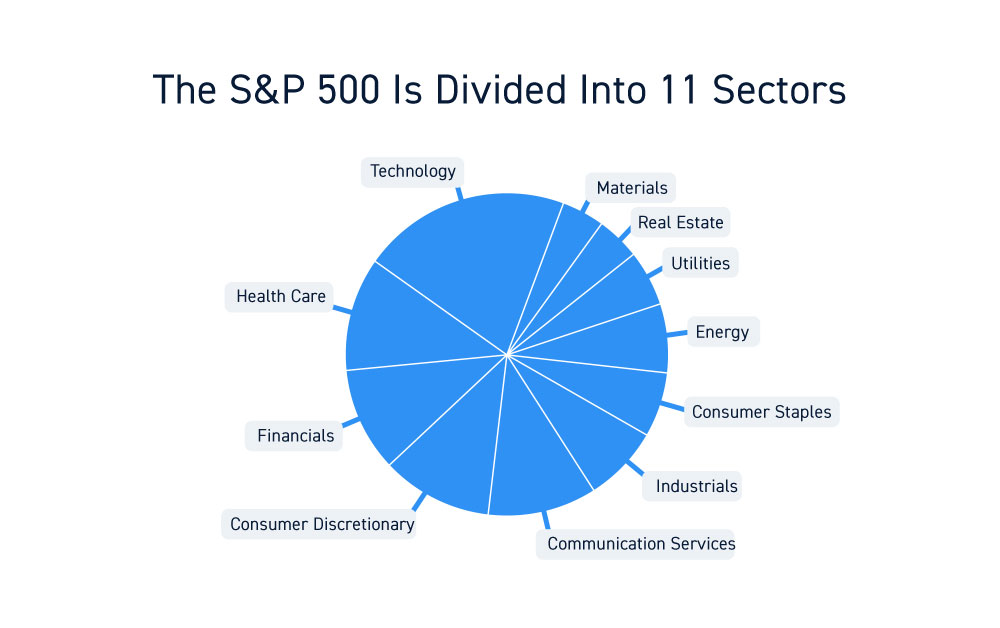
Given its diverse selection criteria and market-cap weighting, the S&P 500 is widely regarded as an excellent proxy for the health and performance of the U.S. economy. Its components span all major sectors, including technology, healthcare, financials, consumer discretionary, industrials, and more. This broad diversification ensures that the index isn’t overly dependent on the performance of a single industry, offering a more holistic view.
When the S&P 500 is rising, it often indicates a period of economic growth and corporate prosperity. Conversely, a sustained decline can signal economic headwinds or recessionary fears. While not a perfect predictor, its movements are closely watched as an indicator of investor confidence and corporate earnings strength across the U.S. landscape.
Why the S&P 500 Matters to Investors
Beyond its role as an economic indicator, the S&P 500 holds immense practical significance for individual and institutional investors alike. It shapes investment strategies, provides a benchmark for performance, and serves as a foundational component for countless investment products.
A Barometer for Market Performance
For many investors, the S&P 500 is the benchmark against which all other U.S. equity investments are measured. If a mutual fund manager claims to be generating superior returns, investors will often compare their fund’s performance against the S&P 500 over a given period. Beating the S&P 500 is considered a mark of success, while consistently underperforming it raises questions about a manager’s strategy. This comparison helps investors understand if their active investments are truly adding value or if they might be better off with a low-cost S&P 500 index fund.
The Foundation for Passive Investing Strategies
Perhaps one of the most transformative impacts of the S&P 500 is its role in the rise of passive investing. Rather than trying to pick individual stocks or time the market, passive investors aim to simply replicate the performance of a broad market index. The S&P 500, due to its comprehensive nature and transparency, is the most popular index for this strategy.
Investors can access the S&P 500 through various low-cost investment vehicles, such as S&P 500 index mutual funds or exchange-traded funds (ETFs). These funds hold all 500 stocks (or a representative sample) in the same proportions as the index, aiming to mirror its returns, less a small expense ratio. This approach offers instant diversification across 500 leading U.S. companies, helping to mitigate the risk of investing in single stocks and providing exposure to the long-term growth potential of the American economy.
A Historical Lens on Returns and Volatility
Over its long history, the S&P 500 has demonstrated a compelling track record of long-term growth, despite experiencing numerous market corrections, bear markets, and economic crises. Historically, its average annual return has been around 10-12% (though past performance is not indicative of future results). This long-term trend underscores the power of compounding and the resilience of the U.S. economy.

Studying the S&P 500’s historical performance helps investors understand the cyclical nature of markets, the inevitability of volatility, and the importance of a long-term perspective. It teaches valuable lessons about staying invested through downturns and avoiding emotional decisions based on short-term fluctuations. For many, investing in the S&P 500 is synonymous with investing in the long-term prosperity of corporate America.
How to Invest in the S&P 500
For those convinced of the S&P 500’s merits, actually investing in it is remarkably straightforward and accessible to nearly anyone with a brokerage account. You don’t buy the “S&P 500” directly; instead, you invest in funds that track its performance.
S&P 500 Index Funds (Mutual Funds)
Traditional S&P 500 index mutual funds are managed by investment firms and pool money from many investors to buy the stocks comprising the S&P 500. They aim to track the index as closely as possible, typically with very low expense ratios compared to actively managed funds.
- Pros: Easy to set up automatic investments, often have a low minimum initial investment, and provide professional management in replicating the index.
- Cons: Trades are typically executed once per day after the market closes, and some funds might have higher expense ratios or minimums than their ETF counterparts.
S&P 500 Exchange-Traded Funds (ETFs)
S&P 500 ETFs are similar to index mutual funds in that they track the S&P 500, but they trade on stock exchanges just like individual stocks. This allows for more flexibility in trading and often comes with even lower expense ratios.
- Pros: Extremely low expense ratios, can be bought and sold throughout the trading day, and offer great flexibility for investors who prefer to control their trade timing.
- Cons: May involve brokerage commissions for buying/selling (though many brokers offer commission-free ETF trading), and requires an understanding of how to place market orders. Popular examples often include tickers like SPY, IVV, or VOO (though specific ticker mentions are for illustrative purposes and not investment advice).
Individual Stocks vs. the Index
While it might be tempting to try and pick the “best” stocks within the S&P 500, history shows that consistently beating the index is incredibly challenging, even for professional money managers. Warren Buffett himself famously recommended that most investors would be better off simply investing in a low-cost S&P 500 index fund. For the vast majority of individual investors, investing in an S&P 500 index fund or ETF offers broad diversification, competitive returns over the long term, and significantly less time and effort than trying to pick winning stocks. It aligns with a core principle of sound financial planning: simplicity and consistency.
Beyond the Basics: Common Misconceptions and Nuances
While the S&P 500 is a powerful tool, understanding some of its nuances and common misconceptions can enhance an investor’s perspective.
Not Just an “Average”: The Power of Market Cap Weighting
It’s easy to view the S&P 500 as an “average” of 500 companies. However, the market-cap weighting means it’s heavily influenced by its largest components. For instance, a small handful of mega-cap technology companies can account for a significant portion of the index’s overall movement. This concentration, while reflective of their economic impact, also means that the index’s performance can be disproportionately tied to the fortunes of these few giants. Investors should be aware that their “diversified” S&P 500 fund might still have significant exposure to specific large companies.
The S&P 500 as a Forward-Looking Indicator (and its limitations)
Stock markets are generally forward-looking, meaning the S&P 500 often reflects investor expectations about future corporate earnings and economic conditions, rather than just current realities. This is why the market can sometimes rally even during challenging economic times, as investors anticipate a future recovery. Conversely, it can decline even when current economic data looks good, if investors foresee a slowdown ahead.
However, the S&P 500 is not infallible as a predictor. It can be influenced by sentiment, speculation, and unexpected events (like global pandemics or geopolitical shifts). While it provides valuable insights, it’s crucial to remember that past performance doesn’t guarantee future results, and market forecasts derived solely from the S&P 500’s movements should be taken with a grain of salt.
S&P 500 vs. Other Indices (Brief Comparison)
It’s helpful to understand how the S&P 500 fits into the broader landscape of market indices:
- Dow Jones Industrial Average (DJIA): Comprises 30 large, established U.S. companies. It’s price-weighted, meaning higher-priced stocks have a greater impact, and its smaller number of components makes it less diversified than the S&P 500.
- Nasdaq Composite: Heavily weighted towards technology and growth companies, often including smaller companies than the S&P 500. Its performance can be more volatile and reflective of the tech sector’s health.
- Russell 2000: Tracks 2,000 small-cap U.S. companies. It’s often used as a benchmark for small-cap performance, which can behave differently from large-cap stocks, sometimes offering higher growth potential but also greater risk.
The S&P 500 strikes a balance, offering broad large-cap exposure across diverse sectors, making it arguably the most representative benchmark for the overall U.S. stock market.

Conclusion
The S&P 500 is far more than just a list of 500 companies; it’s a meticulously constructed index that serves as the preeminent benchmark for the U.S. equity market and a vital indicator of economic health. For investors, understanding “what the S&P 500 means” is the first step toward informed decision-making. Whether you’re comparing investment performance, considering a passive investing strategy through index funds or ETFs, or simply trying to gauge the pulse of the American economy, the S&P 500 provides an invaluable lens. Its historical resilience and broad diversification make it a cornerstone of many long-term financial plans, embodying the principle that for many, investing in the market’s broad performance is a smart, low-cost path to wealth accumulation.
aViewFromTheCave is a participant in the Amazon Services LLC Associates Program, an affiliate advertising program designed to provide a means for sites to earn advertising fees by advertising and linking to Amazon.com. Amazon, the Amazon logo, AmazonSupply, and the AmazonSupply logo are trademarks of Amazon.com, Inc. or its affiliates. As an Amazon Associate we earn affiliate commissions from qualifying purchases.