
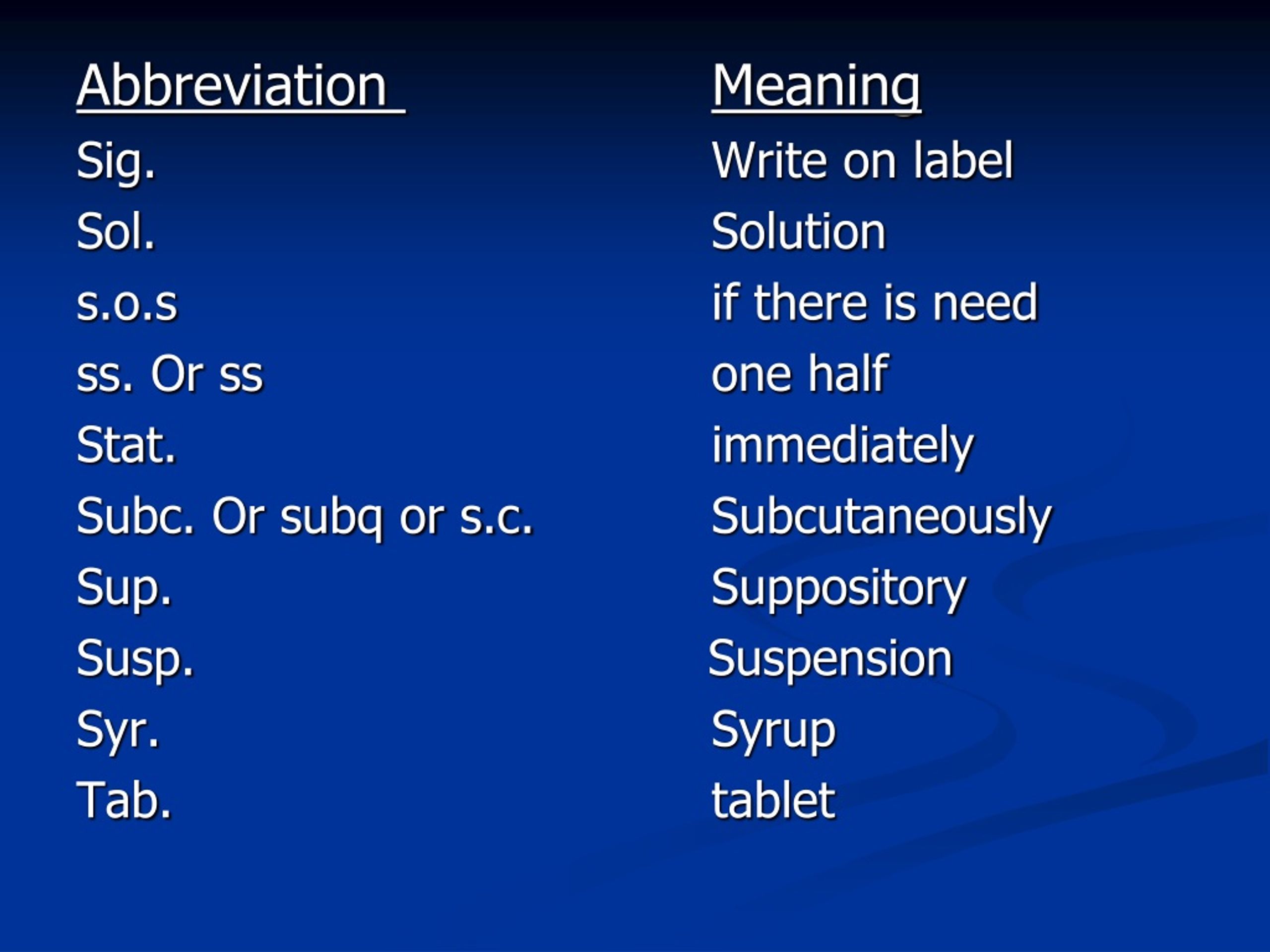
In the traditional world of medicine, the term “Sig” has long served as the bridge between a physician’s intent and a patient’s action. Derived from the Latin signetur, meaning “let it be labeled,” the Sig is the portion of a prescription that contains the instructions for use. However, as we transition from paper pads to sophisticated Health Information Technology (HIT) ecosystems, the “Sig” has evolved from a cryptic shorthand into a complex data string. Understanding what “Sig” means in today’s tech-driven landscape requires a deep dive into electronic health records (EHRs), natural language processing (NLP), and the digital infrastructure that ensures patient safety.

The Digital Anatomy of a Prescription: Decoding “Sig” in Health Tech
The transition from handwritten scripts to e-prescribing (e-Rx) has fundamentally changed the nature of the “Sig.” In a digital environment, the Sig is no longer just a sentence; it is a critical field within a relational database that must be accurately parsed, transmitted, and interpreted by multiple software systems.
From Parchment to Pixels: The Evolution of Signetur
For centuries, “Sig” was synonymous with Latin abbreviations like qd (once a day), bid (twice a day), and po (by mouth). While these served as an efficient shorthand for clinicians, they were notorious for causing medical errors due to illegible handwriting. The digital revolution has replaced the pen with the keyboard, but the core function of the Sig remains: providing clear, actionable instructions. In modern tech terms, the Sig is the “User Interface” (UI) of the prescription, translating clinical data into human-readable instructions.
The Standardized Language of Electronic Health Records (EHR)
Today, when a doctor enters a Sig into an EHR like Epic or Cerner, the software often uses “structured Sig” components. Instead of typing a free-text sentence, the provider selects options from dropdown menus: action (Take), dose (1), unit (Tablet), route (Oral), and frequency (Daily). This structured data approach is the backbone of modern health tech, allowing for “computable” instructions that software can analyze for potential drug-drug interactions or dosage errors before the script even reaches the pharmacy.
The Engineering Behind the Script: How Pharmacy Management Software Processes “Sig”
Once a digital prescription is transmitted, it enters the pharmacy management system (PMS). This is where the “Sig” undergoes a second digital transformation. The software must bridge the gap between the physician’s structured input and the label that ultimately prints out for the consumer.
Parsing Natural Language into Structured Data
Despite the push for structured data, many clinicians still prefer “free-text” Sigs for complex instructions (e.g., tapering doses of prednisone). This creates a technical challenge. Pharmacy software developers utilize sophisticated parsing engines to break down these free-text strings. Advanced algorithms identify key tokens—numbers, frequencies, and routes—to ensure the software can still perform safety checks. This process is a classic example of data normalization, where disparate inputs are converted into a standard format that the pharmacy’s internal database can process for billing and inventory purposes.
Interoperability Challenges and the NCPDP Standards
The seamless movement of “Sig” data between a doctor’s office and a pharmacy is made possible by the National Council for Prescription Drug Programs (NCPDP) SCRIPT standard. This is the “language” of e-prescribing. One of the greatest challenges in health tech interoperability is ensuring that a Sig created in “Software A” doesn’t lose its meaning when read by “Software B.” If the data mapping is off, “take half a tablet” could theoretically be misinterpreted by a system as “take one to two tablets.” Developers spend thousands of hours refining these API integrations to maintain data integrity across the healthcare continuum.
AI and Machine Learning: Reducing Errors in Prescription Instructions

The most exciting trend in the “Sig” tech space is the application of Artificial Intelligence (AI) and Machine Learning (ML) to improve medication safety. Human error in transcribing or interpreting Sigs remains a leading cause of adverse drug events, but new tools are mitigating these risks.
Automated Clinical Decision Support (CDS) Systems
Modern e-prescribing platforms are equipped with Clinical Decision Support (CDS) systems. These are essentially “logic engines” that monitor the Sig field in real-time. If a physician enters a Sig that specifies a dosage significantly higher than the FDA-approved limit for that specific medication, the AI triggers a “hard stop” or an alert. This represents a shift from reactive medicine to proactive, tech-enabled safety, where the software acts as a co-pilot for the prescriber.
The Role of Natural Language Processing (NLP) in Pharmacy Tech
Natural Language Processing (NLP) is being used to bridge the gap between “Doctor-speak” and “Patient-speak.” Many Sigs are still written in clinical jargon that can be confusing to a layperson. Innovative startups are utilizing NLP models to automatically translate complex medical instructions into “Plain Language” Sigs. For example, an NLP engine can take the input “1 tab po qid ac” and instantly convert it to “Take one tablet by mouth four times a day, before meals” for the patient’s digital health portal. This technology significantly improves health literacy and medication adherence.
Consumer Tech: How “Sig” Translates to Patient-Facing Apps
As healthcare becomes more consumer-centric, the “Sig” has moved beyond the pharmacy counter and into the palm of the patient’s hand. Mobile apps and wearables are now the primary touchpoints for medication management.
UX Design and Health Literacy in Med-Tech Apps
For developers building patient-facing health apps, the “Sig” data must be presented through the lens of User Experience (UX). A wall of text is ineffective for a patient managing multiple chronic conditions. Leading apps like Medisafe or MyChart leverage UX principles to break the Sig down into visual cues. Instead of just reading “Take 10mg at 8 AM,” the user sees a high-resolution image of the pill, a color-coded icon for the time of day, and a progress bar. This is “Sig” data transformed into behavioral nudges, using tech to drive better health outcomes.
Wearables and Automated Medication Reminders
The integration of “Sig” data with wearable technology represents the next frontier. By syncing EHR data with smartwatches, the Sig becomes an actionable notification. Using haptic feedback and push notifications, a smartwatch can remind a user to “Take 1 tablet (Sig)” based on the specific timing intervals defined in the digital prescription. Furthermore, some systems are now experimenting with “smart bottles” that use sensors to track if the Sig instructions are being followed, sending data back to the provider if a dose is missed.
The Future of Prescription Tech: Smart Labels and Beyond
Looking forward, the “Sig” will continue to evolve alongside emerging technologies like Augmented Reality (AR) and Blockchain. The goal is to create a “Living Script” that is always accurate, always accessible, and impossible to misinterpret.
Augmented Reality (AR) in the Pharmacy
Imagine a patient pointing their smartphone camera at a medication bottle and seeing a 3D animation of how to administer the drug, based entirely on the “Sig” data. AR could revolutionize how patients interact with complex instructions, such as those for inhalers or injectable medications. By digitizing the Sig and overlaying it on the physical world, tech companies can eliminate the confusion associated with small-print paper labels.
Blockchain for Prescription Integrity
One of the persistent issues in the prescription lifecycle is the “chain of custody” and the prevention of fraudulent scripts. Blockchain technology offers a decentralized ledger where a “Sig” can be securely recorded. Once a physician signs a digital script, the instructions (the Sig) are immutable. This ensures that no unauthorized changes can be made to the dosage or frequency as the prescription moves through the digital ecosystem, providing an extra layer of security in the fight against the opioid crisis and medical fraud.
In conclusion, while the term “Sig” may have its roots in ancient Latin, its modern reality is entirely digital. It is a vital piece of metadata that fuels the engines of pharmacy software, AI safety tools, and consumer health apps. As technology continues to advance, the Sig will become even more integrated into our daily lives, transforming from a static set of instructions into a dynamic, tech-enabled guide for better health.
aViewFromTheCave is a participant in the Amazon Services LLC Associates Program, an affiliate advertising program designed to provide a means for sites to earn advertising fees by advertising and linking to Amazon.com. Amazon, the Amazon logo, AmazonSupply, and the AmazonSupply logo are trademarks of Amazon.com, Inc. or its affiliates. As an Amazon Associate we earn affiliate commissions from qualifying purchases.