
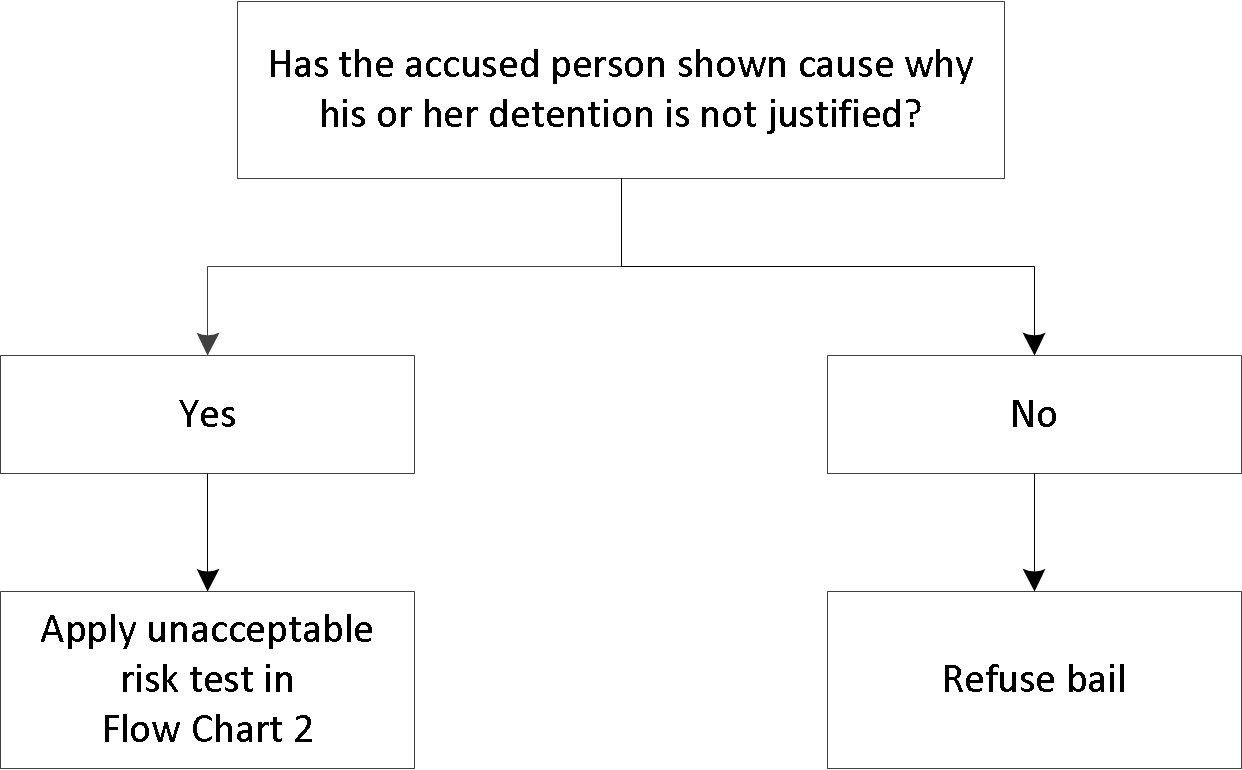
In the intricate world of corporate governance, business finance, and regulatory compliance, terms often emerge from the legal ether that can cause immediate concern for stakeholders, investors, and business owners. Among the most significant of these is the “Show Cause” notice or order. While the phrase may sound archaic to the uninitiated, its implications are modern, direct, and often carry heavy financial weight. At its core, a show cause order is a demand from a court or a regulatory body requiring a party to justify or explain why a proposed action should not be taken.

In the niche of money and business finance, a “Show Cause” notice is rarely a mere formality. It is often the final warning before a license is revoked, a fine is levied, or a contract is terminated. Understanding the nuances of this term is essential for any professional navigating the high-stakes environment of modern commerce.
The Financial Implications of a Show Cause Notice
When a business receives a show cause notice, it is essentially being placed on the defensive in a high-stakes financial game. The notice serves as a bridge between an alleged non-compliance and a formal penalty. For a CFO or a business owner, the arrival of such a document signals an immediate need for resource allocation—both in terms of time and capital.
Regulatory Oversight: When the SEC or IRS Step In
In the United States, and similarly across global markets, regulatory bodies like the Securities and Exchange Commission (SEC) or the Internal Revenue Service (IRS) utilize show cause orders to enforce financial discipline. For instance, if an investment firm fails to maintain the required capital adequacy ratios, the regulator may issue a show cause notice. This document requires the firm to explain why its trading license should not be suspended.
From a financial perspective, the mere receipt of such a notice can be devastating. It can trigger “bad actor” clauses in lending agreements, cause stock prices to plummet due to investor uncertainty, and lead to a sudden withdrawal of credit lines. The cost of responding—involving forensic accountants and specialized legal counsel—can run into the hundreds of thousands of dollars, regardless of the eventual outcome.
Banking and Lending: Responding to Institutional Inquiries
In the private sector, banks and lending institutions use show cause mechanisms to manage risk. If a commercial borrower breaches a covenant—perhaps by taking on additional debt without permission or failing to maintain a certain debt-service coverage ratio—the bank may issue a show cause notice before declaring a formal default.
This period is critical for the business’s liquidity. It provides a narrow window to renegotiate terms, propose a “cure” for the breach, or provide financial projections that justify the current position. Failure to provide a compelling cause often leads to the acceleration of the loan, meaning the entire balance becomes due immediately, often forcing the business into insolvency or a fire-sale reorganization.
Navigating the Legal Landscape of Business Finance
The “Show Cause” order sits at the intersection of law and finance. To handle it effectively, one must understand that it is a procedural safeguard. It exists to ensure that due process is followed before a party is deprived of property, rights, or financial status. However, in the context of business finance, it is a tool of leverage.
Contractual Disputes and the “Show Cause” Clause
In large-scale procurement and B2B contracts, “Show Cause” clauses are standard. If a vendor fails to deliver a critical component or service, the buyer may issue a show cause notice rather than terminating the contract immediately. This allows the buyer to maintain the relationship while putting the vendor on notice that their performance is unacceptable.
For the vendor, the financial risk includes not only the loss of the current contract but also “consequential damages.” If the buyer’s production line stops because of the vendor’s failure, the vendor may be liable for the buyer’s lost revenue. Responding to a show cause notice in this context requires a detailed financial analysis of the delays and a credible plan for remediation that minimizes further economic loss.
Debt Recovery and Judicial Interventions
In debt collection and bankruptcy proceedings, show cause orders are frequently used to compel a debtor to reveal assets. If a creditor obtains a judgment but the debtor refuses to pay, the court may issue an order for the debtor to “show cause” as to why they should not be held in contempt or why their bank accounts should not be garnished.
For the debtor, this is a moment of extreme financial exposure. It forces a transparent accounting of all assets, including offshore accounts, real estate holdings, and digital assets. In the world of “Online Income” and “Side Hustles,” where many entrepreneurs keep their finances fragmented, a show cause order can effectively strip away the veil of anonymity, leading to the seizure of funds to satisfy outstanding liabilities.
Strategic Responses to Protect Business Assets
Once a show cause notice is received, the priority shifts from standard operations to asset protection and risk mitigation. A professional response is not merely a letter of explanation; it is a comprehensive financial and legal package designed to preserve the entity’s viability.
Documentation and Audit Trails
The first line of defense in any show cause scenario is the audit trail. In financial disputes, the party with the best documentation usually wins. This includes a meticulous record of transactions, emails, board minutes, and financial statements. When a regulator asks “why should we not fine you?”, the answer must be backed by data.
For example, if a business is accused of improper tax deductions, the “cause” shown must include receipts, proof of business intent, and expert testimony from a tax professional. In the digital age, this also extends to metadata and timestamped logs of financial software. A failure to produce this documentation during the show cause period is often interpreted as an admission of guilt or negligence, leading to maximum financial penalties.
The Role of Financial Compliance Officers
For mid-to-large-size firms, the Compliance Officer is the primary shield against show cause escalations. Their role is to ensure that the business never reaches the stage where an external body needs to demand an explanation. However, if a notice arrives, the Compliance Officer coordinates the “Response Team.”
This team evaluates the financial impact of various response strategies. Is it cheaper to pay a settlement (a “consent order”) or to fight the notice in court? This is a cold, hard financial calculation. Sometimes, “showing cause” involves admitting a minor error to prevent a major audit, a strategy known as “principled retreat” which saves the company millions in potential litigation costs.
Proactive Measures: Avoiding “Show Cause” Scenarios
In the realm of personal and business finance, the old adage holds true: an ounce of prevention is worth a pound of cure. Avoiding show cause notices altogether is the hallmark of a sophisticated financial strategy.
Implementing Robust Internal Controls
Most show cause notices are the result of internal failures—missed deadlines, overlooked regulations, or unauthorized employee actions. By implementing robust internal controls, such as automated compliance software and multi-stage approval processes for large transactions, businesses can catch errors before they trigger regulatory alarms.
In the context of “Financial Tools,” many modern AI-driven platforms can now predict potential compliance breaches by analyzing patterns in a company’s ledger. These tools act as a pre-emptive “show cause” check, flagging anomalies for the CFO to address internally before they ever reach the eyes of a government auditor.
Staying Ahead of Financial Legislation
The financial landscape is constantly shifting. New laws regarding cryptocurrency, international wire transfers, and climate-related financial disclosures mean that what was compliant yesterday may be a “show cause” trigger tomorrow.
Professional branding and corporate identity are also at stake here. A company that is frequently defending itself against show cause notices develops a reputation for instability. This “reputational risk” translates directly to a higher cost of capital. Lenders charge higher interest rates to firms they perceive as being in constant friction with regulators. Therefore, staying informed about legislative changes is not just a legal duty; it is a fiduciary one to the shareholders to keep the cost of borrowing low.

Conclusion: The “Show Cause” as a Financial Crossroads
To “show cause” is to be given a final opportunity to defend the financial integrity of an enterprise. While the term is rooted in legal procedure, its heart beats in the world of money. It represents a critical juncture where a business must prove its adherence to the rules of the market or face the consequences of exclusion.
For the savvy investor or business leader, a show cause notice is a signal to stop and recalibrate. It demands a rigorous examination of financial practices, a transparent engagement with authorities, and a strategic approach to risk management. By understanding exactly what “show cause” means—not just as a definition, but as a financial catalyst—professionals can better navigate the complexities of the modern economy, ensuring their ventures remain solvent, compliant, and respected in the global marketplace.
aViewFromTheCave is a participant in the Amazon Services LLC Associates Program, an affiliate advertising program designed to provide a means for sites to earn advertising fees by advertising and linking to Amazon.com. Amazon, the Amazon logo, AmazonSupply, and the AmazonSupply logo are trademarks of Amazon.com, Inc. or its affiliates. As an Amazon Associate we earn affiliate commissions from qualifying purchases.