
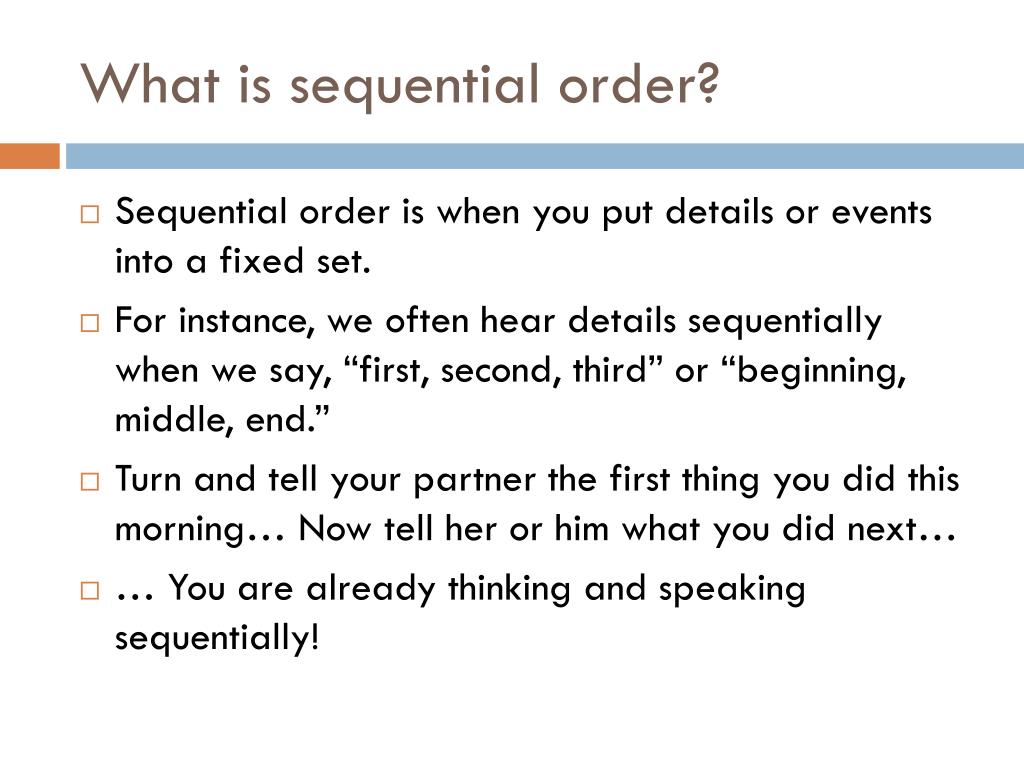
In the vast and intricate landscape of technology, the concept of “sequential order” is not merely a theoretical construct but a fundamental principle that underpins virtually every digital operation. From the execution of complex algorithms to the intuitive flow of user interfaces, and from the structured storage of data to the sophisticated training of artificial intelligence models, sequential order dictates the precise, step-by-step progression required for systems to function predictably and reliably. At its core, sequential order refers to an arrangement or execution of elements, events, or processes in a specific, predetermined series, where one step must be completed before the next can begin. This orderly progression is crucial for achieving desired outcomes, ensuring data integrity, and enabling coherent interaction within technological ecosystems.

The Foundation of Digital Operations
The digital world, in its apparent fluidity and instantaneity, is meticulously built upon sequential logic. Every command, every calculation, and every data manipulation adheres to a strict sequence, making sequential order the bedrock of computing. Without this disciplined progression, the chaotic execution of instructions would render all technology inert or unpredictable.
From Algorithms to Code Execution
At the heart of all software lies the algorithm—a finite set of well-defined, ordered instructions designed to accomplish a specific task. Each step within an algorithm is inherently sequential; one instruction builds upon the result of the preceding one. When an algorithm is translated into code, programming languages enforce this sequential execution. For instance, in a simple program, line 1 must execute before line 2, and line 2 before line 3, unless explicitly altered by control flow statements like loops or conditional branches. Even these branches, while appearing to diverge, are themselves sequential choices within a larger, ordered process. The operating system, in managing processes and allocating resources, also adheres to intricate sequences to ensure that different applications and tasks run without conflict and in a stable manner. From booting up a device to loading an application, a precise sequence of operations is orchestrated by the underlying software, ensuring smooth and predictable performance.
The Logic of Data Processing
Data processing, whether it involves sorting, filtering, transforming, or analyzing information, is another domain where sequential order is paramount. Consider a database query: the system must first locate the relevant data, then apply specified filters, sort the results, and finally present them to the user—each a distinct step in a pre-defined sequence. In data pipelines, raw data often undergoes a series of transformations (e.g., cleaning, normalization, aggregation) in a specific order to produce a refined output suitable for analysis or storage. Disrupting this sequence could lead to erroneous results, corrupt data, or a complete failure of the processing task. Furthermore, when data is transmitted across networks, packets of information are often sequenced to ensure they arrive in the correct order, allowing the receiving system to reassemble the original message accurately. This ordered approach guarantees data integrity and efficiency in information exchange.
User Experience and Interaction Flows
Beyond the backend mechanics, sequential order plays a critical role in shaping how users interact with technology. The design of software, apps, and websites often guides users through a series of logical steps, making interfaces intuitive and efficient. Understanding and leveraging sequential order in user experience (UX) design is key to creating engaging and user-friendly digital products.
Navigating Software and Apps
Think about signing up for a new service, making an online purchase, or configuring settings in an application. These processes are inherently sequential. A user is typically guided through a series of screens or forms, each requiring specific input or action before proceeding to the next. For example, an e-commerce checkout process usually follows steps like adding items to a cart, providing shipping information, entering payment details, and finally, confirming the order. This sequential flow minimizes confusion, reduces errors, and ensures that all necessary information is collected in the correct order. UX designers meticulously map out these “user flows,” considering the optimal sequence of interactions to create a smooth and logical journey for the user, improving usability and satisfaction.
Sequential Steps in Tutorials and Guides
Tutorials, onboarding processes, and help guides are prime examples of sequential order in action, designed to educate users on how to operate software, apps, or gadgets. These resources break down complex tasks into manageable, step-by-step instructions. A digital tutorial for setting up a new smartphone, for instance, will instruct users to insert the SIM card, power on the device, connect to Wi-Fi, and then log in with an account, in that specific order. Following these sequential steps ensures that the user successfully completes the task and learns how to use the technology effectively. Any deviation from the prescribed sequence could lead to confusion, frustration, or an inability to complete the setup, highlighting the critical importance of a clear and logical progression.
Sequential Data in AI and Machine Learning
The advent of artificial intelligence and machine learning has introduced new dimensions to the concept of sequential order, particularly in how models process and learn from data that has an inherent time or order dependency. This field heavily relies on specialized architectures and techniques to effectively handle sequential information.
Understanding Time-Series Data
Many real-world datasets are inherently sequential, meaning the order of observations carries significant meaning. Examples include stock prices over time, sensor readings from an IoT device, natural language sentences, or even a user’s clickstream data on a website. This is known as time-series data. In such data, the value at any given point is often dependent on preceding values. Predicting future stock prices, for instance, requires analyzing the sequence of past prices to identify trends and patterns. Ignoring the sequential nature of this data would lead to a loss of critical context and drastically reduce the accuracy of predictions. Machine learning models designed for time-series analysis explicitly account for this sequential dependency to make informed forecasts and identify anomalies.
Recurrent Neural Networks and Transformers
To effectively process sequential data, AI has developed specialized neural network architectures. Recurrent Neural Networks (RNNs) and their variants like LSTMs (Long Short-Term Memory networks) are specifically designed to handle sequences by maintaining an internal “memory” of previous inputs as they process new ones. This allows them to understand context and dependencies across different steps in a sequence, which is vital for tasks like natural language processing (e.g., understanding sentences where the meaning of a word depends on previous words) or speech recognition. More recently, Transformer networks, which power advanced language models like GPT, have revolutionized sequential data processing. While not strictly “recurrent,” Transformers employ attention mechanisms that allow them to weigh the importance of different parts of an input sequence when making predictions, effectively capturing long-range sequential dependencies more efficiently than traditional RNNs. These architectures underscore the sophisticated ways in which AI systems are engineered to interpret and generate ordered information.
Digital Security Protocols
In the realm of digital security, sequential order is not just a matter of efficiency but often a non-negotiable requirement for maintaining data integrity, confidentiality, and system resilience. Security protocols are built upon precise sequences of actions and checks that must occur in a specific order to thwart unauthorized access and protect sensitive information.
Step-by-Step Authentication and Encryption
Consider a secure login process. It’s a sequential chain: first, the user inputs credentials; then, the system verifies these credentials against a stored database; if valid, a session is initiated, and perhaps a multi-factor authentication (MFA) step is triggered, requiring a second sequential action like entering a code from a mobile app. Each step must succeed for the next to commence, collectively establishing a secure identity verification. Similarly, encryption protocols, such as the TLS (Transport Layer Security) handshake used to secure web communications (HTTPS), involve a complex sequence of message exchanges between a client and a server. These messages—including key exchanges, certificate validations, and cipher suite negotiations—must occur in a strict order to establish a secure, encrypted channel. Any deviation or disruption in this sequence would compromise the security of the connection, making data vulnerable.
Incident Response and Threat Mitigation
When a security breach or incident occurs, the response plan is a highly sequential process. Incident response frameworks outline a series of steps, starting with detection and analysis, followed by containment, eradication, recovery, and finally, post-incident activity. This structured, ordered approach ensures that threats are identified quickly, their spread is limited, systems are cleaned and restored, and lessons are learned to prevent future occurrences. Attempting to eradicate a threat before fully containing it, for instance, would be a sequential misstep that could lead to further compromise. Similarly, digital forensics investigations often follow a strict chain of custody and analysis steps to ensure that evidence is collected, preserved, and examined in a manner that maintains its integrity and admissibility, relying heavily on a sequential approach.

The Importance of Order in Innovation
The ubiquitous nature of sequential order in technology highlights its fundamental importance. It provides the predictability and structure necessary for complex systems to operate reliably and efficiently. From the low-level execution of machine code to the high-level design of user experiences and the sophisticated processing capabilities of AI, understanding and correctly implementing sequential order is paramount. It enables developers to build robust software, designers to create intuitive interfaces, and AI researchers to develop intelligent systems that can comprehend and interact with the world in meaningful ways. As technology continues to evolve, the principles of sequential order will remain a cornerstone, guiding innovation and ensuring that our digital future is built on a foundation of precision and logical progression.
aViewFromTheCave is a participant in the Amazon Services LLC Associates Program, an affiliate advertising program designed to provide a means for sites to earn advertising fees by advertising and linking to Amazon.com. Amazon, the Amazon logo, AmazonSupply, and the AmazonSupply logo are trademarks of Amazon.com, Inc. or its affiliates. As an Amazon Associate we earn affiliate commissions from qualifying purchases.