
In the contemporary digital landscape, the concept of “security” has evolved from a secondary technical requirement into the foundational architecture of the modern world. No longer confined to mere passwords or physical locks, digital security represents a multi-layered discipline designed to protect information, maintain trust, and ensure the continuity of global infrastructure. To understand what security consists of today, one must look beyond the individual tools and examine the systemic frameworks that protect our data from an ever-evolving array of threats.
At its core, digital security is a proactive strategy. It involves the integration of hardware, software, human behavior, and organizational policy to create a resilient environment. As we navigate an era defined by cloud computing, the Internet of Things (IoT), and Artificial Intelligence, the components of security have become more complex and interconnected than ever before.
1. The Core Pillars: The CIA Triad
The most fundamental answer to what security consists of lies in the “CIA Triad.” This is a venerable model used to guide policies for information security within an organization. Every security tool or protocol developed today is designed to address one or more of these three pillars.
Confidentiality: Safeguarding Privacy
Confidentiality ensures that sensitive information is accessible only to those authorized to have it. In the tech world, this is the first line of defense against data breaches. It involves implementing strict access controls and ensuring that data—whether it is a user’s social security number or a corporation’s trade secrets—is not disclosed to unauthorized individuals or processes. Techniques such as data masking, classification, and robust encryption are the primary drivers of confidentiality.
Integrity: Ensuring Data Accuracy
Security is not just about keeping secrets; it is about ensuring that information remains accurate and untampered with. Integrity means that data cannot be modified by unauthorized parties or through undetected errors. In a financial system, for instance, integrity ensures that a transaction of $100 isn’t changed to $1,000 by a malicious actor during transit. This is achieved through version controls, digital signatures, and hashing algorithms that can detect even the slightest alteration in a file.
Availability: Keeping Systems Running
A system is not secure if it is not accessible when needed. Availability ensures that authorized users have reliable and timely access to data and resources. This component of security focuses on defending against hardware failures, power outages, and malicious attacks like Distributed Denial of Service (DDoS), which aim to flood a network until it crashes. Redundancy, load balancing, and comprehensive disaster recovery plans are the technical hallmarks of availability.
2. Technical Defense Mechanisms: Layers of Protection
Moving from theory to practice, technical security consists of the physical and virtual barriers we place between our assets and potential attackers. In the industry, this is often referred to as “Defense in Depth,” a strategy that uses multiple security controls to protect the integrity of information.
Network Security and Firewalls
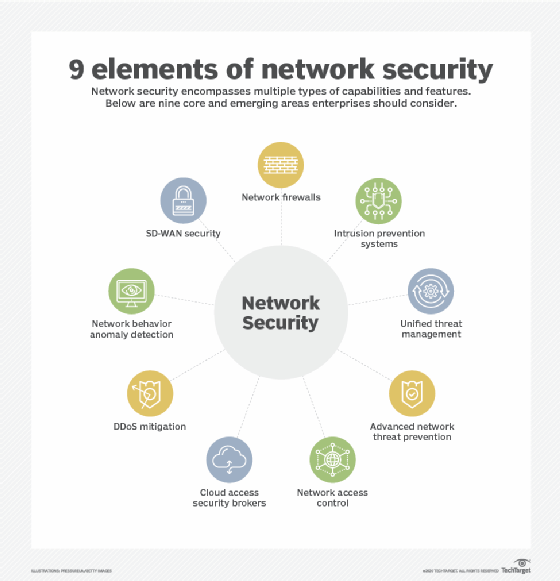
The network is the perimeter of the digital estate. Network security consists of the policies and practices adopted to prevent and monitor unauthorized access, misuse, or modification of a computer network. Firewalls—both hardware and software-based—act as gatekeepers, analyzing incoming and outgoing traffic based on predetermined security rules. Modern network security also includes Virtual Private Networks (VPNs) for secure remote access and Intrusion Detection Systems (IDS) that act as “burglar alarms” for digital traffic.
End-point Security: Protecting Individual Devices
As the workforce becomes more mobile, the “perimeter” has shifted to the device in the user’s hand. End-point security focuses on protecting individual devices such as laptops, smartphones, and tablets. This goes beyond traditional antivirus software; modern Endpoint Detection and Response (EDR) tools use behavioral analysis to identify suspicious activity, such as a file suddenly beginning to encrypt itself (a hallmark of ransomware), and can isolate the device from the network automatically to prevent the spread of an infection.
Encryption: The Mathematical Shield
Encryption is perhaps the most critical technical component of modern security. It involves using complex algorithms to transform readable data into an unreadable format (ciphertext) that can only be unlocked with the correct key. Security today consists of protecting data in three states: “at rest” (stored on a disk), “in transit” (moving across a network), and “in use” (currently being processed by a CPU). Advanced protocols like AES-256 and RSA serve as the mathematical backbone that keeps everything from WhatsApp messages to banking transfers secure.
3. Identity and Access Management (IAM)
In a world where “the perimeter is dead,” identity has become the new security boundary. Modern security consists of a rigorous approach to identifying who a user is and what they are allowed to do.
Authentication vs. Authorization
These two terms are often used interchangeably but represent different components of security. Authentication is the process of verifying that a user is who they claim to be (e.g., via a password or a fingerprint). Authorization, on the other hand, determines the level of access a verified user has. A robust security system ensures that a guest user cannot access administrative settings, a principle known as “Least Privilege.”
Multi-Factor Authentication (MFA)
Because passwords can be stolen, guessed, or “brute-forced,” security now heavily relies on Multi-Factor Authentication. This consists of requiring two or more pieces of evidence from different categories: something you know (a password), something you have (a physical security key or a smartphone app), or something you are (biometrics like facial recognition). MFA is currently one of the most effective ways to prevent unauthorized account takeovers.
Zero Trust Architecture
The “Zero Trust” model is the current gold standard in digital security. Its core philosophy is “never trust, always verify.” Unlike traditional models that trust anyone inside a corporate network, Zero Trust assumes that threats could be anywhere. It requires continuous verification of every user and device, regardless of their location, and segments networks so that if one area is compromised, the attacker cannot “move laterally” to other sensitive data.
4. Human and Procedural Security: The Often-Overlooked Links
Technology alone cannot provide complete security. Because humans are often the weakest link in the chain, security must also consist of rigorous procedures and education.
Cyber Hygiene and Education
A significant percentage of security breaches start with a human error, such as clicking a phishing link in an email. Therefore, security consists of ongoing training and “cyber hygiene.” This includes teaching employees how to recognize social engineering tactics, the importance of regular software updates, and the dangers of using public Wi-Fi for sensitive work.
Incident Response and Disaster Recovery
Security is not just about prevention; it is about resilience. What happens when a breach occurs? A comprehensive security strategy includes an Incident Response (IR) plan. This consists of a pre-defined set of instructions to detect, respond to, and recover from network security incidents. Coupled with Disaster Recovery (DR), which focuses on restoring IT infrastructure and data after a catastrophe, these procedures ensure that an organization can survive a high-level cyberattack.
Compliance and Regulatory Standards
In many industries, security is also defined by legal and regulatory requirements. Standards such as GDPR (General Data Protection Regulation) in Europe, HIPAA in healthcare, and PCI-DSS in the payment industry dictate how data must be handled. Security in this context consists of audits, documentation, and the implementation of specific controls to meet legal mandates, ensuring that organizations are held accountable for the data they store.
5. The Future Landscape: AI and Emerging Threats
As we look forward, the definition of what security consists of is expanding to include automated and intelligent systems. The battle between attackers and defenders is increasingly being fought by algorithms.
AI-Driven Security Operations
Artificial Intelligence and Machine Learning are now essential components of the security stack. These tools can analyze billions of data points in real-time to identify patterns that would be invisible to human analysts. AI can detect a “zero-day” exploit (a previously unknown vulnerability) by noticing subtle deviations in system behavior. This shift toward “proactive” rather than “reactive” security is the next major frontier in the tech niche.
The Quantum Challenge
Finally, the future of security must account for the rise of quantum computing. Current encryption standards, which would take classical computers trillions of years to crack, could potentially be broken by quantum computers in minutes. Consequently, security now consists of developing “Quantum-Resistant” or Post-Quantum Cryptography (PQC). This involves creating new mathematical puzzles that even the most powerful quantum computers cannot solve, ensuring that today’s encrypted data remains secure decades into the future.
In conclusion, digital security is a multifaceted discipline that combines high-level theory with granular technical execution. It consists of the CIA Triad of principles, the multi-layered technical defenses of the network and endpoint, the rigorous management of identity, the essential human element of training and procedure, and an eye toward the future of AI and quantum computing. For any individual or organization, understanding these components is the first step toward building a truly resilient digital existence.
aViewFromTheCave is a participant in the Amazon Services LLC Associates Program, an affiliate advertising program designed to provide a means for sites to earn advertising fees by advertising and linking to Amazon.com. Amazon, the Amazon logo, AmazonSupply, and the AmazonSupply logo are trademarks of Amazon.com, Inc. or its affiliates. As an Amazon Associate we earn affiliate commissions from qualifying purchases.