
The word “scalene” might initially conjure images of complex mathematical equations or abstract geometric figures. However, this term, when applied in mathematics, refers to a surprisingly straightforward concept with implications that extend beyond the classroom. At its core, “scalene” describes a particular type of triangle, and understanding its definition can unlock a deeper appreciation for the diversity and properties of geometric shapes. This exploration will delve into the meaning of scalene in mathematics, examining its defining characteristics, how it contrasts with other triangle types, and importantly, how this seemingly simple concept finds resonance and application in the technology, branding, and financial worlds that shape our daily lives.
Understanding the Scalene Triangle: The Foundation
In geometry, triangles are classified based on their side lengths and angles. The term “scalene” specifically addresses the side lengths.
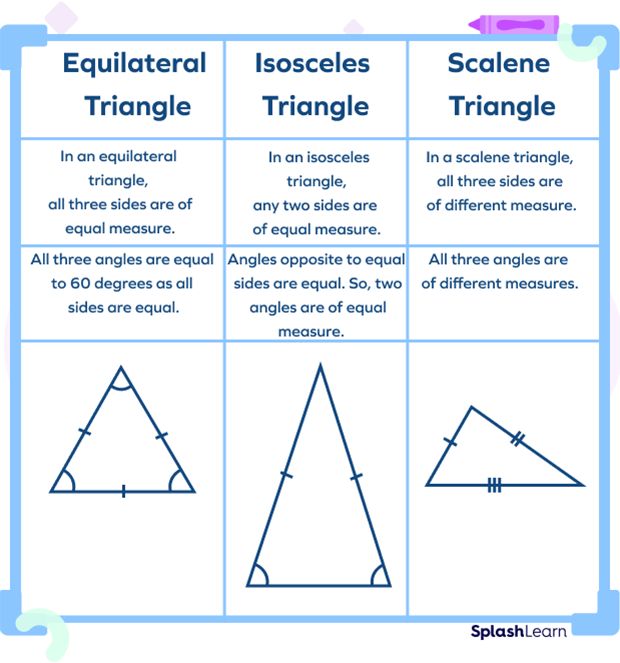
Defining the Scalene Triangle: No Sides Equal, No Angles Equal
A scalene triangle is defined as a triangle in which all three sides have different lengths. This fundamental characteristic has a direct consequence: all three angles within a scalene triangle are also different. This is not a coincidence; it’s a direct outcome of the triangle inequality theorem and the relationships between sides and opposite angles in Euclidean geometry. If two sides were equal, the angles opposite those sides would also be equal, making it an isosceles triangle. If all three sides were equal, all three angles would be equal (60 degrees each), making it an equilateral triangle. Therefore, the defining feature of a scalene triangle is its complete lack of symmetry in terms of side lengths and, consequently, its internal angles.
Visualizing a Scalene Triangle: Beyond the Textbook
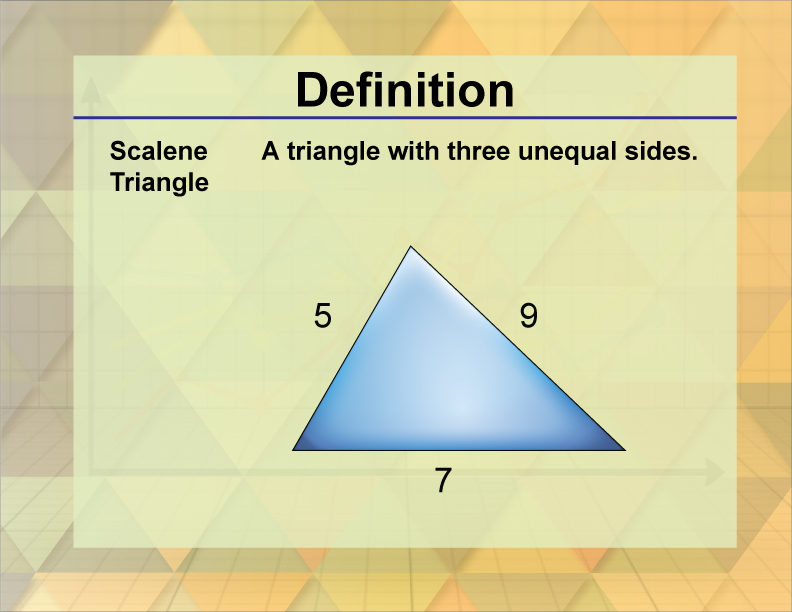
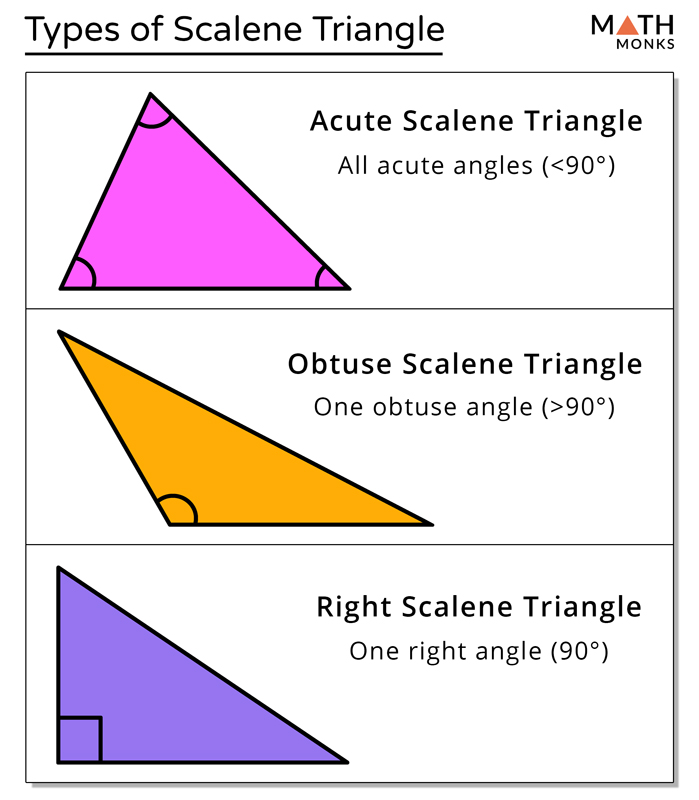
While textbooks often depict scalene triangles as irregular or skewed shapes, it’s crucial to remember that any triangle that doesn’t have at least two equal sides is, by definition, scalene. This includes triangles that might appear somewhat balanced or even close to right-angled or obtuse. The key is to focus on the precise measurement of the sides. For instance, a triangle with side lengths of 3 units, 5 units, and 7 units is unequivocally scalene. A triangle with side lengths 4, 4.1, and 4.2 is also scalene, even though the difference between the side lengths is minimal.
Contrasting with Other Triangle Types: Isosceles and Equilateral
To fully grasp the meaning of scalene, it’s beneficial to compare it with its geometric counterparts:
- Isosceles Triangle: An isosceles triangle has at least two sides of equal length. Consequently, it also has at least two angles of equal measure. The angles opposite the equal sides are the ones that are equal.
- Equilateral Triangle: An equilateral triangle is a special case of an isosceles triangle. It has all three sides of equal length. As a direct result, all three interior angles are also equal, each measuring 60 degrees.
The scalene triangle stands apart as the “uneven” or “asymmetrical” triangle in this classification. It is the most general form of a triangle, as most randomly chosen triangles will inherently have different side lengths.
The Mathematical Significance of Scalene Triangles
Beyond mere classification, the properties of scalene triangles hold mathematical significance, influencing calculations and problem-solving.
Calculations and Properties: Area, Perimeter, and Angles
The formulas for calculating the perimeter and area of a triangle apply to scalene triangles just as they do to any other triangle.
- Perimeter: The perimeter of any triangle is simply the sum of its three side lengths. For a scalene triangle with sides $a$, $b$, and $c$, the perimeter is $P = a + b + c$.
- Area: Several formulas can be used to calculate the area of a scalene triangle.
- Base and Height: If you know the length of one side (the base) and the perpendicular height to that base, the area is $A = frac{1}{2} times text{base} times text{height}$. However, finding the height in a scalene triangle often requires additional calculations using trigonometry or other properties.
- Heron’s Formula: This is a particularly useful formula for scalene triangles when only the side lengths are known. First, calculate the semi-perimeter ($s$) by $s = frac{a+b+c}{2}$. Then, the area is given by $A = sqrt{s(s-a)(s-b)(s-c)}$. This formula elegantly bypasses the need to find heights.
The angles of a scalene triangle, being all different, necessitate the use of trigonometric relationships (sine, cosine, tangent) for detailed analysis, particularly when dealing with side lengths and angles simultaneously. The sum of the interior angles of any triangle, including a scalene one, always equals 180 degrees.
Scalene Triangles in Trigonometry: The Law of Sines and Cosines
Scalene triangles are fundamental to trigonometry. The Law of Sines and the Law of Cosines are specifically designed to solve triangles where side lengths and angles are not predetermined as equal.
- Law of Sines: This law states that for any triangle with sides $a, b, c$ and opposite angles $A, B, C$ respectively, the ratio of the length of a side to the sine of its opposite angle is constant: $frac{a}{sin A} = frac{b}{sin B} = frac{c}{sin C}$. This is invaluable for finding unknown sides or angles in scalene triangles when some information is provided.
- Law of Cosines: This law relates the lengths of the sides of a triangle to the cosine of one of its angles. For example, $c^2 = a^2 + b^2 – 2ab cos C$. This law is particularly useful for finding a third side when two sides and the included angle are known, or for finding an angle when all three sides are known – a common scenario with scalene triangles.
The utility of these laws underscores that scalene triangles, with their inherent asymmetry, represent the general case in trigonometry, providing the framework to analyze a vast array of geometric configurations.
Beyond Geometry: Scalene Concepts in Tech, Brand, and Money
While the term “scalene” is rooted in geometry, its underlying principle of asymmetry and uniqueness can be observed and leveraged across various domains, particularly in the fields of technology, branding, and finance. These applications might not use the word “scalene” explicitly, but they embody its essence: a structure or entity defined by distinct, unequal components or characteristics.
1. Tech: Uniqueness in Data, Algorithms, and User Experience
In the realm of technology, the concept of “scalene” can be seen in how systems are designed to handle diversity and individual differences, rather than relying on uniform, symmetrical patterns.
- Data Heterogeneity: In machine learning and data science, datasets are rarely perfectly uniform. They often contain “scalene” data, meaning features (variables) that have different scales, distributions, and levels of importance. Recognizing and addressing this heterogeneity is crucial for building effective algorithms. For example, in a customer dataset, age, income, and purchase frequency are all different scales and represent unique individual characteristics. An algorithm that treats them as equivalent without proper scaling or weighting would produce flawed results. The development of algorithms that can effectively process and learn from such diverse datasets is a testament to understanding and managing “scalene” data.
- Algorithmic Diversity: Many AI tools and software applications are designed to offer a wide range of functionalities and cater to diverse user needs. This leads to “scalene” feature sets where different features have varying levels of complexity, usage frequency, and technological underpinning. A productivity app, for instance, might offer robust project management tools (complex, high-usage) alongside simple note-taking features (simpler, lower-usage). The “scalene” nature of these features, each with its own development path and user interaction, requires careful design to ensure a cohesive and effective user experience.
- Personalized User Experiences: The drive for personalization in apps and software is a direct embrace of the “scalene” principle. Instead of a one-size-fits-all approach, technology aims to adapt to the unique preferences, behaviors, and needs of each user. This involves analyzing distinct user data points (akin to different side lengths) to tailor interfaces, content recommendations, and functionality. A news aggregator that learns your specific interests, or a music streaming service that curates playlists based on your unique listening history, is a prime example of a “scalene” approach to user engagement.
- Cybersecurity and Threat Profiling: In digital security, threat actors and their methodologies are rarely uniform. They exhibit “scalene” characteristics, with different skill sets, motives, and attack vectors. Effective cybersecurity systems must analyze these distinct patterns to build robust defenses. Identifying these unique threat profiles allows for more targeted and effective security measures, much like understanding the unique properties of a scalene triangle allows for specific mathematical analysis.
2. Brand: Differentiation and Unique Value Propositions
Branding, by its very nature, thrives on uniqueness and differentiation. The concept of “scalene” resonates strongly with how successful brands establish their identity and stand out in a crowded marketplace.
- Brand Identity and Positioning: A strong brand identity is built on a set of distinct attributes that set it apart from competitors. These attributes – product quality, customer service, innovation, price point, emotional connection – are often unequal in their impact or definition, creating a “scalene” profile for the brand. For instance, a luxury brand might emphasize superior craftsmanship and exclusivity (long, distinct sides), while a budget airline focuses on affordability and accessibility (shorter, different sides). The combination of these unequal strengths forms the unique identity of the brand.
- Personal Branding: For individuals seeking to build a personal brand, the goal is to highlight their unique skills, experiences, and personality traits. This is inherently a “scalene” endeavor. A consultant might emphasize their deep industry expertise, strong network, and proven track record – each a distinct and unequal pillar of their professional identity. The ability to articulate and leverage these unique, non-uniform strengths is key to effective personal branding.
- Marketing and Messaging: Effective marketing campaigns often leverage the “scalene” nature of consumer desires and market segments. Instead of broadcasting a single, uniform message, brands create differentiated campaigns that speak to specific customer needs or values. A company might have one marketing strategy for its core demographic, another for a niche audience, and yet another for a new product line. Each strategy is tailored to the distinct characteristics of its target, mirroring the unequal sides of a scalene triangle that require specific analytical approaches.
- Reputation Management: A brand’s reputation is a complex construct built from various interactions and perceptions. These components are rarely equal in influence or impact. Customer reviews, media coverage, employee testimonials, and social media sentiment all contribute to a brand’s overall standing in unequal measure. Understanding these distinct elements and their relative impact is crucial for effective reputation management, much like understanding the differing side lengths and angles of a scalene triangle is essential for its mathematical description.
3. Money: Diversification, Risk, and Individual Financial Journeys
In the world of finance, the principle of asymmetry and distinctness, akin to “scalene” characteristics, is fundamental to managing risk, optimizing investments, and navigating personal financial landscapes.
- Investment Diversification: A core tenet of investing is diversification – spreading investments across different asset classes (stocks, bonds, real estate, etc.). This is a direct application of a “scalene” approach to financial risk. These asset classes have different risk profiles, potential returns, and correlations with each other. By holding a portfolio of these unequal assets, investors aim to reduce overall risk. A portfolio heavily weighted towards a single asset class would be akin to an equilateral or isosceles triangle – more prone to collapse if that single element fails. A diversified portfolio is “scalene” in its construction, with each component playing a unique and unequal role in the overall financial structure.
- Personal Finance Planning: Every individual’s financial situation is unique. Income levels, expenses, debts, savings goals, and risk tolerance are all distinct and unequal. Personal finance planning, therefore, is an inherently “scalene” process. A financial advisor must analyze these varied factors to create a tailored plan for their client. A budget that allocates unequal amounts to different spending categories, or a savings plan that prioritizes specific goals over others, reflects this “scalene” reality of personal financial management.
- Risk Assessment and Management: In finance, risk is rarely uniform. Different investments, business ventures, or economic conditions carry distinct levels of risk. Financial institutions and investors constantly assess these “scalene” risk factors. For example, a loan might have a higher interest rate due to the borrower’s distinct credit profile (unequal risk factors), or a particular market might be deemed riskier due to its unique economic vulnerabilities. Understanding these disparate risk elements is crucial for making informed financial decisions.
- Online Income Streams and Side Hustles: The modern economy offers a multitude of ways to earn income, often through various side hustles or online ventures. These income streams are rarely equal in their earning potential, time commitment, or stability. An individual might have a primary job (one side), a freelance gig (another, different side), and a small online store (a third, distinct side). Each of these income sources has its own unique characteristics and contributions to the overall financial picture, embodying the “scalene” nature of building diverse income.
Conclusion: Embracing Asymmetry in a Complex World
The humble scalene triangle, defined by its unequal sides and angles, serves as a powerful metaphor that extends far beyond the confines of geometry textbooks. Its essence lies in asymmetry, uniqueness, and the absence of perfect symmetry – characteristics that are not limitations but rather foundational elements for complexity and diversity.
In the dynamic landscape of technology, the “scalene” nature of data, algorithms, and user experiences drives innovation and personalization. In branding, it’s the distinct attributes and value propositions that create memorable identities and resonate with diverse audiences. And in finance, the careful management of unequal risks and the tailoring of individual financial journeys are paramount to success.
By understanding what a scalene triangle means in mathematics, we gain not only a geometric insight but also a conceptual framework for appreciating and navigating the inherent asymmetries that define our increasingly interconnected and multifaceted world. The ability to recognize, analyze, and leverage these “scalene” elements is a hallmark of effective problem-solving and strategic thinking in every field.
aViewFromTheCave is a participant in the Amazon Services LLC Associates Program, an affiliate advertising program designed to provide a means for sites to earn advertising fees by advertising and linking to Amazon.com. Amazon, the Amazon logo, AmazonSupply, and the AmazonSupply logo are trademarks of Amazon.com, Inc. or its affiliates. As an Amazon Associate we earn affiliate commissions from qualifying purchases.