
In the world of finance, few terms carry as much weight or are cited as frequently as the S&P 500. Whether you are watching the evening news, reading a financial blog, or discussing retirement plans with a professional, the S&P 500 is often presented as the definitive “market.” But for many individual investors, the term remains a bit of a mystery. At its core, the S&P 500—short for the Standard & Poor’s 500 Index—is a stock market index that tracks the performance of 500 of the largest companies listed on stock exchanges in the United States.
It is more than just a list of names; it is a mathematical measurement of the health of the American corporate landscape and a primary benchmark for the global economy. By understanding what the S&P 500 represents, how it is calculated, and why it matters, investors can better navigate the complexities of personal finance and long-term wealth building.
The Foundation of the S&P 500: The Pulse of the American Economy
To understand the S&P 500, one must first understand the concept of a stock market index. An index is essentially a statistical measure of change in an economy or a securities market. In the case of the S&P 500, it tracks the share prices of 500 leading publicly traded companies. Because these companies represent approximately 80% of the total available market value of the U.S. stock market, the index is widely considered the best single gauge of large-cap U.S. equities.
What Is an Index?
Think of an index as a “basket” of stocks. Instead of looking at the price of a single company like Apple or Walmart to see how the “market” is doing, an index aggregates the performance of many companies. When people say, “the market is up today,” they are usually referring to the fact that the collective value of the stocks within a major index like the S&P 500 has increased. It provides a shorthand for investors to understand the general direction of the economy without needing to analyze thousands of individual tickers.
Market Capitalization Weighting
The S&P 500 is a market-capitalization-weighted index. This is a crucial distinction that separates it from other indices like the Dow Jones Industrial Average (DJIA). In a market-cap-weighted index, the components are weighted according to the total market value of their outstanding shares.
To calculate a company’s market cap, you multiply its current share price by the number of shares outstanding. Therefore, the largest companies—such as Microsoft, Amazon, and Alphabet—have a much greater impact on the index’s performance than the smaller companies on the list. If a massive tech giant sees its stock price drop by 5%, it will pull the entire index down much more significantly than if a smaller utility company experienced the same percentage drop. This structure ensures that the index reflects where the actual “money” is in the economy.
The Mechanics Behind the Numbers: How Companies Are Selected
Many people mistakenly believe the S&P 500 is simply a list of the 500 largest companies in America by revenue. This is not quite accurate. The index is curated by a committee at S&P Dow Jones Indices, and there are strict eligibility requirements that a company must meet before it can be included.
Selection Criteria: How Companies Get In
For a company to be considered for the S&P 500, it must meet several quantitative and qualitative hurdles. First, it must be a U.S. company. Second, it must have an unadjusted market cap of at least several billion dollars (this threshold is updated periodically to reflect market conditions). Third, the company must be highly liquid, meaning its shares are easily traded on the open market.
Perhaps most importantly, the company must demonstrate financial viability. This usually means the sum of its most recent four consecutive quarters of earnings must be positive, as well as the most recent quarter itself. This “profitability rule” acts as a filter, ensuring that the index represents established, successful enterprises rather than speculative startups that might have high valuations but no actual income.
The Role of the S&P Index Committee
Unlike some indices that are purely algorithmic, the S&P 500 is managed by a committee. This committee meets regularly to review the index’s composition. When a company no longer meets the criteria—perhaps its market cap has shrunk, or it has been acquired by another firm—it is removed, and a new company is added. This constant rebalancing ensures that the S&P 500 remains a “living” document of the American economy, shedding the laggards and incorporating the new leaders of industry.
Understanding Float-Adjusted Market Cap
The S&P 500 uses what is called “float-adjusted” market capitalization. This means the index only counts the shares that are actually available for public trading (the “float”). It excludes shares held by control groups, other publicly traded companies, or government agencies. This provides a more accurate reflection of the market because it only accounts for the shares that investors can actually buy and sell.
Why the S&P 500 Matters to Investors

For the average individual looking to grow their wealth, the S&P 500 is more than a news headline; it is a vital financial tool. It serves three primary functions: as a benchmark, a diversification tool, and a vehicle for long-term growth.
A Benchmark for Performance
If you hire a financial advisor or invest in a managed mutual fund, how do you know if they are doing a good job? You compare their performance to the S&P 500. Because the index represents the “average” performance of large-cap U.S. stocks, it serves as the yardstick for success. If a professional fund manager returns 8% in a year while the S&P 500 returns 12%, that manager has “underperformed the market.” Over long periods, it is historically difficult for active managers to consistently beat the S&P 500, which is why the index is so revered.
Diversification and Risk Management
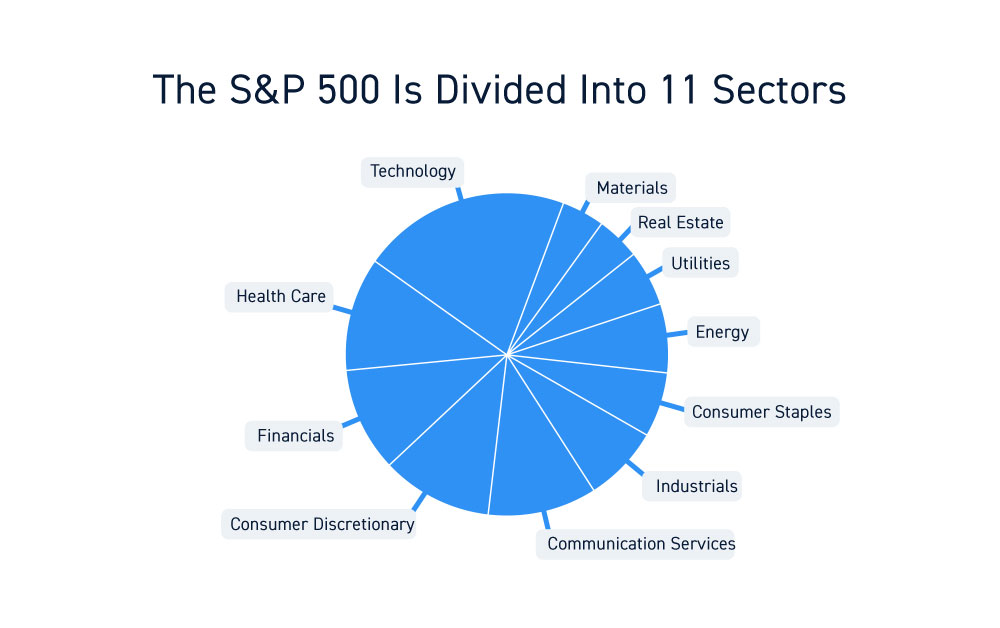
Investing in a single company is risky. If that company goes bankrupt, you lose everything. By contrast, the S&P 500 provides instant diversification across 11 different sectors, including Technology, Healthcare, Financials, Consumer Discretionary, and Energy. When you invest in the index, you are betting on the collective ingenuity of the American workforce and the stability of its largest institutions. While the index can and does go down during recessions, the failure of all 500 companies simultaneously is an economic impossibility in a functioning society.
Historical Returns and Wealth Creation
Historically, the S&P 500 has provided an average annual return of approximately 10% (before adjusting for inflation) over long horizons. This makes it one of the most powerful wealth-building engines in history. Through the power of compounding, an investment in the S&P 500 can grow exponentially over decades. This is why it is the cornerstone of millions of 401(k) plans and Individual Retirement Accounts (IRAs).
How to Invest in the S&P 500
An important distinction to make is that you cannot “buy” the S&P 500 index itself, as it is just a mathematical formula. However, you can invest in funds that are designed to track the index exactly. These are known as index funds or Exchange-Traded Funds (ETFs).
Index Funds vs. ETFs
Index mutual funds and ETFs are the most common ways to gain exposure to the S&P 500. An S&P 500 ETF, such as the SPDR S&P 500 ETF Trust (SPY) or the Vanguard S&P 500 ETF (VOO), buys shares in all 500 companies in the exact proportions they appear in the index. When the index goes up 1%, your investment goes up 1%.
The primary advantage of these funds is their low cost. Because a computer can manage the buying and selling of shares to match the index, there is no need for expensive human analysts. These “passive” investment vehicles typically have very low expense ratios, meaning more of your money stays in your pocket rather than going to a fund manager.
The Rise of Passive Investing
The S&P 500 has been the catalyst for a revolution in passive investing. Financial pioneers like John Bogle, the founder of Vanguard, championed the idea that most investors are better off simply matching the market’s return rather than trying to beat it. Today, trillions of dollars are invested in S&P 500 tracking funds, making it one of the most liquid and accessible investment strategies in the world.
Limitations and Considerations for Investors
While the S&P 500 is a gold standard, it is not without its nuances and potential drawbacks. Investors should be aware of how the index is constructed to avoid common pitfalls.
Concentration Risk in Mega-Cap Stocks
Because the S&P 500 is market-cap weighted, it can become top-heavy. In recent years, the “Magnificent Seven”—a group of high-growth tech companies including Apple, Microsoft, and Nvidia—have come to represent a significant percentage of the entire index’s value. This means that if the tech sector experiences a downturn, the entire S&P 500 will suffer, even if companies in the healthcare or industrial sectors are doing well. Investors who want “true” diversification may sometimes look toward equal-weighted versions of the index, where every company has a 0.2% stake regardless of size.
Domestic vs. International Exposure
The S&P 500 only includes U.S.-based companies. While many of these firms are multinational corporations that derive a large portion of their revenue from overseas, the index does not provide direct exposure to emerging markets or developed international economies like Europe or Japan. A well-rounded financial plan often involves pairing an S&P 500 fund with international indices to ensure global diversification.

The Difference Between the S&P 500 and the Economy
It is also vital to remember that “the market is not the economy.” The S&P 500 tracks the stock prices of large, profitable corporations. It does not directly account for unemployment rates, small business health, or the cost of living for the average citizen. There are times when the S&P 500 reaches all-time highs while the general public is struggling through a recession. Understanding this disconnect is key to maintaining a professional and objective perspective on your investments.
Ultimately, the S&P 500 is more than just a number on a screen. It is a reflection of corporate America’s ability to innovate, adapt, and generate profit. For the modern investor, it represents one of the most efficient paths to participating in the growth of the world’s largest economy. By understanding its mechanics and its role as a benchmark, you can use the S&P 500 as a foundational element of your financial journey.
aViewFromTheCave is a participant in the Amazon Services LLC Associates Program, an affiliate advertising program designed to provide a means for sites to earn advertising fees by advertising and linking to Amazon.com. Amazon, the Amazon logo, AmazonSupply, and the AmazonSupply logo are trademarks of Amazon.com, Inc. or its affiliates. As an Amazon Associate we earn affiliate commissions from qualifying purchases.