
In the ever-evolving landscape of digital communication, acronyms and abbreviations have become an indispensable part of our texting vocabulary. From the ubiquitous “LOL” and “BRB” to more nuanced expressions, these shorthand codes allow us to convey emotions, intentions, and information with remarkable speed and efficiency. Among the plethora of these digital neologisms, “PSH” is one that occasionally surfaces, leaving some users puzzled about its meaning and appropriate usage. This article delves into the world of texting abbreviations to demystify “PSH,” explore its various interpretations, and understand its place within the broader context of digital communication trends.

The Multifaceted Meanings of “PSH”
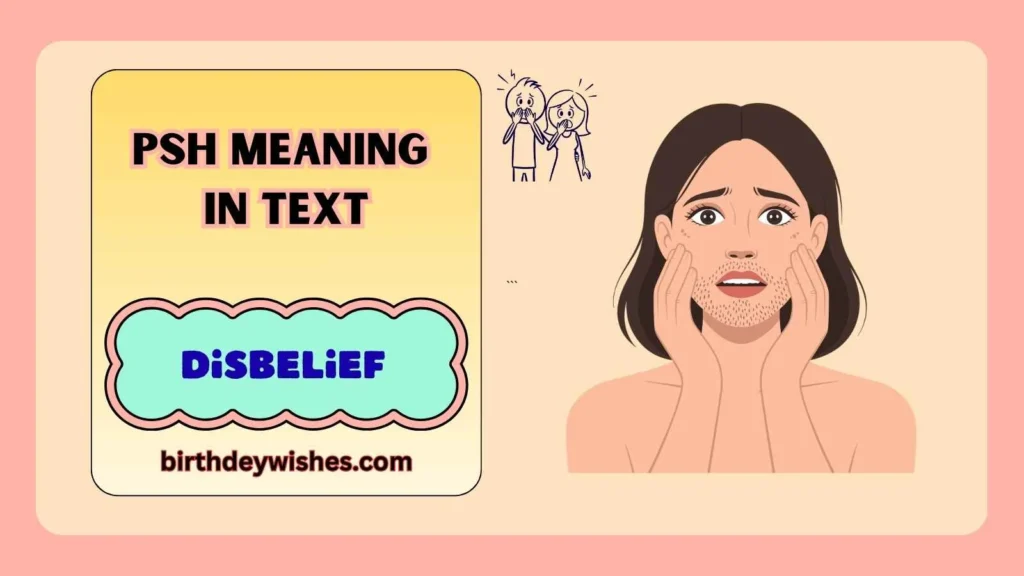
While there isn’t a single, universally agreed-upon definition for “PSH,” its meaning in texting typically revolves around expressing a mild sense of annoyance, exasperation, or dismissal. It’s a vocalization that can be translated into a subtle sigh, a knowing eye-roll, or a dismissive “whatever.” The key to understanding “PSH” lies in deciphering the context in which it’s used, as its nuance can shift depending on the sender and the situation.
Expressing Mild Annoyance and Frustration
One of the most common interpretations of “PSH” is as an expression of mild annoyance or frustration. Imagine a friend is recounting a story about a minor inconvenience, or perhaps they’re complaining about a situation that, while not a major crisis, is nonetheless irksome. In such scenarios, “PSH” can serve as a sympathetic, yet somewhat detached, acknowledgment of their feelings. It’s a way of saying, “Yeah, that’s a bit annoying, I get it,” without necessarily escalating the emotional intensity.
For instance, if someone texts, “My train is delayed by 10 minutes again, I’m going to be late for my appointment,” a response of “PSH, that’s annoying” conveys understanding and a shared sense of minor inconvenience. It’s not a dramatic outpouring of sympathy, but rather a relatable acknowledgment. This usage highlights the efficiency of “PSH” in conveying a specific emotional shade that might otherwise require several words to articulate.
Dismissing or Downplaying a Situation
Beyond expressing annoyance, “PSH” can also be employed to dismiss or downplay a situation, often with a touch of playful sarcasm or indifference. This usage suggests that the matter at hand is not particularly significant or worthy of excessive worry. It’s a way of saying, “It’s not a big deal,” or “Don’t overthink it.”
Consider a scenario where someone is stressing about a minor social faux pas, like accidentally sending a text to the wrong person. If they text, “OMG, I just sent that embarrassing message to my boss! What do I do?!” A friend might reply with “PSH, they probably won’t even notice” or “PSH, just play it cool.” Here, “PSH” serves to alleviate their friend’s anxiety by framing the situation as less dire than they perceive it.
This dismissive quality also extends to situations where someone is being overly dramatic or complaining about something trivial. In such cases, “PSH” can be a subtle way to gently, or sometimes not so gently, suggest that their reaction might be disproportionate to the issue. It’s a linguistic shrug, indicating that while you hear them, you don’t necessarily share their level of concern.
A Subtle Form of Exasperation
At times, “PSH” can signify a more pronounced, albeit still contained, form of exasperation. This occurs when the sender is experiencing a recurring annoyance or is dealing with a situation that, while not inherently disastrous, is particularly irksome due to its persistence or predictability. It’s the sound one might make when encountering a familiar, irritating problem for the umpteenth time.
For example, if a friend consistently forgets to lock their door or leave lights on, and you’ve reminded them multiple times, a text like “You forgot to lock the door again? PSH” conveys a sense of weary resignation. The “PSH” here is a verbal sigh of “Here we go again,” indicating a feeling of being at the end of one’s patience, but not necessarily in a confrontational way.
This type of exasperation is often delivered with a slight humor or a resigned tone, preventing it from being perceived as overtly aggressive. It’s a way of communicating a feeling of being slightly worn down by a predictable pattern of behavior or events.
The Evolution of Texting Lingo: “PSH” in Context
The emergence and usage of abbreviations like “PSH” are intrinsically linked to the evolution of digital communication. As texting became a primary mode of interaction, users naturally developed shorthand to expedite their conversations. This phenomenon is not new; even in the early days of SMS, acronyms like “LOL” (Laughing Out Loud) and “BRB” (Be Right Back) quickly became commonplace.
The Rise of Digital Abbreviations
The rapid proliferation of smartphones and the increasing reliance on instant messaging platforms created a fertile ground for the development of new linguistic shortcuts. These abbreviations serve multiple purposes: they save keystrokes, convey emotion efficiently, and foster a sense of belonging within digital communities. The constant stream of short, informal messages necessitates a language that can keep pace with the speed of thought and interaction.
“PSH,” in its various interpretations, fits neatly into this paradigm. It offers a concise way to express a nuanced emotional state that might otherwise require more verbose phrasing. This is particularly useful in a medium where tone can be easily misconstrued. An emoticon or a well-placed “PSH” can often clarify intent and prevent misunderstandings that might arise from plain text.
Cultural Nuances and Generational Differences
Like many linguistic trends, the understanding and usage of “PSH” can be influenced by cultural nuances and generational differences. What might be a common abbreviation within one social circle or age group could be entirely unfamiliar to another. This is a natural consequence of how language evolves organically within communities.
Younger generations, who have grown up with instant messaging as a primary form of communication, are often at the forefront of adopting and adapting new abbreviations. They tend to be more fluid in their use of these digital shortcuts, often creating new ones or repurposing existing ones to fit their specific communication needs. Older generations, while increasingly adept at digital communication, might be less familiar with the latest lingo, leading to occasional confusion.
Therefore, when encountering “PSH,” it’s always beneficial to consider the demographic and social context of the sender. A “PSH” from a teenager might carry a slightly different weight or connotation than a “PSH” from someone in their late twenties.
The Importance of Contextual Interpretation
Ultimately, the meaning of “PSH” in texting is highly dependent on context. Without the rich tapestry of non-verbal cues present in face-to-face communication, texters rely heavily on surrounding words, emojis, and the established relationship with the recipient to decipher meaning. “PSH” is a prime example of an abbreviation whose interpretation is malleable.
To effectively understand and use “PSH,” consider the following:
- The surrounding text: What is the topic of the conversation? What is the sender’s overall sentiment?
- The relationship with the sender: Do you have a casual or formal relationship? Are they prone to using abbreviations?
- The use of emojis: Are there any accompanying emojis that might further clarify the intended tone? A “PSH” followed by a or might lean more towards dismissiveness or sarcasm.
- The history of your conversations: Have they used “PSH” before, and in what context?
By paying attention to these contextual clues, you can more accurately interpret the intended meaning of “PSH” and use it appropriately in your own digital conversations. It’s a testament to the dynamic and adaptive nature of language in the digital age.
Beyond “PSH”: Other Common Texting Abbreviations and Their Meanings
The world of texting abbreviations is vast and constantly expanding. Understanding “PSH” is just one small piece of this linguistic puzzle. Familiarizing yourself with other common abbreviations can further enhance your ability to navigate digital conversations with ease and clarity.
Frequently Used Acronyms and Initialisms
Many texting abbreviations are formed by taking the first letter of each word in a phrase. These have become so ingrained in our digital lexicon that their meanings are often instantly recognizable.
- LOL (Laughing Out Loud): Expresses amusement or laughter.
- BRB (Be Right Back): Indicates a temporary departure from the conversation.
- OMG (Oh My God/Goodness): Expresses surprise, shock, or excitement.
- FYI (For Your Information): Used to share information that might be useful to the recipient.
- IDK (I Don’t Know): Simply states a lack of knowledge.
- NVM (Never Mind): Used to retract a previous statement or indicate that something is no longer important.
- BTW (By The Way): Introduces a new topic or a tangential piece of information.
- TTYL (Talk To You Later): A farewell indicating a desire to continue the conversation at a later time.
Abbreviations Conveying Emotion and Tone
Beyond simple informational abbreviations, many are designed to convey specific emotions or tones, much like “PSH.”
- SMH (Shaking My Head): Expresses disbelief, disappointment, or disapproval. It’s often used when something is foolish or frustrating.
- IDC (I Don’t Care): A direct expression of indifference.
- IKR (I Know, Right?): Used to express agreement or shared understanding with something someone has said.
- TBH (To Be Honest): Precedes a candid or frank statement.
- WTH (What The Heck/Hell): Expresses confusion, annoyance, or disbelief.
Abbreviations for Efficiency and Slang
Some abbreviations are purely for efficiency, while others are more informal slang that has migrated into texting.
- CU (See You): A casual farewell.
- GR8 (Great): A phonetic spelling of “great.”
- THX/TX (Thanks): A shortened form of “thanks.”
- U (You): A phonetic spelling of “you.”
- R (Are): A phonetic spelling of “are.”
The continued innovation in texting abbreviations reflects the dynamic nature of language and its ability to adapt to new mediums of communication. As texting evolves, so too will its vocabulary, offering new and creative ways for us to connect and express ourselves in the digital realm.
Navigating the Nuances: Best Practices for Using “PSH” and Other Abbreviations
While texting abbreviations offer undeniable benefits in terms of speed and efficiency, their use also requires a degree of awareness and consideration. Misunderstandings can arise, especially when dealing with abbreviations that have multiple meanings or are subject to varying interpretations.
Know Your Audience
The most crucial aspect of using any abbreviation, including “PSH,” is to know your audience. Consider the recipient’s age, their familiarity with texting lingo, and your relationship with them.
- For close friends and family: You can generally use a wider range of abbreviations, including those with more nuanced meanings like “PSH,” as they are more likely to understand your intent.
- For professional contacts or new acquaintances: It’s generally best to err on the side of caution and use clearer, more formal language. While some basic abbreviations like “FYI” might be acceptable in certain professional contexts, overly casual or ambiguous abbreviations like “PSH” are best avoided.
- When in doubt, spell it out: If you’re unsure whether your recipient will understand an abbreviation, it’s always safer to write it out in full. This prevents potential confusion and ensures your message is received as intended.
Avoid Overuse and Ambiguity
While abbreviations can be useful, overusing them can make your message difficult to read and can come across as lazy or overly informal. Additionally, some abbreviations can be ambiguous, having different meanings depending on the context.
- “PSH” is a prime example: As we’ve explored, its meaning can shift from mild annoyance to dismissiveness. If you want to convey a specific emotion with clarity, consider whether “PSH” is the best tool for the job, or if a more descriptive phrase or an emoji would be more effective.
- Consider the impact of abbreviations: In some cases, the reliance on abbreviations can detract from the sincerity or depth of a message. If you are conveying serious news or emotions, a more thoughtful and complete message is generally more appropriate.
Embrace Emojis to Enhance Meaning
Emojis have become an integral part of texting, working in tandem with abbreviations to convey tone and emotion. They can often clarify the intended meaning of an abbreviation or add an extra layer of expression.
- For “PSH”: A “PSH” followed by a might indicate playful annoyance, while a “PSH” with a could suggest genuine exasperation or sarcasm.
- Complementary use: Emojis can help to soften potentially negative connotations of abbreviations or add emphasis to positive ones. For instance, “LOL ” is more expressive than just “LOL.”

The Ever-Evolving Nature of Digital Language
It’s important to remember that digital language is constantly evolving. New abbreviations emerge, older ones fall out of favor, and meanings can shift over time. What is understood today might be obsolete tomorrow, or a new interpretation might gain traction.
- Stay curious and adaptable: Be open to learning new abbreviations and understanding how they are used by different groups.
- Observe and learn: Pay attention to how others use abbreviations in your conversations. This is often the best way to learn the unspoken rules of digital communication.
By approaching texting abbreviations with a thoughtful and context-aware mindset, you can enhance your communication, foster clearer understanding, and participate more effectively in the dynamic world of digital discourse. While “PSH” might seem like a small piece of this puzzle, understanding its nuances and the broader principles of texting lingo empowers you to connect more meaningfully in our increasingly digital lives.
aViewFromTheCave is a participant in the Amazon Services LLC Associates Program, an affiliate advertising program designed to provide a means for sites to earn advertising fees by advertising and linking to Amazon.com. Amazon, the Amazon logo, AmazonSupply, and the AmazonSupply logo are trademarks of Amazon.com, Inc. or its affiliates. As an Amazon Associate we earn affiliate commissions from qualifying purchases.