
To the casual observer, “Nasdaq” is a word that flashes across news tickers alongside fluctuating numbers and green or red arrows. To the seasoned investor, it represents a barometer for the global technology sector and a powerhouse of financial innovation. However, understanding what Nasdaq actually does requires looking beyond the stock quotes. Nasdaq is not just a list of companies; it is a complex financial services corporation that operates global exchanges, provides sophisticated market technology, and manages some of the most influential indices in the world.

Founded in 1971 by the National Association of Securities Dealers (NASD), Nasdaq began as the world’s first electronic stock market. At its inception, it was a revolutionary concept that challenged the traditional “open outcry” floor-trading models used by institutions like the New York Stock Exchange (NYSE). Today, Nasdaq is a multi-faceted entity that serves as the backbone for the modern digital economy.
Understanding Nasdaq as a Global Electronic Marketplace
At its core, Nasdaq is a licensed national securities exchange. It provides the digital infrastructure where buyers and sellers meet to trade shares of publicly held companies. Unlike traditional exchanges that historically relied on physical trading floors, Nasdaq has always been entirely electronic, a factor that has defined its identity and attracted the world’s most forward-thinking companies.
The Dealer Market Model
Nasdaq operates as a “dealer market.” In this system, market makers—large financial institutions—carry an inventory of specific stocks and stand ready to buy and sell them at publicly quoted prices. This is distinct from an “auction market,” where buyers and sellers trade directly with one another on a floor. By utilizing a network of market makers, Nasdaq ensures that there is constant liquidity in the market, meaning investors can almost always find a counterpart for their trades, even during periods of high volatility.
How the Exchange Facilitates Liquidity
Liquidity is the lifeblood of any financial market, and Nasdaq’s electronic framework is designed to maximize it. Through its high-speed execution systems, Nasdaq processes millions of transactions per second. This efficiency reduces the “bid-ask spread”—the difference between the highest price a buyer is willing to pay and the lowest price a seller is willing to accept. For the everyday investor, a narrower spread means lower transaction costs and more efficient pricing for their portfolio.
Nasdaq vs. NYSE: Key Structural Differences
While both are titans of the financial world, Nasdaq and the NYSE differ in more than just their trading style. Traditionally, Nasdaq was seen as the home for “growth” stocks—newer companies with high potential—while the NYSE was the home for “value” stocks—established industrial giants. While these lines have blurred over time, the listing requirements and fee structures remain different. Nasdaq is often perceived as more accessible for tech-leaning firms, offering a variety of listing tiers including the Nasdaq Global Select Market, the Nasdaq Global Market, and the Nasdaq Capital Market, each tailored to companies at different stages of their corporate lifecycle.
The Nasdaq Indices: Benchmarks for Innovation and Growth
When people ask, “How did the Nasdaq do today?” they are usually referring to the Nasdaq Composite Index or the Nasdaq-100. These indices are among the most watched financial metrics in the world, serving as a pulse check for the health of the technology sector and the broader “new economy.”
The Nasdaq Composite vs. The Nasdaq-100
The Nasdaq Composite is a broad-market index that includes almost all stocks listed on the Nasdaq stock exchange—over 3,000 companies. Because the exchange is heavily weighted toward technology, biotechnology, and consumer services, the Composite is the primary indicator of how these specific sectors are performing.
In contrast, the Nasdaq-100 is a more exclusive subset. It consists of the 100 largest non-financial companies listed on the exchange. This index is particularly famous because it includes the “Magnificent Seven” and other tech giants that drive global innovation. Because it excludes financial firms like banks, the Nasdaq-100 is often used by investors as a pure-play benchmark for large-cap growth and innovation.
Why Investors Track Nasdaq Performance
For personal finance enthusiasts and professional fund managers alike, the Nasdaq indices are vital for benchmarking performance. If an investor’s portfolio is heavily geared toward innovation, they will compare their returns against the Nasdaq-100. Over the last two decades, the Nasdaq-100 has frequently outperformed more traditional indices like the S&P 500 or the Dow Jones Industrial Average, primarily due to the explosive growth of the digital and software sectors. Tracking these indices helps investors understand market cycles, specifically the transition between “risk-on” environments (where tech thrives) and “risk-off” environments (where investors move to safer assets).
The Sector Composition: More Than Just “Big Tech”
While technology accounts for a massive portion of the Nasdaq’s weight, it is a misconception to think it is exclusively a tech index. The exchange is home to massive healthcare innovators, retail giants, and telecommunications leaders. Companies like Costco, PepsiCo, and Moderna are prominent fixtures on the Nasdaq. This diversity ensures that while the index is sensitive to tech trends, it also reflects broader consumer behavior and scientific advancement.
Beyond Trading: Nasdaq as a Financial Technology Powerhouse

Perhaps the most overlooked aspect of what Nasdaq does is its role as a global provider of market technology. Nasdaq is not just an exchange; it sells the “engine” that runs other exchanges around the world. This diversification into Software-as-a-Service (SaaS) and data analytics has transformed Nasdaq into a high-margin technology firm in its own right.
Market Technology and SaaS Solutions
Nasdaq’s Market Technology division provides trading, clearing, and settlement technology to over 130 marketplaces, regulators, and post-trade organizations in more than 50 countries. This means that when an investor trades stocks in Istanbul, Singapore, or Stockholm, they may very well be using technology developed and maintained by Nasdaq. By exporting its infrastructure, Nasdaq has become a central nervous system for global capital markets.
Data and Analytics Services
In the modern financial landscape, data is as valuable as capital. Nasdaq provides a massive suite of data products to institutional investors, hedge funds, and retail platforms. This includes “TotalView,” which shows the full depth of the market, allowing traders to see every single quote and order at every price level. Furthermore, Nasdaq provides sophisticated analytics tools that help companies understand who is buying their stock, a service known as “Investor Relations Intelligence.”
The Role of Regulatory and Compliance Software
With the rise of digital assets and increasingly complex financial regulations, compliance has become a massive industry. Nasdaq’s “Verafin” and “SMARTS” technologies are industry leaders in anti-financial crime and market surveillance. These tools use AI and machine learning to detect patterns of money laundering, fraud, and market manipulation. By providing these tools, Nasdaq helps maintain the integrity of the global financial system, ensuring that markets remain fair and transparent for all participants.
How Companies Go Public on Nasdaq
For a company, “listing on the Nasdaq” is a major milestone that signifies maturity and provides access to a massive pool of global capital. The process of going from a private entity to a publicly traded one is rigorous, and Nasdaq plays a consultative role in this transition.
The IPO Process and Listing Requirements
To list on the Nasdaq, a company must meet stringent financial, liquidity, and corporate governance requirements. These include minimum thresholds for the number of shareholders, the total value of shares held by the public, and consistent pre-tax earnings. This vetting process is crucial for investor protection; it ensures that only companies with a certain level of stability and transparency can solicit funds from the general public.
Attracting the Global Giants
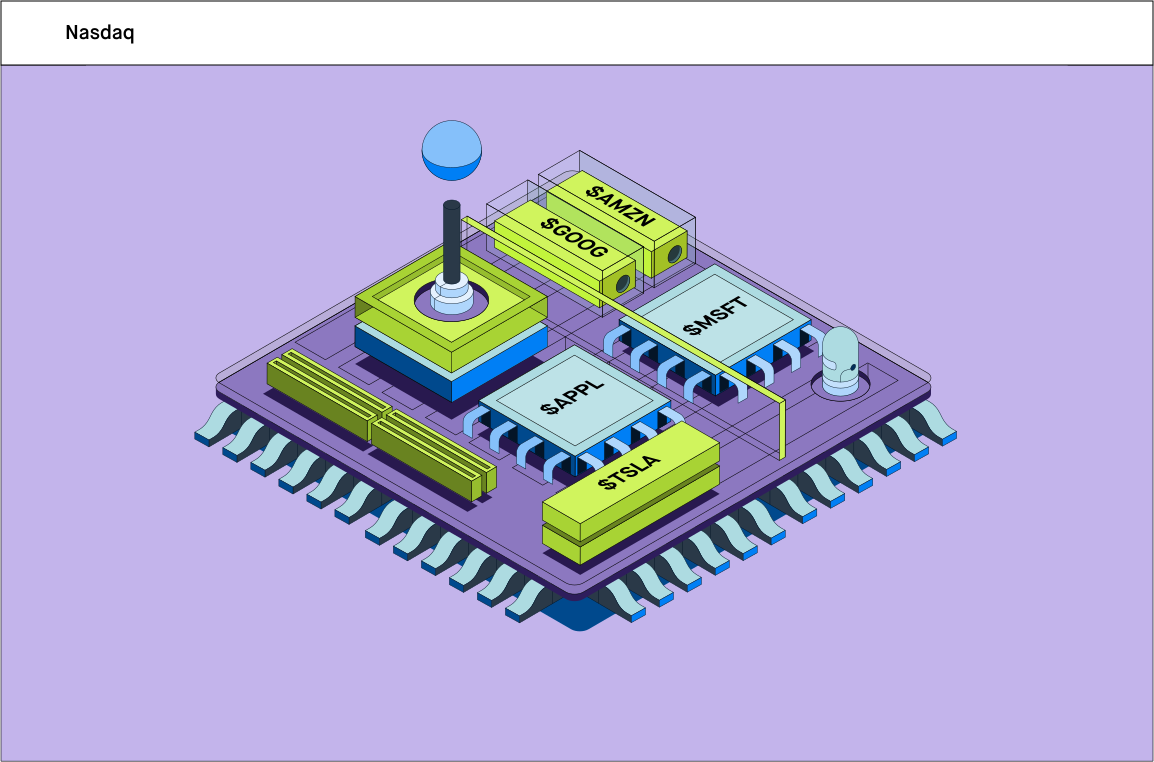
Nasdaq has a storied history of attracting the world’s most successful companies. From the early days of Microsoft and Apple to the modern dominance of Amazon and Alphabet (Google), these companies chose Nasdaq because its electronic-first, innovative branding aligned with their own corporate identities. Nasdaq’s ability to handle massive trading volumes and provide high visibility has made it the preferred destination for the “disruptors” of the business world.
Nurturing Small Caps and ESG Initiatives
While the giants grab the headlines, Nasdaq also provides a platform for small-cap and mid-cap companies through its Capital Market tier. This allows smaller, growing businesses to access public capital earlier in their development. Additionally, Nasdaq has taken a leadership role in Environmental, Social, and Governance (ESG) reporting. They provide tools and frameworks to help listed companies disclose their carbon footprints and diversity metrics, responding to the growing demand from investors for socially responsible investment opportunities.
How Nasdaq Influences Your Personal Portfolio
Understanding what Nasdaq does is not just an academic exercise; it has a direct impact on how individuals manage their money. Whether you are a direct stock picker or a passive index investor, Nasdaq’s operations influence your financial future.
ETFs and Index Funds Tracking Nasdaq
The most common way for individuals to interact with Nasdaq is through Exchange-Traded Funds (ETFs). The Invesco QQQ Trust, which tracks the Nasdaq-100, is one of the most traded and liquid financial instruments in the world. By buying a single share of a Nasdaq-tracking ETF, an investor gains instant exposure to 100 of the world’s most innovative companies. This “passive” investment strategy allows individuals to capture the growth of the tech sector without having to research individual stocks.
Understanding Volatility and Growth Potential
Because Nasdaq is concentrated in growth-oriented sectors, it tends to be more volatile than the broader S&P 500. During bull markets, the Nasdaq often leads the way up, as investors chase high-growth earnings. Conversely, during periods of rising interest rates, the Nasdaq can experience sharper corrections, as the “future value” of growth stocks is discounted more heavily. For the personal investor, understanding this dynamic is key to asset allocation and risk management.
Strategic Positioning for Long-Term Investors
For those building long-term wealth, the Nasdaq represents the “innovation” component of a diversified portfolio. As the world continues to move toward automation, artificial intelligence, and biotechnology, the companies listed on Nasdaq are likely to remain at the forefront of value creation. By understanding that Nasdaq is both a marketplace for these companies and a provider of the technology that enables them to trade, investors can better appreciate the structural importance of this institution in the global economy.
In summary, Nasdaq is a multifaceted engine of the financial world. It is an exchange that facilitates billions of dollars in daily trade, an index provider that benchmarks the world’s progress, and a technology vendor that secures and powers markets globally. For anyone looking to navigate the modern world of money and investing, a clear understanding of Nasdaq’s diverse roles is an essential tool for success.
aViewFromTheCave is a participant in the Amazon Services LLC Associates Program, an affiliate advertising program designed to provide a means for sites to earn advertising fees by advertising and linking to Amazon.com. Amazon, the Amazon logo, AmazonSupply, and the AmazonSupply logo are trademarks of Amazon.com, Inc. or its affiliates. As an Amazon Associate we earn affiliate commissions from qualifying purchases.