
The explosion of generative AI and Large Language Models (LLMs) has fundamentally altered the requirements of the modern data stack. As developers move from simple API wrappers to sophisticated, production-grade AI applications, the challenge of managing massive datasets of unstructured information—images, videos, documents, and audio—has become a primary bottleneck. Enter LanceDB, an open-source vector database designed specifically for the AI era. Unlike traditional relational databases or even first-generation vector stores, LanceDB redefines how high-dimensional data is stored, indexed, and queried.
At its core, LanceDB is an embedded, high-performance vector database that leverages a unique columnar data format. It provides the backbone for Retrieval-Augmented Generation (RAG), recommendation engines, and computer vision applications by allowing developers to store and search through vector embeddings with unprecedented efficiency. To understand what LanceDB does, one must look past its interface and into the architectural innovations that make it a standout tool in the developer’s toolkit.
Understanding the Core Mechanics of LanceDB
To grasp the utility of LanceDB, one must first understand the “Lance” format it is built upon. Traditionally, data scientists have relied on formats like Parquet for analytical workloads. While Parquet is excellent for bulk processing, it struggles with the low-latency, random access patterns required by vector search. LanceDB utilizes the Lance format, a modern alternative designed to be 100x faster than Parquet for random access and optimized for AI data.
The Lance Columnar Data Format
The Lance format is the secret sauce of LanceDB. It is a high-performance, versioned, columnar data format that supports complex data types including tensors, images, and deeply nested structures. What LanceDB does is provide a database layer over this format that treats vectors as first-class citizens.
In a typical vector database, you might store your embeddings in one place and your metadata (like filenames or timestamps) in another. LanceDB eliminates this decoupling. By using the Lance format, it stores vectors and metadata together in a single, unified columnar structure. This significantly reduces the overhead of “joining” data during a query and allows for highly efficient filtering. When you ask LanceDB to find “all vectors similar to X where the date is after 2023,” it performs this hybrid search natively at the storage layer, rather than filtering results in memory after the fact.
Serverless and Embedded by Design
One of the most disruptive aspects of what LanceDB does is its deployment model. Traditional vector databases like Milvus or Weaviate often require a complex distributed cluster, involving multiple containers, orchestration, and significant infrastructure overhead. LanceDB takes a different approach: it is serverless and embedded.
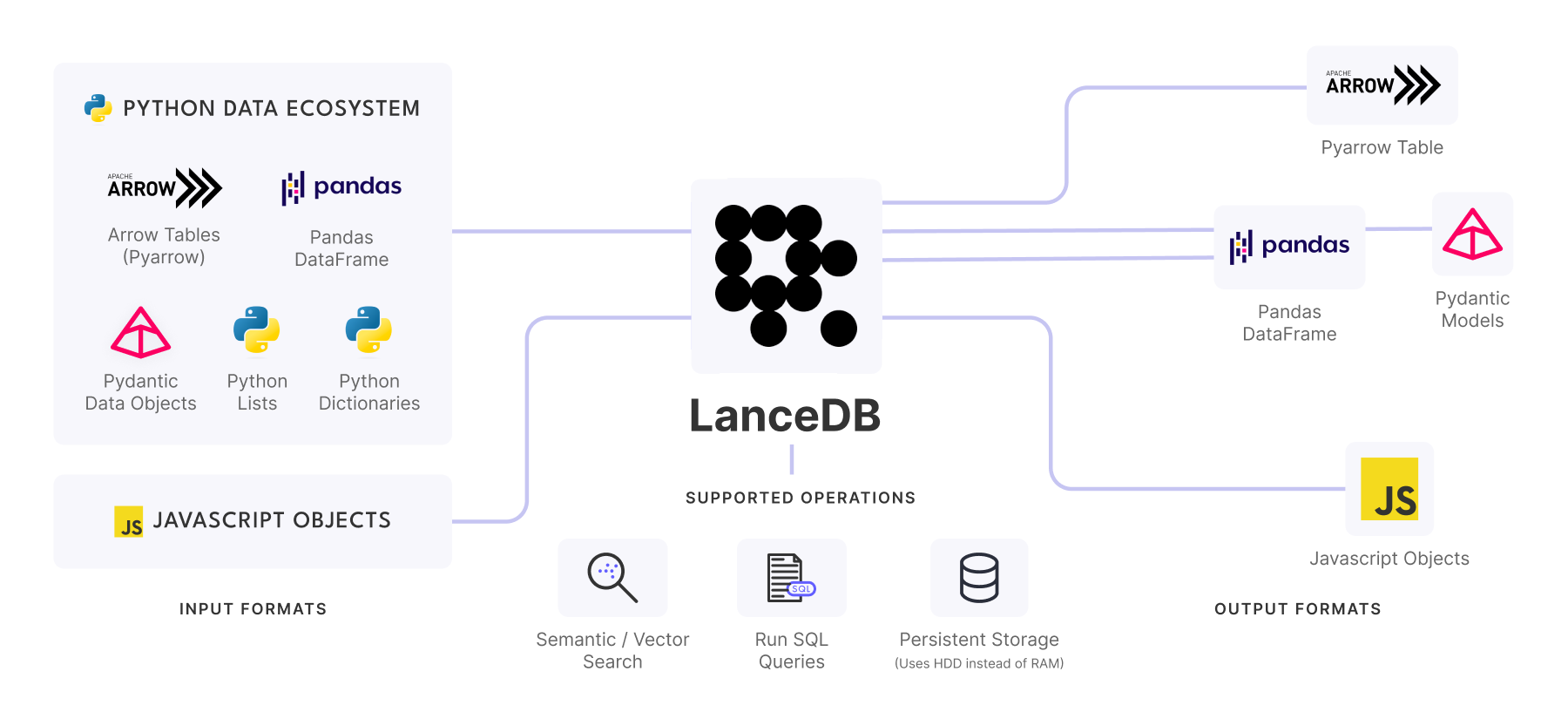
Being “embedded” means LanceDB runs inside your application process. If you are using Python, you simply pip install lancedb. There is no database server to manage, no connection strings to troubleshoot, and no latency between your application logic and the data layer. This is similar to how SQLite operates for relational data. However, unlike SQLite, LanceDB is built to scale to billions of rows by leveraging cloud storage like AWS S3 or Azure Blob Storage. This architecture allows developers to start small on their local machines and scale to production without changing a single line of code.
Key Features and Technological Advantages
LanceDB is more than just a place to put vectors; it is a comprehensive management system for AI data. Its feature set is designed to solve the specific pain points encountered when building LLM-based systems.
Beyond In-Memory: High-Performance Disk Storage
Most early vector databases were designed to be “in-memory,” meaning all embeddings had to fit into the system’s RAM to ensure fast search speeds. As datasets grew into the terabyte range, this became prohibitively expensive.
LanceDB solves this by being disk-native. It uses advanced indexing techniques and the Lance format’s fast random-access capabilities to provide sub-millisecond search speeds even when the data is stored on disk or in the cloud. By utilizing SSDs and NVMe drives effectively, LanceDB allows companies to manage massive datasets at a fraction of the cost of RAM-heavy alternatives. It performs “zero-copy” reads, meaning data is mapped directly into memory without unnecessary duplication, further optimizing performance.
Multi-modal Data Handling
In the current AI landscape, data is rarely just text. We are seeing a surge in multi-modal models that process images, audio, and video simultaneously. What LanceDB does exceptionally well is treat these complex types as native elements.
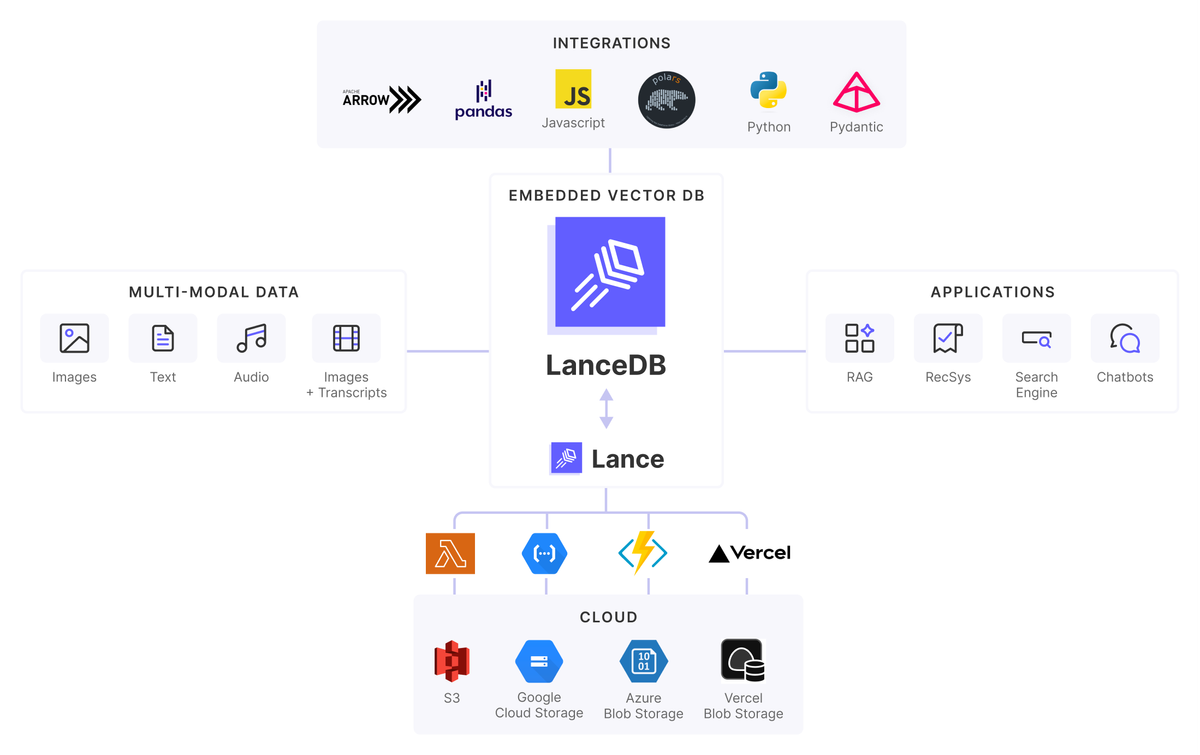
In LanceDB, you don’t just store a “link” to an image stored in an S3 bucket; you can store the image data itself alongside its vector embedding within the database. This creates a “data lake” experience within a database environment. Because the Lance format is optimized for high-bandwidth data, retrieving a batch of images for a computer vision training loop or a search result page is incredibly fast.
Full-Text Search and Vector Hybridization
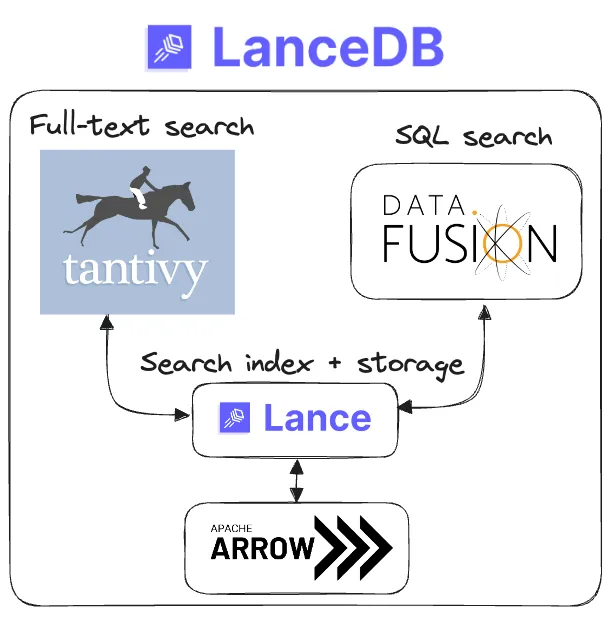
While vector search (semantic search) is powerful, it isn’t a silver bullet. Sometimes, you need to find an exact keyword, a specific SKU, or a unique identifier. This is where “Hybrid Search” comes in. LanceDB integrates full-text search (BM25) with vector search (ANN – Approximate Nearest Neighbor).
This allows users to combine the strengths of both worlds. For example, a user could search a legal database for the concept of “intellectual property theft” (vector search) while specifically filtering for documents containing the word “arbitration” (keyword search). LanceDB handles the ranking and merging of these disparate search results internally, providing a seamless API for the developer.
How LanceDB Powers the AI Stack
The most common question developers ask is: where does this fit in my stack? LanceDB acts as the long-term memory for AI agents and LLM applications.
Retrieval-Augmented Generation (RAG)
RAG is currently the most popular architecture for building specialized AI tools. In a RAG setup, when a user asks a question, the system searches a private database for relevant documents, retrieves them, and feeds them into an LLM (like GPT-4) to generate an answer.
LanceDB is the engine for the “Retrieval” part of this process. Because it is embedded, it can be deployed within an AWS Lambda function or a Vercel Edge Function, making it ideal for serverless AI applications. It maintains the context that the LLM lacks, ensuring that the AI has access to the most up-to-date and relevant private data without the need for expensive model fine-tuning.
Integrating with the AI Ecosystem
LanceDB does not exist in a vacuum. It is deeply integrated with the tools developers already use. It has first-class support for:
- LangChain and LlamaIndex: The primary frameworks for building LLM applications.
- Arrow and Pandas: The standard libraries for data manipulation in Python. Because Lance is based on Apache Arrow, moving data between LanceDB and a Pandas DataFrame is nearly instantaneous with zero overhead.
- PyTorch and TensorFlow: Making it easy to use LanceDB as a high-speed data loader for machine learning training.
Practical Applications and Use Cases
Beyond the theoretical, what does LanceDB do in the real world? Its versatility allows it to span across industries.
- E-commerce Recommendation Engines: Retailers use LanceDB to store product embeddings. When a user views an item, the database instantly finds visually or conceptually similar products. Because LanceDB handles metadata efficiently, it can filter these results by “in-stock” status or “price range” in the same query.
- Autonomous Vehicles: Companies in the robotics and AV space deal with massive amounts of sensor data. LanceDB allows them to store LiDAR and camera frames alongside embeddings, enabling them to search for specific scenarios, such as “pedestrians in heavy rain,” across petabytes of recorded data.
- Knowledge Management: Large enterprises use LanceDB to index millions of internal documents, Slack messages, and emails. This creates a centralized “corporate brain” where employees can ask questions and receive answers backed by internal citations.
- Digital Asset Management: For creative agencies, LanceDB can index entire libraries of video and high-resolution imagery. Users can search for “a sunset over a mountain range” and get instant results based on the visual content of the files rather than manual tags.
The Future of Vector Databases in the Edge Era
As we move forward, the trend in AI is shifting toward decentralization and edge computing. Users want their data to stay on their devices, and developers want to reduce the latency and cost of centralized cloud databases. LanceDB is uniquely positioned for this future.
Because it is a lightweight, file-based database, LanceDB can run on edge devices, mobile phones, or locally on a user’s desktop. This enables a new class of “Local AI” applications where personal data is indexed and searched without ever leaving the user’s control. By providing a database that is as easy to use as a library but as powerful as a distributed cluster, LanceDB is lowering the barrier to entry for sophisticated AI development.
In summary, LanceDB does not just “store vectors.” It provides a high-performance, cost-effective, and developer-friendly foundation for the next generation of data-driven applications. By combining the best of columnar storage, embedded architecture, and multi-modal support, it bridges the gap between static data and the dynamic requirements of artificial intelligence. For the modern developer, it is more than a database; it is the essential infrastructure for building the future.
aViewFromTheCave is a participant in the Amazon Services LLC Associates Program, an affiliate advertising program designed to provide a means for sites to earn advertising fees by advertising and linking to Amazon.com. Amazon, the Amazon logo, AmazonSupply, and the AmazonSupply logo are trademarks of Amazon.com, Inc. or its affiliates. As an Amazon Associate we earn affiliate commissions from qualifying purchases.