
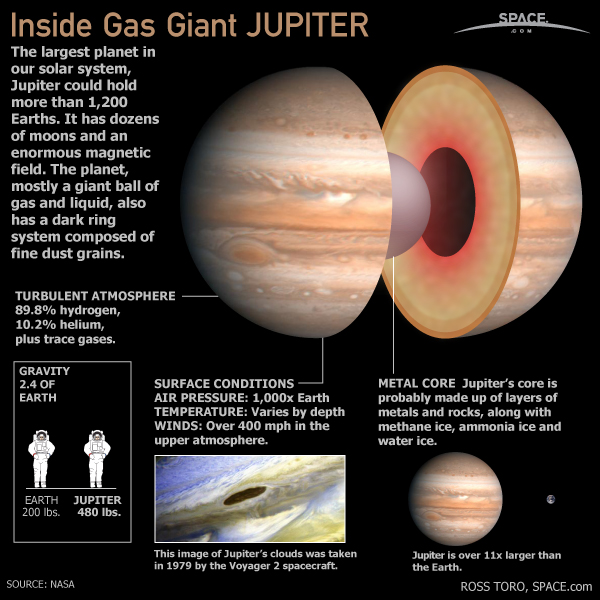
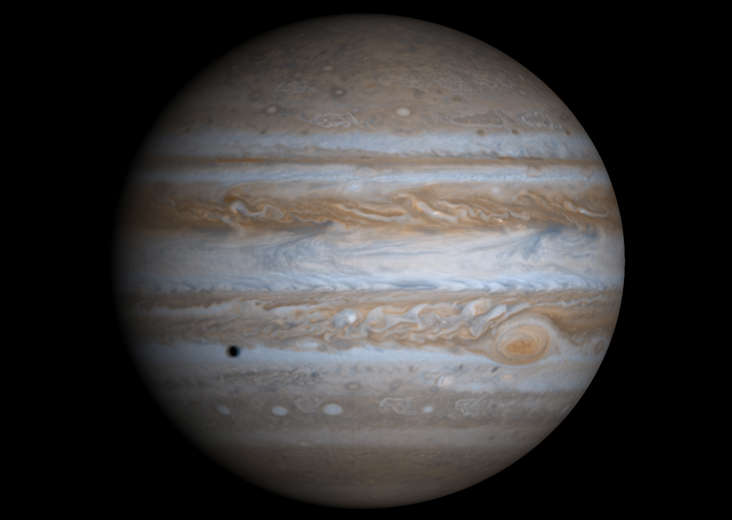
For decades, the question of what Jupiter’s “surface” looks like has captivated the public imagination. However, from a technological and scientific standpoint, the question itself is a paradox. Jupiter is a gas giant, meaning it lacks a solid, well-defined surface like Earth or Mars. To “see” Jupiter is not a matter of simply pointing a camera and clicking a shutter; it is a complex feat of data engineering, sensor technology, and advanced image processing.
The visuals we admire today—the swirling ochre storms, the Great Red Spot, and the delicate filaments of its polar cyclones—are the products of some of the most sophisticated technology ever built by humanity. To understand what Jupiter looks like, we must first understand the technology that allows us to peer through its lethal radiation and thick layers of hydrogen and helium.
1. The Optical Challenge: High-Resolution Imaging in Deep Space
Capturing a clear image of Jupiter is one of the most significant challenges in optical engineering. Because Jupiter is roughly 484 million miles from the Sun, the light levels are significantly lower than on Earth. Furthermore, the planet’s immense magnetosphere creates a radiation environment that can fry standard digital sensors in minutes.
The Evolution of Sensor Tech: From Voyager to JunoCam
Early missions like Voyager 1 and 2 relied on vidicon camera tubes, which were essentially television cameras adapted for space. These primitive sensors provided our first close-ups but lacked the dynamic range and pixel density required for modern analysis. Today, the Juno spacecraft utilizes “JunoCam,” a high-resolution, visible-light camera.
The tech behind JunoCam is unique because it was designed as a “participatory” instrument. It uses a “push-broom” sensor, where the rotation of the spacecraft itself provides the scanning motion needed to build a full image. This reduces the need for complex moving parts that could fail in the harsh Jovian environment.
Infrared and Ultraviolet: Seeing the Invisible
Because Jupiter’s “surface” is actually an endless series of cloud decks, visible light only tells half the story. To see deeper, engineers use infrared (IR) sensors like those on the James Webb Space Telescope (JWST) and the Near-Infrared Spectrograph (NIRSpec). These gadgets allow us to see heat escaping from the planet’s interior, revealing the structure of the clouds beneath the top layer. By mapping different wavelengths, technology allows us to “see” the altitude of storms, distinguishing between high-altitude ammonia ice and deeper water clouds.
2. The Software Frontier: Processing Raw Data into Reality
When a space probe sends data back to Earth, it doesn’t arrive as a .JPEG file. It arrives as a stream of binary code—zeros and ones representing signal intensities across various spectral bands. The process of turning this data into the breathtaking images we see in tech journals is where software and AI tools take center stage.
AI and Machine Learning in Image Reconstruction
The sheer volume of data returned by modern probes requires automated processing. NASA and various tech institutions utilize machine learning algorithms to “clean” the images. Jupiter is surrounded by high-energy particles that strike the camera sensors, creating “noise” or white dots in the raw files.
AI tools are trained to distinguish between a cosmic ray hit and a genuine atmospheric feature. These algorithms can reconstruct missing pixels and stabilize images taken from a spinning spacecraft, ensuring that the final visual is a sharp, accurate representation of the planet’s turbulent atmosphere.
Computational Fluid Dynamics (CFD) and Digital Twins
To understand the “surface” motion, software engineers use Computational Fluid Dynamics to create digital twins of Jupiter’s atmosphere. By feeding the visual data into these simulations, researchers can predict how storms will evolve. This is the same technology used in aerospace engineering to design jet engines, applied here to the largest scale imaginable. It allows us to visualize the “surface” not just as a static photo, but as a living, moving 3D environment.
3. Hardware Resilience: Operating in a Lethal Magnetosphere
The reason we have so few “surface-level” views of Jupiter is that the planet is essentially a giant microwave. Its magnetic field is 20,000 times stronger than Earth’s, trapping electrons and accelerating them to near-light speeds. Designing hardware that can survive long enough to take a photo is a triumph of digital security and structural engineering.
Radiation Hardening (Rad-Hard) Components
The internal “brains” of a Jovian probe are protected by what engineers call a “vault.” For example, Juno’s command and data handling box is encased in 1-centimeter-thick titanium walls. Even then, the microchips used must be “Radiation Hardened.”
Unlike the high-end consumer chips in your smartphone, which prioritize speed and miniaturization, Rad-Hard chips prioritize stability. They are built using specialized manufacturing processes (like Silicon-on-Insulator) that prevent an ionizing particle from “flipping a bit” and causing a system crash. This is the ultimate form of hardware-level digital security.
Power Systems: Beyond Solar Tech
While many satellites use solar panels, Jupiter’s distance from the sun makes this difficult. The tech leap for Juno was the development of incredibly efficient, massive solar arrays (over 60 feet long) that can generate power in the dim reaches of the outer solar system. For missions where solar isn’t viable, engineers utilize Multi-Mission Radioisotope Thermoelectric Generators (MMRTGs), which convert the heat from decaying plutonium into electricity, ensuring the cameras and sensors stay online for years.
4. The Data Pipeline: Transmitting High-Resolution Visuals Across the Void
Once an image is captured and processed by the onboard computer, it must be sent back to Earth. This involves a specialized branch of communication technology known as the Deep Space Network (DSN).
Bandwidth and Compression Algorithms
Transmitting 4K-quality imagery from Jupiter is not like uploading a video to the cloud via 5G. The data rates are incredibly slow, often measured in kilobits per second. To solve this, software engineers employ advanced lossless compression algorithms. These tools shrink the file sizes without losing the scientific integrity of the pixels. Every bit of data is precious, and the protocols used—often based on the Consultative Committee for Space Data Systems (CCSDS) standards—ensure that even if parts of the signal are lost during the 40-minute journey to Earth, the image can be reconstructed.
Ground-Based Tech: The Receiving End
On Earth, the “visuals” are finalized through the use of massive 70-meter radio antennas. These gadgets are sensitive enough to detect a signal weaker than the energy of a snowflake hitting the ground. The integration of ground-based software with space-based hardware creates a seamless tech ecosystem that allows a person on their smartphone to see a high-resolution image of a Jovian storm just hours after it was captured millions of miles away.
5. Future Trends: VR and Real-Time Planetary Visualization
As we move forward, the way we perceive Jupiter’s surface is shifting from 2D photos to immersive 3D experiences. The next generation of space tech is focused on accessibility and hyper-realistic rendering.
Photogrammetry and 3D Modeling
By taking multiple images from different angles as a probe orbits, software can use photogrammetry to create a 3D topographic map of the cloud tops. We are reaching a point where VR (Virtual Reality) tools allow researchers—and eventually the public—to “fly” through the canyons of Jupiter’s clouds. Using game engines like Unreal Engine 5, developers are porting NASA’s telemetry data into real-time environments.

The Next Frontier: The Europa Clipper
The upcoming Europa Clipper mission represents the next peak of this tech trajectory. Its goal is to look at Jupiter’s moon, but its sensors will also provide the most detailed look yet at the Jovian system. With improved CMOS sensors and advanced spectroscopic mapping, the “visuals” of Jupiter will move from artistic interpretations to high-fidelity, real-time data streams.
In conclusion, what Jupiter’s “surface” looks like is a question that is answered by the cutting edge of human technology. It is a synthesis of radiation-resistant hardware, AI-driven software, and global communication networks. We don’t just see Jupiter; we reconstruct it through a sophisticated technological lens that turns the invisible into the visible. As our gadgets become more resilient and our algorithms more “intelligent,” the face of the king of planets will only become clearer, revealing a world of terrifying beauty and endless technical fascination.
aViewFromTheCave is a participant in the Amazon Services LLC Associates Program, an affiliate advertising program designed to provide a means for sites to earn advertising fees by advertising and linking to Amazon.com. Amazon, the Amazon logo, AmazonSupply, and the AmazonSupply logo are trademarks of Amazon.com, Inc. or its affiliates. As an Amazon Associate we earn affiliate commissions from qualifying purchases.