
From the perspective of modern science and technology, a double rainbow is more than a fleeting moment of atmospheric beauty; it is a complex display of optical physics, a challenge for digital imaging sensors, and a data point for hyper-local weather prediction algorithms. While folklore often attributes mystical significance to the phenomenon, the “meaning” of a double rainbow in the digital age is rooted in the precision of light refraction, the capabilities of computational photography, and the evolution of spectral analysis.
Understanding this phenomenon requires a deep dive into the intersection of atmospheric science and the hardware we use to document our world. When we witness a secondary arc appearing above the primary one, we are seeing a rare alignment of environmental variables that tests the limits of our current technological tools.
The Physics of Light: A Masterclass in Natural Optics
To understand what it means to see a double rainbow, one must first understand the technical requirements for its formation. A rainbow is not a physical object in a specific location; rather, it is an optical phenomenon whose appearance depends on the observer’s position relative to the sun and water droplets in the atmosphere.
The Mechanics of Primary vs. Secondary Refraction
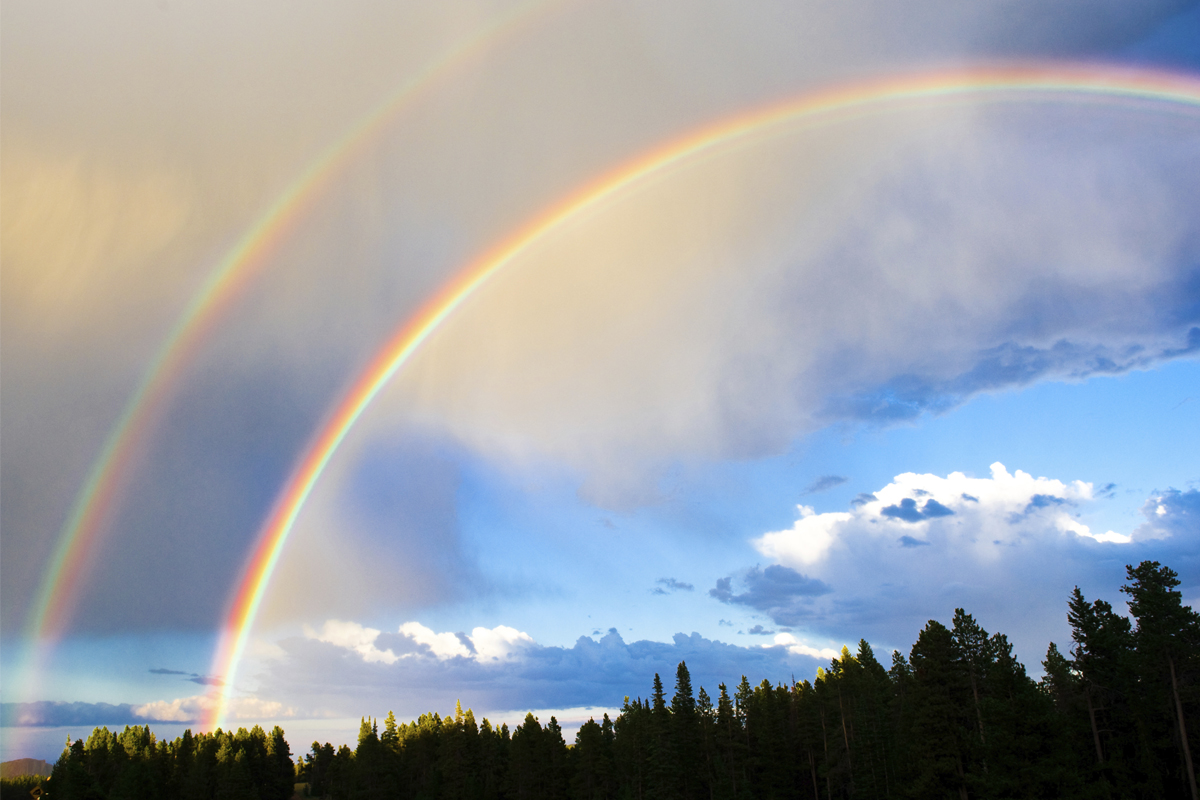
A primary rainbow occurs when sunlight enters a raindrop, reflects once off the back of the drop, and exits at an angle of approximately 42 degrees. However, a double rainbow occurs when light undergoes a second internal reflection inside the water droplet. This second reflection causes the light to exit at a different angle—roughly 51 degrees—and results in several distinct technical characteristics.
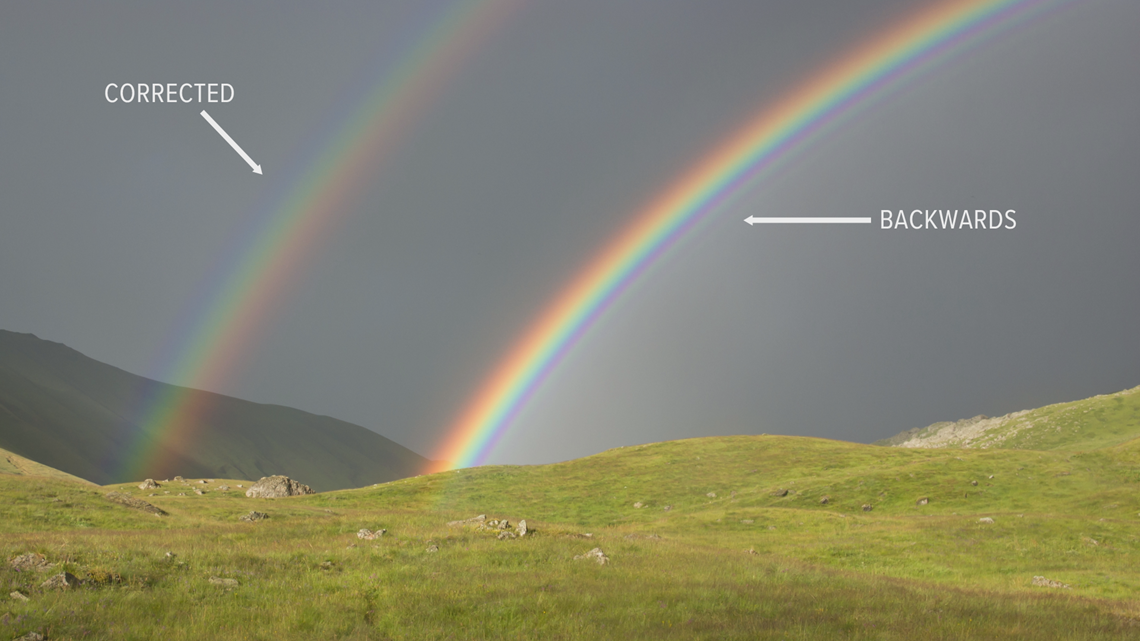
First, the secondary arc is significantly fainter than the primary one. Each time light reflects within a droplet, a portion of its energy is lost. From a photonics perspective, the secondary rainbow represents a lower-intensity signal. Second, the color sequence is inverted. In a primary rainbow, red is on the outside; in the secondary arc, the internal reflection flips the spectrum, placing violet on the outer edge.
Alexander’s Band: The Digital Contrast Challenge
Between the two arcs of a double rainbow lies a region of the sky that appears noticeably darker than the surrounding areas. Known as Alexander’s Band, this phenomenon is caused by the way light is scattered. In the region between the 42-degree and 51-degree angles, there is virtually no light scattered by the raindrops toward the observer’s eye.
For digital sensors, this creates an extreme contrast scenario. Capturing the vibrant, multi-spectral data of two distinct rainbows while maintaining the deep, shadow-heavy detail of Alexander’s Band requires a high degree of dynamic range. This is where hardware limitations often meet the complexity of natural optics.
Capturing the Spectrum: Digital Imaging and Computational Photography
When an observer sees a double rainbow, their immediate instinct is often to capture it using a smartphone. This simple act triggers a cascade of high-end technological processes designed to replicate the human eye’s perception of light and color.
Sensors and the Bayer Filter
Digital cameras utilize a Bayer filter—a color filter array—to record the red, green, and blue (RGB) components of light. Because a double rainbow represents a nearly pure spectral distribution, it serves as an accidental “stress test” for sensor accuracy. To accurately render the secondary arc, the sensor must distinguish between very subtle gradations of light intensity. If the sensor’s signal-to-noise ratio is poor, the fainter secondary rainbow may be lost in “noise” or electronic interference, appearing as a muddy smear rather than a distinct arc.
The Role of HDR (High Dynamic Range)
High Dynamic Range (HDR) technology is perhaps the most critical software tool in capturing a double rainbow. Because the scene involves direct sunlight (the source) and a darkened sky (the background), a single exposure would typically result in either “blown-out” highlights or “crushed” shadows.
Modern computational photography solves this by taking multiple exposures in rapid succession and merging them. AI-driven image signal processors (ISPs) identify the primary and secondary arcs, boosting the luminance of the secondary rainbow to ensure it is visible to the viewer while maintaining the integrity of the darker Alexander’s Band. What the viewer “sees” on their screen is a synthesized version of reality, optimized by algorithms to match the emotional impact of the live event.
Spectral Metadata and Geotagging
Beyond the visual image, seeing a double rainbow provides a wealth of metadata. A photograph of a double rainbow contains information about the sun’s elevation (which must be low, usually less than 42 degrees above the horizon), the observer’s orientation, and the atmospheric moisture content. Developers are increasingly looking at ways to crowdsource this metadata to improve weather modeling.
Predicting the Phenomenon: AI and Hyper-Local Weather Tech
In the tech sector, the ability to predict rare atmospheric events is a growing field. Seeing a double rainbow means that a very specific set of meteorological conditions has been met: uniform spherical raindrops, high-intensity direct sunlight, and a clear line of sight.
Machine Learning in Meteorology
Traditional weather forecasting operates on a macro scale, but “Nowcasting”—the prediction of weather events within a zero-to-six-hour window—relies heavily on machine learning. AI models are now trained on thousands of images of rainbows and corresponding satellite data to identify the exact conditions under which a double rainbow might appear.
These models analyze variables such as aerosol optical depth, humidity gradients, and cloud thickness. For the tech-savvy user, this means that augmented reality (AR) apps or specialized weather notifications can now alert photographers and enthusiasts to “rainbow-favorable” conditions in their immediate vicinity.
Doppler Radar and Polarization
Modern Doppler radar systems utilize dual-polarization technology. By sending out both horizontal and vertical pulses of energy, meteorologists can determine the size and shape of falling precipitation. Since double rainbows require large, relatively spherical droplets to maintain internal reflections, dual-polarization data is instrumental in identifying the regions of a storm most likely to produce these optical displays. This tech represents a shift from observing nature to quantifying it with surgical precision.
The Future of Visualization: AR and Optics Beyond the Human Eye
As we look toward the future, the “meaning” of seeing a double rainbow expands into the realms of Augmented Reality (AR) and sophisticated display technologies. We are moving toward a period where our interaction with these natural phenomena is mediated by a layer of digital enhancement.
Augmented Reality Overlays
Imagine wearing AR glasses while witnessing a double rainbow. Real-time computer vision could identify the phenomenon and overlay a technical breakdown: the exact refractive index of the raindrops, the angle of the sun, and the wavelength of each color band. In this context, seeing a double rainbow becomes an educational experience, where the tech provides a “HUD” (Heads-Up Display) for the natural world.
OLED and HDR10+ Display Standards
The way we view a double rainbow on a screen is also evolving. Standard displays often struggle with the “purity” of spectral colors. However, the advent of OLED (Organic Light Emitting Diode) technology and HDR10+ standards allows for infinite contrast ratios. Because OLED pixels can turn off completely, the darkness of Alexander’s Band can be rendered perfectly, making the rainbows appear to pop off the screen with a luminosity that was previously impossible. This represents the pinnacle of consumer display tech—the ability to replicate the most elusive of natural light shows with absolute fidelity.
Remote Sensing and Environmental Monitoring
Finally, in the professional tech space, the presence of a double rainbow is a indicator used in remote sensing. Scientists use the light-scattering properties of double rainbows to calculate the size distribution of raindrops in distant storms. This data is vital for understanding storm intensity and flood risks. To a hydrologist or a remote sensing engineer, seeing a double rainbow is a live data stream that informs water management and disaster preparedness.
Conclusion: The Convergence of Nature and Innovation
To see a double rainbow in the modern era is to witness a perfect convergence of environmental physics and technological advancement. It is a reminder that even the most “magical” moments are governed by rigorous physical laws—laws that we are increasingly able to map, simulate, and capture.
From the internal reflections within a single raindrop to the complex algorithms of a smartphone’s ISP, the double rainbow serves as a benchmark for how far our technology has come. It challenges our sensors, refines our weather models, and pushes the boundaries of our displays. Ultimately, seeing a double rainbow means participating in a grand optical experiment, where the atmosphere acts as the laboratory and our devices act as the recording instruments of a vibrant, multi-layered reality.
aViewFromTheCave is a participant in the Amazon Services LLC Associates Program, an affiliate advertising program designed to provide a means for sites to earn advertising fees by advertising and linking to Amazon.com. Amazon, the Amazon logo, AmazonSupply, and the AmazonSupply logo are trademarks of Amazon.com, Inc. or its affiliates. As an Amazon Associate we earn affiliate commissions from qualifying purchases.