
Privatizing Social Security is a concept that has been debated for decades, sparking passionate arguments from both proponents and opponents. At its core, privatization refers to shifting elements of Social Security from a government-administered, pay-as-you-go system to one that incorporates private investment accounts, similar to those found in 401(k)s or individual retirement accounts (IRAs). This shift aims to alter how retirement benefits are funded and managed, with the potential to fundamentally change the retirement landscape for millions. Understanding the implications of such a transformation requires a deep dive into the mechanics, the proposed benefits, the significant risks, and the broader economic and social ramifications.

Understanding the Current Social Security System
Before exploring privatization, it’s crucial to grasp the fundamental structure of the current Social Security system. Established in 1935 as part of the New Deal, Social Security was designed as a social insurance program to provide a safety net for retirees, the disabled, and survivors. It operates primarily on a “pay-as-you-go” basis, meaning that the taxes collected from today’s workers are used to pay benefits to today’s retirees and other beneficiaries. This intergenerational contract is the bedrock of the system’s current financial stability.
The Pay-As-You-Go Model
The pay-as-you-go (PAYGO) structure is a defining characteristic of Social Security. Payroll taxes, primarily the Federal Insurance Contributions Act (FICA) tax, are levied on wages up to a certain annual limit. A portion of these taxes funds retirement, disability, and survivor benefits, while another portion goes towards Medicare. Under PAYGO, there isn’t a direct correlation between an individual’s contributions and their future benefits in a personal account. Instead, benefits are determined by a formula that considers an individual’s highest 35 years of earnings, adjusted for inflation. This system is inherently social; it redistributes wealth to some extent, providing a more progressive benefit structure where lower-income earners receive a proportionally larger return on their contributions compared to higher earners.
Trust Funds and Their Role
While the system is largely PAYGO, Social Security does maintain trust funds: the Old-Age and Survivors Insurance (OASI) Trust Fund and the Disability Insurance (DI) Trust Fund. These trust funds accumulate surplus tax revenue when incoming taxes exceed outgoing benefits. Historically, these surpluses have been invested in special-issue U.S. Treasury bonds, essentially loans to the general government. The Treasury pays interest on these bonds, which is then credited to the trust funds. The idea is that these accumulated reserves, along with future tax receipts, will be used to pay benefits as the population ages and the ratio of workers to retirees shifts. However, these trust funds are not independent pools of money that can be drawn upon without impacting future taxation or benefits; they represent a claim on future government revenues.
The Challenge of an Aging Population and Declining Birth Rates
The sustainability of the current Social Security model faces significant demographic challenges. As the Baby Boomer generation retires and life expectancies increase, the number of beneficiaries is growing relative to the number of contributing workers. Coupled with declining birth rates, this demographic shift creates a projected shortfall in the system’s ability to meet its future obligations under current law. Projections from the Social Security Trustees indicate that without legislative changes, the trust funds are projected to be depleted within the next decade and a half, after which only a portion of promised benefits could be paid from ongoing tax revenues. This projected shortfall is a primary driver behind discussions of reform, including privatization.
Proposed Models of Social Security Privatization
The term “privatization” in the context of Social Security is not monolithic. Various proposals have been put forth over the years, each with its own distinct approach to introducing private investment accounts. These models range from allowing individuals to divert a portion of their payroll taxes into personal accounts to more comprehensive restructuring of the system.
Carve-Out Accounts
One of the most frequently discussed privatization models is the “carve-out” approach. Under this proposal, a percentage of an individual’s Social Security payroll taxes would be “carved out” and deposited into a private investment account managed by the individual or a chosen financial institution. This portion of taxes would no longer go directly into the general Social Security trust funds. Instead, these funds would be invested in market-based instruments, such as stocks and bonds, with the expectation that they would grow over time, potentially generating higher returns than those offered by the current system.
Add-On Accounts
Another model, sometimes referred to as “add-on” accounts, suggests that individuals could contribute additional money, beyond their mandatory payroll taxes, into private retirement accounts. These accounts would complement, rather than replace, the existing Social Security benefits. The idea here is to provide individuals with an opportunity to supplement their guaranteed Social Security income with potentially higher returns from private investments, thereby enhancing their overall retirement security. This approach avoids directly diverting current tax revenue from the Social Security system, thus mitigating some of the immediate funding concerns.
Hybrid Systems
Some proposals envision a hybrid system that attempts to blend the security of the current Social Security program with the potential growth of private investments. In such a model, individuals might receive a base level of guaranteed benefits from Social Security, supplemented by returns from personal investment accounts. The specifics of how the guaranteed portion is calculated and how much individuals can invest privately would vary significantly across different hybrid proposals. The goal is often to maintain a safety net while allowing for greater individual wealth accumulation.
Potential Benefits of Privatization
Proponents of privatizing Social Security argue that it could lead to a more robust retirement system for individuals and a more efficient economy overall. They point to the potential for higher returns, increased individual control, and a reduction in the long-term financial obligations of the government.
Enhanced Returns and Wealth Accumulation
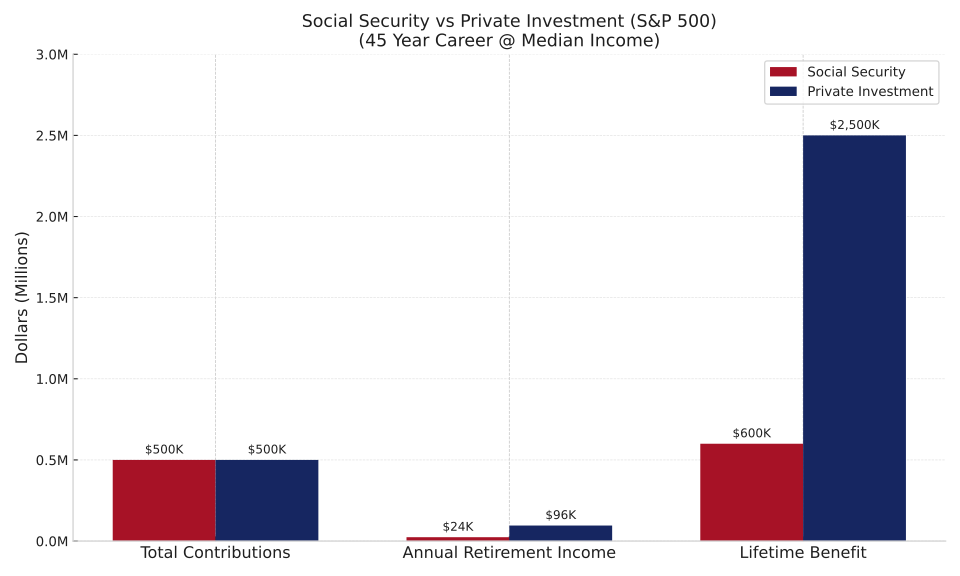
A primary argument for privatization is the potential for higher investment returns compared to what Social Security has historically provided. Proponents cite the average historical returns of the stock market, which have often outpaced the implicit rate of return within the Social Security system. By allowing individuals to invest their contributions in market-based assets, the hope is that they can accumulate greater wealth for retirement, leading to higher overall retirement incomes. This could potentially address the projected shortfall by allowing individuals to fund a larger portion of their own retirement.
Increased Individual Control and Choice
Privatization would grant individuals greater control over their retirement savings. Instead of contributions being pooled and managed by the government, individuals would have the agency to choose how their money is invested, potentially aligning their investments with their risk tolerance and financial goals. This increased autonomy is seen by some as a fundamental right and a more empowering approach to retirement planning, fostering a sense of personal responsibility.
Reduced Government Liabilities
From a fiscal perspective, proponents suggest that shifting towards private accounts could reduce the long-term unfunded liabilities of the Social Security system. By reducing the government’s commitment to providing defined benefits, the federal government’s balance sheet would improve, potentially freeing up resources for other government priorities or reducing the need for future tax increases or benefit cuts to shore up the system.
Risks and Criticisms of Privatization
Despite the potential advantages, privatization also carries significant risks and has faced considerable criticism. Critics highlight the inherent volatility of financial markets, the potential for inadequate retirement savings, and the erosion of Social Security’s social insurance function.
Market Volatility and Risk of Loss
The most significant criticism of privatization revolves around market volatility. Unlike the guaranteed, inflation-adjusted benefits provided by the current Social Security system, returns from private investment accounts are not guaranteed. Individuals could experience substantial losses, especially if market downturns occur close to their retirement age. This risk could leave many individuals with less retirement income than they would have received under the current system, potentially increasing poverty rates among the elderly. The inherent uncertainty of market performance is a stark contrast to the predictable nature of traditional Social Security benefits.
Inadequate Savings and Increased Inequality
There is concern that not all individuals would be equipped to manage their investments effectively. Some might make poor investment choices, fall victim to high fees, or simply not save enough, leading to inadequate retirement income. This could disproportionately affect lower-income individuals, who may have less disposable income to invest and less financial literacy. Instead of leveling the playing field, privatization could exacerbate existing income inequality, creating a two-tiered retirement system where those who can invest wisely prosper, while others struggle.
Erosion of Social Insurance and Progressive Benefits
Critics argue that privatizing Social Security would fundamentally undermine its role as a social insurance program. Social Security is designed to provide a safety net and a degree of income redistribution, ensuring a basic level of support for all retirees, particularly those with lower lifetime earnings. By shifting to individual accounts, this redistributive element is weakened, potentially leaving vulnerable populations without adequate protection. The progressive nature of Social Security benefits, which provide a higher replacement rate for lower earners, could be lost or significantly diminished.
Transition Costs and Implementation Challenges
Implementing a privatized Social Security system would involve immense transition costs. Shifting from a PAYGO system to one with private accounts would require the government to continue paying benefits to current retirees and near-retirees while simultaneously diverting tax revenues to fund new private accounts. This “transition deficit” could be substantial, requiring significant borrowing or new taxes. Furthermore, the administrative complexity of managing millions of individual accounts, overseeing investment choices, and ensuring regulatory compliance would be a formidable challenge.
The Broader Economic and Social Implications
The debate over privatizing Social Security extends beyond individual retirement accounts and touches upon the fundamental nature of government’s role in providing economic security. It involves questions of individual responsibility versus collective security and the long-term health of the national economy.
Redefining the Social Contract
Privatization represents a significant shift in the social contract between citizens and their government. The current system embodies a commitment to intergenerational solidarity and a collective responsibility to ensure that all citizens have a basic standard of living in retirement. Privatization, conversely, emphasizes individual responsibility and market-based solutions. This redefinition could have profound implications for societal views on fairness, collective action, and the role of government in mitigating economic risks.
Impact on National Savings and Investment
The potential impact on national savings and investment is another critical consideration. Proponents argue that private accounts would boost national savings as individuals invest more. However, critics contend that if the government has to borrow heavily to finance the transition to privatization, this could offset any gains in private savings, potentially leading to higher interest rates and a crowding out of private investment in other productive areas of the economy. The net effect on the overall savings and investment landscape is a complex economic question with no easy answers.

Political and Ideological Divides
The debate over Social Security privatization is deeply entrenched in political and ideological divides. Conservative and libertarian perspectives often favor market-based solutions and individual choice, seeing privatization as a way to reduce government dependency. Progressive and liberal viewpoints tend to emphasize the importance of social insurance, collective well-being, and the government’s role in protecting vulnerable populations. These fundamental differences in philosophy shape the arguments and make finding common ground exceptionally difficult, contributing to the ongoing stalemate in reform discussions.
In conclusion, privatizing Social Security is a multifaceted proposal that seeks to introduce market mechanisms into a system designed for social insurance. While proponents highlight the potential for enhanced returns and individual control, critics raise serious concerns about market volatility, increased inequality, and the erosion of Social Security’s core mission. Any move towards privatization would necessitate careful consideration of these competing interests and a thorough analysis of the profound economic and social consequences it would entail. The future of Social Security reform, whether it involves privatization or other adjustments, will undoubtedly continue to be a central focus of policy debate for years to come.
aViewFromTheCave is a participant in the Amazon Services LLC Associates Program, an affiliate advertising program designed to provide a means for sites to earn advertising fees by advertising and linking to Amazon.com. Amazon, the Amazon logo, AmazonSupply, and the AmazonSupply logo are trademarks of Amazon.com, Inc. or its affiliates. As an Amazon Associate we earn affiliate commissions from qualifying purchases.