
In the rapidly evolving landscape of digital transformation, businesses are constantly seeking ways to bridge the gap between physical documentation and digital data. Among the most pivotal technologies facilitating this transition is ICR. But what does ICR mean in a technical context? ICR stands for Intelligent Character Recognition.
While many are familiar with OCR (Optical Character Recognition), ICR represents the next frontier—an advanced AI-driven evolution that allows machines to interpret not just printed text, but also various styles of handwriting. As organizations move toward hyper-automation, understanding the nuances of ICR technology is essential for anyone involved in software development, data science, or enterprise digital strategy.

The Evolution of Data Capture: From OCR to ICR
To understand ICR, one must first understand its predecessor, Optical Character Recognition. OCR was designed to recognize machine-printed text—the standard, uniform fonts found in books or digital documents. While revolutionary, OCR remains limited by its inability to handle the unpredictability of human handwriting. This is where ICR enters the frame.
From OCR to ICR: Defining the Difference
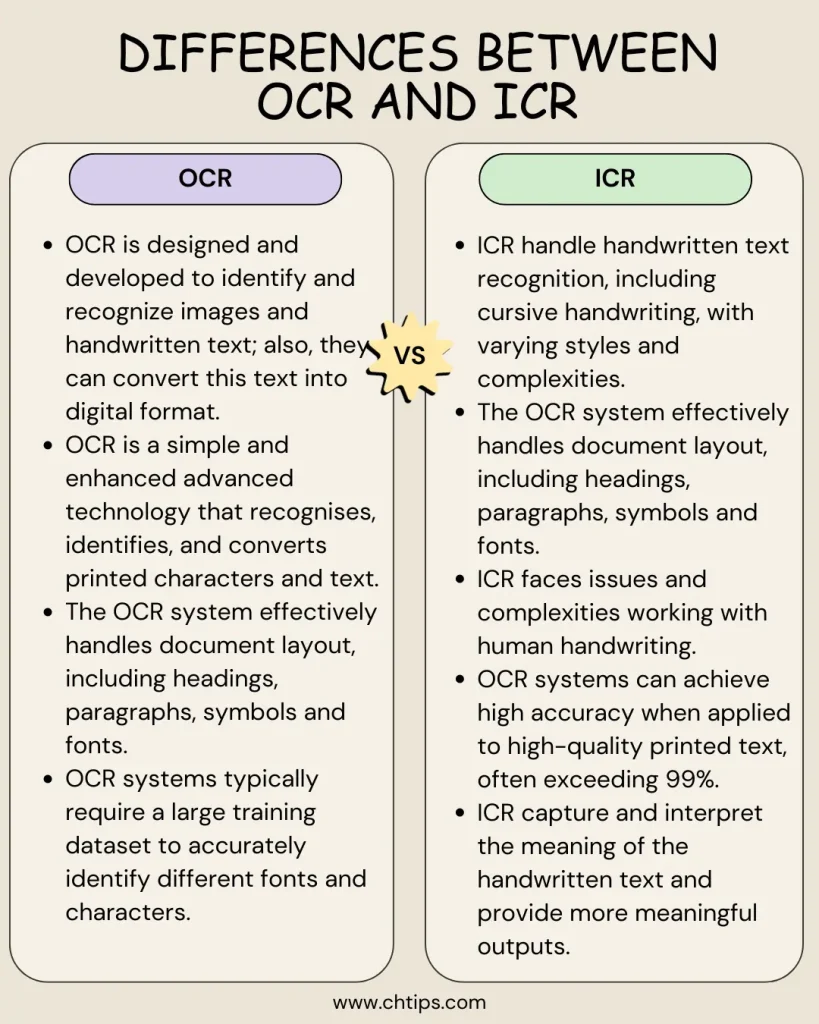
The fundamental difference between OCR and ICR lies in “intelligence.” Traditional OCR uses pattern matching or feature extraction to identify static characters. If a letter deviates too far from the standard template—as handwriting inevitably does—OCR fails.
ICR, however, utilizes machine learning (ML) and neural networks. It doesn’t just look for a shape; it learns to recognize patterns, styles, and context. While OCR treats every “A” as a specific geometric arrangement, ICR understands that an “A” written by a doctor, a student, or a clerk may look vastly different but still carries the same semantic value.
The Role of Machine Learning and Artificial Neural Networks
The “Intelligent” in ICR refers to the software’s ability to self-learn. Modern ICR engines are powered by Artificial Neural Networks (ANN). During the training phase, these networks are fed millions of samples of hand-printed and cursive text.
Through a process known as backpropagation, the software adjusts its internal parameters to minimize errors. Over time, the ICR system becomes remarkably adept at recognizing nuances in handwriting, such as the slant of a letter, the pressure of a stroke, and the linguistic context surrounding a word. This allows the system to achieve accuracy rates that were once thought impossible for non-human readers.
Adaptive Learning and Continuous Improvement
One of the most powerful tech features of modern ICR is adaptive learning. Unlike legacy software that requires manual updates to recognize new fonts or styles, ICR systems can implement a feedback loop. When a human operator corrects a misread character, the system logs that correction as a new data point. This means the software literally becomes smarter with every document it processes, tailoring its recognition capabilities to the specific handwriting styles prevalent in a particular organization’s workflow.
How ICR Technology Works: The Technical Pipeline
The journey from a scanned image of a handwritten form to a structured digital database is a complex multi-stage process. Understanding this pipeline reveals why ICR is considered a cornerstone of modern AI tools.
Data Capture and Pre-processing
The process begins with an image—usually a scan or a high-resolution photograph of a document. Before the “recognition” happens, the image must undergo pre-processing to ensure the highest possible quality.
- De-skewing and De-speckling: The software aligns the image and removes digital noise or “artifacts” that might confuse the AI.
- Binarization: The image is converted to black and white (bitonal) to distinguish the text clearly from the background.
- Layout Analysis: The ICR engine identifies zones on the page, distinguishing between machine-printed headers, checkboxes, and the handwritten fields that require intelligent recognition.
Feature Extraction and Recognition Engines
Once the image is cleaned, the ICR engine breaks down the handwritten text into smaller components. Using Convolutional Neural Networks (CNNs), the software analyzes the “features” of the handwriting. It looks for loops, intersections, and stroke directions.
Instead of analyzing characters in isolation, advanced ICR often uses Recurrent Neural Networks (RNNs) or Long Short-Term Memory (LSTM) networks. These are specifically designed for sequential data. They allow the software to look at a whole word or sentence, using the surrounding letters to “guess” a difficult-to-read character, much like a human does when reading a messy note.
Post-processing and Logical Validation
The final stage of the ICR pipeline involves validation. Even the best AI can make mistakes, so ICR systems use “Confidence Scores.” If the software is 99% sure a word is “Tech,” it proceeds. If it is only 60% sure, it flags the document for human review.
To further increase accuracy, developers integrate ICR with external databases and “lookup tables.” For example, if an ICR engine is processing a handwritten zip code, it can cross-reference the recognized digits against a postal database to ensure the city and state match. This integration of AI recognition with logical verification is what makes ICR a robust enterprise tool.
Practical Applications of ICR in Modern Business
In the tech sector, the value of a tool is measured by its utility. ICR has found a home in industries where manual data entry was previously a massive bottleneck.
Automated Forms Processing in Healthcare and Government
Healthcare remains one of the largest beneficiaries of ICR. Despite the push for digital records, patient intake forms and clinician notes are often still handwritten. ICR tools can scan these forms, extract patient data, and automatically populate Electronic Health Records (EHR). This reduces the administrative burden on staff and minimizes the risk of transcription errors that could lead to medical mishaps.
Similarly, government agencies use ICR to process tax returns, census forms, and benefit applications. By automating the extraction of data from millions of handwritten documents, these agencies can drastically reduce processing times and operational costs.
Digital Banking and Financial Services
The Fintech sector relies heavily on ICR for “Know Your Customer” (KYC) protocols and check processing. When a user uploads a photo of their ID or a handwritten check via a mobile app, ICR technology is working behind the scenes. It extracts the name, signature, and monetary amounts, validating them against the bank’s records in real-time. This level of automation is what enables the “instant” features we expect from modern digital banking apps.
Legal and Administrative Document Management
Law firms and corporate legal departments often deal with historical archives and handwritten contracts. ICR allows these organizations to digitize “dark data”—information stored in physical formats that isn’t searchable or analyzable. By converting these archives into searchable digital text, legal teams can use AI discovery tools to find specific clauses or evidence across thousands of pages in seconds.
The Benefits of Implementing ICR Systems
For organizations looking to upgrade their tech stack, the implementation of ICR offers a high Return on Investment (ROI) by solving the “analog-to-digital” friction point.
Enhanced Accuracy and Error Reduction
Human data entry is prone to fatigue. A clerk entering data for eight hours a day will inevitably make mistakes. ICR systems, however, maintain a consistent level of performance. By combining neural network recognition with database validation, ICR often achieves higher accuracy rates than manual entry, especially when dealing with standardized forms.
Scalability in Data Management
One of the greatest advantages of ICR is its scalability. A human team can only process a set number of documents per day. An ICR system running on cloud infrastructure can scale up to process millions of pages simultaneously. This makes it an essential tool for “Big Data” initiatives, where the goal is to ingest and analyze vast quantities of information as quickly as possible.
Improving User Experience and Accessibility
From a software design perspective, ICR improves the end-user experience. Instead of forcing a user to type long strings of data into a mobile app, a developer can implement a “scan” feature. This friction-less interaction is a hallmark of modern app design, where ease of use is a primary competitive advantage.
The Future of ICR: Convergence with Generative AI
The world of ICR is not static. We are currently witnessing a convergence between traditional character recognition and the broader field of Document AI.
Integration with Large Language Models (LLMs)
The next generation of ICR will not just read text; it will understand it. By integrating ICR with Large Language Models like GPT-4 or Claude, systems can perform “Semantic Data Extraction.” This means the AI can read a handwritten letter and not only transcribe it but also summarize the intent, detect the sentiment, and suggest a follow-up action.

Moving Toward Unstructured Data Mastery
Most current ICR success happens with “structured” or “semi-structured” forms (where handwriting is in a specific box). The future of the technology lies in “unstructured” handwriting—long-form letters, journals, and chaotic notes. As spatial intelligence in AI improves, ICR will become capable of navigating complex page layouts with the same ease as a human reader, effectively ending the era of the “unreadable” digital document.
In summary, when asking “what does ICR mean,” the answer goes far beyond simple text recognition. It represents a sophisticated intersection of computer vision, machine learning, and linguistic processing. As a pillar of modern technology, ICR is the key to unlocking the value hidden in the billions of handwritten pages that still define much of our world.
aViewFromTheCave is a participant in the Amazon Services LLC Associates Program, an affiliate advertising program designed to provide a means for sites to earn advertising fees by advertising and linking to Amazon.com. Amazon, the Amazon logo, AmazonSupply, and the AmazonSupply logo are trademarks of Amazon.com, Inc. or its affiliates. As an Amazon Associate we earn affiliate commissions from qualifying purchases.