
In the landscape of modern action gaming, few titles have achieved the mechanical precision and systemic depth of Sekiro: Shadows Die Twice. Central to this experience is a unique game-design philosophy that challenges players to master the combat loop rather than simply out-leveling obstacles. Among the many hidden features that alter the difficulty of the game, “Kuro’s Charm” stands out as a quintessential example of how FromSoftware uses game-state modifiers to dictate player experience. Understanding exactly what this item does—and the consequences of relinquishing it—is essential for any player looking to transition from a casual playthrough to a true mastery of the shinobi arts.
The Purpose of Kuro’s Charm in Game Design
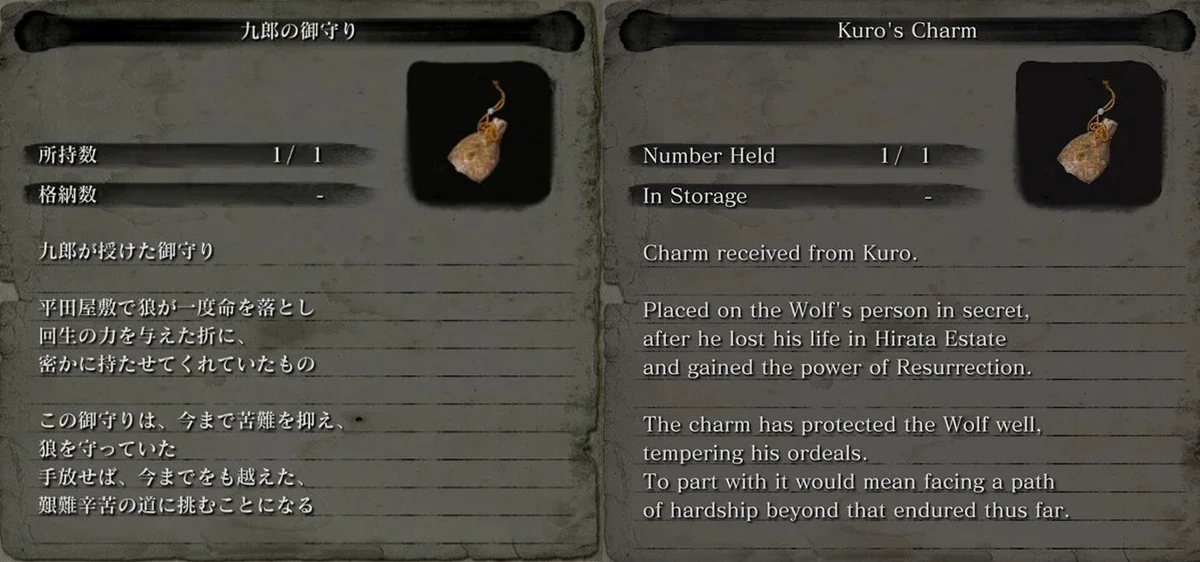
Kuro’s Charm is a key item received early in the game, representing the divine protection of the Young Lord. When players begin a standard playthrough, the charm is active by default. It acts as a passive buff, mitigating incoming chip damage and providing a safety net for those still learning the complexities of the deflection system.
Defining the “Hard Mode” Toggle
The decision to give Kuro’s Charm back to the Young Lord (Kuro) is effectively the game’s way of enabling “Hard Mode.” This choice is not merely a difficulty slider; it is a fundamental shift in how the game engine handles damage calculation. By discarding the charm, the player voluntarily removes the divine protection that prevents chip damage during combat, forcing the player to play with a level of technical perfection that is rarely required in standard action games.
The Philosophy of Risk and Reward
From a design perspective, this mechanic serves as a litmus test for player skill. It caters to the “power user”—the player who has internalized the rhythm of sword clashing and is seeking a more punishing, high-stakes environment. By allowing the player to opt into this state, the developers successfully extended the replayability of Sekiro without relying on cheap enemy sponges or inflated health pools.
Mechanical Consequences: The Shift in Combat Dynamics
The most immediate impact of discarding Kuro’s Charm is the introduction of chip damage. Under normal circumstances, blocking an attack—rather than performing a perfect deflection—will result in the player’s posture bar filling up, but their health bar will remain untouched. Once the charm is given away, blocking an attack will result in both posture buildup and a significant portion of health being depleted.
The Necessity of Perfect Deflection
With the charm removed, the margin for error effectively vanishes. Players can no longer rely on holding the block button to stay alive during intense boss encounters. Every enemy strike that is not met with a frame-perfect deflection becomes a direct threat to the player’s vitality. This forces the player to engage with the game’s primary mechanic—the rhythm of the deflect—with absolute consistency. It transforms the combat from an endurance test into a precise dance where timing is the only currency that matters.
Impact on Posture and Stamina Management
When players take chip damage through the block, they are often pushed into a defensive posture that makes them vulnerable to guard breaks. When you do not have the charm, the game penalizes the player for being indecisive. If you stop attacking or hesitate to initiate a deflect, your health will tick away, leading to a much faster death. This shift incentivizes aggressive play; the most effective way to stay alive is to force the enemy into a state of panic by maintaining unrelenting offensive pressure, thereby minimizing the number of incoming attacks you have to deflect in the first place.
Why Advanced Players Choose to Relinquish the Charm
For the veteran player, the standard game state can eventually feel forgiving. Once the patterns of bosses like Genichiro Ashina or Isshin, the Sword Saint are memorized, the risk of death decreases significantly. Discarding the charm is the primary method for these players to maintain the “thrill of the unknown” that defined their first playthrough.
Elevating the Skill Ceiling
Removing the charm effectively raises the skill ceiling of Sekiro. It forces the player to learn boss attack strings that they might have previously “tanked” through by blocking. For instance, multi-hit combos that would normally be safe to block now require a rhythmic sequence of inputs that can test the reflexes of even the most experienced players. This creates a feedback loop of improvement; you are not just getting better at the game’s systems; you are refining your internal clock to handle high-speed inputs.
Personalizing the Difficulty Curve
The beauty of the charm mechanic is its accessibility. It is not hidden behind a console command or a menu that requires a restart; it is a physical interaction within the game world. Because the game allows you to reclaim the charm from the Sculptor at any time, it provides a flexible experience. If a player finds the “Hard Mode” experience too frustrating, they can revert to the normal state without penalty. This level of customization allows the player to tailor the difficulty to their current skill level, making the game approachable while still providing a legendary challenge for those who seek it.
Mastering the Game Under Constraint
Playing without Kuro’s Charm is not just about making the game harder—it is about uncovering the developer’s true intent for the combat system. Sekiro was built from the ground up to be a game about precision. When you play with the charm, you are essentially playing with training wheels. When you remove it, you are experiencing the combat system in its rawest, most unforgiving form.
Strategies for Success
To succeed without the charm, players must adopt a mindset of complete focus. This includes:
- Prioritizing Deflection: Practice the timing of deflects until they become muscle memory.
- Aggression as Defense: Understand that by keeping the enemy’s posture bar high, you reduce the number of cycles they can complete, which in turn reduces your exposure to damage.
- Utilizing Prosthetic Tools: In a no-charm run, tools like the Mist Raven or the Umbrella become essential for surviving attacks that are too difficult to deflect, rather than being optional curiosities.
The Psychological Aspect of Difficulty
There is a unique psychological satisfaction in overcoming a boss fight without the divine protection of Kuro’s Charm. It validates the player’s mastery of the game’s core mechanics. It turns every encounter into a high-stakes duel where the slightest lapse in concentration is punished. This depth of engagement is what has allowed Sekiro to remain a benchmark for action game design years after its release.
Final Reflections on the Mechanic
Whether you are a newcomer curious about what the item does or a seasoned veteran looking for your next challenge, understanding Kuro’s Charm is fundamental to the Sekiro experience. It represents a rare instance where the game’s narrative themes—the Young Lord’s protection—are perfectly mirrored in the game’s mechanical systems. By deciding whether to hold onto that protection or cast it aside, you are not just choosing a difficulty level; you are choosing how you want to interact with the challenge presented by the developers. Giving away the charm is, ultimately, an invitation to see just how far your skill can take you in a world that demands perfection.
aViewFromTheCave is a participant in the Amazon Services LLC Associates Program, an affiliate advertising program designed to provide a means for sites to earn advertising fees by advertising and linking to Amazon.com. Amazon, the Amazon logo, AmazonSupply, and the AmazonSupply logo are trademarks of Amazon.com, Inc. or its affiliates. As an Amazon Associate we earn affiliate commissions from qualifying purchases.