
The advent of advanced testing methodologies has significantly broadened the scope of drug detection, moving beyond simply identifying the presence of illicit substances themselves. Ethyl Glucuronide (ETG) testing represents a prime example of this evolution. Unlike traditional drug screens that focus on the parent drug or its immediate metabolites, ETG tests are designed to detect a biomarker of alcohol consumption. This distinction is crucial, as it allows for a more nuanced understanding of an individual’s recent alcohol intake, often for extended periods beyond what conventional methods can ascertain. For professionals in fields requiring sobriety, legal compliance, or comprehensive health monitoring, understanding ETG’s significance, its detection window, and the factors influencing its results is paramount. This article delves into the technical aspects of ETG testing, its applications in the digital age, and the technological advancements that underpin its reliability.
The Science Behind Ethyl Glucuronide (ETG) Testing
At its core, ETG testing is a sophisticated analytical process rooted in biochemistry and advanced laboratory techniques. Understanding the fundamental science is key to appreciating the implications of an ETG test.
How Ethyl Glucuronide is Formed
When alcohol (ethanol) is consumed, the body metabolizes it through a series of enzymatic reactions. While the primary metabolic pathway involves alcohol dehydrogenase converting ethanol to acetaldehyde, a secondary, minor pathway is catalyzed by the enzyme uridine 5′-diphospho-glucuronosyltransferase (UGT). This enzyme conjugates ethanol with glucuronic acid, forming ethyl glucuronide (ETG). This conjugation process essentially makes the ethanol molecule more water-soluble, facilitating its excretion from the body. Crucially, ETG is not formed from any other source in the body; its presence is a direct indicator that ethanol has been processed. This direct link between consumption and ETG formation is what makes it such a valuable biomarker.
The Analytical Process: GC/MS and LC/MS/MS
The accurate detection and quantification of ETG in biological samples are achieved through highly sensitive and specific laboratory techniques. The two primary methods employed are Gas Chromatography-Mass Spectrometry (GC/MS) and Liquid Chromatography-Tandem Mass Spectrometry (LC/MS/MS).
-
Gas Chromatography-Mass Spectrometry (GC/MS): This technique separates volatile compounds in a sample based on their chemical properties (GC) and then identifies them by their mass-to-charge ratio (MS). For ETG testing, the sample (typically urine) is first prepared to isolate and concentrate the ETG. It is then injected into the GC, where it is vaporized and passed through a column that separates it from other substances. The separated ETG then enters the MS, where it is ionized and fragmented. The resulting mass spectrum is unique to ETG and can be compared to known standards for identification and quantification. GC/MS is known for its high specificity and is considered a gold standard in many forensic and toxicological analyses.
-
Liquid Chromatography-Tandem Mass Spectrometry (LC/MS/MS): This method is often preferred for ETG testing due to its exceptional sensitivity and specificity, especially when dealing with complex biological matrices. In LC/MS/MS, the sample is first separated using liquid chromatography, which sorts molecules based on their interaction with a stationary phase. The separated compounds then enter a tandem mass spectrometer. Here, the molecules are ionized, and a specific precursor ion (related to ETG) is selected. This ion is then fragmented, and a specific product ion is monitored. This multi-stage process significantly reduces the possibility of false positives, as the test requires a specific molecular fragment to be detected under specific conditions. LC/MS/MS is particularly effective for detecting low concentrations of ETG, which is essential for establishing abstinence over longer periods.
Advantages Over Traditional Alcohol Tests
ETG testing offers significant advantages over traditional methods of alcohol detection, primarily concerning its detection window and its ability to confirm abstinence rather than just intoxication.
-
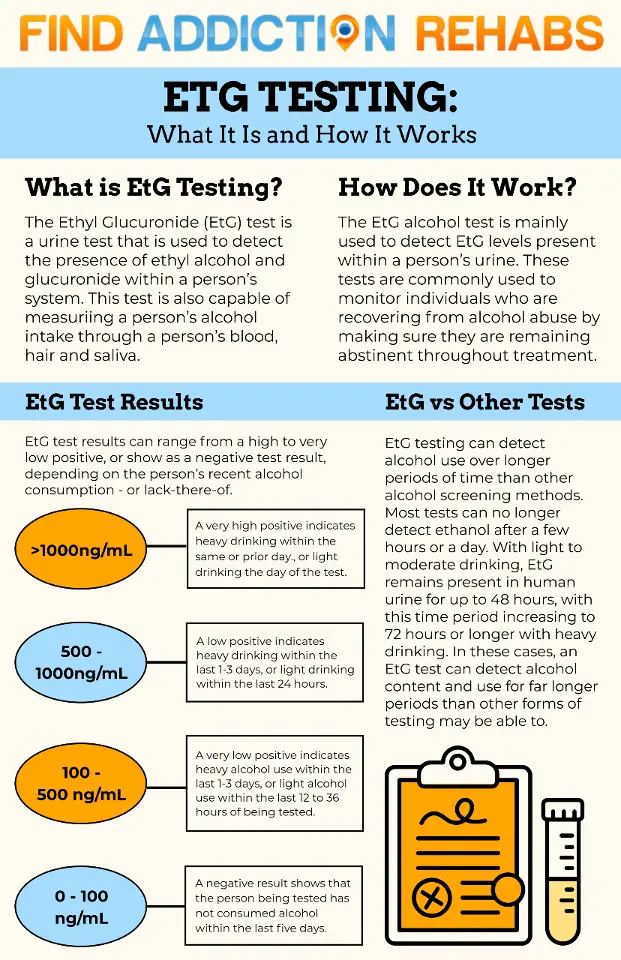
Extended Detection Window: Traditional breathalyzer tests or blood alcohol content (BAC) tests can only detect alcohol for a relatively short period after consumption, typically several hours. ETG, however, can be detected in urine for up to 3-5 days, and in some cases, even longer, depending on the individual’s metabolism and the amount of alcohol consumed. This extended window is critical for monitoring compliance in situations where continuous abstinence is required.
-
Confirmation of Abstinence: While BAC tests indicate current intoxication, ETG tests can provide evidence of recent alcohol consumption. This is invaluable for individuals in recovery programs, those undergoing legal mandates (e.g., DUI cases), or in workplace safety-sensitive positions where any alcohol intake needs to be identified. It shifts the focus from immediate impairment to a pattern of recent consumption.
-
Sensitivity to Low-Level Consumption: ETG can be detected even after moderate alcohol consumption, unlike some other tests that might only register higher BAC levels. This sensitivity is important for situations where even trace amounts of alcohol could have significant consequences.
Technological Advancements and Application in Digital Environments
The reliability and widespread adoption of ETG testing are intrinsically linked to technological advancements in laboratory instrumentation and the integration of these tests into digital monitoring platforms.
Precision Instrumentation and Automation
Modern laboratory equipment for ETG analysis is highly sophisticated and increasingly automated. High-resolution mass spectrometers, coupled with advanced liquid chromatography systems, enable the precise separation, identification, and quantification of ETG at very low concentrations. Automation plays a crucial role in enhancing throughput, reducing human error, and ensuring consistency in testing protocols. Robotic sample preparation systems can handle large volumes of specimens efficiently, while automated data analysis software can process results rapidly and generate detailed reports. This technological evolution has made ETG testing more accessible, cost-effective, and reliable for various applications. The development of internal standards and calibration curves further refines accuracy, allowing laboratories to meet stringent accreditation requirements.
Digital Integration and Telehealth Monitoring
The rise of digital health and remote monitoring has opened new avenues for the application of ETG testing. In the realm of addiction recovery, for instance, individuals can now undergo frequent ETG testing at local collection sites, with the results securely transmitted to their treatment providers electronically. This digital integration offers several benefits:
- Enhanced Accessibility: Individuals in remote areas or with mobility issues can access testing services more conveniently.
- Real-time Data for Providers: Treatment professionals can receive timely updates on a patient’s sobriety, allowing for prompt intervention if necessary.
- Secure Data Management: Laboratory Information Management Systems (LIMS) are employed to securely store, manage, and report on ETG test results, ensuring data integrity and confidentiality.
- Integration with Wearable Technology: While not yet mainstream for ETG itself, the broader trend of wearable technology for health monitoring suggests a future where biometric data could be correlated with self-reported information or even potentially integrated with future non-invasive alcohol detection methods, though ETG testing remains a laboratory-based gold standard for confirmed recent consumption.
Software for Interpretation and Reporting

The interpretation of ETG test results requires specialized software that can analyze the complex data generated by GC/MS or LC/MS/MS instruments. These software platforms are designed to:
- Quantify ETG Levels: Accurately measure the concentration of ETG in the sample.
- Compare Against Cut-off Levels: Evaluate the quantified level against established thresholds set by regulatory bodies or specific program guidelines to determine a positive or negative result. These cut-off levels are crucial for balancing sensitivity with the potential for false positives from incidental exposure.
- Generate Comprehensive Reports: Produce clear, detailed, and legally defensible reports that include specimen information, testing methodology, results, detected concentrations, and the laboratory’s accreditation details.
- Maintain Audit Trails: Ensure that all data processing steps are logged, providing an auditable history of the analysis.
Understanding the Nuances of ETG Test Results
While ETG testing offers significant advantages, interpreting its results requires an understanding of various factors that can influence the findings, including potential sources of contamination and the limitations of detection windows.
Factors Influencing ETG Detection and Levels
Several variables can affect the presence and concentration of ETG in a biological sample, particularly urine. Understanding these factors is crucial for accurate interpretation and to avoid misdiagnosis or incorrect conclusions.
- Amount of Alcohol Consumed: This is the most significant factor. Higher alcohol intake will lead to the production of more ETG, resulting in higher concentrations in the urine and a longer detection window. Conversely, very small amounts of alcohol may produce ETG levels below the detectable limit or within a very short detection period.
- Time Since Last Drink: As mentioned, ETG has an extended detection window, but it is not infinite. The concentration of ETG in urine gradually decreases over time as the body metabolizes and excretes it. Therefore, the longer the period since alcohol consumption, the lower the ETG concentration will be, and eventually, it will fall below the laboratory’s reporting threshold.
- Hydration Levels: A highly hydrated individual will produce more dilute urine, which can lead to lower ETG concentrations compared to a less hydrated individual who consumed the same amount of alcohol. This is why laboratories often use specific gravity and creatinine levels as indicators of urine dilution.
- Individual Metabolism: While the metabolic pathway for ETG formation is consistent, individual variations in liver enzyme activity and kidney function can influence the rate at which ETG is produced and excreted. This can lead to slight variations in detection windows between individuals.
- Frequency of Consumption: Chronic or binge drinking can lead to a buildup of ETG in the system, potentially extending the detection window.
Potential for False Positives and Incidental Exposure
The sensitivity of ETG testing, while a strength, also necessitates careful consideration of potential false positives, particularly those arising from incidental exposure to alcohol.
- Alcohol-Containing Products: Certain over-the-counter products, such as mouthwash, hand sanitizers, certain foods (e.g., some baked goods or ripe fruits), and even some prescription medications, contain small amounts of ethanol. While typically in concentrations unlikely to produce a positive ETG test, in rare instances, or with extremely frequent use of high-ethanol content products, it is theoretically possible for detectable levels of ETG to be produced. Laboratories employ strict protocols to minimize the risk of such contamination during sample collection and analysis.
- Environmental Contamination: In very rare circumstances, cross-contamination in a testing facility or improper sample handling could lead to a false positive. Reputable laboratories adhere to stringent chain-of-custody procedures and quality control measures to prevent this.
- Laboratory Error: While highly unlikely with modern technology and rigorous quality assurance, human or equipment error in the laboratory setting is a theoretical possibility, underscoring the importance of accreditation and proficiency testing.
To mitigate the risk of false positives, laboratories typically use highly specific analytical methods like LC/MS/MS and employ strict cut-off levels. They also often test for EtS (Ethyl Sulfate), another metabolite of ethanol, and analyze urine creatinine and specific gravity to assess dilution. This multi-faceted approach provides a more robust confirmation of alcohol consumption.
Interpreting Results in Different Contexts
The meaning of an ETG test result is heavily dependent on the context in which it is administered.
- Legal and Probationary Settings: For individuals on probation or mandated to abstain from alcohol due to legal infractions (e.g., DUI convictions), a positive ETG test typically signifies a violation of their terms. The specific cut-off levels and interpretation guidelines are usually defined by the court or probation department.
- Addiction Treatment and Recovery: In rehabilitation programs, ETG testing is a vital tool for monitoring a patient’s progress and ensuring abstinence. A positive result can trigger immediate intervention, reassessment of treatment plans, or a return to a more intensive level of care.
- Workplace Safety: For safety-sensitive positions (e.g., pilots, commercial drivers, healthcare professionals), ETG testing can be part of a comprehensive drug and alcohol testing program to ensure that employees are not consuming alcohol, even off-duty, in a way that could compromise their performance and the safety of others.
- Medical Monitoring: In some clinical settings, ETG testing may be used to monitor patients with certain medical conditions or those undergoing treatment for alcohol-related disorders.
Understanding the specific policy or mandate associated with the ETG test is paramount for interpreting the results accurately and understanding the consequences.
The Future of ETG Testing and Alcohol Biomarkers
As technology continues to advance, the field of alcohol biomarker testing is likely to see further innovation, with ETG testing remaining a cornerstone.
Emerging Biomarkers and Detection Methods
While ETG is a widely accepted biomarker, researchers are continuously exploring other indicators of alcohol consumption that might offer different detection windows, sensitivities, or detection matrices. For example, phosphatidylethanol (PE), another direct metabolite of ethanol, is also used and can be detected in red blood cells for longer periods. Research is also ongoing into biomarkers that can indicate chronic heavy alcohol use over months or even years, moving beyond the short-to-medium term detection capabilities of ETG.
Developments in non-invasive testing technologies, such as those using infrared spectroscopy or electrochemical sensors, are also on the horizon. While these technologies are still largely in their developmental stages for reliable alcohol detection, they hold the promise of more convenient and frequent monitoring in the future. However, the current gold standard for confirming recent alcohol consumption remains laboratory-based analysis of biomarkers like ETG and EtS.
Advancements in Portability and Accessibility
The trend towards greater accessibility and portability in diagnostic testing is also influencing alcohol biomarker analysis. While high-sensitivity ETG testing currently requires sophisticated laboratory equipment, efforts are underway to develop more compact and potentially even point-of-care testing devices that could provide rapid results. This could make ETG testing more feasible in remote locations, emergency settings, or for more frequent self-monitoring by individuals in recovery. The integration with mobile technology for secure data transmission and reporting will also play a significant role in expanding accessibility.

Ethical Considerations and Data Privacy
As ETG testing becomes more integrated into various aspects of life, from legal requirements to personal health monitoring, ethical considerations and data privacy are becoming increasingly important. Robust data security measures, transparent policies regarding how results are used and stored, and informed consent are crucial. The potential for discrimination based on alcohol use history also necessitates careful consideration and robust legal frameworks to protect individuals. As technology evolves, ensuring that the application of these sensitive tests remains fair, equitable, and respectful of individual privacy will be a critical challenge. The ongoing development of sophisticated analytical techniques for ETG detection underscores its importance as a reliable indicator of alcohol consumption, playing a vital role in public safety, health, and individual well-being.
aViewFromTheCave is a participant in the Amazon Services LLC Associates Program, an affiliate advertising program designed to provide a means for sites to earn advertising fees by advertising and linking to Amazon.com. Amazon, the Amazon logo, AmazonSupply, and the AmazonSupply logo are trademarks of Amazon.com, Inc. or its affiliates. As an Amazon Associate we earn affiliate commissions from qualifying purchases.