
The night sky has always held a certain mystique, a canvas for celestial events that can inspire awe, spark curiosity, and even influence how we perceive our world. Among these captivating sights, the appearance of a luminous halo or ring encircling the moon is a phenomenon that has, for centuries, drawn human attention. While ancient cultures often attributed such sights to omens or divine messages, in the modern, scientifically-driven era, we understand these lunar rings as the result of predictable optical principles. This article delves into the science behind these celestial rings, exploring the atmospheric conditions and light interactions that create them, and how this understanding aligns with the technological advancements that allow us to observe and analyze such phenomena with unprecedented precision. For those interested in the intersection of nature and technology, understanding the lunar halo offers a fascinating glimpse into the power of light, ice crystals, and the atmospheric science that underpins our ability to predict and appreciate these ephemeral displays.
The Atmospheric Alchemy: How Ice Crystals Sculpt Lunar Light
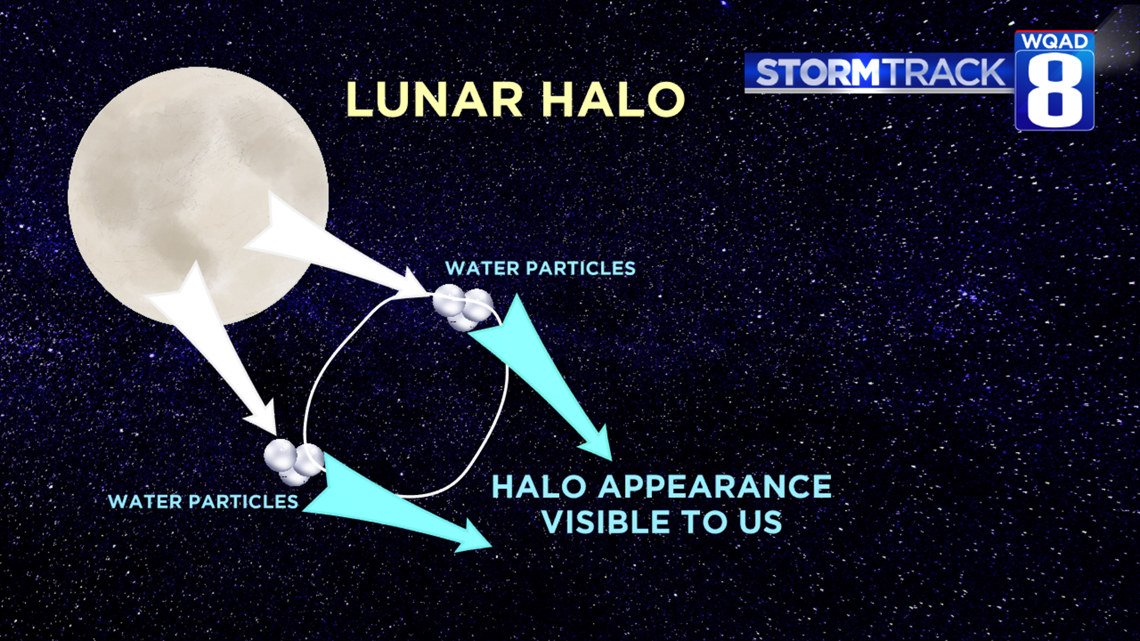
The captivating spectacle of a circle around the moon, often referred to as a lunar halo, is not a product of the moon itself, but rather a testament to the intricate workings of Earth’s atmosphere. This phenomenon is a visual symphony orchestrated by sunlight (or moonlight) interacting with a specific type of atmospheric particle: hexagonal ice crystals. Understanding the genesis of these halos requires a journey into the upper reaches of our troposphere, where temperatures are consistently below freezing, even in otherwise temperate climates.
The Crucial Role of Hexagonal Ice Crystals
At altitudes where cirrus and cirrostratus clouds reside, typically above 20,000 feet, water vapor readily freezes into ice crystals. The fundamental building blocks of these clouds are not spherical water droplets, but rather tiny, six-sided crystalline structures. The precise shape of these ice crystals is paramount to the formation of halos. While ice can form in various crystalline structures, hexagonal shapes are prevalent in atmospheric conditions. These perfectly geometric formations possess a remarkable property: they act as natural prisms.
When light rays from the moon, or sun, encounter these hexagonal ice crystals, they are refracted, or bent. The specific angle at which this refraction occurs is dependent on the crystal’s geometry and the wavelength of light. Imagine millions of these tiny prisms suspended in the atmosphere, each catching and bending the moonlight. The collective effect of this widespread refraction is what creates the visible halo. The light that reaches our eyes from the moon has, in essence, been guided and redirected by countless ice crystals, coalescing into a circular band.
Cloud Types and Their Halo-Forming Potential
Not all clouds will produce a lunar halo. The key lies in the composition and structure of the clouds. As mentioned, cirrus and cirrostratus clouds are the primary culprits. Cirrus clouds are thin, wispy, and feathery, composed almost entirely of ice crystals. Cirrostratus clouds, on the other hand, form a more uniform, sheet-like veil across the sky. It is within these high-altitude, icy cloud layers that the optimal conditions for halo formation are met.
The density and uniformity of the ice crystals within these clouds also play a significant role in the halo’s clarity and brightness. A denser, more uniform layer of ice crystals will result in a more distinct and vivid halo, while a more scattered or less organized cloud layer may produce a fainter or even imperceptible ring. The orientation of the ice crystals is also important. For a halo to form, the hexagonal crystals need to be randomly oriented, or predominantly oriented with their horizontal faces parallel to the ground. This orientation allows for a consistent bending of light at a specific angle, leading to the circular appearance.
The Science of Refraction and Diffraction: A Harmonious Interaction
The creation of a lunar halo is a beautiful interplay between two fundamental optical phenomena: refraction and, to a lesser extent, diffraction. Refraction is the bending of light as it passes from one medium to another, in this case, from air into an ice crystal and back into air. The hexagonal shape of the ice crystals causes light to bend at a specific, consistent angle of approximately 22 degrees relative to the incoming light. This 22-degree angle is crucial, as it is the most common angle at which ice crystals refract light to form visible halos. This is why the most frequently observed lunar halos have a radius of roughly 22 degrees, meaning the halo appears to be about the width of two outstretched fists held at arm’s length from the moon.
While refraction is the primary driver, diffraction also plays a subtle role, particularly in the finer details and coloration of the halo. Diffraction is the bending of light waves as they pass around obstacles or through narrow openings. In the case of halos, the edges of the ice crystals can cause light waves to spread out. This can contribute to the subtle iridescence sometimes seen within the halo, where the colors of the rainbow are faintly visible, with red on the inside and blue on the outside. However, for the most part, the primary reason for the halo’s existence and its consistent radius is the prismatic effect of the hexagonal ice crystals causing 22-degree refraction.
Technological Lenses: Observing and Analyzing Lunar Halos
In the contemporary world, the study of celestial phenomena, from the grandest cosmic events to the seemingly ephemeral atmospheric optics like lunar halos, is profoundly enhanced by technology. What was once solely the domain of stargazers and poets is now a subject of scientific inquiry supported by sophisticated instruments and analytical tools. The ability to observe, record, and even predict these atmospheric displays has been revolutionized by technological advancements, allowing us to move beyond anecdotal observation to data-driven understanding.
Advanced Optical Instruments and Imaging Technologies
Modern observatories, equipped with powerful telescopes and sensitive cameras, are capable of capturing detailed images of lunar halos, revealing subtle variations in their intensity, color, and structure. These instruments allow astronomers and atmospheric scientists to analyze the light spectrum of the halo, providing clues about the composition and properties of the ice crystals responsible for its formation. High-resolution digital cameras, even those found in advanced smartphones, can capture stunning images of halos, making this phenomenon more accessible and shareable than ever before.
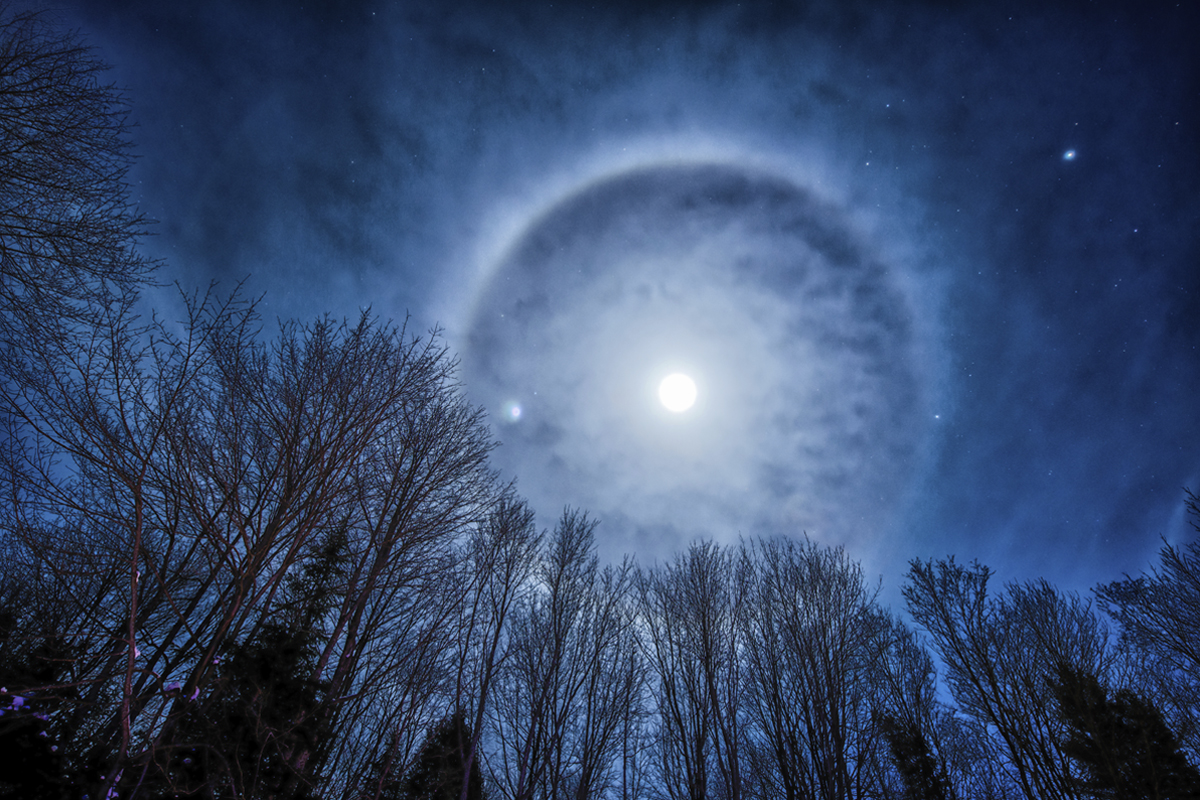
Furthermore, the development of specialized filters and sensors allows for the isolation and analysis of specific wavelengths of light. This technology is crucial in understanding the precise angles of refraction and in identifying any unique spectral signatures that might be present. The ability to capture high-dynamic-range images is also essential, as halos can sometimes be very faint against the dark night sky, while the moon itself can be incredibly bright, posing a challenge for standard imaging techniques.
Satellite Remote Sensing and Atmospheric Modeling
Beyond ground-based observations, satellite technology plays a critical role in understanding the atmospheric conditions that lead to halo formation. Satellites equipped with advanced sensors can monitor cloud cover, temperature, and water vapor content at various altitudes across vast regions. This data provides meteorologists and climate scientists with a comprehensive, real-time picture of the atmosphere, allowing them to identify areas where the formation of cirrus and cirrostratus clouds, the prerequisites for halos, is likely.
These satellite observations feed into sophisticated atmospheric models. These models use complex algorithms to simulate the behavior of the atmosphere, predicting weather patterns and the potential for specific optical phenomena. By inputting data on atmospheric temperature, humidity, and wind patterns, these models can forecast the likelihood of halo formation with increasing accuracy. This predictive capability is invaluable for both scientific research and for informing the public about potential celestial displays. For instance, if an atmospheric model predicts the formation of ideal ice crystal clouds over a populated area, public outreach efforts can be initiated to encourage people to look for the halo.
Computational Analysis and Data Visualization
The sheer volume of data generated by astronomical observations and satellite imagery requires powerful computational tools for analysis. Sophisticated software allows scientists to process images, extract quantitative data on halo size, brightness, and color distribution, and compare these observations with theoretical predictions. Machine learning algorithms are increasingly being employed to identify patterns in vast datasets, potentially leading to new insights into the complex physics of atmospheric optics.
Data visualization techniques are also crucial for making the complex science behind lunar halos understandable to a wider audience. Interactive visualizations can demonstrate how light interacts with ice crystals, showing the paths of light rays and the resulting refraction. These tools transform abstract scientific concepts into engaging and intuitive experiences, fostering a greater appreciation for the natural world and the technological means by which we study it. From educational apps that explain atmospheric phenomena to virtual reality simulations that allow users to “experience” the formation of a halo, technology is bridging the gap between scientific understanding and public engagement.
Beyond the Visual: Technological Implications and Future Research
The study of lunar halos, while seemingly focused on a beautiful but fleeting natural event, has broader implications within technological research and development. The principles of light interaction with crystalline structures, the complex dynamics of atmospheric particles, and the sophisticated methods of observation and analysis all contribute to advancements in various scientific and technological fields. Understanding these natural optical phenomena can inspire new approaches in fields ranging from material science to advanced optical engineering.
Biomimicry and Optical Material Design
The intricate way in which ice crystals refract and reflect light to create halos has inspired scientists in the field of biomimicry. Researchers are studying the structural properties of these crystals to design novel optical materials with enhanced light manipulation capabilities. For example, understanding how the hexagonal structure of ice crystals leads to specific light bending angles can inform the development of new types of lenses, prisms, or optical coatings.
Imagine materials that can precisely control the direction and intensity of light, mimicking the efficiency of natural optical phenomena. This could lead to breakthroughs in areas such as advanced camera lenses, more efficient solar energy harvesting, and even new forms of displays that utilize light in innovative ways. The quest to replicate or improve upon nature’s optical designs is a continuous driver of innovation, and the humble lunar halo provides a compelling case study.
Advancements in Atmospheric Sensing and Prediction
The ongoing effort to understand and predict atmospheric phenomena like halos pushes the boundaries of our atmospheric sensing technologies. The demand for higher resolution data, more sensitive detectors, and more accurate predictive models drives innovation in meteorology, climatology, and remote sensing. This, in turn, has downstream effects on various industries that rely on accurate weather forecasting, from agriculture and aviation to disaster management and urban planning.
The development of specialized instruments for studying ice crystal formation and properties, for instance, can lead to improvements in sensors used for monitoring air quality, detecting pollutants, or tracking the effects of climate change. The algorithms developed for atmospheric modeling, designed to simulate complex interactions of light and atmospheric particles, can be adapted for other complex systems, such as fluid dynamics or economic forecasting.

Citizen Science and Global Data Networks
Technology has empowered a new era of citizen science, where individuals can contribute to scientific research using everyday devices. The ubiquity of smartphones with high-quality cameras allows anyone to capture images of lunar halos and contribute them to global databases. Platforms dedicated to citizen science initiatives collect these user-generated observations, creating vast datasets that complement professional scientific research.
This collaborative approach allows scientists to gather data from a much wider geographical area and over longer periods than would be possible with traditional methods alone. Analyzing this citizen-contributed data can reveal regional variations in halo formation, identify rare occurrences, and help validate or refine atmospheric models. The democratization of scientific observation, facilitated by technology, not only accelerates discovery but also fosters a deeper public connection with scientific endeavors, turning curious onlookers into active participants in understanding the wonders of our atmosphere. The next time you see a circle around the moon, remember that your photograph could be a valuable piece of the global scientific puzzle.
aViewFromTheCave is a participant in the Amazon Services LLC Associates Program, an affiliate advertising program designed to provide a means for sites to earn advertising fees by advertising and linking to Amazon.com. Amazon, the Amazon logo, AmazonSupply, and the AmazonSupply logo are trademarks of Amazon.com, Inc. or its affiliates. As an Amazon Associate we earn affiliate commissions from qualifying purchases.