
In the dynamic world of database management and data analysis, the ability to manipulate and transform data is paramount. Structured Query Language (SQL), the universal language for interacting with relational databases, provides a rich set of functions to achieve this. Among the most fundamental yet powerful of these functions is CAST. At its core, CAST serves as a vital tool for explicitly converting data from one type to another. Understanding its functionality, syntax, and practical applications is indispensable for any database professional, developer, or data analyst seeking to build robust, efficient, and error-free SQL queries.
Databases are meticulously designed with predefined data types for each column, ensuring data integrity, optimizing storage, and dictating how data can be used in operations. However, real-world data is often messy, originates from disparate sources, or needs to be presented or compared in a format different from its stored type. This is where CAST steps in, offering a precise mechanism to handle these transformations, enabling seamless data flow and complex analytical operations that would otherwise be impossible or prone to errors.
Understanding Data Types in SQL
Before delving into the specifics of CAST, it’s crucial to grasp the concept of data types in SQL and why they are so critical. Data types define the kind of values that can be stored in a column, such as numbers, text, dates, or binary data. They are the bedrock of data integrity and play a significant role in how SQL processes and stores information.
The Foundation of Data Integrity
Every column in a SQL table is assigned a specific data type when the table is created. This assignment is not arbitrary; it’s a deliberate choice that impacts several aspects:
-
Storage Efficiency: Different data types require varying amounts of storage space. For instance, an
INT(integer) typically uses less space than aVARCHAR(255)(variable-length string) for numerical values. -
Data Validation: Data types enforce rules about what kind of data can be entered into a column. You cannot insert text into an
INTcolumn without an explicit conversion, preventing invalid data from corrupting your database. -
Operation Compatibility: Arithmetic operations can only be performed on numeric data types. Date functions only work on date/time types. Data types ensure that operations are semantically meaningful and computationally possible.
-
Indexing and Performance: The choice of data type can significantly influence the performance of queries, especially when dealing with indexing, filtering, and joining tables.
Common SQL Data Types
SQL databases support a wide array of data types, though specific implementations might have minor variations. Some of the most common categories include:
-
Numeric Types:
-
INT,SMALLINT,BIGINT: For whole numbers of various ranges. -
DECIMAL,NUMERIC: For exact decimal numbers, often used for monetary values. -
FLOAT,REAL: For approximate floating-point numbers.
-
-
String Types:
-
VARCHAR,NVARCHAR: For variable-length strings of characters.NVARCHARhandles Unicode characters. -
CHAR,NCHAR: For fixed-length strings. -
TEXT,NTEXT: For very long strings.
-
-
Date and Time Types:
-
DATE: Stores only the date (year, month, day). -
TIME: Stores only the time (hour, minute, second). -
DATETIME,TIMESTAMP: Stores both date and time.TIMESTAMPoften includes timezone information or greater precision.
-
-
Boolean Type:
BOOLEAN,BIT: Stores true/false values, often represented as 1/0.
-
Binary Types:
VARBINARY,BLOB: For storing binary data like images or files.
Implicit vs. Explicit Conversion
SQL databases can sometimes perform implicit data type conversion (or type coercion) automatically. This happens when the database engine tries to make sense of an operation involving different data types by converting one to match the other. For example, if you compare an INT to a VARCHAR containing a number, SQL might implicitly convert the VARCHAR to an INT for the comparison.
While convenient, implicit conversions can be unpredictable, lead to performance issues, or, worse, produce incorrect results without warning. For instance, comparing VARCHAR values like '10' and '2' might treat them as strings ('10' < '2' is false because ‘1’ comes before ‘2’), whereas converting them to numbers (10 < 2 is false) yields a different, numerically correct outcome. This is why explicit data type conversion using functions like CAST is generally preferred. It puts the developer in control, ensuring clarity, correctness, and often better performance.
The Core Functionality of SQL’s CAST Operator
The CAST operator is an ANSI SQL standard function, meaning it is widely supported across different database systems (like MySQL, PostgreSQL, SQL Server, Oracle). Its primary purpose is to convert an expression of one data type into another specified data type.
Syntax and Basic Usage
The syntax for CAST is straightforward:
CAST (expression AS target_data_type)
-
expression: This is the value, column, or result of an operation that you want to convert. -
target_data_type: This is the data type you want to convert the expression to. It must be a valid SQL data type recognized by your specific database system.
Simple Example:
Let’s say you have a column named product_code stored as VARCHAR and you want to ensure it’s treated as an integer for a comparison:
SELECT product_name

FROM products

WHERE CAST(product_code AS INT) > 1000;
Here, CAST converts the product_code string to an integer before the comparison, ensuring a numeric comparison rather than a lexicographical string comparison.
Why Explicit Conversion Matters
Relying solely on implicit conversion can introduce subtle bugs that are hard to diagnose. Explicitly using CAST offers several advantages:
-
Predictability: You know exactly how your data is being handled.
-
Clarity: The intent of your query is clear to anyone reading the code.
-
Error Prevention: It helps prevent unintended truncations, rounding, or incorrect comparisons that might arise from implicit conversions.
-
Performance: While
CASTitself has an overhead, it can often lead to better query plans by giving the optimizer explicit type information, potentially enabling the use of indexes that might otherwise be ignored.
Common Use Cases for CAST
CAST is incredibly versatile and finds application in a multitude of scenarios:
-
Converting Strings to Numeric Types: Essential when numbers are stored as text (e.g.,
'123.45') but need to be used in calculations or aggregations.SELECT SUM(CAST(price_string AS DECIMAL(10, 2))) AS total_price FROM orders; -
Converting Numeric Types to Strings: Useful for concatenating numbers with text, formatting for display, or preparing data for export.
SELECT 'Order ID: ' || CAST(order_id AS VARCHAR(10)) AS formatted_order_id FROM orders; -
Converting Strings to Date/Time Types: When date or time information is stored as text (e.g.,
'2023-10-27'),CASTcan convert it into a proper date/time object, allowing temporal functions and comparisons.SELECT event_name FROM calendar_events WHERE event_date > CAST('2023-01-01' AS DATE); -
Handling Different Precision/Scale for Numeric Types: Changing the precision or scale of a decimal number.
SELECT CAST(original_value AS DECIMAL(10, 4)) AS four_decimal_places FROM financial_data; -
Changing Data Types for Compatibility: Ensuring consistency for
JOINconditions,UNIONoperations, orGROUP BYclauses where columns from different sources might have slightly different but compatible types. -
Preparing Data for Export or Reporting: Transforming data into a specific format required by external applications or reporting tools.
Practical Examples and Advanced Scenarios
Understanding CAST deeply involves exploring its application with various data types and considering potential pitfalls.
Numeric Conversions
Converting between string and numeric types is one of the most frequent uses of CAST.
-
String to Integer/Decimal:
-- Convert a string representing an integer

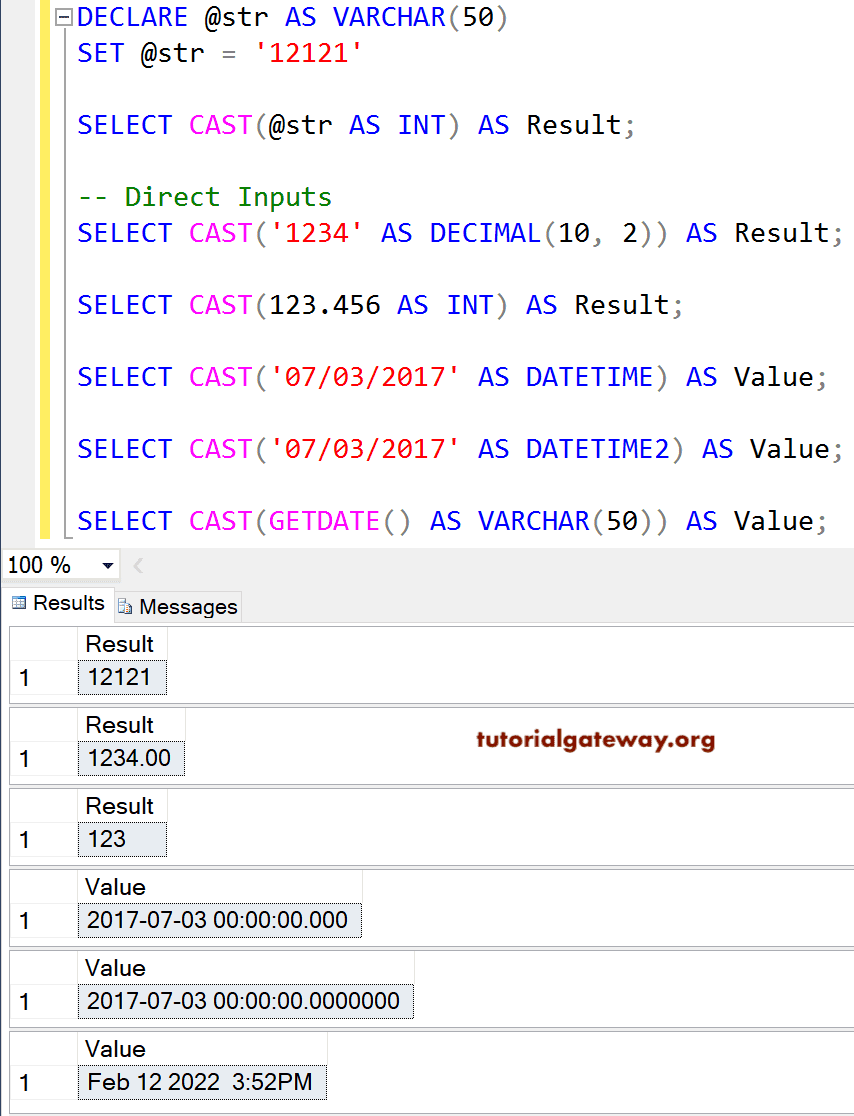
SELECT CAST('500' AS INT); -- Result: 500


-- Convert a string representing a decimal to a specific precision

SELECT CAST('123.456' AS DECIMAL(10, 2)); -- Result: 123.46 (might round based on database)
Note that when converting a string with more decimal places than the target
DECIMALtype, rounding or truncation may occur. -
Integer to String:
-- Convert an integer to a string for concatenation

SELECT 'The ID is: ' || CAST(42 AS VARCHAR(5)); -- Result: 'The ID is: 42'

Date and Time Conversions
Working with dates and times is a common source of data type challenges, and CAST is a key solution.
-
String to DATE/DATETIME/TIMESTAMP:
-- Convert a standard formatted string to a DATE

SELECT CAST('2023-10-27' AS DATE); -- Result: 2023-10-27


-- Convert a standard formatted string to a DATETIME/TIMESTAMP

SELECT CAST('2023-10-27 14:30:00' AS DATETIME); -- Result: 2023-10-27 14:30:00.000
The success of these conversions heavily depends on the string’s format matching the database’s expected date/time literal format.
-
DATETIME to DATE (Truncating Time):
-- Extract only the date part from a DATETIME column

SELECT CAST(order_timestamp AS DATE) AS order_date_only

FROM sales;
This is extremely useful for grouping data by day, regardless of the time component.
Boolean and Other Type Conversions
CAST can also handle conversions involving boolean or binary types, though these are less common for basic reporting.
-
Representing Booleans:
-- Convert an integer to a boolean (e.g., 0 for false, 1 for true)

SELECT CAST(1 AS BOOLEAN); -- Result: TRUE (or equivalent '1'/'T')

SELECT CAST(0 AS BOOLEAN); -- Result: FALSE (or equivalent '0'/'F')
Behavior for other integers (e.g.,
CAST(5 AS BOOLEAN)) can vary by database; some treat any non-zero as true, others might error.
Error Handling and Best Practices
Data type conversion is a potential source of errors. It’s crucial to handle these gracefully.
-
What Happens on Conversion Failure?
If
CASTattempts to convert anexpressionthat cannot be interpreted as thetarget_data_type, it typically results in an error. For example,CAST('abc' AS INT)will cause an error because ‘abc’ is not a valid integer.-
SQL Server: By default, throws an error. However,
TRY_CAST(andTRY_CONVERT) can be used to returnNULLinstead of an error if the conversion fails. -
PostgreSQL: Also typically throws an error.
-
MySQL: Often returns
0for numeric conversions orNULLfor date/time conversions on failure, which can be less explicit and harder to debug. Always test thoroughly!
-
-
Data Loss Implications: Be aware that converting to a data type with lower precision or a smaller range can lead to data loss.
-- Converting a decimal to an integer will truncate the decimal part

SELECT CAST(123.78 AS INT); -- Result: 123
Similarly, converting a
VARCHAR(50)toVARCHAR(10)will truncate any string longer than 10 characters. Always ensure thetarget_data_typecan accommodate the range and precision of theexpression. -
Performance Considerations: While
CASTis powerful, overusing it, especially on large datasets or withinWHEREclauses, can negatively impact query performance. WhenCASTis applied to a column in aWHEREclause (e.g.,WHERE CAST(my_varchar_column AS INT) = 123), it often prevents the database from using an index onmy_varchar_column, leading to a full table scan. Whenever possible, convert the literal value instead (e.g.,WHERE my_int_column = CAST('123' AS INT)) or ensure the column is already of the correct data type.
CAST vs. CONVERT (and other related functions)
While CAST is the ANSI standard, some database systems, notably SQL Server, offer an alternative function called CONVERT. It’s important to understand the distinctions.
Understanding the Differences
-
CAST:-
ANSI SQL standard.
-
Syntax:
CAST(expression AS target_data_type). -
More portable across different database systems.
-
Simpler syntax, generally preferred for straightforward type conversions.
-
-
CONVERT(SQL Server specific):-
T-SQL specific (Transact-SQL).
-
Syntax:
CONVERT(target_data_type, expression [, style]). -
Offers an optional
styleparameter, particularly useful for formatting date/time and numeric conversions into specific string representations. This is its primary advantage overCASTin SQL Server, allowing for precise output formatting without additional string manipulation. -
Less portable; using
CONVERTties your SQL to SQL Server.
-
Example of CONVERT with style in SQL Server:
-- Convert current date to a specific string format (mm/dd/yyyy)

SELECT CONVERT(VARCHAR(10), GETDATE(), 101); -- Result: '10/27/2023' (example date)
CAST would require additional string formatting functions (like FORMAT in SQL Server 2012+) to achieve the same result.
Other Type Conversion Functions
Some database systems provide additional functions for conversion and error handling:
-
TRY_CAST/TRY_CONVERT(SQL Server): These functions attempt a conversion and returnNULLif the conversion fails, rather than throwing an error. This is invaluable for handling potentially invalid data gracefully in ETL processes or data cleansing.SELECT TRY_CAST('abc' AS INT); -- Result: NULL SELECT TRY_CAST('123' AS INT); -- Result: 123 -
PARSE/TRY_PARSE(SQL Server): Used for converting string representations of numbers and dates to their respective types, with culture-aware parsing. They are more robust for internationalization.
When writing portable SQL, CAST is always the safest choice. If you are developing exclusively for a specific database system and need its advanced features (like CONVERT‘s styles or TRY_CAST‘s error handling), then leveraging those platform-specific functions can be beneficial.
The Impact of CAST on Data Manipulation and Analysis
The CAST function is far more than a simple type changer; it profoundly impacts how data can be manipulated, analyzed, and presented, enhancing the flexibility and power of SQL.
Enhancing Query Flexibility
CAST unlocks the ability to perform operations that involve different data types, leading to more flexible and powerful queries:
-
Complex Comparisons: Compare a numeric ID stored as text with an actual numeric value.
-
Aggregations: Sum, average, or count values that might be stored as strings but represent numbers.
-
Filtering: Filter records based on specific parts of a date or timestamp by casting it to a
DATEtype. -
Joins: Join tables where key columns might have slightly different, but semantically equivalent, data types. For instance, joining a
VARCHARID to anINTID after casting one to match the other (though ideally, join keys should be consistently typed).
Preparing Data for Reporting and BI
In business intelligence and reporting, data often needs to be presented in user-friendly formats, or conform to specific schemas of reporting tools. CAST is a critical step in this data preparation:
-
Standardized Formats: Ensure dates are always in a
YYYY-MM-DDformat or numbers always have a specific number of decimal places for consistency across reports. -
Concatenated Fields: Combine numeric and string data into a single descriptive text field for display.
-
Compatible Data Types: Ensure that columns sent to a BI tool (like Tableau, Power BI, Excel) are of the expected data type, preventing errors or misinterpretations in visualizations.
Maintaining Data Consistency
CAST can play a role in maintaining data consistency within your database and across different systems during ETL (Extract, Transform, Load) processes:
-
ETL Pipelines: When loading data from a source system with one data type into a target system with another,
CASTperforms the necessary transformation. -
Data Cleansing: Converting ‘true’/’false’ strings to boolean types, or standardizing numeric fields that might have inconsistent string representations.
-
Schema Evolution: When a column’s data type needs to be updated (e.g., from
INTtoBIGINT),CASTcan be part of the migration script to ensure existing data is correctly transformed.
Conclusion
The CAST function in SQL is an indispensable tool for explicit data type conversion, offering precision, predictability, and control over how data is handled within a database. By understanding its syntax, common use cases, and the nuances of error handling and performance, database professionals can write more robust, efficient, and maintainable SQL queries.
From ensuring data integrity and enabling complex analytical operations to preparing data for reporting and facilitating data integration, CAST empowers developers to bridge the gaps between disparate data types. While implicit conversions exist, the explicit nature of CAST removes ambiguity and minimizes the risk of unexpected outcomes, making it a cornerstone of effective data manipulation in SQL. Thoughtful and appropriate use of CAST is a hallmark of skilled SQL development, crucial for building reliable database solutions in today’s data-driven landscape.