
In the rapidly evolving landscape of digital communication, language is shifting at a pace that often outstrips traditional dictionaries. As we navigate through various messaging apps, social media platforms, and collaborative software, the use of acronyms has become a fundamental component of “tech-speak.” One such acronym that has gained significant traction is “ATP.” While the scientific community may immediately think of cellular energy, in the realm of texting and social media, ATP takes on entirely different meanings that reflect our modern, fast-paced digital culture.
Understanding these nuances is not just about keeping up with slang; it is about mastering the subtle art of digital literacy in a world where software, mobile hardware, and social algorithms dictate how we interact.
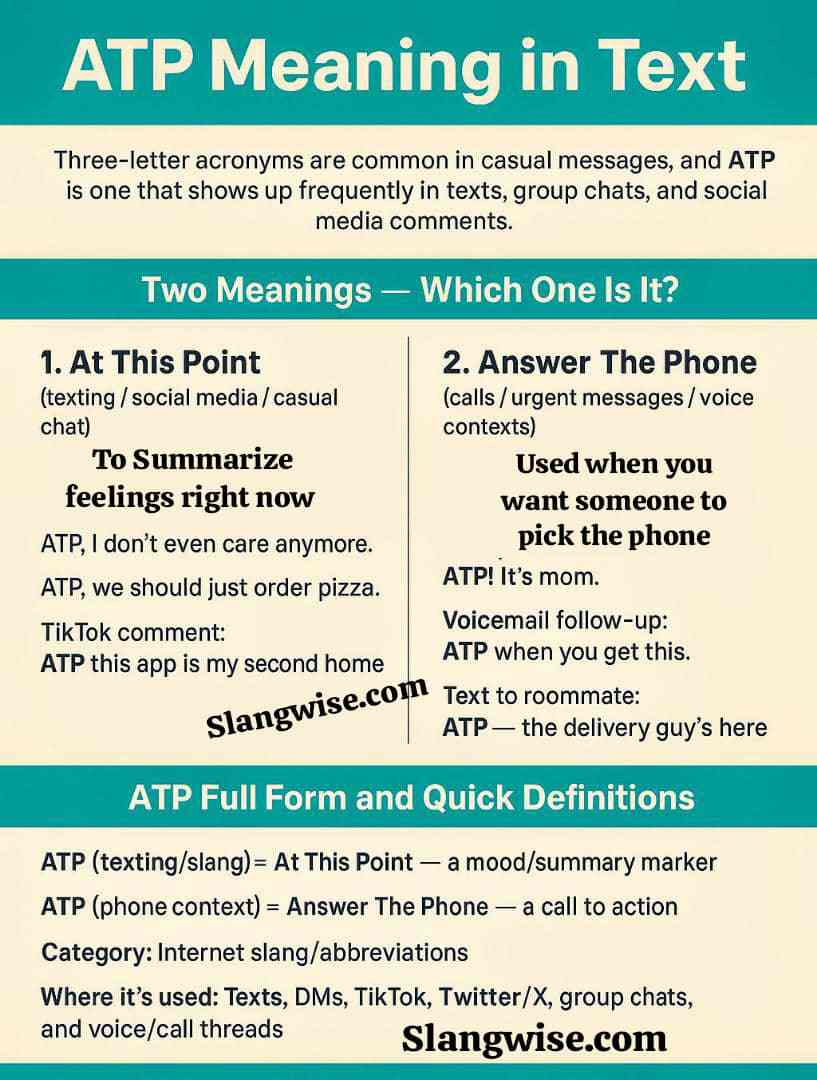
Decoding ATP: The Most Common Meanings in Mobile Messaging
When you see “ATP” pop up in a text message or a comment section on a platform like TikTok or Instagram, it usually serves one of two primary functions. Unlike static professional jargon, these meanings are highly contextual and rely on the relationship between the sender and the receiver.
“At This Point”: Contextual Usage and Nuance
The most prevalent interpretation of ATP in modern texting is “At This Point.” This phrase is a temporal marker used to express a sense of resignation, realization, or a summary of current circumstances.
In terms of digital linguistics, “at this point” often prefaces a statement of fact that has become unavoidable due to prior events. For example, a user might text, “ATP, I don’t think the update is ever going to finish downloading.” Here, the acronym acts as a linguistic shortcut, conveying a mood of frustration or patience-wearing-thin without requiring the user to type out the full phrase on a mobile keyboard. This efficiency is a hallmark of mobile-first communication, where reducing keystrokes is a primary driver of language evolution.
“Answer the Phone”: The Urgency of Real-Time Connection
A secondary, though equally important, meaning of ATP is “Answer the Phone.” In the era of asynchronous communication—where we often prefer texts, voice notes, and DMs over live calls—the sudden need for a synchronous conversation usually implies urgency.
When a contact sends “ATP” in a standalone message, they are often bypassing the etiquette of “pinging” someone to ask if they are free. It is a direct command, facilitated by the speed of instant messaging. This usage is particularly common among younger demographics who view traditional phone calls as high-stakes or emergency-only interactions. The tech-driven shift from voice to text has made the request to actually “answer the phone” so distinct that it warranted its own shorthand.
The Evolution of Texting Acronyms in the Digital Age
To understand why ATP has become a staple of our digital vocabulary, we must look at the technological milestones that shaped how we type. The transition from T9 predictive texting on feature phones to the multi-touch glass screens of modern smartphones has fundamentally altered our “input economy.”
Why We Use Shortcuts: Cognitive Load and Speed
Digital communication is governed by the principle of least effort. Whether we are using Slack for professional coordination or iMessage for social planning, we are constantly looking for ways to reduce cognitive load and physical effort. Acronyms like ATP allow for “high-density communication”—conveying a complex sentiment or a specific instruction in just three characters.
From a software perspective, the rise of autocorrect and predictive text engines has an interesting relationship with acronyms. Modern AI-driven keyboards often “learn” a user’s slang. If a user frequently types “ATP,” the device’s machine learning model will stop correcting it to “ADP” or “Ate” and instead prioritize the acronym. This creates a feedback loop where the technology reinforces the use of shorthand, cementing it into the user’s daily lexicon.
From 160 Characters to Unlimited Data
In the early days of SMS, the 160-character limit per message forced users to be incredibly frugal with their words. This was the era that birthed “LOL,” “BRB,” and “GR8.” While modern data plans and messaging apps like WhatsApp or Telegram have removed those character constraints, the habit of abbreviation has persisted and evolved.
The move from “character saving” to “vibe setting” is a key trend in tech communication. We no longer use ATP because we have to save space; we use it to signal that we are part of a specific digital subculture. It provides a tone of informality and immediacy that full-length sentences often fail to capture.

ATP and Beyond: Navigating the Social Landscape of Apps and Slang
The meaning of ATP can shift slightly depending on the platform where it is used. The “tech stack” of our social lives—the various apps we use for different purposes—creates unique environments for language.
Platform-Specific Slang: TikTok vs. iMessage
On TikTok, ATP is frequently seen in captions and “POV” (Point of View) videos. In this environment, it almost always means “At This Point.” The platform’s algorithm favors quick, relatable content, and using current shorthand helps creators appear more authentic and “in the know” to the viewers.
Conversely, on iMessage or WhatsApp, the meaning is more likely to be dictated by the immediate needs of the conversation. If you are in the middle of a logistics-heavy group chat, ATP might lean toward “Answer the Phone” if a quick decision is needed. Understanding the “user interface” of the social context is just as important as understanding the software interface itself.
Avoiding Miscommunication in Professional vs. Personal Tech
One of the challenges of modern digital communication is “context collapse.” This occurs when the shorthand we use in personal, casual settings bleeds into professional environments. While ATP is perfectly acceptable in a text to a friend, using it in a professional email or a formal Slack channel can lead to confusion.
In a corporate tech environment, “ATP” might be misinterpreted as “Available to Promise” (a supply chain term) or “Acceptance Test Procedure” (a software development term). This highlights a critical rule of digital literacy: always consider the “end-user” of your message. If there is a risk that your recipient is operating on a different “operating system” of slang, it is always better to opt for the long-form version of the phrase.
The Psychology Behind Modern Digital Shorthand
The use of ATP is more than just a technological shortcut; it is a psychological tool used to build digital rapport. Language has always been a way to identify “in-groups” and “out-groups,” and the digital world is no different.
Building In-Group Identity through Acronyms
By using current acronyms, users signal their fluency in digital culture. It is a form of social signaling that says, “I am active on these platforms, and I understand the current speed of communication.” For developers and tech innovators, staying abreast of these shifts is vital for creating user-focused interfaces and social features that feel intuitive to the target demographic.
The Future of Digital Expression: AI and Auto-Correction
As we move further into the age of Generative AI, the way we use acronyms like ATP may change again. We are already seeing AI writing assistants that can expand our shorthand into full sentences or, conversely, “summarize” our long-winded emails into a series of punchy bullet points and acronyms.
Future iterations of messaging software may even include “translation” layers. Imagine a feature where an older user receives a message saying “ATP I’m done,” and the software provides a small tooltip explaining that the sender is frustrated “at this point.” While this may seem far-fetched, the integration of Natural Language Processing (NLP) into our daily communication tools is making this kind of real-time linguistic bridge-building more likely.

Best Practices for Using Tech Shorthand Safely and Effectively
As we integrate more acronyms into our digital lives, it is essential to maintain a level of “digital hygiene” to ensure our messages are both effective and secure.
- Verify the Context: Before hitting send, take a micro-second to ensure that “ATP” makes sense in the current flow of the conversation. If you are asking someone to “Answer the Phone,” ensure that the urgency is warranted.
- Mind the Professional Gap: In tools like Microsoft Teams or LinkedIn, err on the side of clarity. Tech trends move fast, but professional standards move slower. Don’t let a misunderstood acronym derail a project or a job opportunity.
- Digital Security Awareness: Be cautious of “slang-heavy” messages from unknown numbers. Scammers often use casual language and current acronyms to build a false sense of familiarity (a tactic known as social engineering). If an “ATP” request to “Answer the Phone” comes from an unrecognized contact, it is best to ignore it.
- Stay Updated: The digital lexicon is not static. Just as “YOLO” and “ROFL” have faded into the background, “ATP” may eventually be replaced by a newer, faster shortcut. Staying engaged with tech trends ensures that your digital communication remains relevant and effective.
In conclusion, “ATP” is a prime example of how technology influences human language. It represents the intersection of mobile efficiency, social signaling, and the constant need for faster, more expressive communication. Whether you are using it to express your exhaustion “at this point” or to demand that someone “answer the phone,” you are participating in a global shift toward a more streamlined, tech-integrated form of human connection. Understanding these terms is no longer optional—it is a core component of navigating the modern digital world.
aViewFromTheCave is a participant in the Amazon Services LLC Associates Program, an affiliate advertising program designed to provide a means for sites to earn advertising fees by advertising and linking to Amazon.com. Amazon, the Amazon logo, AmazonSupply, and the AmazonSupply logo are trademarks of Amazon.com, Inc. or its affiliates. As an Amazon Associate we earn affiliate commissions from qualifying purchases.