
The name “Armalite” resonates within certain circles with a distinct and significant meaning, far beyond a mere brand identifier. It evokes a specific era of firearms development, a revolutionary design philosophy, and a lineage of influential weaponry that has shaped modern military and civilian shooting sports. To truly understand “what Armalite means,” we must delve into its historical context, its core technological contributions, and its enduring impact on the world of firearms. This exploration will reveal that Armalite is not just a company; it’s a concept, a benchmark, and a testament to innovation in a field often characterized by tradition.

The Genesis of a Revolution: Armalite’s Early Innovations
Armalite’s story is inextricably linked to the post-World War II era, a period ripe for advancements in military technology. The company, founded in 1948 as a division of the Fairchild Engine and Airplane Corporation, emerged with a singular focus: to develop lightweight, modern firearms for the U.S. military. This ambition led to groundbreaking designs that challenged conventional wisdom and laid the groundwork for the firearms we recognize today.
Rethinking the Infantry Rifle: The AR-10 and its Design Philosophy
The most impactful innovation to emerge from Armalite was, undoubtedly, the AR-10. This rifle was not an evolution of existing designs; it was a radical departure. Designed by Eugene Stoner, Robert Fremont, and Arthur Miller, the AR-10 was conceived with several key objectives in mind:
- Lightweight Construction: Utilizing aluminum alloys and plastics where possible, the AR-10 was significantly lighter than its contemporaries, such as the M1 Garand and the FN FAL. This was a crucial advantage for infantrymen who had to carry their equipment over long distances.
- Modular Design: The AR-10 incorporated a modular design that allowed for easier maintenance, modification, and parts interchangeability. This was a forward-thinking concept that would influence firearm manufacturing for decades.
- Gas Operated System: Armalite pioneered the direct impingement gas system in the AR-10. In this system, hot gases from the fired cartridge are tapped from the barrel and directly impinge upon a bolt carrier group, driving it rearward to cycle the action. This system, while controversial at times, offered several advantages, including reduced recoil and a cleaner operating mechanism compared to some other gas-operated systems.
- Ergonomics and Handling: The rifle’s “straight-line” stock and pistol grip were designed to improve handling and control, especially during rapid fire. The prominent carrying handle, while iconic, also served to protect the rear sight and provide a stable grip.
While the AR-10 ultimately lost out to the M14 in U.S. military trials, its revolutionary concepts did not go unnoticed. Its innovative approach to materials, operation, and design fundamentally shifted the paradigm for future rifle development. The AR-10’s influence, though indirect initially, would soon become overwhelmingly apparent.
The Evolution to the AR-15: A Design That Defined an Era
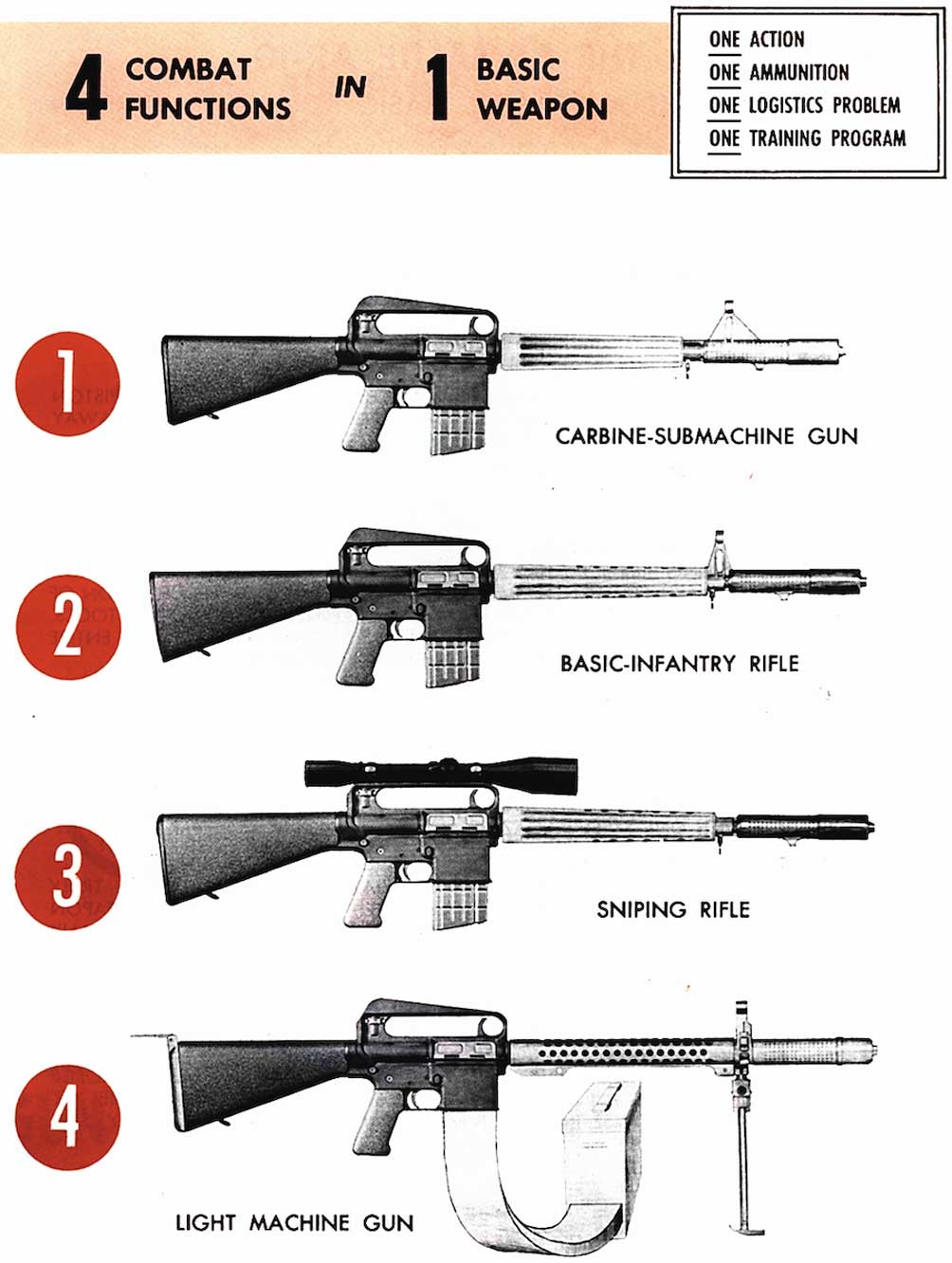
The true world-altering success of Armalite’s design philosophy came with the development of the AR-15. Building upon the foundational principles of the AR-10, the AR-15 was scaled down to fire a smaller, lighter cartridge: the .223 Remington (later adopted as the 5.56x45mm NATO). This change in caliber was a strategic decision to enable soldiers to carry more ammunition, a critical factor in modern warfare.
The AR-15 retained the direct impingement gas system, the modular construction, and the lightweight materials that characterized its predecessor. These features, combined with the manageable recoil of the smaller cartridge, made the AR-15 exceptionally effective for automatic and semi-automatic fire.
The U.S. Air Force’s purchase of the AR-15 in 1962, and its subsequent adoption by the U.S. Army as the M16 rifle, marked a pivotal moment in firearms history. The M16, and its later iterations, became the standard infantry rifle for the U.S. military and countless other armed forces around the globe. The AR-15 platform, in its various civilian-legal configurations, has also achieved immense popularity in the civilian shooting market, becoming one of the most widely owned and recognized rifle designs in the world.
Armalite’s Technological Footprint: Beyond the Direct Impingement System
While the direct impingement gas system and the modular aluminum receiver are Armalite’s most celebrated contributions, the company’s technological impact extends further. Their willingness to experiment and integrate new materials and manufacturing techniques set them apart.

Material Science and Manufacturing Techniques
Armalite’s early focus on lightweight materials like aluminum alloys and high-strength plastics was a significant departure from the traditional steel and wood construction prevalent at the time. This not only reduced the weight of their firearms but also opened up new possibilities for design and manufacturing. The use of advanced machining processes allowed for the creation of precise, interchangeable parts, which was crucial for their modular designs and for achieving consistent performance.
The company’s engineers were not afraid to explore unconventional approaches. This experimental spirit, though sometimes leading to initial challenges in widespread adoption (as seen with early M16 reliability issues, which were largely due to ammunition and maintenance rather than the core design), was ultimately what propelled firearms technology forward. Armalite demonstrated that by embracing new materials and innovative manufacturing, the performance and usability of firearms could be dramatically improved.
The Concept of the Modern Sporting Rifle
The AR-15 platform, born from Armalite’s vision, is often credited with defining the “Modern Sporting Rifle” category. This designation refers to semi-automatic rifles, typically magazine-fed, that share the ergonomic and operational characteristics of the AR-15. These rifles are celebrated for their versatility, accuracy, and adaptability.
The modularity of the AR-15 platform is its defining characteristic in this regard. Users can easily swap barrels, handguards, stocks, optics, and a myriad of other accessories to customize the rifle for specific purposes, whether it’s target shooting, hunting, or self-defense. This level of user customization was largely unheard of in traditional bolt-action or lever-action rifles, making the AR-15 platform a game-changer for civilian shooters. Armalite’s initial design philosophy directly enabled this unparalleled adaptability, solidifying its meaning as the progenitor of a hugely influential class of firearms.
The Enduring Legacy: Armalite’s Meaning Today
The term “Armalite” today carries a multifaceted meaning. It represents a pivotal moment in firearms history, a foundational design that continues to evolve, and a symbol of innovation that has left an indelible mark on both military and civilian applications.
A Standard Bearer in Firearms Design
For many enthusiasts and professionals, “Armalite” is synonymous with the AR-15 platform itself, even if the rifles are manufactured by other companies. The name has become shorthand for a specific type of rifle that prioritizes modularity, ergonomics, and a direct impingement gas system. It signifies a particular lineage of design that prioritizes innovation and user adaptability.
The AR-15 platform has become a canvas for customization and innovation. Manufacturers continue to refine and improve upon the original design, introducing new calibers, materials, and features. However, the core principles established by Armalite – lightweight construction, modularity, and an effective gas-operated system – remain the bedrock of this enduringly popular platform.
The Spirit of Innovation and the Future of Firearms
Beyond specific rifle models, “Armalite” embodies a spirit of innovation within the firearms industry. The company dared to question established norms and explore new possibilities. This mindset is crucial for any technological field. While Armalite as a company has experienced changes in ownership and focus over the years, its original contributions continue to inspire and influence.
The ongoing development of firearms, from advanced materials to new operating systems and integration with digital technologies, can trace some of its lineage back to the bold ideas that emerged from Armalite’s workshops in the mid-20th century. The company’s legacy serves as a reminder that progress often comes from challenging the status quo and embracing a future-forward approach to design and engineering. The meaning of Armalite, therefore, is not just about a historical company or a specific rifle; it’s about a paradigm shift that continues to shape the way we think about and use firearms today.
aViewFromTheCave is a participant in the Amazon Services LLC Associates Program, an affiliate advertising program designed to provide a means for sites to earn advertising fees by advertising and linking to Amazon.com. Amazon, the Amazon logo, AmazonSupply, and the AmazonSupply logo are trademarks of Amazon.com, Inc. or its affiliates. As an Amazon Associate we earn affiliate commissions from qualifying purchases.