
In the early days of automotive engineering, a vehicle was a purely mechanical beast. Fuel was delivered via physical vacuum pressure in a carburetor, and ignition timing was managed by mechanical weights and springs. However, as the demand for efficiency, power, and environmental compliance grew, the mechanical limits of these systems were reached. Enter the Engine Control Unit (ECU).
At its core, the ECU is a specialized embedded system—a high-performance computer designed to manage the complex electronic systems of a modern internal combustion engine or electric powertrain. It is the central nervous system of the vehicle, processing millions of data points every second to ensure that the machine operates at peak performance. In this deep dive into automotive technology, we will explore the architecture, functionality, and future of the ECU.
Understanding the Architecture of an Engine Control Unit
To understand what an ECU does, one must first understand what it is. It is not merely a simple circuit board; it is a sophisticated piece of computing hardware designed to survive the harshest environments—vibration, extreme heat, and electromagnetic interference.
Hardware Components: The Digital Core
The hardware of an ECU consists of several key layers. At the heart is the Microcontroller, which contains the CPU (Central Processing Unit), RAM (Random Access Memory), and Flash Memory. Unlike a consumer laptop, an ECU’s CPU is optimized for “real-time” processing. This means it must guarantee a response to an input within a specific, tiny window of time.
Surrounding the CPU are the Input/Output (I/O) interfaces. These are the “senses” and “limbs” of the computer. Analog-to-digital converters (ADCs) take raw electrical signals from sensors and translate them into binary data that the CPU can understand. On the output side, high-power transistors (often MOSFETs) act as switches to trigger physical components like fuel injectors and ignition coils.
Software and Control Logic: The Decision Maker
The software residing within the ECU’s flash memory is often referred to as “firmware.” This software contains complex multi-dimensional maps, also known as look-up tables. These tables are essentially “if-then” logic structures on a massive scale. For example, the software might look at a table that says: “If engine RPM is 3,000 and the throttle position is 50%, then inject X amount of fuel.”
Modern ECU software also utilizes sophisticated algorithms for closed-loop control. Using feedback loops, the ECU doesn’t just follow a set of instructions; it observes the results of its actions and adjusts its strategy in real-time to achieve a desired outcome, such as the perfect air-fuel ratio.
The Sensory Network: How the ECU Perceives the World
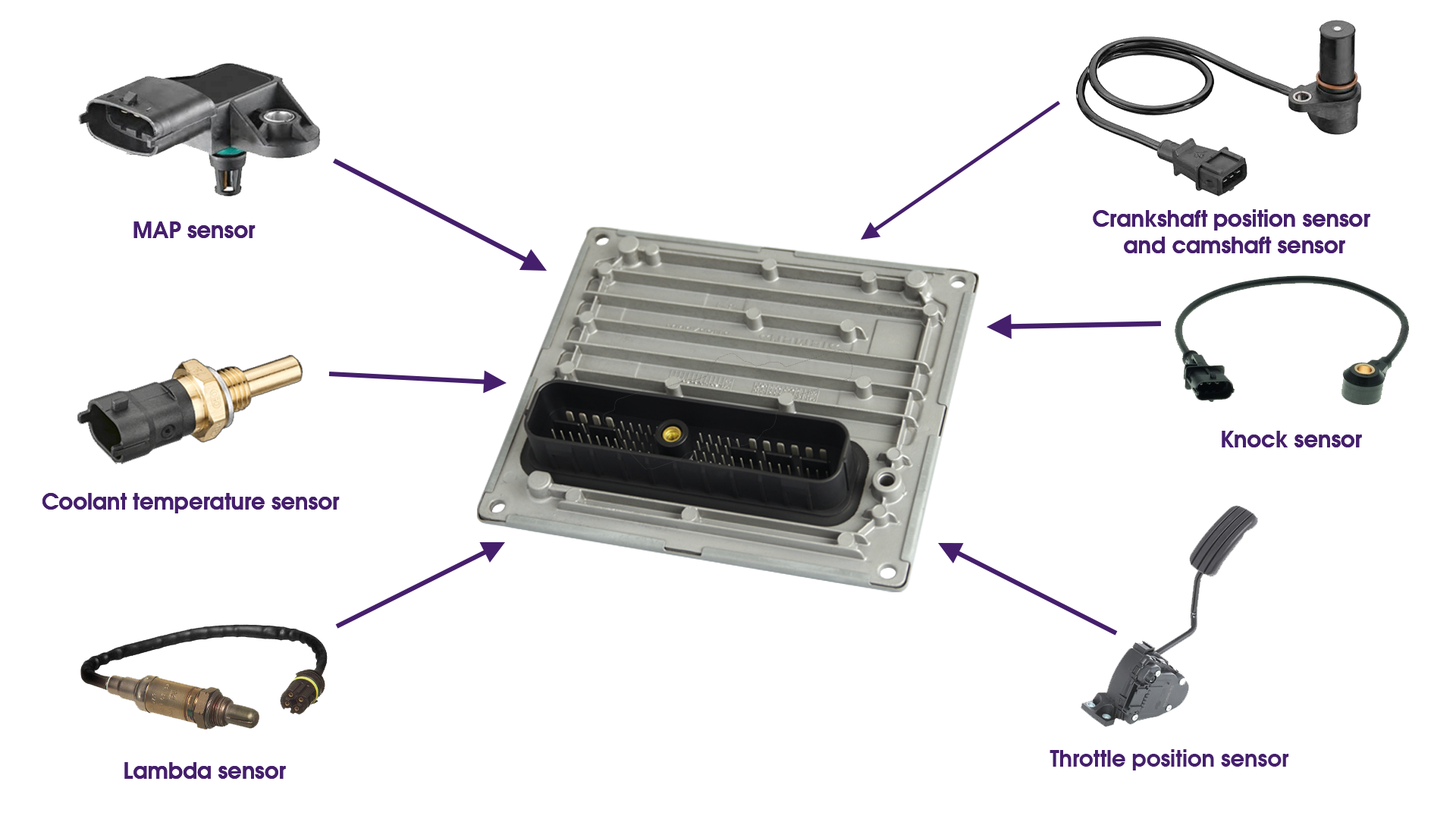
An ECU is only as good as the data it receives. To manage an engine effectively, the unit relies on a vast network of sensors distributed throughout the vehicle. This tech-driven sensory network allows the car to understand its internal state and its external environment.
Input Signals and Data Acquisition
The ECU monitors a staggering array of variables. Key sensors include:
- Mass Air Flow (MAF) Sensor: Measures the volume and density of air entering the engine.
- Throttle Position Sensor (TPS): Monitors how far the driver is pressing the accelerator.
- Coolant Temperature Sensor: Ensures the engine is at the optimal operating temperature.
- Crankshaft and Camshaft Position Sensors: These are critical for timing, telling the ECU exactly where the pistons and valves are in their cycle.
- Oxygen (O2) Sensors: Located in the exhaust, these measure how much unburnt fuel or excess oxygen is leaving the engine, providing the “feedback” for closed-loop operation.
Processing Real-Time Telemetry
Once these signals reach the ECU, the digital processing begins. The ECU doesn’t just read these numbers in isolation; it correlates them. For instance, if the MAF sensor says a lot of air is coming in, but the TPS says the throttle is closed, the ECU identifies a potential vacuum leak or sensor failure. This high-speed data correlation is what allows modern vehicles to run smoothly under varying altitudes, temperatures, and load conditions.
Control and Optimization: The ECU in Action
The primary function of the ECU is to control the engine’s “actuators” based on the sensor data. This is where the digital commands are translated into physical motion.
Fuel Injection and Ignition Timing
The two most critical tasks of an ECU are managing fuel injection and ignition timing. In older cars, these were static. In a tech-forward modern vehicle, the ECU determines the “pulse width” of a fuel injector—how many milliseconds it stays open—down to a fraction of a percent.
Ignition timing is equally precise. The ECU must decide exactly when to fire the spark plug. If it fires too early (advanced) or too late (retarded), the engine loses power or can even sustain physical damage from “knock” (pre-detonation). The ECU monitors knock sensors to detect the microscopic vibrations of poor combustion and adjusts timing instantly to protect the engine.
Emission Control and Environmental Efficiency
From a technology standpoint, the ECU is the greatest tool ever invented for environmental protection. By constantly adjusting the air-fuel ratio to the “stoichiometric” point (14.7 parts air to 1 part fuel for gasoline), the ECU ensures that the catalytic converter can operate at maximum efficiency. Without the ECU’s ability to manage vapor recovery systems and exhaust gas recirculation (EGR), modern emission standards would be impossible to meet.
Adaptive Learning and Performance Tuning
Modern ECUs feature “Adaptive Learning” algorithms. Over time, as engine components wear or fuel quality fluctuates, the ECU learns these variances and adjusts its base maps. It stores “Long Term Fuel Trims” to compensate for a slightly clogged filter or a minor air leak.
Furthermore, the “Tech” community has embraced ECU remapping or “chipping.” By modifying the software code within the ECU, enthusiasts can unlock higher boost pressures in turbocharged engines or sharper throttle response, demonstrating the software-defined nature of modern horsepower.
The Evolution of ECUs in the Age of Software-Defined Vehicles
We are currently transitioning from the era of the Engine Control Unit to the era of the Domain Control Unit. As vehicles become more electronic, the role of the ECU is expanding and merging with other systems.
From Basic Control to Advanced ADAS Integration
In the past, the ECU lived in a silo. Today, it communicates via a High-Speed CAN bus (Controller Area Network) with other modules like the Transmission Control Module (TCM) and the Advanced Driver Assistance Systems (ADAS). When your car automatically brakes to avoid a collision, the ADAS module sends a high-priority command over the network to the ECU, telling it to cut throttle immediately. This level of inter-system communication is a hallmark of modern automotive software architecture.
Over-the-Air (OTA) Updates and Digital Security
As cars become “computers on wheels,” the way we maintain them is shifting. Many modern ECUs are now capable of receiving Over-the-Air (OTA) updates. Manufacturers can push a software patch to the ECU to improve fuel efficiency or fix a bug without the car ever entering a service center.
However, this connectivity brings the need for robust digital security. Cybersecurity for ECUs is now a major field within automotive tech. Engineers use encryption and secure boot protocols to ensure that the ECU’s firmware cannot be hijacked by malicious actors, which could theoretically take control of vehicle functions.
Troubleshooting and Diagnostic Power
One of the most user-facing aspects of ECU technology is its ability to self-diagnose. This has transformed automotive repair from a game of guesswork into a data-driven science.
The Role of OBD-II Systems
Since the mid-1990s, ECUs have been required to support OBD-II (On-Board Diagnostics). When the ECU detects that a sensor reading is out of its expected range or that a “misfire” has occurred, it generates a Diagnostic Trouble Code (DTC) and illuminates the Check Engine Light. Technicians use specialized diagnostic software to “interrogate” the ECU, pulling real-time data logs and freeze-frame data to see exactly what the computer was thinking at the moment the fault occurred.
Predictive Maintenance through Data Analysis
The future of ECU technology lies in predictive maintenance. By utilizing AI and machine learning models within the vehicle’s cloud-connected ecosystem, the ECU can analyze patterns of wear. Instead of waiting for a part to break, the system can identify a degrading sensor signal and alert the driver that a component is likely to fail within the next 500 miles. This shift from reactive to proactive maintenance is a direct result of the increasing computational power of the ECU.

Conclusion
The Engine Control Unit is a testament to the marriage of mechanical engineering and computer science. It has evolved from a simple transistorized ignition box into a powerful multi-core processor capable of executing billions of instructions per journey. By managing the delicate balance between performance, economy, and reliability, the ECU remains the most critical piece of technology in the modern vehicle. As we move toward a future of electric propulsion and autonomous driving, the “ECU” may change its name or its specific tasks, but its role as the digital brain of the machine will only become more vital.
aViewFromTheCave is a participant in the Amazon Services LLC Associates Program, an affiliate advertising program designed to provide a means for sites to earn advertising fees by advertising and linking to Amazon.com. Amazon, the Amazon logo, AmazonSupply, and the AmazonSupply logo are trademarks of Amazon.com, Inc. or its affiliates. As an Amazon Associate we earn affiliate commissions from qualifying purchases.