
Navigating the landscape of federal benefits is a cornerstone of sound personal finance and retirement planning. For many Americans, the Social Security Administration (SSA) serves as the bedrock of their long-term financial stability. However, as you move from the “earning” phase of your life into the “benefit” phase, the terminology often shifts. One of the most common points of confusion for retirees and those planning for their financial future is the Social Security claim number.
While almost everyone is familiar with their nine-digit Social Security Number (SSN), the claim number is a slightly different animal. Understanding what a Social Security claim number looks like, how to interpret it, and where it fits into your broader financial strategy is essential for ensuring you receive the correct payments and protect your financial identity.
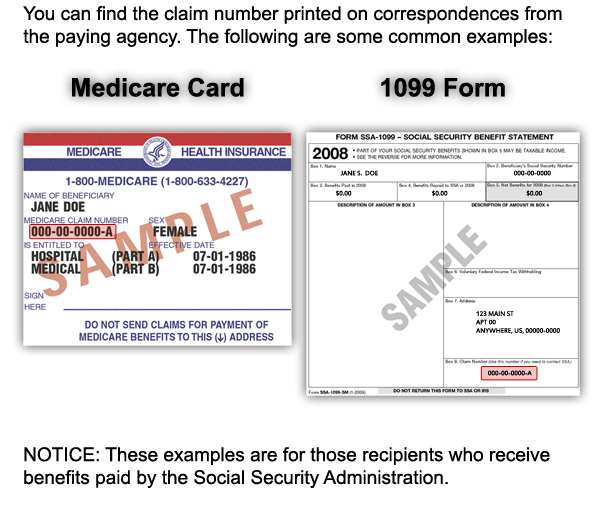
Anatomy of a Social Security Claim Number
When you ask, “What does a Social Security claim number look like?” the answer usually involves a familiar sequence of numbers followed by a specific alphanumeric code. In its most basic form, a Social Security claim number is the Social Security Number of the primary wage earner, followed by a one- or two-character “Beneficiary Identification Code” (BIC).
The Core Nine Digits
The foundation of any claim number is the standard nine-digit Social Security Number. Historically, these numbers were issued based on geography, but since 2011, the SSA has used a randomized assignment process. In the context of a claim, these nine digits represent the “record” under which benefits are being paid. If you are claiming benefits based on your own work history, the nine digits will be your own SSN. If you are claiming as a spouse or a survivor, these digits will be the SSN of the worker whose record provides the benefits.
Decoding the Beneficiary Identification Code (BIC)
The most distinctive part of a claim number is the letter or letter-number combination at the end. This is the Beneficiary Identification Code (BIC). The BIC tells the SSA—and other financial institutions—exactly what type of benefit is being paid and the relationship of the claimant to the primary worker.
Without the BIC, the nine-digit number is just an identity marker. With the BIC, it becomes a financial instrument that specifies the flow of monthly income. It is the “suffix” that clarifies the status of the account.
Common BIC Examples
Understanding the most common BICs can help you verify that your financial records are accurate. Here are the most frequent codes you will encounter:
- A: This indicates the primary claimant (the wage earner themselves). If your claim number is your SSN followed by an “A,” you are receiving benefits based on your own work history.
- B: This indicates a wife, age 62 or older, claiming on her husband’s record.
- B1: This indicates a husband, age 62 or older, claiming on his wife’s record.
- D: This is used for a widow, age 60 or older.
- W: This is used for a disabled widow or widower.
- C: This is used for a child of the primary worker.
Seeing these codes on official documentation allows you to confirm that the SSA has categorized your filing status correctly, which is vital for ensuring the dollar amount of your monthly disbursement is accurate.
Social Security Claim Numbers vs. Social Security Numbers
In the realm of personal finance, precision is paramount. Mistaking a Social Security Number for a Social Security claim number (or vice versa) can lead to administrative hurdles when dealing with private insurers, pension funds, or the IRS. While they share the same nine-digit root, their functions in your financial portfolio are distinct.
Key Functional Differences
Your Social Security Number is a lifelong identifier used for taxes, employment, and credit tracking. It is a static number that defines “who you are” in the eyes of the government and financial systems.
The Social Security claim number, conversely, is a dynamic tool used to define “what you are owed.” It identifies the source of your income. For instance, a person might have their own SSN for tax purposes but use a different claim number (their deceased spouse’s SSN plus a “D” code) to receive survivor benefits. Recognizing this distinction is crucial for estate planning and when filling out applications for supplemental private insurance.
The Shift to the MBI (Medicare Beneficiary Identifier)
It is important to note a significant change in how these numbers are displayed on modern financial and medical documents. For decades, the Social Security claim number was printed directly on Medicare cards. However, to combat identity theft and financial fraud, the Centers for Medicare & Medicaid Services (CMS) moved away from this practice.
Between 2018 and 2019, the government replaced Social Security-based claim numbers on Medicare cards with a Medicare Beneficiary Identifier (MBI). The MBI is an 11-character string of random letters and numbers. While the MBI is now used for medical billing, the Social Security claim number remains the internal standard for the SSA’s financial distributions. From a financial management perspective, you must still keep track of your claim number for any direct correspondence with the Social Security Administration regarding your monthly income.
Locating Your Claim Number for Financial Management
For anyone managing a portfolio or a household budget, knowing where to find your claim number is essential for periodic financial check-ups. You will rarely find it on your standard Social Security card (which only lists your SSN); instead, you must look at documents related to the actual payment of benefits.
Official SSA Correspondence and Award Letters
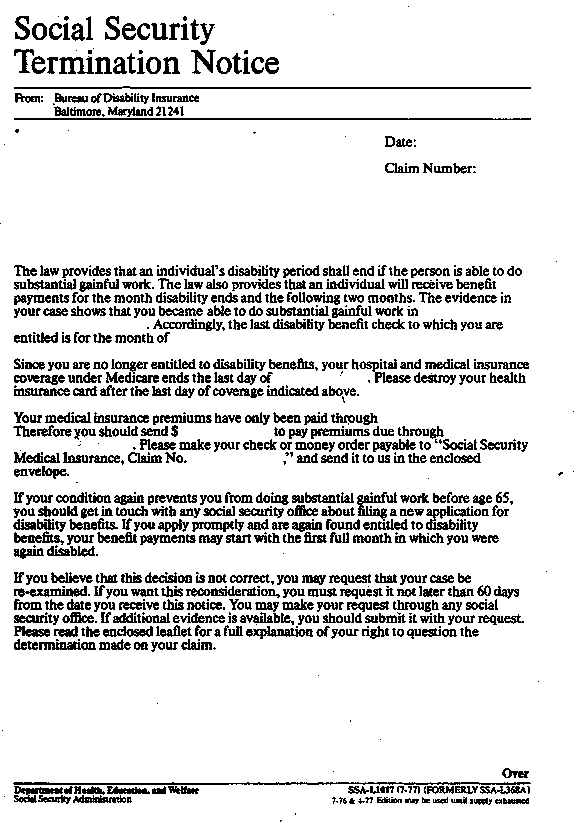
The most reliable place to see what your Social Security claim number looks like is on your “Notice of Award” or “Notice of Change” letter. These letters are sent by the SSA when you are first approved for benefits or when your benefit amount changes (such as during a Cost-of-Living Adjustment, or COLA). The claim number is typically positioned at the top right or within the first paragraph, clearly labeled as the “Claim Number.”
Tax Forms (SSA-1099)
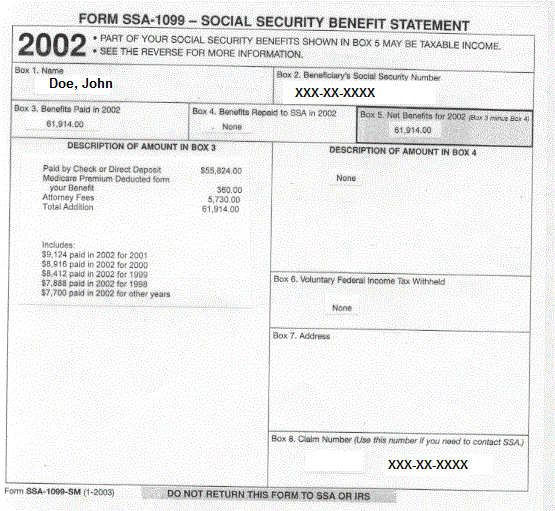
Every January, the SSA sends out Form SSA-1099, which reports the total amount of benefits you received in the previous tax year. For those who include Social Security as a portion of their taxable income, this form is a critical piece of the financial puzzle. Your claim number is clearly listed on this form to ensure the IRS can reconcile the income against the correct benefit record.
Online Portals and the “my Social Security” Account
In the digital age, the most efficient way to manage your financial identifiers is through the “my Social Security” online portal. By logging into your account at ssa.gov, you can view your benefit verification letter. This digital document acts as official proof of income and contains your full claim number, including the BIC. This is particularly useful when applying for loans, housing, or other financial services that require proof of steady income.
The Role of the Claim Number in Retirement Planning
Integrating Social Security into a comprehensive financial plan requires more than just knowing the monthly amount you receive; it requires understanding the mechanics of how those funds are generated. The claim number is the key that unlocks this understanding, particularly when dealing with complex family benefit structures.
Coordination of Spousal and Survivor Benefits
Strategic retirement planning often involves deciding whose record to claim benefits on. For example, a lower-earning spouse might choose to take spousal benefits (a “B” code) rather than their own retirement benefits (“A” code) if the payout is higher. Monitoring the claim number ensures that the household is maximizing its total cash flow. If a spouse passes away, the transition from a “B” code to a “D” code represents a significant shift in financial status that must be reflected in the survivor’s updated budget and tax strategy.
Ensuring Accuracy in Benefit Payments
The SSA processes millions of transactions every month. While their systems are robust, errors can occur—especially regarding the BIC. If your claim number ends in the wrong code, you could be underpaid (or overpaid, leading to a future “overpayment” clawback that can derail your financial stability). Periodically checking your claim number against your filing status is a simple but effective form of financial audit.
Protecting Your Financial Identity
Because the Social Security claim number contains a full SSN, it is a high-value target for identity thieves. Protecting this number is as important as protecting your bank account credentials or your credit card information.
Recognizing Red Flags and Phishing
Financial predators often pose as SSA employees to “verify” claim numbers. It is vital to remember that the SSA will never call you to ask for your claim number; they already have it. Any unsolicited communication—be it via phone, email, or text—asking for your claim number or “BIC” is a major red flag. Legitimate financial institutions will have secure protocols for sharing this information.
Steps to Take if Your Claim Number is Compromised
If you believe your Social Security claim number has been exposed, the financial implications can be severe. You should immediately:
- Contact the SSA Fraud Hotline: Alert the administration to prevent unauthorized changes to your direct deposit information.
- Monitor Your SSA-1099: Ensure no one else is claiming income under your record.
- Place a Fraud Alert on Your Credit: Since the claim number includes your SSN, your entire credit profile is at risk.
By understanding what your Social Security claim number looks like and the weight it carries in your financial life, you can better navigate your retirement years with confidence. Whether you are identifying a “B” code on a spousal benefit or verifying your income on a 1099, this alphanumeric string is a vital component of your personal financial toolkit. Stay vigilant, keep your records organized, and always treat your claim number as the sensitive financial asset it truly is.
aViewFromTheCave is a participant in the Amazon Services LLC Associates Program, an affiliate advertising program designed to provide a means for sites to earn advertising fees by advertising and linking to Amazon.com. Amazon, the Amazon logo, AmazonSupply, and the AmazonSupply logo are trademarks of Amazon.com, Inc. or its affiliates. As an Amazon Associate we earn affiliate commissions from qualifying purchases.