
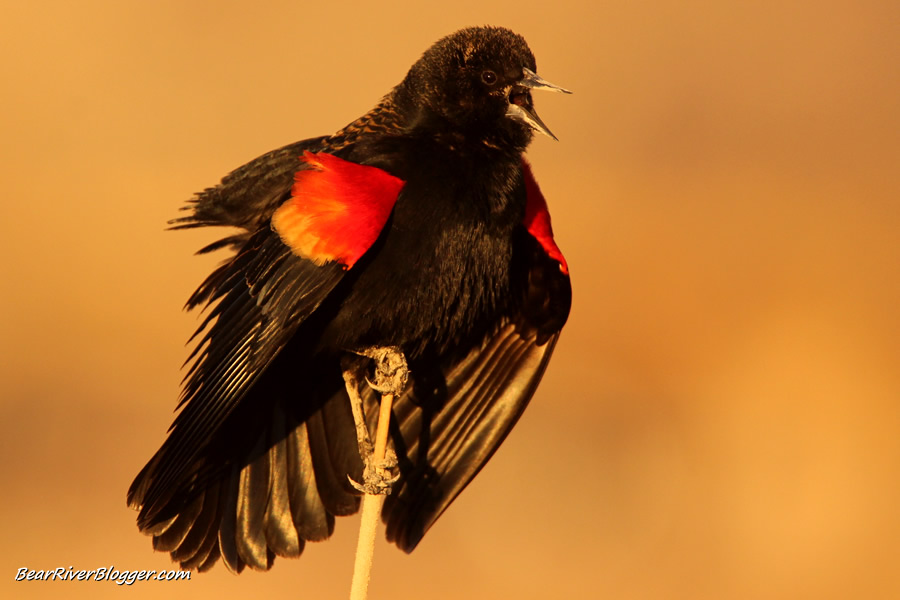
The distinctive “con-ka-ree!” of the Red-Winged Blackbird is one of the most recognizable sounds of the North American wetlands. However, in the modern digital age, the question “what does a red-winged blackbird sound like” is no longer answered solely by nature guides or memory. Today, this query sits at the intersection of bio-acoustics, artificial intelligence, and sophisticated software engineering. Identifying this specific avian vocalization has become a benchmark for machine learning models and audio processing tools designed to decode the complexities of the natural world.
The Digital Fingerprint: How Bio-Acoustics Analyzes the Red-Winged Blackbird
To a technologist, a bird’s song is not just a melody; it is a complex data set. When we ask what a Red-Winged Blackbird sounds like, we are asking for a breakdown of frequency, duration, and modulation. Bio-acoustics, the branch of technology that combines biology and acoustics, treats these sounds as digital fingerprints that can be isolated and analyzed with precision.

Understanding Spectrograms and Waveform Analysis
The primary tool used by tech professionals to visualize the Red-Winged Blackbird’s call is the spectrogram. Unlike a standard waveform that shows volume over time, a spectrogram provides a three-dimensional representation of sound, plotting time on the x-axis, frequency (pitch) on the y-axis, and intensity through color or brightness.
When analyzing the Red-Winged Blackbird, the spectrogram reveals a highly specific pattern. The call typically begins with a series of quick, low-frequency introductory notes, followed by a harsh, trilling whistle that climbs in frequency. Software tools like Raven Pro or Audacity allow researchers to “see” these notes, enabling the isolation of the bird’s signature from background noise like wind, traffic, or other species.
The “Kon-ka-ree!” Signature: Frequency and Amplitude Decoded
Technically speaking, the “kon-ka-ree” call is a masterpiece of biological engineering. The introductory notes usually hover around 1–2 kHz, while the concluding trill can spike up to 5 or 6 kHz. Audio analysis software identifies the rapid “frequency modulation” (FM) within the trill. By digitizing these parameters, developers can create “golden samples”—perfect digital representations of the species—which serve as the baseline for all automated identification technology.
AI and Machine Learning: From Raw Audio to Species Identification
The most significant leap in answering “what does a red-winged blackbird sound like” has come through Artificial Intelligence (AI). We have moved past simple pattern matching into the realm of deep learning, where software can identify a bird in real-time, even in a crowded “soundscape” filled with competing noises.
Convolutional Neural Networks (CNNs) in Audio Recognition
The backbone of modern bird identification apps is the Convolutional Neural Network (CNN). While CNNs are traditionally used for image recognition, tech developers have found a way to apply them to audio. By converting the sound of a Red-Winged Blackbird into a spectrogram (an image), the AI can “look” at the sound.
The CNN analyzes the visual patterns of the trill—the specific angle of the frequency rise and the density of the harmonics. This allows the AI to distinguish the Red-Winged Blackbird from a Common Grackle or a European Starling, which might sound similar to the untrained human ear but possess distinct “visual” signatures in the spectral domain.
Training Models on Global Soundscapes
For an AI tool to be accurate, it requires massive amounts of training data. Platforms like Xeno-Canto and the Macaulay Library have digitized hundreds of thousands of recordings. Data scientists use these libraries to train models like BirdNET, an ecological monitoring tool.
The challenge for the technology lies in “noise robustness.” A Red-Winged Blackbird recorded in a quiet marsh is easy to identify, but identifying one recorded near a highway requires sophisticated filtering algorithms. Machine learning models are trained using “data augmentation,” where clean bird calls are mixed with digital white noise, wind artifacts, and urban sounds to ensure the software remains accurate in any field environment.
Leading Apps and Hardware for Field Audio Analysis

The transition of bio-acoustic technology from the lab to the smartphone has revolutionized how we interact with nature. Several high-tech solutions currently lead the market, providing users with instant answers to their acoustic queries.
Merlin Bird ID and the Power of Big Data
Developed by the Cornell Lab of Ornithology, Merlin Bird ID is perhaps the most prominent example of consumer-facing audio tech. The app uses a “Sound ID” feature that utilizes the smartphone’s microphone to capture ambient audio.
The tech stack behind Merlin is immense. It processes the incoming audio stream, generates a real-time spectrogram, and runs it through an on-device neural network. This allows for near-instant identification without needing a cloud connection, a critical feature for researchers in remote wetlands. The success of Merlin has set a high bar for UI/UX in nature-based apps, proving that complex AI can be made accessible through intuitive design.
Professional Field Recording Gear: Parabolic Microphones vs. Digital Handhelds
While smartphones are convenient, professional-grade identification relies on specialized hardware. To capture the highest-fidelity sound of a Red-Winged Blackbird, technologists use parabolic microphones. These devices use a dish-shaped reflector to focus sound waves onto a central microphone, significantly increasing the “reach” and signal-to-noise ratio.
On the digital side, handheld recorders like those from Zoom or Tascam offer high-resolution sampling rates (up to 96kHz/24-bit). This level of detail is necessary for scientific-grade analysis, allowing researchers to detect subtle variations in a blackbird’s call that might indicate regional “dialects” or stress levels—data points that are invisible to standard consumer tech.
The Future of Audio-Tech: Citizen Science and Real-Time Environmental Monitoring
The technology used to identify what a Red-Winged Blackbird sounds like is evolving toward autonomous, large-scale environmental monitoring. We are moving from individual apps to “Smart Forests” and automated sensor networks.
Autonomous Recording Units (ARUs) in Wildlife Research
Autonomous Recording Units, or ARUs, are ruggedized computers equipped with high-sensitivity microphones and high-capacity storage. These devices are deployed in the wild for months at a time, programmed to wake up and record at specific intervals (such as dawn and dusk).
The data collected by ARUs is massive. Processing thousands of hours of audio would be impossible for humans, but it is a perfect task for AI. Using cloud-based processing power, researchers can run “batch analysis” to track the arrival of Red-Winged Blackbirds in the spring, monitoring how climate change might be shifting their migratory patterns. This represents a shift from “reactive” identification (asking what a bird is) to “proactive” environmental data science.
API Integration: Bringing Birdsong into the Smart Home
We are also seeing the integration of bio-acoustic identification into the Internet of Things (IoT). Developers are now creating APIs that allow smart home devices to identify local wildlife. Imagine a smart home system that recognizes the morning call of a Red-Winged Blackbird through an outdoor security camera and provides a notification or logs the sighting in a personal biodiversity diary.
This level of integration requires highly efficient, low-power edge computing. The goal is to move the identification process away from massive servers and onto small, energy-efficient chips located within the devices themselves. This “Edge AI” ensures privacy, reduces latency, and makes the technology more sustainable.
Conclusion: The Synergy of Sound and Software
Answering the question “what does a red-winged blackbird sound like” has evolved from a simple observation into a sophisticated technological feat. Through the lenses of bio-acoustics, machine learning, and advanced hardware, we have gained a deeper understanding of avian communication.
The Red-Winged Blackbird serves as an ideal subject for these technological advancements. Its call is loud, distinct, and structurally complex, making it a perfect candidate for testing new algorithms and recording equipment. As we continue to refine our digital tools, the line between technology and nature begins to blur, allowing us to monitor, protect, and appreciate the natural world with unprecedented clarity and precision. The “kon-ka-ree!” of the marsh is no longer just a sound; it is a stream of data that helps us unlock the mysteries of the environment.
aViewFromTheCave is a participant in the Amazon Services LLC Associates Program, an affiliate advertising program designed to provide a means for sites to earn advertising fees by advertising and linking to Amazon.com. Amazon, the Amazon logo, AmazonSupply, and the AmazonSupply logo are trademarks of Amazon.com, Inc. or its affiliates. As an Amazon Associate we earn affiliate commissions from qualifying purchases.