
The $2 bill is perhaps the most misunderstood and mythologized piece of legal tender in the United States. While many Americans rarely encounter one in their daily transactions, leading to the common misconception that they are out of circulation or even “fake,” the $2 bill remains a staple of the U.S. Treasury’s currency production. Understanding what a $2 bill looks like involves more than just identifying a portrait; it requires an appreciation for its intricate design, its historical evolution, and its specific role within the broader landscape of personal finance and numismatics.
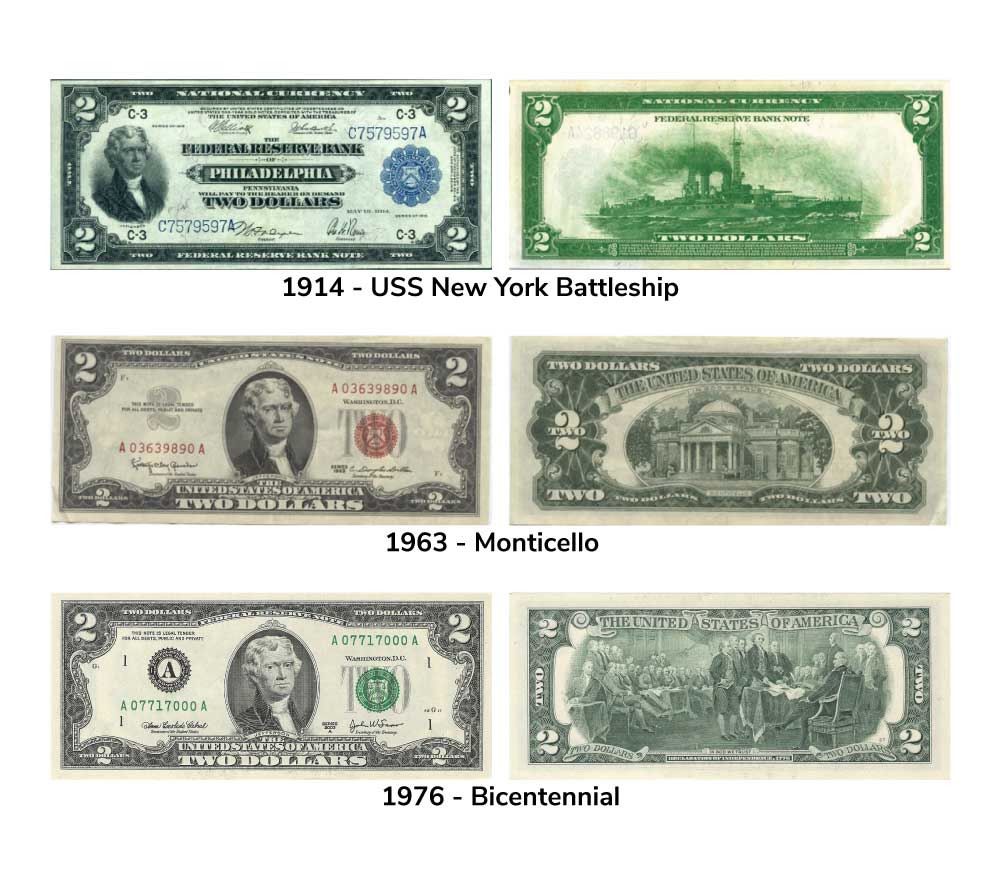
In this guide, we will explore the visual anatomy of the $2 bill, the security features that protect its integrity, and the financial context that makes this denomination a unique asset for collectors and consumers alike.
The Anatomy of a $2 Bill: Visual and Security Features
To the untrained eye, a $2 bill might seem like a novelty, but it is a sophisticated piece of financial engineering. The current design, which has remained largely unchanged since the 1976 Bicentennial redesign, features a blend of historical portraiture and high-detail engravings.
The Obverse: Thomas Jefferson and the Federal Reserve Seal
The front (obverse) of the $2 bill features a portrait of Thomas Jefferson, the third President of the United States and the principal author of the Declaration of Independence. This portrait is based on a painting by Gilbert Stuart.
Surrounding the portrait are several key financial markers:
- The Federal Reserve Seal: Located to the left of the portrait, this black seal identifies the specific Federal Reserve Bank that issued the note.
- The Treasury Seal: To the right of the portrait, you will find a green seal representing the U.S. Department of the Treasury.
- Serial Numbers: Unique combinations of letters and numbers appear in the upper right and lower left quadrants. These are essential for tracking the currency and identifying rare print runs.
The Reverse: The Declaration of Independence
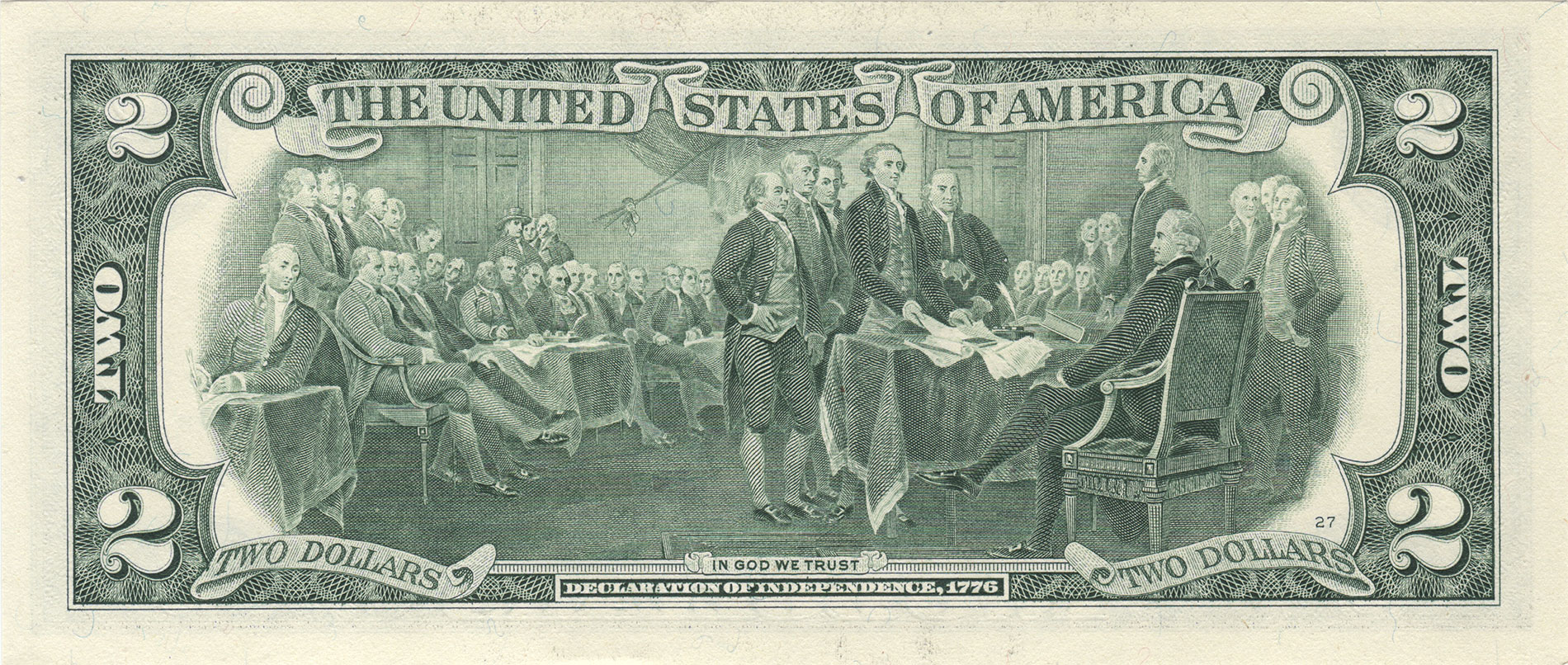
The back (reverse) of the $2 bill is arguably the most artistically significant of all U.S. denominations. It features an engraving of John Trumbull’s famous painting, “The Declaration of Independence.”
While many people mistakenly believe the scene depicts the signing of the document, it actually shows the five-man drafting committee presenting their work to the Continental Congress. Because of the complexity of the original painting, the engravers had to omit several figures to fit the scene onto the currency, yet it remains a masterwork of micro-engraving.
Security Measures: Paper, Ink, and Fibers
What a $2 bill “looks like” is also defined by how it feels and reacts to light. Unlike commercial paper made from wood pulp, U.S. currency is composed of a 75% cotton and 25% linen blend.
- Security Fibers: If you look closely at a $2 bill, you will see tiny red and blue synthetic fibers embedded throughout the paper. These are not printed on the surface but are part of the paper’s structure.
- Raised Printing: The $2 bill uses intaglio printing, which gives the note a distinct texture. Running your fingernail across Jefferson’s vest will reveal a tactile “ribbed” feel that is difficult for counterfeiters to replicate.
- Border Detail: The border of the bill features incredibly fine lines and “microprinting” that appears as solid lines to the naked eye but reveals distinct patterns under magnification.
The Evolution and Rarity of the “Deuce”
A common question in personal finance circles is why the $2 bill feels so rare compared to the $1 or $20 bill. The answer lies in the history of its production and the public’s psychological relationship with the note.
Brief History of Issuance (1862 to Present)
The $2 bill was first authorized by Congress in 1862. For much of the 19th and early 20th centuries, it was a standard part of the American wallet. However, it gained a reputation for being inconvenient. It was often confused with the $1 bill, and in the early 1900s, $2 was a significant amount of money—often equivalent to a day’s wages—making it less practical for small change but too small for large purchases.
In 1966, the Treasury discontinued the $2 bill due to a lack of public demand. However, it was resurrected in 1976 as part of the United States Bicentennial celebration. The 1976 version replaced the previous reverse image (which featured Jefferson’s home, Monticello) with the Trumbull engraving of the Declaration of Independence.
Why They Are Less Common in Daily Transactions
The “rarity” of the $2 bill is a self-fulfilling prophecy. Because the public perceived the 1976 re-issue as a commemorative item, many people hoarded the bills rather than spending them. This kept the velocity of the currency low. When a bill doesn’t circulate, banks don’t request new ones from the Federal Reserve, leading to lower production volumes.
Today, the $2 bill accounts for less than 1% of all notes in circulation. Despite this, the Bureau of Engraving and Printing still produces millions of them every few years to meet the modest but steady demand from banks and collectors.
The Numismatic Value: Is Your $2 Bill Worth More Than Two Dollars?
From a personal finance perspective, many people hold onto $2 bills in the hopes that they will appreciate in value. While most $2 bills are worth exactly their face value, certain factors can make a note significantly more valuable to collectors.
Factors Influencing Value: Condition and Serial Numbers
The primary driver of a $2 bill’s value is its “grade” or physical condition. A crisp, uncirculated note is always more desirable than one that has been folded or stained.
Beyond condition, serial numbers play a massive role:
- Low Serial Numbers: Notes with numbers below 1,000 (e.g., 00000523) are highly sought after.
- Star Notes: If a bill is damaged during the printing process, the Treasury replaces it with a “Star Note,” which features a small star at the end of the serial number. These are rarer and carry a premium.
- Fancy Serials: “Ladders” (12345678), “Radars” (palindromes like 12344321), and “Solid” numbers (77777777) can sell for hundreds or even thousands of dollars in the collector’s market.
Notable Printings and Red Seals
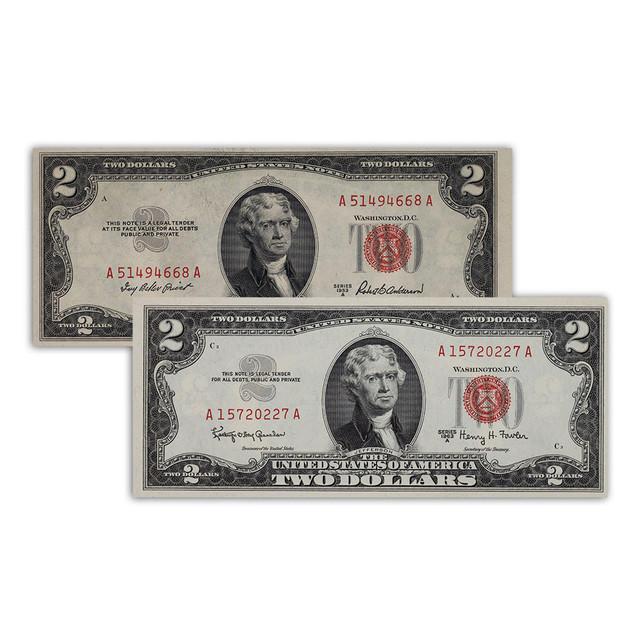
Before the 1976 redesign, $2 bills were issued as “United States Notes” rather than “Federal Reserve Notes.” These older versions are easily identifiable by their Red Seals and red serial numbers. Because these have not been printed since the 1960s, they are generally worth more than the modern green-seal versions. A Red Seal $2 bill in good condition can typically fetch $10 to $20, while rare 19th-century versions can be worth thousands.
Myths, Superstitions, and the $2 Bill’s Role in Modern Finance
The $2 bill carries a heavy load of cultural baggage that influences how it is used in the modern economy. For a “Money” niche enthusiast, understanding these psychological factors is just as important as knowing the security features.
The Legend of the “Unlucky” Bill
In the early 20th century, the $2 bill was associated with various forms of “bad luck.” It was frequently used at horse tracks for $2 bets and in bars, leading to an association with gambling and vice. Some even believed that the bill was “jinxed,” and a tradition arose where people would tear off the corners of the bill to “remove the curse.” This, of course, only served to mutilate the currency and make it unfit for circulation.
Practical Uses and Benefits of Using $2 Bills Today
In contemporary personal finance, using $2 bills can actually be a strategic choice.
- Efficiency in Tipping: Many people use $2 bills for tipping at hotels or valet services. It is seen as more generous than a $1 bill but more budget-conscious than a $5.
- Educational Tools: Parents often use $2 bills to teach children about the history of American currency and the value of saving “special” items.
- The “Clemson” Tradition: Some communities have embraced the $2 bill. Fans of Clemson University, for example, have a long-standing tradition of stamping $2 bills with a tiger paw and spending them at away games to demonstrate the economic impact of their fan base on the local economy.
Conclusion: The Enduring Legacy of the Two-Dollar Note
To know what a $2 bill looks like is to recognize a piece of living history. From Thomas Jefferson’s stoic gaze to the intricate rendering of the Declaration of Independence, the note is a testament to American heritage and the evolution of financial security.
While it may not be common in the cash register, the $2 bill is very much a real, spendable, and fascinating part of the U.S. monetary system. Whether you view it as a lucky charm, a collector’s item, or simply a unique tool for managing small transactions, the “deuce” remains one of the most intriguing assets in the world of personal finance. The next time you encounter one, take a moment to appreciate the details—you aren’t just holding two dollars; you are holding a masterpiece of American design.
aViewFromTheCave is a participant in the Amazon Services LLC Associates Program, an affiliate advertising program designed to provide a means for sites to earn advertising fees by advertising and linking to Amazon.com. Amazon, the Amazon logo, AmazonSupply, and the AmazonSupply logo are trademarks of Amazon.com, Inc. or its affiliates. As an Amazon Associate we earn affiliate commissions from qualifying purchases.