
In the vast, blocky world of Minecraft, players constantly seek ways to enhance their gameplay, whether it’s for survival, creativity, or the thrill of a well-executed prank. Among the myriad of items and blocks available, the Trapped Chest occupies a unique, albeit often overlooked, niche. While its visual appearance might be identical to its standard counterpart, the Trapped Chest harbors a hidden functionality that can drastically alter the dynamics of player interaction and in-game mechanics. This article will delve deep into the technological intricacies and practical applications of the Trapped Chest within Minecraft’s robust game engine, exploring its activation mechanisms, its utility in complex redstone contraptions, and its potential for strategic gameplay and advanced player-driven narratives.

The core of the Trapped Chest’s functionality lies in its inherent ability to act as a trigger. Unlike a regular chest, which merely serves as a static storage container, the Trapped Chest possesses an embedded sensor that detects when a player or a mob attempts to open it. This detection then broadcasts a redstone signal, a fundamental element of Minecraft’s “tech” tree, enabling a cascade of potential actions. Understanding this signal propagation is key to unlocking the full potential of this deceptively simple block.
The Redstone Signal: The Heart of Trapped Chest Functionality
At its most basic level, the Trapped Chest functions as a switch. When interacted with, it emits a redstone signal of a specific strength. This signal is not directly visible to the player but is interpreted by other redstone components in its vicinity. This interaction forms the bedrock of its technological application within the game.
Redstone Emission Mechanics
The Trapped Chest, when opened, emits a redstone signal with a power level of 15. This is the maximum signal strength in Minecraft, meaning it can activate a wide array of redstone devices directly or through multiple signal boosters. The signal is emitted from the block itself, making its placement and proximity to other redstone components crucial for effective circuit design. This constant output of a potent signal makes it a reliable component for initiating complex sequences.
Crucially, the signal is not continuous. It is emitted only at the moment of interaction. This means that for the Trapped Chest to act as a persistent trigger, it needs to be paired with a component that can latch or repeat the signal, such as a lever that is toggled by the redstone pulse, or a more complex memory circuit. However, for immediate effects, such as setting off a trap the moment a player opens it, its single pulse is sufficient.
Activation Conditions: Player and Mob Interactions
The Trapped Chest responds to interactions from both players and hostile mobs. This dual activation capability significantly broadens its strategic implications. For player-to-player interactions, this means a carefully placed Trapped Chest can initiate an unexpected outcome for an unsuspecting ally or opponent. When a mob interacts with a Trapped Chest – for instance, a zombie attempting to break into a player’s storage area – it will also trigger the redstone signal. This can be leveraged to create automated defenses or to alert players to the presence of danger in a specific location.
It is important to note that passive mobs, such as sheep or cows, do not trigger Trapped Chests. This specificity in its technological design allows for precise control over what events initiate the redstone output, preventing unintended activations in less critical scenarios. The developers have thus engineered the Trapped Chest to be a discerning trigger, responding to intentional actions or threats rather than random environmental encounters.
Practical Applications in Redstone Engineering
The ability of the Trapped Chest to act as a redstone trigger opens up a vast landscape of possibilities for players who engage with Minecraft’s technical aspects. From intricate security systems to elaborate puzzle rooms, the Trapped Chest serves as a versatile building block in redstone engineering.
Automated Traps and Defense Systems
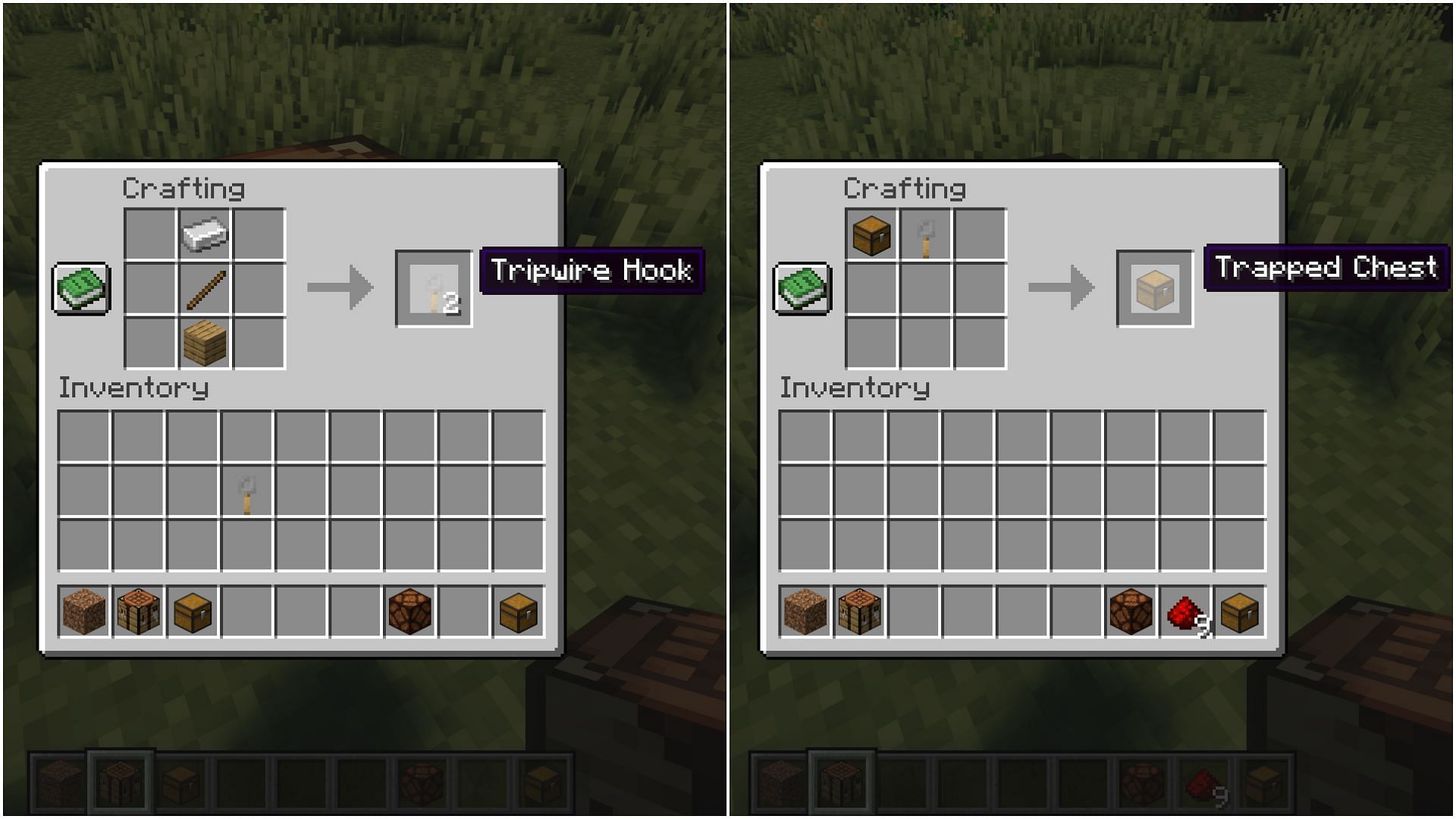
Perhaps the most intuitive application of the Trapped Chest is in the creation of automated traps. By strategically placing a Trapped Chest in a location where an unsuspecting player or mob is likely to open it, one can then connect it to a variety of destructive or debilitating mechanisms.
- Explosive Traps: Connecting a Trapped Chest to a TNT block, often via a redstone line or repeater, creates a classic pressure-plate-like trap. The moment the chest is opened, the TNT detonates, causing significant damage or destruction. This is particularly effective in player-versus-player scenarios or in defending valuable areas.
- Arrow Traps: A Trapped Chest can be wired to a dispenser filled with arrows. Upon activation, the dispenser fires a volley of arrows at the opening player or mob, offering a less destructive but still potent defensive measure.
- Pitfall Traps: By integrating the Trapped Chest with pistons that retract blocks or deploy sticky pistons, players can create traps that cause victims to fall into a designated area, be it a lava pit, a long drop, or a confinement chamber.
- Alarm Systems: For more subtle applications, a Trapped Chest can be linked to a series of note blocks or even a beacon, acting as an early warning system. This alerts the player to the presence of an intruder without immediately engaging in direct conflict, allowing for a more strategic response.
Puzzle Design and Player Interaction Mechanisms
Beyond direct defensive applications, the Trapped Chest is an invaluable tool for designers of adventure maps, escape rooms, and complex puzzles. Its ability to initiate a specific event upon interaction makes it ideal for creating interactive challenges.
- Sequential Activation: In puzzles requiring a specific order of operations, a Trapped Chest can be used to unlock the next stage. For example, opening a Trapped Chest might dispense a key item, or activate a hidden door that reveals the next part of the puzzle. The signal’s strength of 15 ensures it can reach distant mechanisms without excessive signal boosting.
- Conditional Progress: Trapped Chests can be used to gate progression. A player might need to find a specific item or solve a riddle to safely open a Trapped Chest, which in turn triggers the mechanism to advance them. This adds a layer of intellectual challenge to the gameplay.
- Illusionary Storage: The visual similarity to regular chests allows for deceptive puzzle design. Players might be led to believe they are simply accessing storage, only to trigger an unexpected event, adding an element of surprise and misdirection to the experience.
- Narrative Triggers: In story-driven maps, Trapped Chests can be used to trigger dialogue text (via command blocks activated by the redstone signal) or to initiate cutscenes, furthering the narrative and immersing players in the game’s world.
Advanced Redstone Circuitry and Beyond
The 15-strength redstone signal emitted by the Trapped Chest is a powerful starting point for intricate redstone contraptions. Its consistent output allows for integration into complex circuits that go beyond simple on/off switches.
Signal Manipulation and Logic Gates
The strong redstone signal from a Trapped Chest can be easily manipulated using standard redstone components. This allows for the creation of more sophisticated logic systems.
- Signal Splitting and Distribution: Using redstone repeaters, the signal can be sent in multiple directions simultaneously, activating several devices at once. This is crucial for coordinated trap systems or for powering multiple puzzle elements from a single trigger.
- Signal Attenuation and Amplification: While the initial signal is powerful, it can be intentionally weakened using redstone dust or repeaters set to fewer ticks to trigger devices that require lower signal strengths. Conversely, it can be amplified by using repeaters to maintain its strength over long distances.
- Integration with Logic Gates: The signal can be fed into standard redstone logic gates (AND, OR, NOT, XOR) to create more complex conditions. For example, an AND gate could require both a lever to be pulled and a Trapped Chest to be opened for a specific outcome to occur, demonstrating a high level of technological control within the game.
- Pulse Extenders and Redstone Clocks: While the Trapped Chest itself provides a momentary pulse, this pulse can be used to initiate longer-lasting effects. By feeding the Trapped Chest’s signal into a pulse extender, the effect can be sustained for a set duration. Alternatively, it can be used to trigger a redstone clock, creating repeating cycles of activation.

Creative Uses and Niche Applications
The versatility of the Trapped Chest extends to less common but equally ingenious applications, showcasing the depth of Minecraft’s technological sandbox.
- Automated Sorting Systems: In conjunction with hoppers and comparators, a Trapped Chest can be part of a system that sorts items based on their presence or absence. While not its primary function, the signal it emits can, with clever design, influence sorting mechanisms.
- “Black Box” Mechanics: In competitive multiplayer servers or team-based games, Trapped Chests can be used to create “black box” challenges where players must figure out how to interact with a specific chest to progress, without knowing the exact consequence of their action.
- Interactive Storytelling and Roleplaying: For roleplaying servers or custom game modes, Trapped Chests can be integrated into quests and narratives, offering rewards or triggering events that advance the story based on player actions. Their deceptive nature can be used to create dramatic twists or moments of discovery.
- Resource Management and Harvesting: While less common, a Trapped Chest could theoretically be used in conjunction with other redstone components to automate certain resource gathering processes. For example, opening a chest could trigger a harvesting mechanism, though this would typically be less efficient than dedicated farming contraptions.
In conclusion, the Trapped Chest is far more than just a visually distinct storage block. It is a sophisticated technological component within Minecraft, offering a reliable and potent redstone signal upon interaction. Its ability to be triggered by both players and mobs, combined with its seamless integration into the game’s redstone circuitry, makes it an indispensable tool for anyone looking to delve into advanced trap design, intricate puzzle creation, automated defense systems, or any form of interactive redstone engineering. Mastering the Trapped Chest is a step towards truly unlocking the creative and technical potential that Minecraft’s blocky world has to offer.
aViewFromTheCave is a participant in the Amazon Services LLC Associates Program, an affiliate advertising program designed to provide a means for sites to earn advertising fees by advertising and linking to Amazon.com. Amazon, the Amazon logo, AmazonSupply, and the AmazonSupply logo are trademarks of Amazon.com, Inc. or its affiliates. As an Amazon Associate we earn affiliate commissions from qualifying purchases.